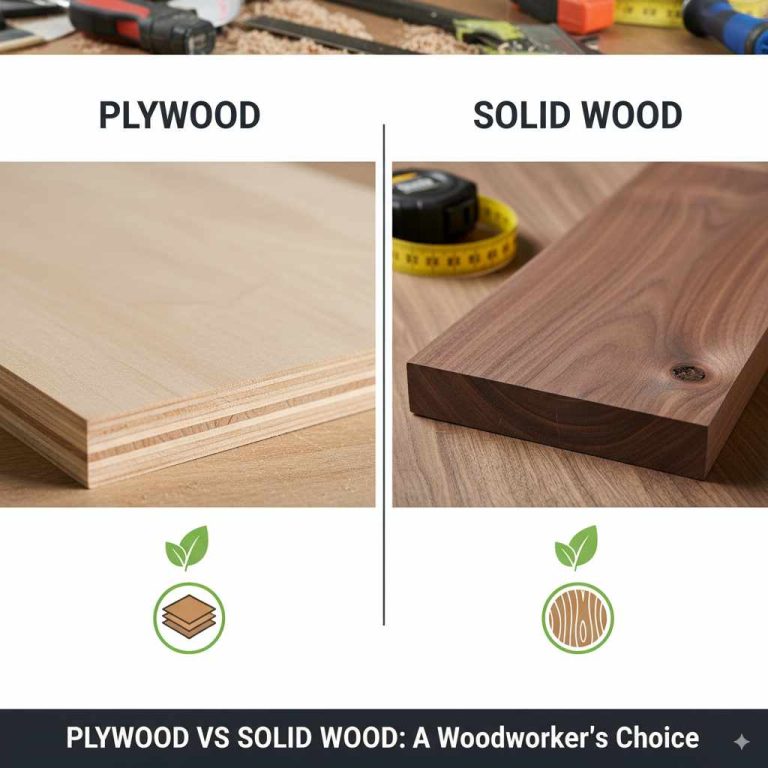
Can You Dovetail Plywood? Precision Guide for Joinery
Plywood can be dovetailed, but I tend to rely on void-free, cabinet-grade panels around 1/2 inch thick or thicker; thinner, lower-grade sheet goods often chip out. Bad stock, loose fit, or wrong bit settings leave blown corners, weak pins, and a box that looks rough fast. This guide shows when plywood dovetails are worth the effort, which grades hold them, and which joint is the smarter choice when they are not.
Can you dovetail plywood without it splitting?


Yes, but the margin for error is tighter than with solid wood. Plywood is built from thin veneers bonded with adhesive, so the cut edge shows alternating layers instead of continuous grain. That layered edge can chip, crush, or split at the corners if the stock is thin, void-prone, or cut with a dull blade.
The split usually starts in three places: thin tails, thin pins, and weak corners where the outer veneer has little support. I can get cleaner results with sharp tools and careful layout, but they do not erase the limits of bad stock. If the panel feels spongy at the edge, the joint is already working against the material.
Why plywood edges behave differently from solid wood
Solid wood has continuous grain that can flex a little as a chisel pares waste. Plywood does not. The layers can separate at the edge, especially where the cut crosses glue lines or where a void interrupts the core. That is why the same dovetail profile that looks crisp in maple can look ragged in bargain plywood.
Where splitting starts
Thin stock is the biggest problem. Once the part gets narrow, there is less veneer thickness left to hold the tail or pin shape together. Thin corners also crush under clamp pressure if the fit is too tight. A joint that needs force to assemble is already too risky in plywood.
What cut quality still improves the result
Sharp tools, a fine layout line, and careful waste removal can make a visible difference. A dovetail saw gives cleaner angled cuts than a coarse blade, and I rely on chisels to finish the last fibers at the baseline. On jig-cut parts, a clean router pass can reduce fuzz, but only if the work is held firmly and the bit is set correctly.
What type of plywood is best for dovetails?

Baltic birch plywood is the most forgiving common choice because it has a void-free core and cuts cleanly. Other cabinet-grade plywood can work if the core is tight and the plies are uniform, but void-prone stock is far more likely to chip, collapse at the edge, or leave ugly gaps in the joint.
For dovetails, core quality matters as much as veneer face quality. A pretty face veneer does not rescue a weak core. If the inside layers show gaps at the edge, expect those gaps to appear in the joint line, too.
Baltic birch plywood and why it cuts cleaner
Baltic birch plywood is popular for dovetailing because the plies are even and the core is described as void-free. That makes the edge more predictable when saw teeth or a router cutter meet it. The layers still show at the joint, but they tend to show in neat stripes instead of broken-out chunks.
Void-free vs void-prone cores
Void-free panels support the cut all the way through the thickness. Void-prone panels do not. A hidden gap can swallow part of a pin or tail, then leave a fragile wall that breaks during assembly. That is why two sheets with the same face veneer can behave very differently at the bench.
Minimum thickness and when thin stock becomes a bad bet
Thin plywood can be dovetailed, but it is often a poor trade. The thinner the panel, the smaller the glue-bearing surfaces and the less meat there is around the pins. For light boxes or drawer parts, around 1/2 inch material is a practical floor; below that, dados, rabbets, or fastener-assisted joints often make more sense.
| Plywood grade / core quality | Part thickness and orientation | Recommended joint method |
|---|---|---|
| Baltic birch, void-free core, cabinet-grade face | 1/2 inch or thicker; sides and ends where edges will be visible | Hand dovetail or jig dovetail |
| Good cabinet-grade plywood with uniform plies | 1/2 inch to 3/4 inch; box sides, drawer parts, small casework | Jig dovetail for repeat parts, or hand dovetail for one-offs |
| Standard plywood with minor core gaps | Thicker parts only; edge not highly visible | Dado or rabbet |
| Void-prone, rough construction-grade sheet goods | Thin panels, short ends, load-bearing corners | Fastener-assisted alternative |
| Decorative plywood with good face veneer but unknown core | Visible furniture parts where edge finish matters | Test cut first; if the core is weak, use rabbet or dado |
Do you need a dovetail jig for plywood?
No, but a dovetail jig makes plywood joinery more consistent, especially on repeated parts. Hand-cut dovetails can work well for one-off boxes and small runs. For multiple matching pieces, a jig reduces spacing errors and keeps the angle and depth more uniform, which matters when plywood edges are less forgiving.
The right choice depends on quantity, skill, and how visible the joint will be. If the project is a single small box, hand-cutting may be faster than setting up hardware. If the job includes several drawers or mirrored sides, a jig pays back in repeatability.
Hand-cut dovetails for one-off boxes and small parts
A dovetail saw and chisels are the core hand-tool path. The saw creates the angled cheeks, and the chisels clean the waste to the line. I use this method when the parts are thick enough to support the joint and when I can clamp the work so it does not move.
Jig-guided dovetails for repeat parts
A dovetail jig is helpful when the same cut must be repeated across several parts. It guides the cut locations and spacing, which improves accuracy on drawer sides, small cabinet boxes, and matched assemblies. On plywood, that repeatability matters because one oversize pin can chip adjacent veneer during fitting.
Router-assisted cleanup versus saw-and-chisel work
A router is optional, but it speeds waste removal in some jig setups. It is most useful when the jig establishes the layout and the router removes the bulk of the waste before final paring. Saw-and-chisel work is quieter and more direct; router work is faster for batches, but it can leave fuzzy edges if the bit is dull or the stock shifts.
What tools do you need to dovetail plywood cleanly?
Clean plywood dovetails start with a sharp saw, sharp chisels, solid clamps, and accurate layout tools. A jig helps on repeat parts, and a router can speed waste removal in some setups. The real goal is control: the panel must stay still, the cut must stay on line, and the waste must come out without bruising the plies.
Dovetail saw, chisels, clamps, and layout tools
A dovetail saw gives fine angled cuts. Chisels pare waste and refine the fit to the baseline. Clamps hold the plywood securely so the piece does not shift mid-cut. Marking gauge, square, knife line, and pencil all matter because plywood edges do not forgive wandering layout.
How a router fits into some jig workflows
When a jig is used, the router often becomes the waste-removal tool. It can remove the bulk of the middle material quickly, leaving only a small amount for final cleanup. That helps on repeat parts, but it also means the setup must be exact. A sloppy bit height or loose clamping sends the error right into the joint.
Workholding tips that reduce shifting and tear-out
The workpiece should be clamped flat, with support close to the cut line. Thin plywood flexes easily, and flex leads to breakout at the exit edge. Backing boards can help. So can cutting from the show face toward the inside on test pieces, then adjusting the sequence until the exit edge stays cleaner.
Why do plywood dovetails tear out or splinter?
Plywood dovetails tear out when the cutter meets weak glue lines, hidden voids, or thin veneer that lacks support at the corner. Splintering is most common on exit cuts and at narrow pins. The problem is usually the material first, then the tool, then the setup. Dull cutters only make it worse.
Visible layer lines are normal in plywood, but ragged layers are a sign that the cut was too aggressive or the stock was poor. If the outer veneer lifts before the waste is cleared, the joint will need extra cleanup or it may have to be abandoned.
How to reduce tear-out
- Choose void-free or cabinet-grade plywood before cutting.
- Clamp the part firmly so it cannot chatter.
- Use a sharp dovetail saw, sharp chisels, or a sharp router bit.
- Take small waste cuts instead of forcing the full depth at once.
- Test on offcuts before committing to final parts.
How thick should plywood be for dovetail joints?
Thicker plywood holds dovetails better because it gives the tails and pins more bearing surface and leaves more material around the corners. For practical cabinet and box work, around 1/2 inch is a sensible lower limit. Thinner panels are more likely to split, crush, or look messy once the joint is assembled.
Part orientation matters as much as thickness. A long side with the grain-like veneer running lengthwise can still fail if the end grain edge is too thin or unsupported. The strongest plywood dovetail is one where the joint sits in enough material to survive clamping and daily use.
When thin stock becomes the wrong choice
Once the stock gets thin enough that the pins look fragile before the cut is even made, dovetails stop being the best answer. In those cases, a rabbet or dado gives more glue area and less risk. If the piece will be painted and not handled heavily, screws plus glue can be smarter than a showy but weak dovetail.
Should you glue dovetail joints in plywood?
Yes. Plywood dovetails are usually best glued, because the mechanical lock alone may not be enough to make up for thin faces and exposed plies. A dry-fit can check the shape, but the final assembly should typically use glue and clamps. The clamp pressure should hold the joint together while the adhesive cures, not force the parts into alignment.
Dry joints in plywood are a mistake unless the design is meant to be knocked apart later. A well-fit glued dovetail gives better long-term security, and it helps stabilize the joint where the plies meet the corner.
Glue, fit, and clamping sequence
Fit the joint dry first to check the fit. If it needs heavy force, it is too tight. Apply glue sparingly to the mating faces, assemble the joint, and clamp it just enough to close the seam without crushing the veneers. Wipe squeeze-out before it hardens, especially on visible edges and face veneer.
When dovetails are worth it in plywood
Dovetails are worth it in plywood when the joint will stay visible, the parts are thick enough, and the stock is good enough to justify the effort. They work well for furniture making, boxes, drawers, and casework where the joint is part of the design. If the edge will be hidden, simpler joints are often faster and stronger for the time spent.
Boxes, drawers, and visible casework
Plywood dovetails make the most sense on small to medium parts that will be seen up close. Drawer sides, jewelry boxes, and display cases can all benefit from the visual character of the exposed joint. The layered edge is part of the look, but it must be neat or the effect turns sloppy fast.
When a dado, rabbet, or screws are better
A dado or rabbet usually wins when speed, repeatability, or hidden strength matter more than appearance. These joints give generous glue area in plywood and avoid the fragile pins that dovetails require. For utility cabinets, shop storage, and thin sheet goods, fastener-assisted joinery is often the safer call.
Plywood dovetail decision checklist
Use this checklist before cutting. It separates the panels that are worth dovetailing from the ones that should be joined another way. The goal is to match the joint to the stock, not force the stock to fit the joint.
| Plywood grade and core quality | Part thickness and orientation | Recommended joint method |
|---|---|---|
| Void-free cabinet-grade plywood or Baltic birch plywood | 1/2 inch or thicker; visible ends, box sides, drawer parts | Hand dovetail for one-off work, jig dovetail for repeat parts |
| Cabinet-grade plywood with decent but not perfect core quality | Thick enough to leave solid pins; moderate visibility | Jig dovetail if repeated parts matter, otherwise test first |
| Standard plywood with minor voids | Thicker stock, hidden corner, lower appearance demand | Dado or rabbet |
| Void-prone sheet goods or unknown construction plywood | Thin parts, short corners, load-bearing edges | Fastener-assisted alternative |
| Decorative plywood with good face veneer but uncertain core | Visible casework where edge finish matters | Test cut, then decide between dovetail, rabbet, or dado |
- Choose void-free or cabinet-grade stock first.
- Keep to thicker parts when the joint will be visible.
- Use hand-cut joinery for one-off pieces with careful fitting.
- Use a dovetail jig when you need repeatable parts.
- Use a router only if it fits the workflow cleanly.
- Switch to dados, rabbets, or screws when the plywood is thin or weak.
Frequently asked questions
Can you dovetail plywood without it splitting?
Yes, but only when the plywood is good enough for the job and the cuts are controlled. Void-free or cabinet-grade material holds up far better than cheap sheet goods. Thin pins, tight fits, and rough cutting are the usual reasons a corner splits during assembly.
What type of plywood is best for dovetails?
Baltic birch plywood is a strong choice because it has a void-free core and cuts cleanly. Other cabinet-grade panels can work if the plies are uniform and the edge is solid. Avoid sheet goods with obvious voids, soft cores, or rough interior layers.
Do you need a dovetail jig for plywood?
No. A dovetail jig is helpful for repeat parts and more even spacing, but hand-cut dovetails are still practical for one-off boxes and small projects. The jig becomes more useful as part count rises or when the router setup is already part of the workflow.
How thick should plywood be for dovetail joints?
At least 1/2 inch is a practical floor for plywood dovetails. Thinner stock leaves too little material around the pins and tails, so the joint chips or crushes more easily. For lighter or thinner panels, a rabbet, dado, or screw-assisted joint is usually the safer choice.
Should you glue dovetail joints in plywood?
Yes. Plywood dovetails should normally be glued and clamped, because the mechanical fit alone does not compensate for the layered edge and possible voids. A dry fit is useful for checking the cut, but the final assembly should depend on adhesive for long-term hold.
Why do plywood dovetails tear out or splinter?
Tear-out usually comes from weak cores, thin veneers, dull tools, or aggressive cutting at the exit edge. Plywood does not behave like solid wood at the corner, so chips can lift in layers instead of shaving cleanly. Better stock, sharper tools, and firmer clamping reduce the damage.
Sponsored / affiliate links. As an Amazon Associate I earn from qualifying purchases. I may earn additional commission from eligible campaigns.