Cord of Firewood Measurements Explained Simply
Buying firewood can seem confusing, especially with all the different ways to measure it. You might see “cords,” “ricks,” or “face cords” and wonder what they all mean. It’s easy to feel lost when you just want a good supply of wood for your fireplace or stove.
Don’t worry, understanding Cord of Firewood Measurements Explained is simpler than you think. We’ll break it down step-by-step so you know exactly what you’re getting.
Understanding Firewood Cord Measurements
Knowing how firewood is measured is key to getting the amount you need. A cord is the standard unit, but variations can lead to confusion. This section will clarify what a full cord is and why it’s the benchmark for all other measurements.
We’ll cover the standard dimensions and how they translate into usable firewood. Understanding these basics prevents overpaying or getting less wood than expected.
What Exactly Is a Standard Cord
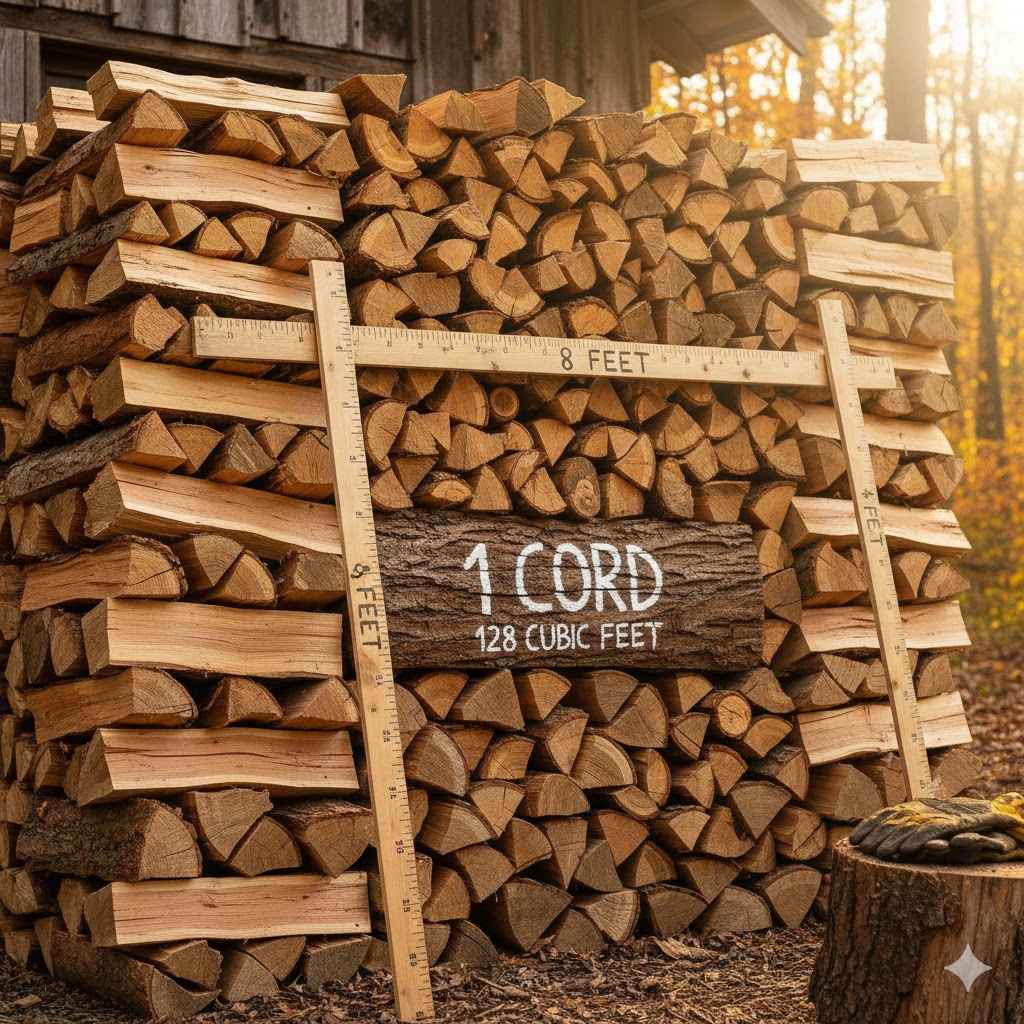
A standard cord of firewood is a very specific measurement. It’s a stack of wood that measures 4 feet high, 4 feet wide, and 8 feet long. When stacked this way, it contains about 128 cubic feet of wood and air.
The air space is important because wood is rarely perfectly stacked without gaps. Think of it as a large, rectangular pile of logs.
The wood itself, not including the air, typically takes up around 80 to 90 cubic feet within that standard 128 cubic feet space. This variation depends on how the wood is cut and stacked. Shorter logs or logs with irregular shapes will create more air pockets.
Longer, straighter logs tend to stack more tightly, reducing the air space and increasing the actual wood volume.
When you buy a cord, you are generally buying this entire volume. Sellers might stack it in different ways, but the total stacked volume should equal the standard cord dimensions. It’s essential to confirm if the seller is referring to a full cord or a different measurement that might be smaller.
Why Cord Size Matters for Buyers
The size of the cord directly impacts how much heat and how long that heat will last. A full cord provides a significant amount of fuel. Knowing the dimensions helps you estimate how many loads you’ll need throughout the winter.
It also helps you compare prices between different sellers. If one seller offers wood by the face cord, you need to know how that compares to a full cord to make a fair price comparison.
For example, if you have a large home or a very cold climate, you will need a larger supply of firewood. A full cord will likely last a certain amount of time depending on your stove’s efficiency and how often you use it. If you only get a fraction of a cord, it will run out much faster.
This understanding helps budget your firewood purchases and ensures you stay warm without unexpected shortages.
It’s also about getting your money’s worth. If you are new to buying firewood, you might not realize the difference between a full cord and a smaller measurement. A seller might present a smaller stack and call it a “cord” if you are not informed.
This is where learning the measurements saves you from potential disappointment and financial loss.
Common Firewood Measurements
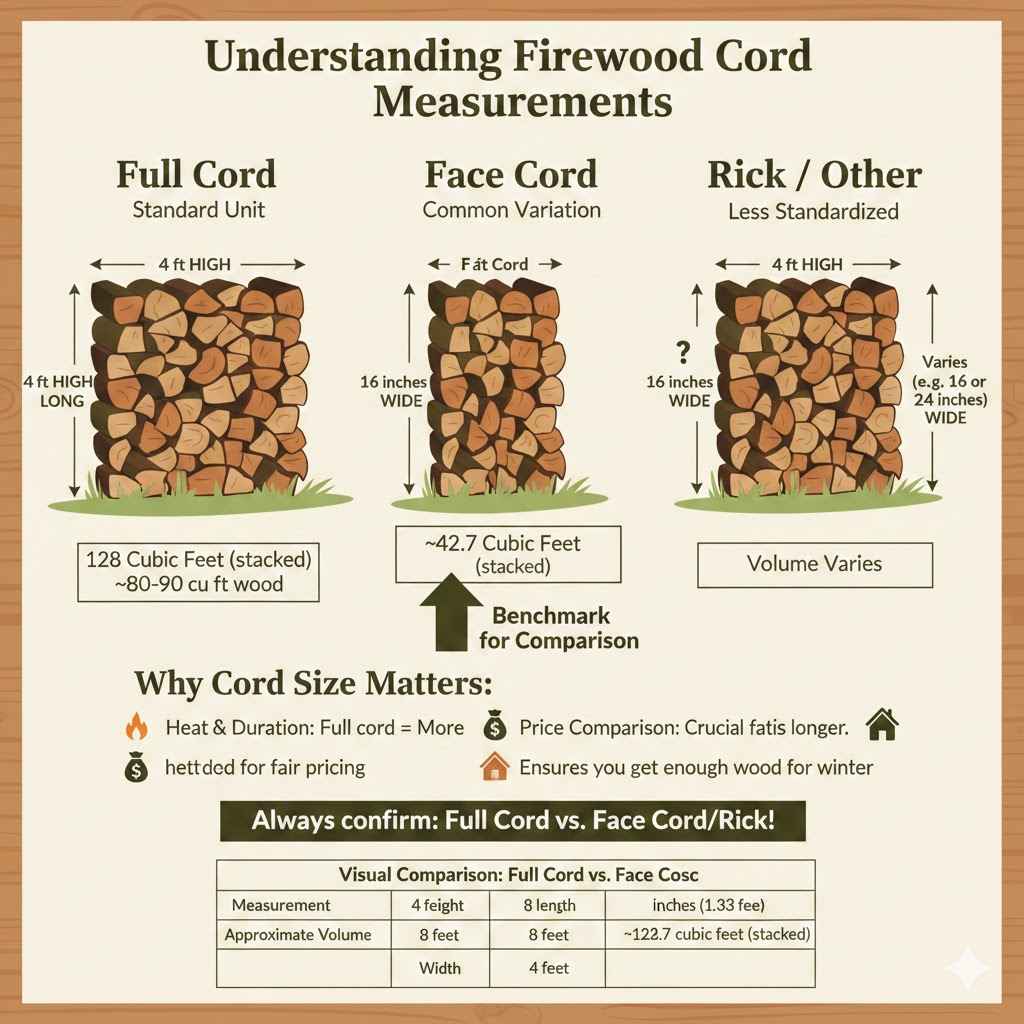
Beyond the full cord, other terms are used. A “rick” is sometimes used, but it’s less standardized and can vary by region. It often refers to a stack that is 4 feet high and 8 feet long, but the width can differ, often being 16 inches or 24 inches.
This means a rick is usually less than a full cord.
A “face cord” is another common term, and it’s where much confusion arises. A face cord typically refers to a stack of wood that is 4 feet high and 8 feet long, but it is only 16 inches wide. This means a face cord contains about one-third the amount of wood as a full cord.
Some sellers might use “rick” and “face cord” interchangeably, adding to the ambiguity.
To illustrate, imagine a stack of firewood. A full cord is a big rectangle. A face cord is a thinner slice of that same rectangle.
If you stack logs that are 16 inches long, and the stack is 4 feet high and 8 feet long, you have a face cord. If those same logs were arranged to be 4 feet wide instead of 16 inches, you would then have a full cord.
Here’s a visual comparison:
| Measurement | Height | Length | Width | Approximate Volume |
|---|---|---|---|---|
| Full Cord | 4 feet | 8 feet | 4 feet | 128 cubic feet (stacked) |
| Face Cord | 4 feet | 8 feet | 16 inches (1.33 feet) | ~42.7 cubic feet (stacked) |
This table shows the core difference. Always ask for clarification if a seller uses terms other than “full cord.” It’s your right to know exactly what you are buying.
How Firewood Is Stacked and Measured
The way firewood is stacked can affect the volume. While the standard cord dimensions are fixed, the actual wood content can vary slightly. This section will explore how stacking techniques influence the amount of wood you receive.
We will also discuss common stacking practices and their impact on measurement.
Understanding Stacked Volume
When firewood is sold by the cord, it’s usually presented as a neatly stacked pile. The goal is to create a uniform stack so the volume can be easily calculated. Sellers will try to stack the wood as compactly as possible, but air gaps are inevitable.
These gaps are part of the measurement of a stacked cord.
A cord is not just the volume of the wood itself, but the volume of the stack that contains the wood. This means that even if the wood logs were solid, without any air, the stack would still be measured by its outer dimensions. This is a crucial distinction that often causes confusion for newcomers.
Imagine buying a box of cookies. The box has dimensions, and the cookies are inside. You buy the whole box, not just the cookie material.
Similarly, when you buy a cord of firewood, you are buying the entire stacked volume, including the air between the logs.
Impact of Log Length on Stacking
The length of the firewood logs can affect how they stack and, consequently, the total volume of air within a cord. Logs cut to standard lengths, typically 16 inches or 24 inches, tend to stack more uniformly. This makes it easier to achieve a standard cord measurement.
If logs are cut to very different lengths, they will not stack as neatly. This can lead to more air space within the stack. A cord with highly irregular log lengths might contain less actual wood than a cord with uniform lengths, even if the stacked volume appears the same.
This is why consistency in cutting is often preferred by sellers aiming for accurate measurement.
Some buyers prefer logs of a specific length to fit their stove. If you specify a shorter log length, say 12 inches, a seller would need to cut more logs to fill the 8-foot length of the cord. This might result in more end-grain surface area and potentially more air within the stack, although the overall cubic footage of the stacked wood should still aim for the standard cord.
The “Loose” vs. “Stacked” Distinction
Sometimes firewood might be sold “loose,” meaning it’s dumped into a truck or trailer. This is much harder to measure accurately. A loosely piled cord is generally considered to contain less actual wood than a neatly stacked cord because the gaps are much larger and more unpredictable.
When you buy firewood, always request that it be stacked for measurement.
A stacked cord ensures a more consistent volume. Loose firewood can settle significantly during transport, reducing its volume even further. If you receive loose firewood, you might end up with much less than you paid for, especially if you were expecting a full cord equivalent.
This is a common way buyers can be shortchanged without realizing it.
When measuring loose firewood, a common rule of thumb is that a loose cord is equivalent to about 0.7 to 0.8 of a stacked cord. So, if you order a cord loose, you might only get the equivalent of a half-cord or slightly more of stacked wood. This is a significant difference and highlights the importance of specifying stacked firewood.
Measuring Your Firewood Pile
To verify you are getting what you paid for, you can measure your stacked firewood. First, ensure the wood is stacked neatly in a rectangular pile. Then, measure the height, length, and width of the stack in feet.
Multiply these three numbers together to get the total cubic feet of the stacked wood.
For example, if your stack is 4 feet high, 8 feet long, and 4 feet wide, then 4 x 8 x 4 = 128 cubic feet. This is a standard cord. If your stack measures 4 feet high, 8 feet long, and only 1.33 feet wide (16 inches), then 4 x 8 x 1.33 = 42.56 cubic feet.
This is roughly a face cord, or about one-third of a full cord.
This simple calculation is your best tool for ensuring fair dealings. It allows you to independently confirm the volume of wood you have received, no matter how the seller described it.
Comparing Firewood Measurements For Value
Getting the best value for your firewood purchase means understanding how different measurements compare. This section will help you translate various terms into comparable quantities. We will provide practical advice on how to ensure you are getting a fair deal every time you buy wood.
Calculating Equivalent Wood Volumes
To compare prices effectively, you need to convert all measurements to a common unit, usually the full cord. As established, a full cord is 128 cubic feet of stacked wood. A face cord, with its 16-inch width, is about 42.7 cubic feet.
If you are buying by the “rick,” you need to find out the width the seller uses. If a rick is defined as 4 feet high, 8 feet long, and 2 feet wide (24 inches), then its volume is 4 x 8 x 2 = 64 cubic feet. This is half a full cord (64/128 = 0.5).
So, if a face cord costs $100, and a full cord is 3 times the amount of wood, a comparable full cord price would be around $300. If a rick (at 2 feet wide) costs $150, then a full cord would be double that, around $300. This standardization is crucial for intelligent purchasing.
Price Per Cubic Foot Analysis
A more precise way to compare value is to calculate the price per cubic foot of actual wood. While this requires estimating the air space, it can give you a very close comparison. A common estimate is that 128 cubic feet of stacked wood contains about 90 cubic feet of actual wood.
Let’s take an example:
Seller A sells a full cord (128 cu ft stacked) for $300. Price per cubic foot of stacked wood = $300 / 128 cu ft = $2.34 per cu ft. Estimated actual wood volume = 90 cu ft.
Estimated price per actual cubic foot of wood = $300 / 90 cu ft = $3.33 per cu ft.
Seller B sells a face cord (42.7 cu ft stacked) for $120. Price per cubic foot of stacked wood = $120 / 42.7 cu ft = $2.81 per cu ft. Estimated actual wood volume = 42.7 cu ft * 0.7 (assuming 70% wood) = 29.9 cu ft.
Estimated price per actual cubic foot of wood = $120 / 29.9 cu ft = $4.01 per cu ft.
In this scenario, Seller A offers a better value per actual cubic foot of wood, even though the initial price per stacked volume seems closer. This detailed analysis helps uncover the true cost.
Real-Life Scenario: Comparing Two Sellers
Sarah was looking to buy firewood for her cabin. Seller 1 offered a “full cord” for $250. Seller 2 offered a “rick” for $150, stating that their ricks were 4 feet high, 8 feet long, and 2 feet wide.
Sarah, remembering her lessons on Cord of Firewood Measurements Explained, decided to do some math.
Seller 1’s full cord: 4 ft x 8 ft x 4 ft = 128 cubic feet. Price: $250. Price per cubic foot = $250 / 128 = $1.95 per cubic foot.
Seller 2’s rick: 4 ft x 8 ft x 2 ft = 64 cubic feet. Price: $150. Price per cubic foot = $150 / 64 = $2.34 per cubic foot.
Sarah realized that Seller 1 was offering a better deal per cubic foot of stacked wood. By converting both offers to a common measurement (cubic feet of stack), she could confidently choose the more economical option.
Tips for Avoiding Overcharging
Always clarify the dimensions. If someone offers a “cord,” ask for the height, length, and width. Insist on seeing the wood stacked, not loose.
If possible, see the stacking process to ensure it’s done fairly.
Be wary of prices that seem too good to be true. A significantly lower price per cord compared to others in your area might indicate a smaller volume or lower quality wood. Do your research on local firewood prices to have a baseline.
If you receive your firewood, take a few minutes to measure it yourself. A simple tape measure is all you need. This verification process is your best defense against being shortchanged.
It’s a small effort that can save you a considerable amount of money over time.
Practical Application of Firewood Measurements
Now that you understand the measurements, let’s look at how this knowledge applies to your actual firewood needs. This section will help you estimate how much wood you’ll need and how to make smart purchasing decisions based on accurate measurements.
Estimating Your Firewood Needs
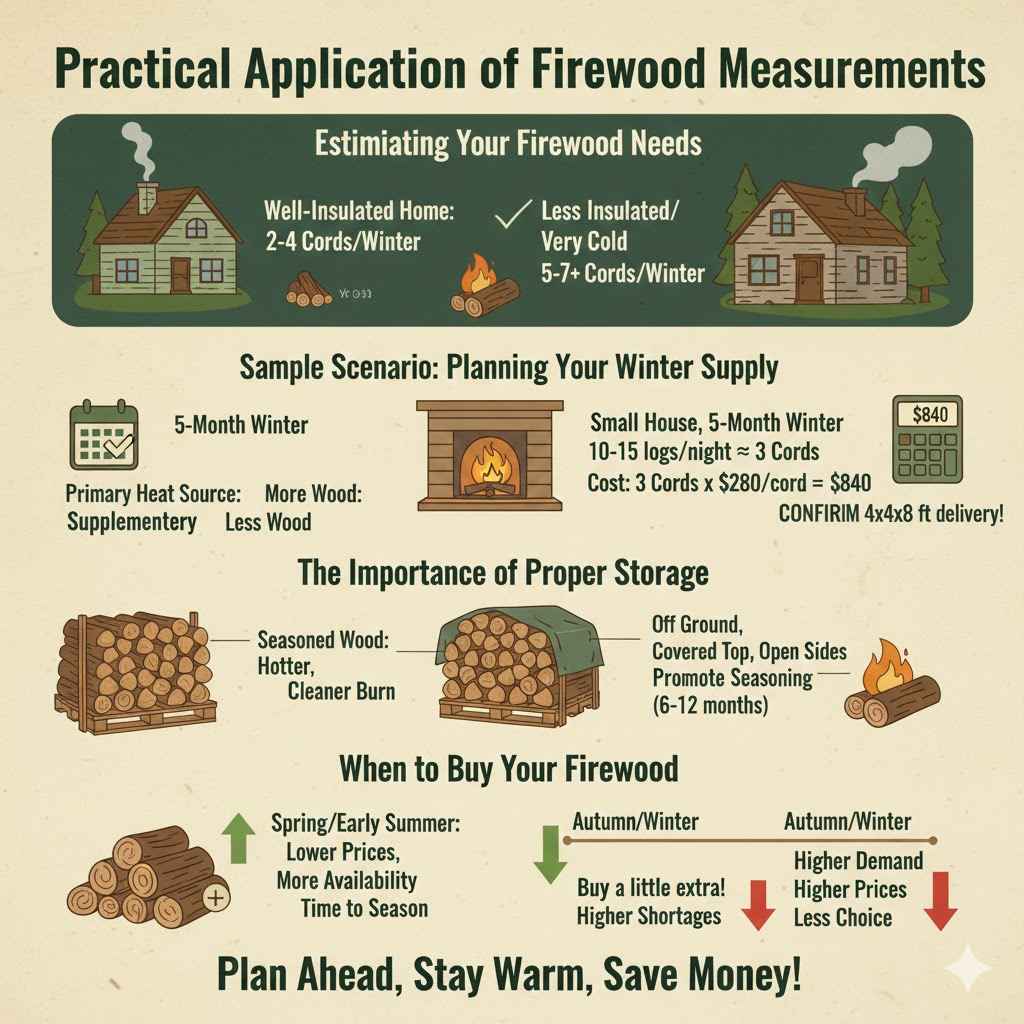
Your firewood needs depend on several factors: the size of your home, how well insulated it is, the type of wood stove or fireplace you use, and how cold your winters are. A good rule of thumb is that a well-insulated home in a moderately cold climate might use 2 to 4 cords of firewood per winter.
If you have an older, less insulated house, or if you live in a very cold region, your needs could be higher, perhaps 5 to 7 cords or even more. For a weekend cabin that is only used occasionally, you might only need 1 to 2 cords per season.
Consider your heating habits. Do you rely on firewood as your primary heat source, or do you use it to supplement your main heating system? If it’s supplementary, you’ll use less.
If it’s your main source, you’ll need to factor in consistent burning, which requires a larger supply.
Sample Scenario: Planning Your Winter Supply
Let’s say you have a small, fairly well-insulated house and plan to use your fireplace for heating most evenings during a 5-month winter. You estimate you’ll burn about 10-15 logs per night. Based on average log size and burn rate, this might translate to needing approximately 3 cords of firewood for the season.
You find a local supplier who offers firewood for $280 per full cord. You decide to buy 3 cords, costing you $840. You ensure the wood will be delivered and stacked.
Upon delivery, you measure the stack to confirm it meets the 4x4x8 feet dimensions. This proactive approach ensures you have enough wood to stay warm and comfortable all winter.
The Importance of Proper Storage
Once you have your firewood, proper storage is crucial. Wood should be stored off the ground, ideally in a dry, well-ventilated area. This helps prevent rot and keeps the wood seasoned, meaning it has dried sufficiently for efficient burning.
Wet or rotten wood burns poorly and produces more smoke and creosote.
A common storage method is a woodpile that’s elevated on pallets or runners. It should be covered at the top but open on the sides for air circulation. This protects the wood from rain and snow while allowing it to “breathe.” This process can take 6 to 12 months, so buying seasoned wood is often a good idea.
Consider that your firewood will lose some volume as it dries, but the measurement of a cord refers to the stacked volume at the time of sale. Properly seasoned wood burns hotter and cleaner, making your measured volume go further in terms of heat output.
When to Buy Your Firewood
The best time to buy firewood is usually in the spring or early summer. This is when suppliers often have the most wood available and may offer lower prices because demand is lower. Buying in advance also gives the wood time to season properly if you purchase it green.
As autumn approaches and winter nears, demand increases, and prices may rise. Last-minute purchases can also lead to less choice in terms of wood type and availability. Planning ahead ensures you get good quality wood at a potentially better price.
Many people underestimate how much wood they will need. It’s usually better to buy a little more than you think you will need. Running out of firewood in the middle of winter is an unpleasant experience.
Having a surplus means you are prepared for colder-than-expected weather or a longer winter.
Frequently Asked Questions
Question: What is the difference between a cord and a face cord
Answer: A full cord of firewood is a stack measuring 4 feet high, 8 feet long, and 4 feet wide, totaling 128 cubic feet. A face cord is a stack that is 4 feet high and 8 feet long, but only 16 inches (1.33 feet) wide, making it about one-third the volume of a full cord.
Question: How many logs are in a cord of firewood
Answer: The number of logs in a cord varies greatly depending on the length and thickness of the logs. However, a typical cord might contain anywhere from 500 to 1000 logs, depending on these factors.
Question: Can I buy firewood by the truckload
Answer: Yes, but this is not a standardized measurement and can be unreliable. It’s best to ask for measurements in cords or face cords and ensure the wood is stacked for accurate volume assessment.
Question: Is it better to buy seasoned or green firewood
Answer: Seasoned firewood has been dried for 6-12 months and burns more efficiently and cleanly. Green firewood is freshly cut and needs to be seasoned before burning, which can take time and proper storage.
Question: How do I measure my firewood if it’s not stacked neatly
Answer: If the wood is loosely piled, it’s very difficult to get an accurate measurement. Try to estimate the cubic feet of the pile by measuring its approximate dimensions. Remember that loose wood has much more air space than stacked wood, so a “loose cord” is significantly less than a stacked cord.
Conclusion
Now you know how to confidently understand firewood measurements. A full cord is the standard 4x4x8 feet stack. Face cords are smaller, typically one-third of a cord.
Always clarify dimensions when buying. Measure your stacks to ensure fairness. This knowledge helps you buy the right amount of wood at the best price.