How Big is 3 Gallon Boxwood: Size, Growth, and Care Tips
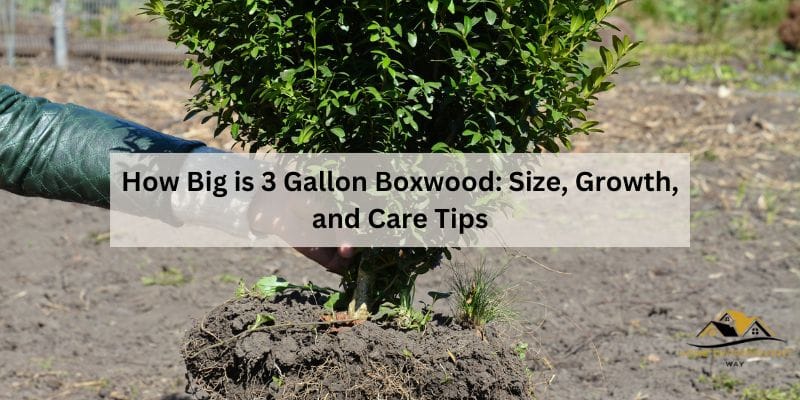
A 3-gallon boxwood is usually a young, starter shrub that may be about 12 to 24 inches tall and wide, depending on cultivar and nursery pruning. The pot size does not predict the final garden size. Use the cultivar’s mature spread, local climate, and drainage to decide where it belongs and how closely it can be planted.
What does a 3-gallon boxwood look like?
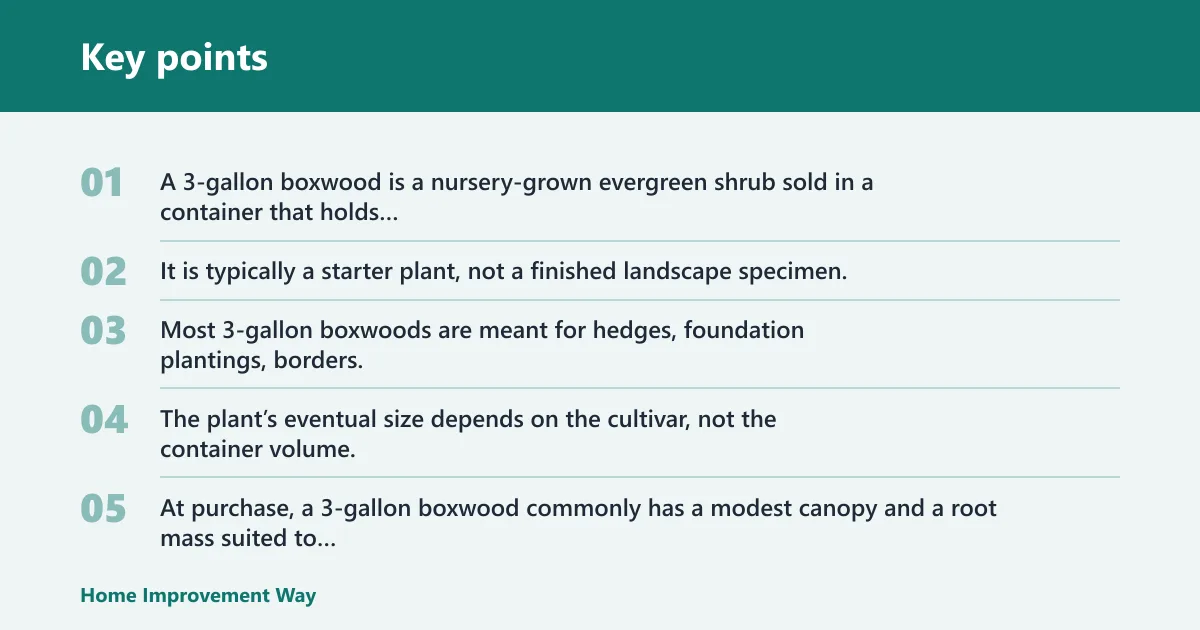

A 3-gallon boxwood is a nursery-grown evergreen shrub sold in a container that holds about 3 gallons of mix. It is typically a starter plant, not a finished landscape specimen, so the top may look compact or lightly branched while the root ball is still settling after transplanting.
Most 3-gallon boxwoods are meant for hedges, foundation plantings, borders, and specimen use after they establish. The plant’s eventual size depends on the cultivar, not the container volume, which is why spacing should be based on mature width and airflow rather than the size you see in the pot.
Typical purchase size and root volume
At purchase, a 3-gallon boxwood commonly has a modest canopy and a root mass suited to transplanting, but it still needs time to re-root in the landscape. The first season is usually about establishment, not fast top growth. That is normal for container-grown shrubs moved into the ground.
If the root flare is set too deep, if the plant is watered inconsistently, or if it is moved into harsh sun or poor drainage, establishment slows. Keep the soil evenly moist, set the root flare at or slightly above grade, and avoid piling mulch against the stem.
Boxwood sizing and planting table
| Boxwood group / common cultivars | Typical 3-gallon purchase height × width | First-season settle-in | Estimated 2-year size range | Estimated 5-year size range | Hedge spacing | Specimen spacing | Watering / pruning / winter-protection trigger |
|---|---|---|---|---|---|---|---|
| Japanese boxwood (Buxus microphylla types), including dwarf forms | 12–20 in. × 12–18 in. | Roots first; slight top growth, especially after spring planting | 18–30 in. tall × 18–30 in. wide | 2–4 ft. tall × 2–4 ft. wide | 12–18 in. apart for a low hedge | 3–5 ft. from center to center | Water when top 1 in. dries; prune after spring flush; protect from winter wind if exposed |
| Littleleaf boxwood cultivars such as ‘Green Velvet’ and ‘Green Gem’ | 12–24 in. × 12–24 in. | Slow, steady establishment; moderate fill after rooting | 2–3 ft. tall × 2–3 ft. wide | 3–4 ft. tall × 3–4 ft. wide | 18–24 in. apart for a denser hedge | 4–6 ft. from center to center | Water during dry spells; lightly shape after growth flush; shield from reflected winter sun |
| Common English boxwood types such as ‘Suffruticosa’ | 10–18 in. × 10–18 in. | Settles in slowly; keep soil evenly moist without saturation | 12–24 in. tall × 18–30 in. wide | 2–3 ft. tall × 3–4 ft. wide | 12–18 in. apart for edging or low formal lines | 3–4 ft. from center to center | Watch closely for boxwood blight in dense plantings; prune only to maintain outline; protect roots from winter drying |
| American boxwood (Buxus sempervirens forms) and taller landscape cultivars | 18–24 in. × 12–20 in. | Can look open at first; root establishment drives later growth | 2–4 ft. tall × 2–4 ft. wide | 4–8 ft. tall × 4–8 ft. wide | 24 in. apart for a hedge that will eventually knit | 6–10 ft. from center to center | Water deeply in drought; prune in late spring or early summer; use wind protection in exposed sites |
| Outlier large species and forms outside common landscape boxwood use | Varies widely; do not generalize from pot size alone | Always check species-specific label data before planting | Can exceed common hedge sizes | Can become much larger than typical garden boxwood | Only follow cultivar-specific spacing | Only follow cultivar-specific spacing | Use site and climate guidance for the exact species; do not rely on broad “boxwood” averages |
How tall and wide will it get?
Boxwood size depends on the cultivar, climate, and site conditions, not the container size. Common landscape boxwoods are usually much smaller than the outlier species sometimes grouped under the boxwood name. Mature sizes are best checked cultivar by cultivar because published ranges differ by type and region.
For broad landscape planning, many common garden boxwoods mature in the 2- to 8-foot range, while some dwarf selections stay low for edging and some taller forms become screening shrubs. Always use the tag or nursery listing for the specific cultivar rather than a generic “boxwood” average.
How fast does a 3-gallon boxwood grow?
Boxwood grows slowly, and a 3-gallon plant usually spends its first season building roots before it adds noticeable canopy growth. In years two through five, the rate depends on cultivar vigor, soil drainage, moisture, and light. That slow pace is useful for formal hedges, but it also makes spacing mistakes harder to correct later.
If the goal is a hedge, tight planting can make the row look complete sooner, but it also raises pruning demands and can reduce airflow in the lower canopy. Wider spacing takes longer to knit together, yet it often keeps the hedge healthier over time.
Why growth stays slow after planting
Newly planted boxwood sends energy into root recovery before pushing much top growth. Heat, drought, compacted soil, poor drainage, and extreme shade or full hot sun can all slow establishment. Winter injury can also set the plant back by killing tips and reducing the spring flush.
For detailed spacing and placement planning, see boxwood spacing calculators and the cultivar’s mature spread. Matching the plant to the site is more important than trying to force quick closure with crowded planting.
How should you plant and space it?
Plant container-grown boxwood in spring or early fall so roots can establish in mild weather before summer heat or hard frost. For hedges, spacing is usually based on half the cultivar’s mature width. For specimen planting, leave room for the full spread and enough airflow to reduce disease pressure.
Boxwood does best in well-drained soil with consistent moisture and a mildly acidic to neutral pH, often around 6.5 to 7.5. Extension and botanical references commonly stress that poor drainage is one of the biggest causes of failure, especially on heavy soils or low sites.
Soil, drainage, and pH checks before planting
Before planting, confirm that water drains well and that the root flare will sit at or just above grade. Boxwood prefers soil that stays evenly moist, not soggy, and many references place the target pH in the 6.5 to 7.5 range. If the site stays wet, improve drainage first instead of relying on fertilizer.
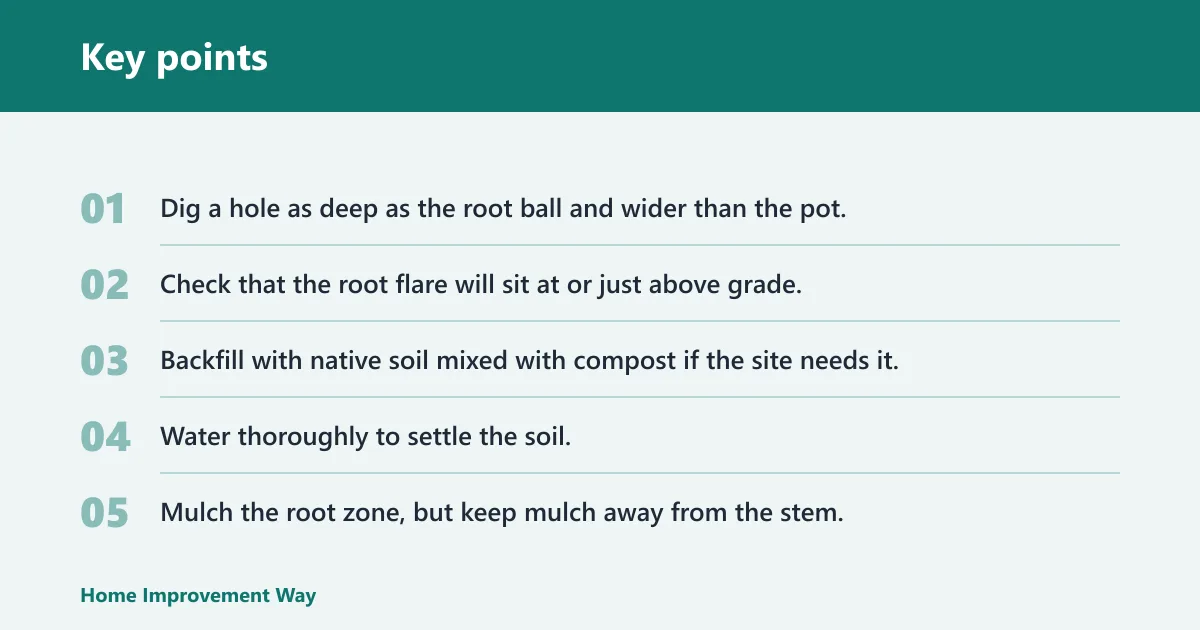
- Dig a hole as deep as the root ball and wider than the pot.
- Check that the root flare will sit at or just above grade.
- Backfill with native soil mixed with compost if the site needs it.
- Water thoroughly to settle the soil.
- Mulch the root zone, but keep mulch away from the stem.
If the bed drains slowly, use soil drainage improvement strategies before planting. Raised beds, grading changes, or selective soil replacement are often more effective than overwatering or heavy amendment in place.
Spacing for hedges versus specimen plants
For hedges, use the mature width as the starting point and then decide how fast you want the row to close. Half-width spacing is common because it balances quicker fill with enough airflow. For specimen plants, leave the full mature width plus a little extra room so the shrub keeps its natural form.
For a low hedge, many common boxwoods are set about 12 to 18 inches apart. Taller hedges often use 18 to 24 inches or more, depending on the cultivar. For exact pruning strategy and timing, see hedge pruning timing.
What care does it need after planting?
Newly planted boxwood needs steady moisture, mulch, and protection from stress while its roots re-establish. Keep the root zone evenly moist, but do not let it stay waterlogged. Because boxwood roots are relatively shallow, the plant can dry faster than expected in heat, wind, reflected sun, or pots.
After the first season, watering can become less frequent, but dry weather still matters. If foliage bronzes, wilts, or the tips die back, the shrub may need better moisture management, improved drainage, or less exposure. Potted boxwood always dries faster than ground-planted boxwood and needs tighter monitoring.
Watering schedule for the first season
Water thoroughly at planting, then check moisture often during the first season. If the top inch of soil is dry, water again. In hot or windy weather, newly planted shrubs may need more frequent watering. Container-grown plants dry faster than those in the ground and should be checked more often.
Mulch helps hold moisture and moderate temperature swings, but it should never touch the trunk. Keep mulch a few inches back from the stem so the base stays dry enough to inspect for rot, girdling roots, or damage. For more detail on establishing shrubs through dry weather, use winter shrub protection as a general stress-reduction guide for exposed sites.
Pruning, shearing, and shaping basics
Boxwood can be lightly trimmed to shape, and formal hedges or topiaries can be sheared. Remove dead or diseased wood as soon as you spot it, but avoid heavy cuts into old bare stems unless you know the cultivar can bud back well. Light shaping is usually safer than hard renovation pruning.
For a formal hedge, trim after a flush of growth so the outline stays even. For a specimen, use selective pruning to preserve the natural form. The most reliable rule is to prune before the plant becomes overly dense, because thick interiors are slower to dry and more prone to disease.
What causes browning or winter damage?
Browning is often linked to drought stress, poor drainage, boxwood blight, or winter injury. In cold weather, wind and sun can dry leaves faster than frozen roots can replace water. In wet ground, roots may struggle even if the canopy initially looks healthy. The first clue is usually where and when the browning begins.
If the damage follows a cold, bright, windy period, winter burn is a strong possibility. If the soil stays wet, root stress becomes more likely. If leaves spot, defoliate, or die back in patches during warm weather, disease should be investigated promptly, especially in tightly spaced plantings.
Boxwood blight and other disease risks
Boxwood blight is a serious fungal disease that can spread through dense plantings, causing rapid leaf drop and dieback. Reputable extension sources emphasize sanitation, airflow, and avoiding overhead wetting as key risk reducers. Clean tools between cuts, remove infected debris promptly, and do not leave fallen leaves under the shrub.
If you want a deeper diagnostic guide, see boxwood blight symptoms. Early identification matters because the disease can move quickly in crowded hedges and can be confused with winter damage or drought stress.
Winter sun, wind, and drying injury
Boxwood generally performs best in partial sun to part shade, but sun tolerance varies by cultivar and climate. In cooler regions, many cultivars handle more sun; in hotter or more exposed sites, afternoon sun and reflected heat can increase stress. Many references place boxwood broadly in USDA zones 5 to 9, with some cultivars hardy into zone 4.
Winter injury often comes from desiccating sun and wind rather than cold alone. If the shrub is in an exposed location, use windbreaks, burlap, or other protection on the windward side. For step-by-step ideas, see winter shrub protection.
When poor drainage is the real problem
If a boxwood sits in wet soil, roots can decline long before the canopy fails. Yellowing, browning, sparse growth, and dieback can follow. In that case, fertilizer usually does not help. The better fix is to improve drainage, raise the planting area, or move the shrub to a more suitable site.
Soil drainage problems are especially important for older hedges where one plant starts declining while the others still look acceptable. Check the wettest spots first, not just the foliage. If the soil stays saturated after rain, address grading or drainage before replacing the plant.
Frequently asked questions
How big is a 3 gallon boxwood when I buy it?
Most 3-gallon boxwoods are about 12 to 24 inches tall and wide at purchase, though cultivar, pruning, and nursery production style can shift that range. The pot size tells you container volume, not mature size. A young shrub like this is meant to establish first and fill in later.
How tall will a 3 gallon boxwood get at maturity?
Mature height depends on the cultivar. Common landscape boxwoods may stay in the 2- to 8-foot range, while dwarf forms remain much smaller and some larger types can exceed that. Check the cultivar tag or nursery reference for the specific mature height and spread before choosing a planting site.
How far apart should I plant 3 gallon boxwoods for a hedge?
Use about half the mature width as a spacing guide, then adjust for the speed of closure you want. Low hedges are often planted 12 to 18 inches apart, while taller hedges may need 18 to 24 inches or more. Tighter spacing closes faster but increases pruning and moisture management needs.
Does boxwood need sun or shade?
Boxwood typically performs best in partial sun to part shade, but sun tolerance depends on cultivar and climate. Cooler sites can handle more sun, while hot afternoon exposure can stress the plant. Morning sun with some afternoon relief is often the safest choice in warmer or more exposed locations.
What kind of soil does boxwood need?
Boxwood needs well-drained soil that stays evenly moist, not wet. Many references place the ideal pH around 6.5 to 7.5. Heavy clay or persistently soggy soil increases the risk of root stress, so drainage should be fixed before planting if water tends to stand after rain.
How often should I water a newly planted boxwood?
Water right after planting, then check soil moisture often during the first season. If the top inch dries out, water again. During heat, wind, or container growing, the plant may need more frequent checks. The main goal is consistent moisture without saturation while the roots expand.
When is the best time to plant boxwood?
Spring and early fall are usually the best planting windows for container-grown boxwood because temperatures are milder and the plant has time to root in before extreme heat or hard frost. That timing reduces transplant stress and gives the shrub a better chance to establish before weather becomes harsh.
What causes boxwood to turn brown or suffer winter damage?
Browning can come from drought stress, poor drainage, boxwood blight, or winter burn. Winter injury often follows bright, windy, dry weather, while disease and root problems can show up as leaf drop or dieback in other conditions. The best prevention is good drainage, steady moisture, airflow, and protection from exposure.
I can’t seem to find 1 gallon Boxwood shrubs anywhere. Anyone have any ideas?
One-gallon boxwoods can be harder to find because many nurseries stock 3-gallon plants for a faster landscape effect. If you want a smaller size, ask local garden centers about special orders, spring shipments, or cultivar-specific availability. Searching by cultivar name can help more than searching by pot size alone.
Sources
- University extension guidance on boxwood culture, spacing, drainage, and winter injury management
- Botanical garden and arboretum references on mature sizes for common boxwood cultivars
- Major nursery cultivar sheets for cultivar-specific height and spread ranges
- Extension publications on boxwood blight prevention, sanitation, and airflow
- Extension and horticultural references on soil pH targets, establishment watering, and site selection
Sponsored / affiliate links. As an Amazon Associate I earn from qualifying purchases. I may earn additional commission from eligible campaigns.