How Do You Port a Chainsaw for More Power Safely Now?
Port a chainsaw only if the saw has strong compression, enough displacement, and a muffler/carb setup worth tuning. Otherwise, the gain is usually small and the risk is not. Bad port work can shorten engine life fast and turn a strong saw into an expensive paperweight. This guide covers how porting changes power, which parts matter, what not to grind, and how to decide between DIY, pro work, or buying a different saw.
What you’ll need before you touch the cylinder
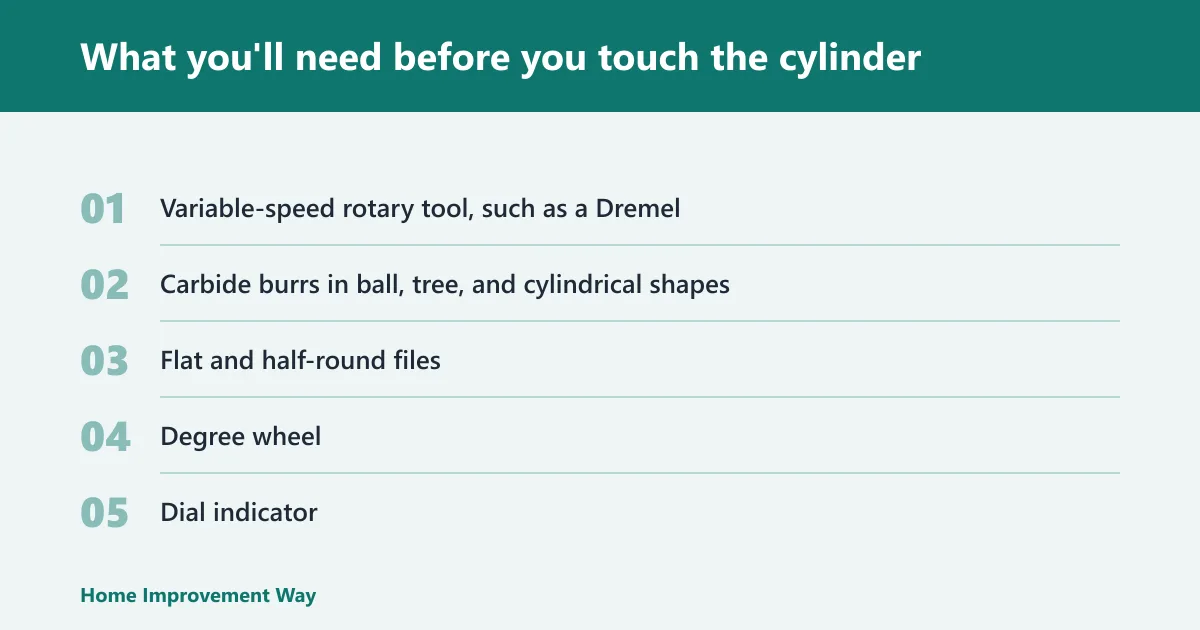


- Variable-speed rotary tool, such as a Dremel
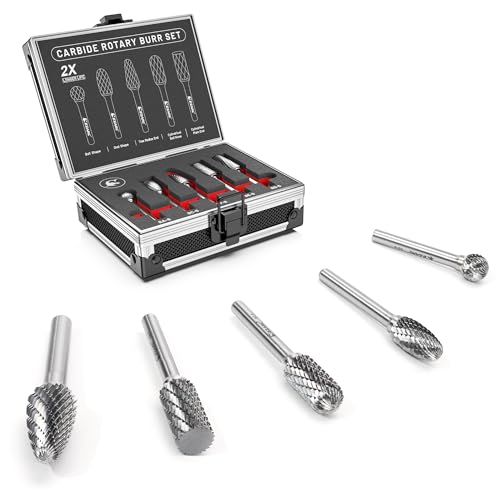
- Carbide burrs in ball, tree, and cylindrical shapes
- Flat and half-round files
- Degree wheel
- Dial indicator
- Digital caliper
- Basic hand tools for teardown and reassembly
- Safety glasses, a dust mask or respirator, and gloves
- Clean bench, parts trays, and compressed air or cleaning solvent
- New gaskets and sealant as needed
What chainsaw porting changes inside the cylinder
Chainsaw porting changes the intake port, exhaust port, and transfer ports in a two-stroke engine. The aim is to alter air-fuel-exhaust timing and crankcase scavenging so the saw fills and empties the cylinder better. Done correctly, porting can increase horsepower, torque, and throttle response. Done badly, it can damage the engine.
The cylinder is not a blank block of metal. Each port has a job, and each cut changes a tradeoff. Open the exhaust too much and you may help high-RPM flow while hurting low-speed pull. Touch the transfers carelessly and you can ruin mixture direction, weaken scavenging, and make the saw hotter instead of faster.
How port timing affects power
Port timing is the relationship between when each port opens and closes. In a two-stroke engine, that timing controls when fresh charge enters, when spent gas leaves, and how well the crankcase pushes mixture through the transfers. Small changes can sharpen throttle response. Large changes can move power up the RPM range and make the saw less friendly in wood.
That is why this is an engine setup problem, not a grinding job. The same cut that helps a race-style saw can make a homeowner saw boggy, hard to tune, or short-lived. A good setup usually pairs moderate port work with muffler flow, carb adjustment, and the right chain and bar combination.
What parts of a chainsaw cylinder do you port?
You port the intake port, exhaust port, and transfer ports. Each one affects a different part of the cycle, and each one carries different risk. The intake influences mixture entry and low-end torque. The exhaust controls burnt-gas exit and high-RPM bias. The transfers move mixture from the crankcase and are usually the most complex modification.
Intake port
The intake port admits the air-fuel mixture. Enlarging it too much can hurt velocity and soften low-end torque. Small shaping changes can improve flow and response, but the intake usually gives less dramatic gains than the exhaust. The safe rule is simple: change the shape, not the basic geometry, unless you already measured the timing and know the limit.
Exhaust port
The exhaust port lets burnt gas leave. Raising or widening it can improve scavenging and high-RPM output, but it also pushes the saw toward a narrower power band. The roof height matters because it controls timing. If you overdo it, ring support suffers and the top end can get unstable or weak.
Transfer ports
Transfer ports send fresh mixture from the crankcase into the cylinder. Their angle matters as much as their area. Good transfer work improves scavenging efficiency and cylinder filling. Bad transfer work sprays mixture into the wrong part of the chamber, leaves exhaust behind, and makes tuning harder. This is usually the least forgiving area to change.

How do you know if your saw is a good candidate?
A good candidate usually has healthy compression, a solid crankcase seal, enough displacement to benefit from better breathing, and a muffler that can often be opened up and tuned afterward. Pro saws often respond better than small homeowner saws because they already have stronger hardware and more tuning headroom. A weak or worn saw usually needs repair first.
Many homeowner saws are better left stock or only lightly tuned. If the saw is already tired, has scoring, low compression, air leaks, or hard-to-find parts, porting is a bad first move. Port work cannot fix worn rings, a leaking seal, or a neglected air filter.
| Condition | Good candidate | Poor candidate |
|---|---|---|
| Compression | Strong and even on pull | Weak, inconsistent, or dropping |
| Cylinder condition | Clean bore, no scoring | Scored piston, damaged plating |
| Parts availability | Easy to get rings, gaskets, seals | Hard-to-find or discontinued parts |
| Use case | Frequent cutting, firewood, milling, racing-style work | Light occasional limbing |
| Budget | Room for tuning, muffler work, and cleanup | Only enough for a quick grind |
Use the setup matrix and tuning worksheet first
Compare stock, muffler-only, DIY ported, and pro ported options before cutting metal. A saw that only needs better muffler flow and a carb retune should not jump straight to cylinder work. Record compression, carb settings, muffler opening size, and chain setup before and after so you know whether the work actually helped.
| Setup | Best for | Expected change | Risk level |
|---|---|---|---|
| Stock | Reliable general use | Baseline cut speed and torque | Low |
| Muffler-only | Small gain with low cost | Better throttle response, modest top-end gain | Low to moderate |
| DIY ported | Experienced users with measuring tools | More power if timing is correct | Moderate to high |
| Pro ported | Users who want a known result | Matched cylinder work and retune | Moderate |
Before/after tuning worksheet
- Compression before work: note the reading or pull feel
- Compression after work: check for any loss
- Carb setting before work: record H and L needle position and idle quality
- Carb setting after work: retune for clean four-stroking at no load and crisp acceleration
- Muffler flow before work: stock outlet or opened outlet size
- Muffler flow after work: confirm no fresh restriction
- Chain setup: note chain type, depth gauge condition, bar length, and sharpness
- Cut result: compare pull in the cut, chain speed feel, and chip quality
What tools do you need to port a chainsaw?
A variable-speed rotary tool, such as a Dremel, is commonly used for porting, and speed control can matter when shaping aluminum. Carbide burrs in ball, tree, and cylindrical shapes are listed as essential because each shape handles a different surface. A degree wheel and dial indicator are commonly used for timing checks. A digital caliper helps confirm dimensions before you remove material.
Files are useful for cleanup, not aggressive cutting. Basic hand tools are needed for teardown and reassembly. Keep safety glasses on, use a dust mask or respirator, wear gloves, disconnect the spark plug, and work in a well-ventilated area. Metal dust and grit do real damage if they get into the engine.
How do you port a chainsaw for more power?
Start with measurement, not grinding. Strip the saw, inspect the cylinder, and check port timing with a degree wheel and dial indicator before any material comes off. Then shape only the areas that support your goal: exhaust for freer exit, intake for controlled entry, and transfers for cleaner movement. Clean and retune after every change.
- Remove the top end and inspect the piston, ring, and cylinder.
- Measure current port timing with a degree wheel and dial indicator.
- Mark safe limits on each port roof and wall.
- Open the exhaust only enough to improve flow without sacrificing ring support.
- Shape the intake within safe limits to preserve mixture speed.
- Refine transfer ports for better angle and flow, not just size.
- Deburr, clean every passage, and recheck edges before reassembly.
- Reinstall, retune the carburetor, and verify the saw in wood.
What can go wrong when porting a chainsaw?
Over-porting often shows up as thin walls, a broken port roof, low compression, hot running, or a saw that sounds louder but cuts worse. Another common problem is poor ring support after the exhaust roof is raised too far. If the cylinder material is removed past the safe limit, the fix may be a replacement top end.
Weak carb tuning can hide good port work. A saw with too little fuel will run hot and feel flat. A muffler that still chokes flow can also bury gains. If compression drops after the work, stop and inspect the piston, ring seal, and cylinder edges before running it hard again.
If that didn’t work, try this next:
- Return the carburetor to a safe baseline setting and test again.
- Inspect muffler outlet size and clear any restriction.
- Check the air filter, plug, and fuel delivery.
- Recheck compression and leak points around seals and base gasket.
- Replace the top end if ring seal or cylinder shape is compromised.
Prevention: Mark your timing numbers before each cut. That one habit stops most bad port jobs from getting too far.
Should I port my chainsaw or buy a professionally ported saw?
DIY porting makes sense if you already own measuring tools, understand two-stroke timing, and accept that mistakes can ruin a cylinder. A mail-in service makes more sense when you want a matched setup without buying the learning curve. Buying a faster saw is better when your current saw is undersized for the work.
Cost and effort tradeoff
DIY usually has the lowest cash outlay if the tools are already on hand. It becomes expensive if a mistake ruins the cylinder or forces a replacement top end. Mail-in work, including services like RIPSAW’s mail-in chainsaw porting service, can be a better value when the saw is sound and the owner wants predictable results. RIPSAW also states it is now accepting brand new saws for mail-in performance services.
Choose a different saw when the base machine is too small, too worn, or too hard to support with parts. A well-sized stock saw often beats an overworked small saw that was ported into a bad operating range.
Can porting a chainsaw damage the engine?
Yes. Improper porting can lead to engine damage or complete failure. The usual failure points are thin cylinder walls, excessive exhaust roof height, poor ring support, distorted port edges, and bad tuning after reassembly. The damage can be serious, and the saw may need a cylinder, piston, or full top-end replacement.
Look for warning signs early: loss of compression, harder starting, higher head temperature, metallic noise, or a saw that only runs well in one narrow throttle range. Those symptoms mean the setup needs inspection before more cuts are made.
Frequently asked questions
How do you port a chainsaw for more power?
Measure port timing first, then make small changes to the exhaust, intake, and transfers. After that, retune the carburetor and verify the cut in wood. The power gain comes from better timing and airflow, not from removing the most metal.
What parts of a chainsaw cylinder do you port?
The main parts are the intake port, exhaust port, and transfer ports. The exhaust usually affects top-end output the most, the intake influences mixture entry and response, and the transfers control how efficiently the fresh charge moves through the cylinder.
What tools do you need to port a chainsaw?
A variable-speed rotary tool, such as a Dremel, carbide burrs, files, a degree wheel, a dial indicator, and a digital caliper are the core tools. Add safety glasses, a respirator, gloves, and a clean bench so grit does not enter the engine.
Can porting a chainsaw damage the engine?
Yes. Too much material removal can break ring support, lower compression, or create hot spots that shorten engine life. If timing changes are guessed instead of measured, the saw can run worse than stock and may need a replacement cylinder.
How much performance gain does chainsaw porting add?
The gain depends on the saw, the timing changes, and the rest of the setup. On a sound saw with proper retuning, the difference often shows up as stronger throttle response, better chain speed feel, and faster cutting. Without muffler and carb work, the result is usually smaller.
Is chainsaw porting safe for a beginner?
It is not the best first project for a beginner. A first-time user is safer starting with carb tuning, muffler flow changes, and basic maintenance. Porting becomes a reasonable next step only after measuring timing, reading the cylinder correctly, and accepting the chance of costly mistakes.
Sponsored / affiliate links. As an Amazon Associate I earn from qualifying purchases. I may earn additional commission from eligible campaigns.