How Much Does It Cost to Install Wood Flooring
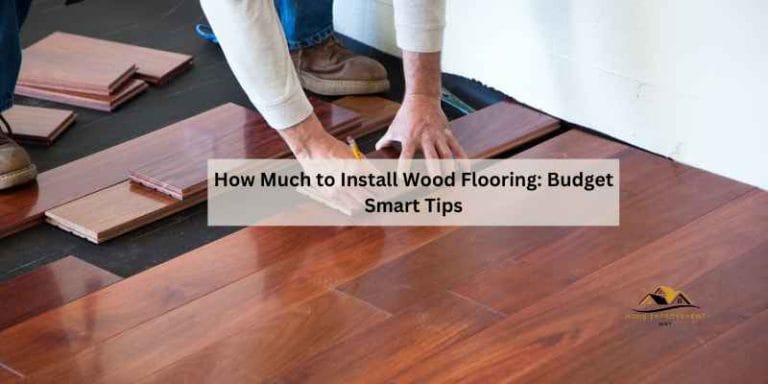
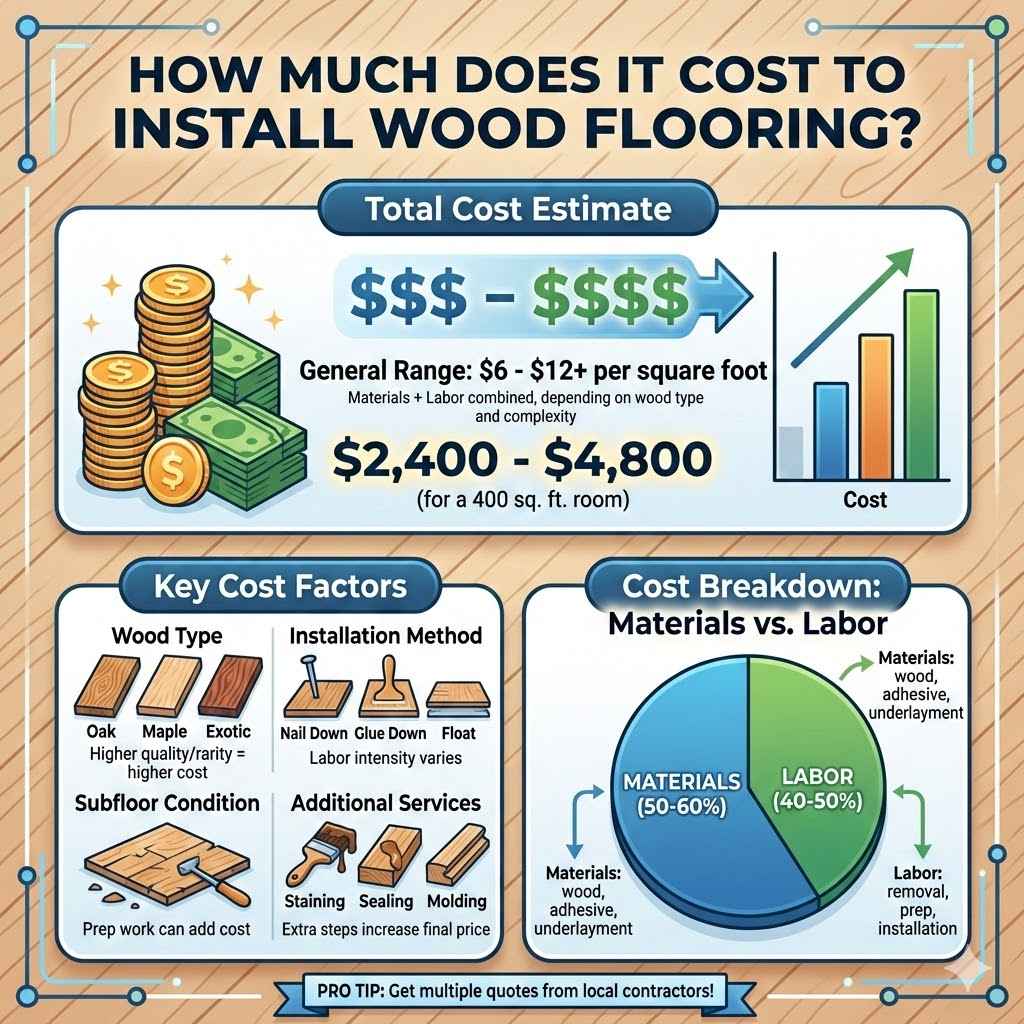
Thinking about new wood floors? You’re probably wondering, How Much Does It Cost to Install Wood Flooring. It’s a common question, and the answer can seem a little tricky at first.
Lots of different things can change the price, which can make it hard for folks just starting out to get a clear picture. Don’t worry, though! We’ll break it all down simply, step by step.
After this, you’ll know exactly what to expect and how to budget for your beautiful new wood floors.
Wood Flooring Installation Cost Factors
The price tag for installing wood flooring isn’t just one number; it’s a mix of many different pieces that add up. Think of it like building with blocks – each block adds to the total. We’ll look at the main things that influence how much you’ll spend.
These include the type of wood you pick, how big your room is, and whether you’re doing it yourself or hiring professionals. Getting a good handle on these costs helps you plan your budget right from the start.
Type of Wood Flooring
One of the biggest impacts on cost is the kind of wood flooring you choose. There are many options, each with its own price range. Solid hardwood is made from a single piece of wood, while engineered hardwood has layers.
Laminate and vinyl are often more budget-friendly alternatives that mimic wood looks.
Solid Hardwood Flooring
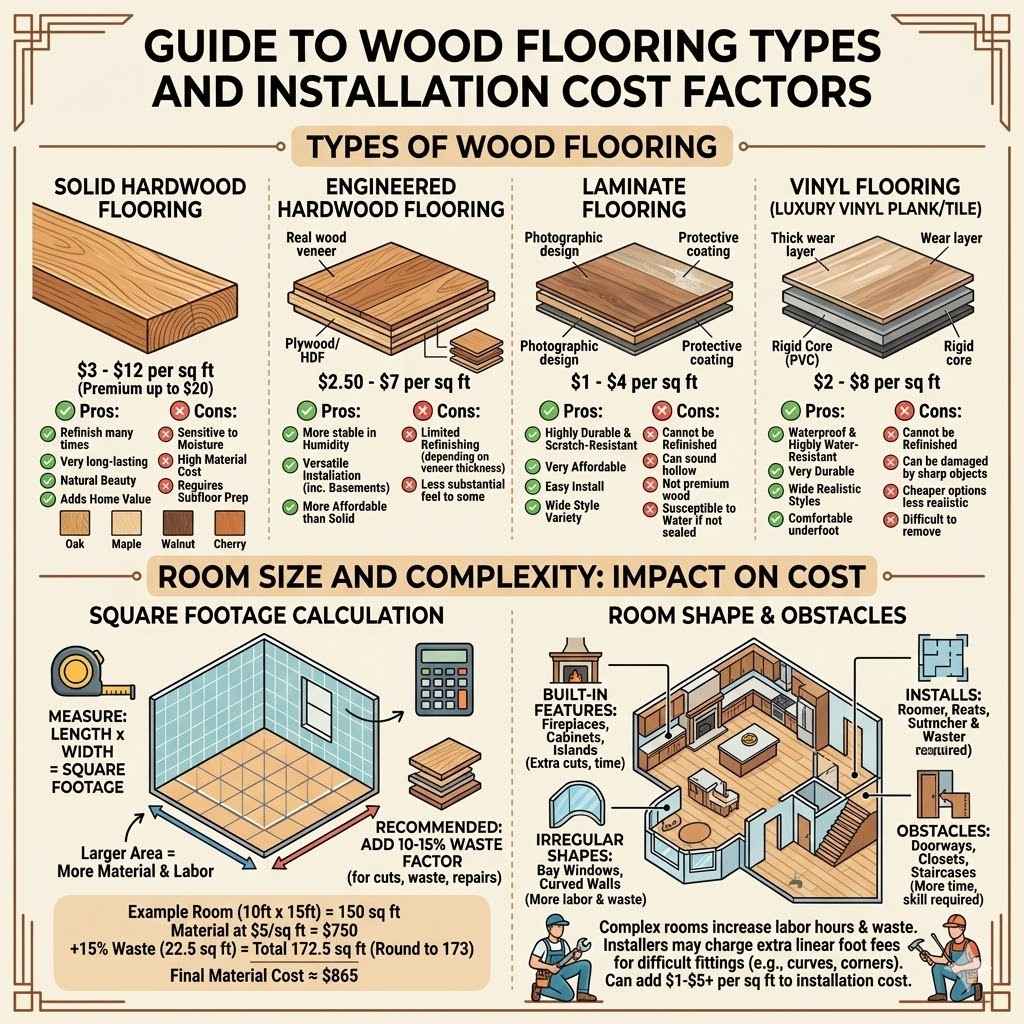
Solid hardwood planks are milled from one solid piece of timber. This makes them durable and able to be refinished many times over their lifespan. Because they are made from natural, valuable materials, they tend to be on the higher end of the price spectrum.
- Pros: Very long-lasting, can be refinished multiple times, adds significant value to a home, natural beauty.
- Cons: More expensive than engineered options, can be sensitive to moisture and humidity changes, requires proper subfloor preparation.
The cost for solid hardwood material alone can range from $3 to $12 per square foot. Premium woods like Brazilian cherry or walnut can push this cost even higher, sometimes reaching $15 to $20 per square foot. This price difference is due to the scarcity, durability, and unique grain patterns of these exotic species.
For instance, a 200-square-foot room could see material costs between $600 and $2,400 for standard oak or maple, jumping to $3,000 to $4,000 for exotic hardwoods.
Engineered Hardwood Flooring
Engineered hardwood flooring has a top layer of real hardwood veneer glued onto multiple layers of plywood or high-density fiberboard (HDF). This construction makes it more stable and less prone to expanding or contracting with humidity changes compared to solid hardwood.
- Pros: More stable in varying humidity, can be installed in more locations (even basements), often more affordable than solid hardwood.
- Cons: Can only be refinished a limited number of times (depending on veneer thickness), may not feel as substantial as solid wood to some homeowners.
The material cost for engineered hardwood typically falls between $2.50 and $7 per square foot. This makes it a popular choice for homeowners looking for the look of real wood without the highest price tag. The thickness of the top hardwood veneer layer is a key factor in its price and refinishing potential.
A veneer of 2mm or more allows for at least one refinish, while thinner veneers are often not refinishable.
Laminate Flooring
Laminate flooring is a synthetic product made from multiple layers fused together. It features a photographic image layer under a clear protective coating, giving it the appearance of wood or stone. It’s a durable and cost-effective option.
- Pros: Very affordable, highly durable and scratch-resistant, easy to install, wide variety of styles and colors.
- Cons: Cannot be refinished, can sound hollow when walked on, may not feel as premium as real wood, susceptible to water damage if not properly sealed.
Laminate flooring is one of the most budget-friendly options, with material costs ranging from $1 to $4 per square foot. High-quality laminate with realistic textures and robust wear layers can cost a bit more but still remain significantly cheaper than hardwood. For a 200-square-foot room, you might spend between $200 and $800 on laminate materials, making it an attractive option for high-traffic areas or budget-conscious renovations.
Vinyl Flooring (Luxury Vinyl Plank/Tile)
Luxury Vinyl Plank (LVP) and Luxury Vinyl Tile (LVT) are highly popular types of vinyl flooring that offer a realistic wood or stone look. They are made from several layers, including a wear layer, a design layer, and a core, often made of PVC. They are known for their water resistance and durability.
- Pros: Extremely water-resistant and waterproof, highly durable and scratch-resistant, comfortable underfoot, wide range of realistic styles, easy maintenance.
- Cons: Cannot be refinished, can be damaged by sharp objects, some cheaper options may not look as realistic, can be difficult to remove once installed.
The cost for LVP and LVT typically ranges from $2 to $8 per square foot for materials. Higher-end products with thicker wear layers and more sophisticated designs can reach $10 per square foot. This price point offers excellent value considering its durability and waterproof nature.
For a 200-square-foot area, material costs could be anywhere from $400 to $1,600, making it a versatile choice for kitchens, bathrooms, and basements.
Room Size and Complexity
The square footage of the area you want to cover is a direct factor in the total cost. Larger rooms mean more material and more labor hours. Also, the shape and features of the room add to the complexity and therefore the price.
Square Footage Calculation
To figure out how much flooring you need, you measure the length and width of your room and multiply them to get the square footage. For example, a room that is 10 feet wide and 15 feet long is 150 square feet. It’s always recommended to buy about 10-15% extra material to account for cuts, waste, and potential future repairs.
This is called “waste factor” or “overage.”
-
Calculation Example: Room size is 12ft x 14ft = 168 sq ft. Add 15% waste: 168 sq ft * 0.15 = 25.2 sq ft. Total material needed: 168 sq ft + 25.2 sq ft = 193.2 sq ft.
You would round up to 194 sq ft to purchase.
A typical living room might be around 200 square feet. If the material costs $5 per square foot, the material alone would be $1,000. Add the waste factor, and you’re looking at closer to 230 square feet, bringing the material cost to around $1,150.
Room Shape and Obstacles
Rooms with irregular shapes, many corners, or built-in features like cabinets or islands require more time and skill to cut and fit the flooring around. This means more labor for the installers and potentially more waste.
- Obstacles: Doorways, closets, fireplaces, staircases, built-in furniture, and oddly shaped walls all add to installation time and cost. Each cut and fit takes extra effort from the installer.
- Complex Room Example: A room with a bay window, a fi
For instance, installing flooring around a curved fireplace can be significantly more time-consuming than cutting straight lines for a rectangular room. Installers may charge an extra fee per linear foot for fitting around complex architectural details. This can add anywhere from $1 to $5 or more per square foot to the installation cost, depending on the difficulty.
Labor Costs for Installation
The cost of hiring professionals to install your wood flooring is a major part of the overall expense. This price can vary based on your location, the installer’s experience, and the type of flooring being installed.
Average Labor Rates
Labor costs for installing wood flooring typically range from $4 to $12 per square foot. This price can be higher in areas with a higher cost of living or for highly specialized installations. Some installers may charge an hourly rate, while others prefer a per-square-foot price.
It’s always wise to get multiple quotes from different contractors.
- Factors Influencing Rates: Geographic location (urban vs. rural), reputation and experience of the installer, demand for flooring services in the area, and complexity of the job all play a role.
- Example Scenario: In a major metropolitan area, labor might be $8 to $10 per square foot, while in a smaller town, it could be $4 to $6 per square foot for the same job. For a 200-square-foot room, this difference could mean $800 to $2,000 in labor costs.
The labor cost also often includes basic prep work, like removing old flooring or ensuring the subfloor is level. However, significant subfloor repairs might incur extra charges.
DIY vs. Professional Installation
Choosing to install the flooring yourself can save a significant amount on labor costs. However, it requires time, the right tools, and a certain level of skill. If you’re not comfortable with DIY projects, hiring a professional is often the best route to ensure a beautiful and lasting result.
- DIY Savings: By doing it yourself, you save the entire labor cost, which can be hundreds or even thousands of dollars depending on the project size. This saved money can then be put towards higher-quality materials.
- DIY Challenges: Tools like a flooring nailer, miter saw, and possibly a specialized underlayment roller can be expensive to buy or rent. Mistakes can be costly, leading to wasted material or an uneven finish that requires professional correction later.
A recent survey showed that homeowners who hire professionals spend an average of $4 to $12 per square foot on labor, while DIYers only spend money on tools and their time. This highlights the substantial savings potential of DIY, but also the risk involved if the project isn’t done correctly.
Subfloor Preparation
Before any new flooring can be installed, the existing subfloor needs to be in good condition. This preparation step is crucial for the longevity and appearance of your new wood floors. Any issues with the subfloor can lead to problems down the line.
Assessing the Subfloor
Installers will check the subfloor for issues like unevenness, moisture, or damage. A concrete subfloor might need a moisture barrier, while a wooden subfloor might need to be leveled or have squeaks addressed.
- Common Issues: Warping, rot, water damage, old adhesive residue, or significant dips and humps in the subfloor. These all need to be corrected before flooring can be laid.
- Moisture Testing: For concrete subfloors, moisture testing is vital. High moisture levels can cause wood flooring to swell, warp, or even develop mold. A proper vapor barrier is often installed to mitigate this risk.
Failing to prepare the subfloor properly can void manufacturer warranties for the flooring itself. This makes it a non-negotiable step for a successful installation.
Leveling and Repair Costs
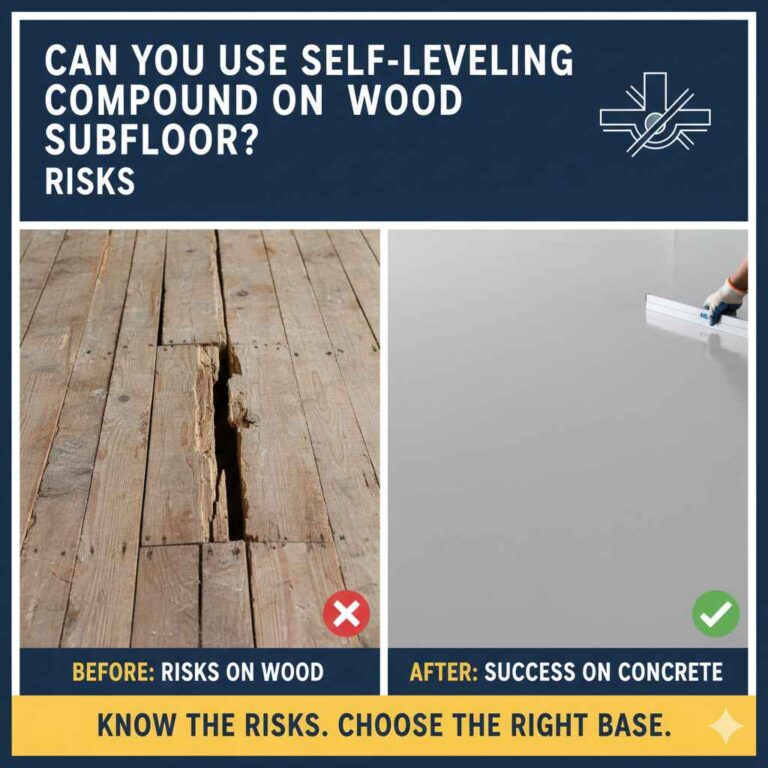
If the subfloor isn’t perfectly flat, it will need to be leveled. This can involve adding a self-leveling compound or sanding down high spots. Repairs for damaged subflooring, such as replacing sections of rotten wood, will also add to the cost.
- Leveling Costs: Self-leveling compound typically costs between $1 and $3 per square foot for the material. Labor for application can add another $1 to $3 per square foot.
- Repair Costs: Replacing damaged subfloor sections can cost $5 to $20 per square foot, depending on the extent of the damage and the cost of materials and labor.
The average cost for subfloor preparation can range from $0.50 to $3 per square foot. For a 200-square-foot room, this means an extra $100 to $600, which is a small price to pay for a stable and long-lasting floor.
Additional Costs to Consider
Beyond the main price of materials and labor, there are often other smaller costs that can add up. Thinking about these upfront can prevent surprises later in the project.
Underlayment
An underlayment is a layer installed between the subfloor and the flooring. It provides cushioning, sound insulation, and a moisture barrier, depending on the type. The cost varies but is usually between $0.25 and $1.50 per square foot.
- Types of Underlayment: Foam underlayment is common for laminate and engineered wood, offering sound dampening. Felt or rubber underlayments are used for specific applications. Some floors, like certain types of luxury vinyl plank, have an integrated underlayment.
- Benefits: A good underlayment can significantly improve the feel and sound of your floor, making it feel more solid underfoot and reducing the noise from footsteps.
For a 200-square-foot room, underlayment might cost between $50 and $300. This is a worthwhile investment for comfort and longevity.
Trim and Moldings
You’ll need new trim and moldings to finish the edges of your floor where it meets the walls. This includes baseboards, quarter-round, or transition strips for doorways and where different flooring types meet. These can cost from $2 to $10 per linear foot.
- Baseboards: These cover the gap between the floor and the wall, hiding the expansion space needed for wood flooring. They can be made of wood, MDF, or PVC.
- Transition Strips: These are used to create a smooth transition between different flooring materials (e.g., wood to tile) or to cover expansion gaps in doorways.
A room with 40 linear feet of wall perimeter would require about 40 feet of baseboard. If it costs $4 per linear foot, that’s an additional $160. Add transition strips, and the total could easily be $200 to $400.
Removal of Old Flooring
If you have existing flooring that needs to be removed, this will add to the cost. The price depends on the type of flooring being removed (carpet, tile, vinyl) and whether it can be disposed of easily.
- Carpet Removal: Often the least expensive, typically $0.50 to $1 per square foot.
- Tile or Linoleum Removal: Can be more labor-intensive and costly, ranging from $1.50 to $5 per square foot, especially if the adhesive is difficult to remove.
For a 200-square-foot room with old tile, removal could add $300 to $1,000 to your project cost, plus disposal fees which can range from $50 to $200.
Total Cost Breakdown Examples
Let’s put all these pieces together with some examples to give you a clearer picture of what you might expect to spend for installing wood flooring. These are estimates, and actual costs can vary.
Example 1 Budget-Friendly Installation
This scenario assumes a standard, rectangular room (e.g., a bedroom) and the use of a more affordable flooring option.
| Item | Estimated Cost Per Sq Ft | Total Cost (200 sq ft room) |
|---|---|---|
| Laminate Flooring Material | $2.00 | $400.00 |
| Underlayment (Basic Foam) | $0.30 | $60.00 |
| Installation Labor | $4.00 | $800.00 |
| Trim and Moldings | (Flat Fee) | $200.00 |
| Old Flooring Removal (Carpet) | $0.75 | $150.00 |
| Estimated Total | $1,610.00 |
In this example, for a 200-square-foot room, the total cost might be around $1,610. This is a good estimate for a budget-conscious renovation using laminate or a similar cost-effective material with professional installation. The cost per square foot is approximately $8.05 ($1610 / 200 sq ft).
Example 2 Mid-Range Installation
This example considers a moderate-sized room (e.g., a living room) with engineered hardwood and professional installation.
| Item | Estimated Cost Per Sq Ft | Total Cost (200 sq ft room) |
|---|---|---|
| Engineered Hardwood Material | $4.50 | $900.00 |
| Quality Underlayment | $0.75 | $150.00 |
| Installation Labor | $7.00 | $1,400.00 |
| Trim and Moldings | (Flat Fee) | $250.00 |
| Subfloor Prep (Minor Leveling) | $1.50 | $300.00 |
| Estimated Total | $3,000.00 |
For a 200-square-foot living room with engineered hardwood, the estimated total cost comes in around $3,000. This includes better quality materials, more comprehensive labor, and some necessary subfloor preparation. The cost per square foot is approximately $15 ($3000 / 200 sq ft).
Example 3 High-End Installation
This scenario is for a larger area or a room with more complex requirements, using premium solid hardwood.
| Item | Estimated Cost Per Sq Ft | Total Cost (400 sq ft room) |
|---|---|---|
| Solid Hardwood Material (Premium) | $8.00 | $3,200.00 |
| Advanced Underlayment | $1.00 | $400.00 |
| Installation Labor (Skilled) | $10.00 | $4,000.00 |
| High-Quality Trim and Moldings | (Flat Fee) | $400.00 |
| Subfloor Repair/Extensive Prep | $2.50 | $1,000.00 |
| Estimated Total | $9,000.00 |
For a larger 400-square-foot area featuring premium solid hardwood, the total cost can reach $9,000. This reflects the higher material expenses, specialized labor, and any necessary significant subfloor work. The cost per square foot is approximately $22.50 ($9000 / 400 sq ft).
Getting Accurate Quotes
To know exactly how much it will cost to install wood flooring in your home, getting specific quotes is the best approach. This ensures you have the most accurate pricing for your unique situation. Professionals will assess your space and provide a detailed breakdown.
What to Expect from a Quote
A good quote should be itemized, showing the cost of materials, labor, and any additional services like subfloor preparation or old flooring removal. It should clearly state the type and quantity of flooring being used, the per-square-foot labor rate, and the total estimated cost.
- Itemized Breakdown: A professional quote will list each component of the cost: flooring material, underlayment, installation labor, trim, removal of old flooring, and any necessary subfloor preparation. This transparency helps you understand where your money is going.
- Scope of Work: The quote should detail exactly what the installer will do, including the preparation steps, installation method, and clean-up. Be sure it covers moving furniture if needed and protection of your walls.
Many flooring companies offer free in-home consultations and quotes. This is a great opportunity to ask questions and get a feel for the company’s professionalism.
Comparing Quotes
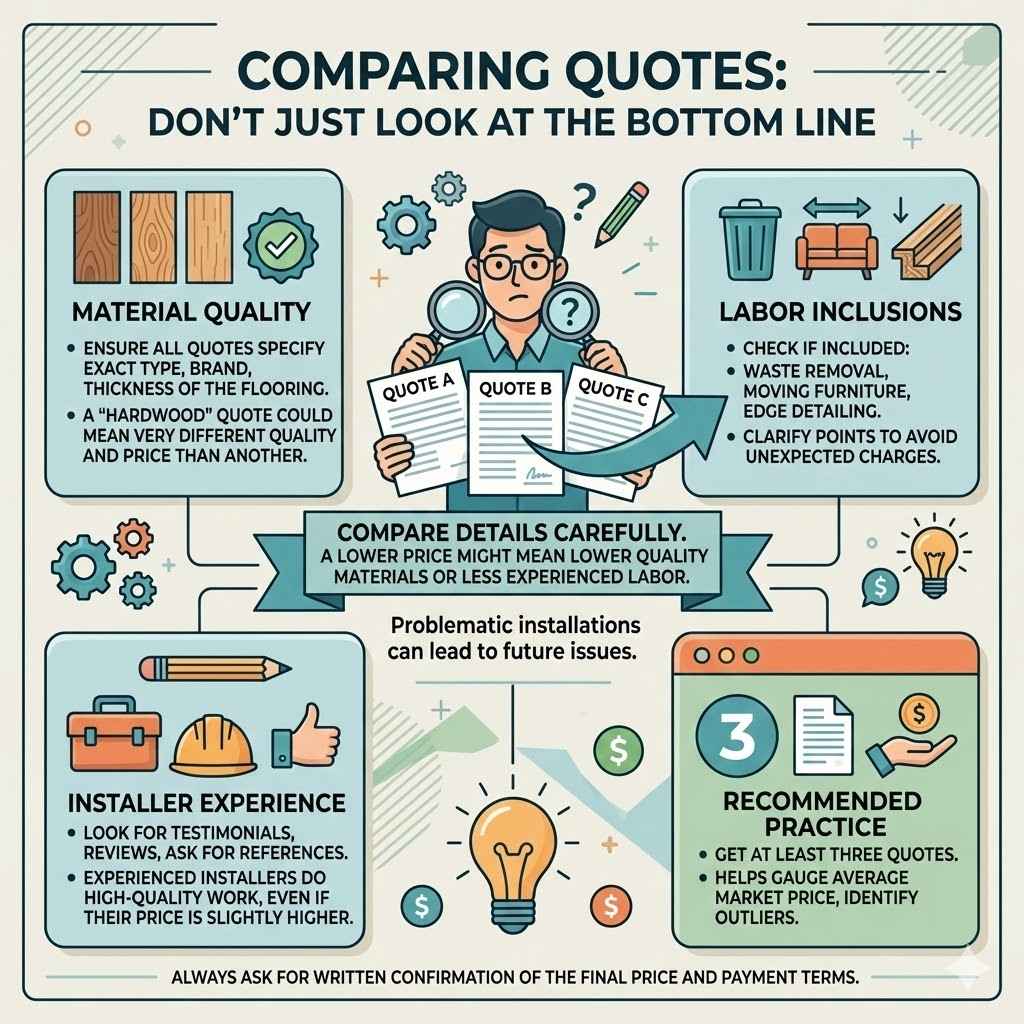
When you receive multiple quotes, don’t just look at the bottom line. Compare the details carefully. A lower price might mean lower quality materials or less experienced labor, which could lead to problems later.
- Material Quality: Ensure all quotes specify the exact type, brand, and thickness of the flooring. A “hardwood” quote could be for something very different in quality and price than another.
- Labor Inclusions: Check if waste removal, moving furniture, or edge detailing are included in the labor cost. Clarify these points to avoid unexpected charges.
- Installer Experience: Look for testimonials, reviews, or ask for references. Experienced installers are more likely to do a high-quality job, even if their price is slightly higher.
A good rule of thumb is to get at least three quotes. This helps you gauge the average market price for your project and identify any outliers. Always ask for written confirmation of the final price and payment terms.
Frequently Asked Questions
Question: Is it cheaper to install wood flooring yourself
Answer: It can be cheaper if you have the right tools and skills because you save on labor costs. However, mistakes can be costly, and professional installation often ensures a better, longer-lasting result.
Question: What is the most expensive type of wood flooring
Answer: Exotic hardwoods like Brazilian cherry, walnut, or teak tend to be the most expensive due to their rarity, durability, and unique aesthetic qualities.
Question: Does the cost of wood flooring include installation
Answer: No, typically the price you see for wood flooring is for the material only. Installation is a separate cost that can significantly increase the overall expense.
Question: How much extra flooring should I buy
Answer: It’s recommended to buy 10-15% more flooring than your room’s exact square footage to account for cuts, waste, and potential future repairs.
Question: Can I install wood flooring over existing tile
Answer: In some cases, yes, especially with engineered wood or laminate. However, the existing tile must be level, firmly adhered, and free from damage. Often, the tile will need to be removed for the best results.
Summary
The total cost to install wood flooring depends on many factors. These include the type of wood, room size, labor rates, and necessary subfloor prep. By understanding these elements and getting detailed quotes, you can accurately budget for your beautiful new floors.