How Much To Install 1000 Sq Ft Hardwood Flooring
Figuring out the cost of putting in hardwood floors can feel tricky, especially if you’re new to home projects. You might wonder, “How Much to Install 1000 Sq Ft Hardwood Flooring?” It’s a big question because prices can change a lot. But don’t worry!
We’ll break it down super simply, step by step. We’ll help you understand what goes into the cost so you can plan your budget with confidence. Let’s get started on making your home beautiful.
Understanding Hardwood Flooring Installation Costs
This section will guide you through the main factors that influence how much you’ll spend to install 1000 square feet of hardwood flooring. It’s not just about the wood itself; many other elements contribute to the final price. We will explore materials, labor, and other expenses you should consider.
This will give you a clear picture of the investment involved in transforming your home with beautiful hardwood.
Materials: The Cost of Hardwood Itself
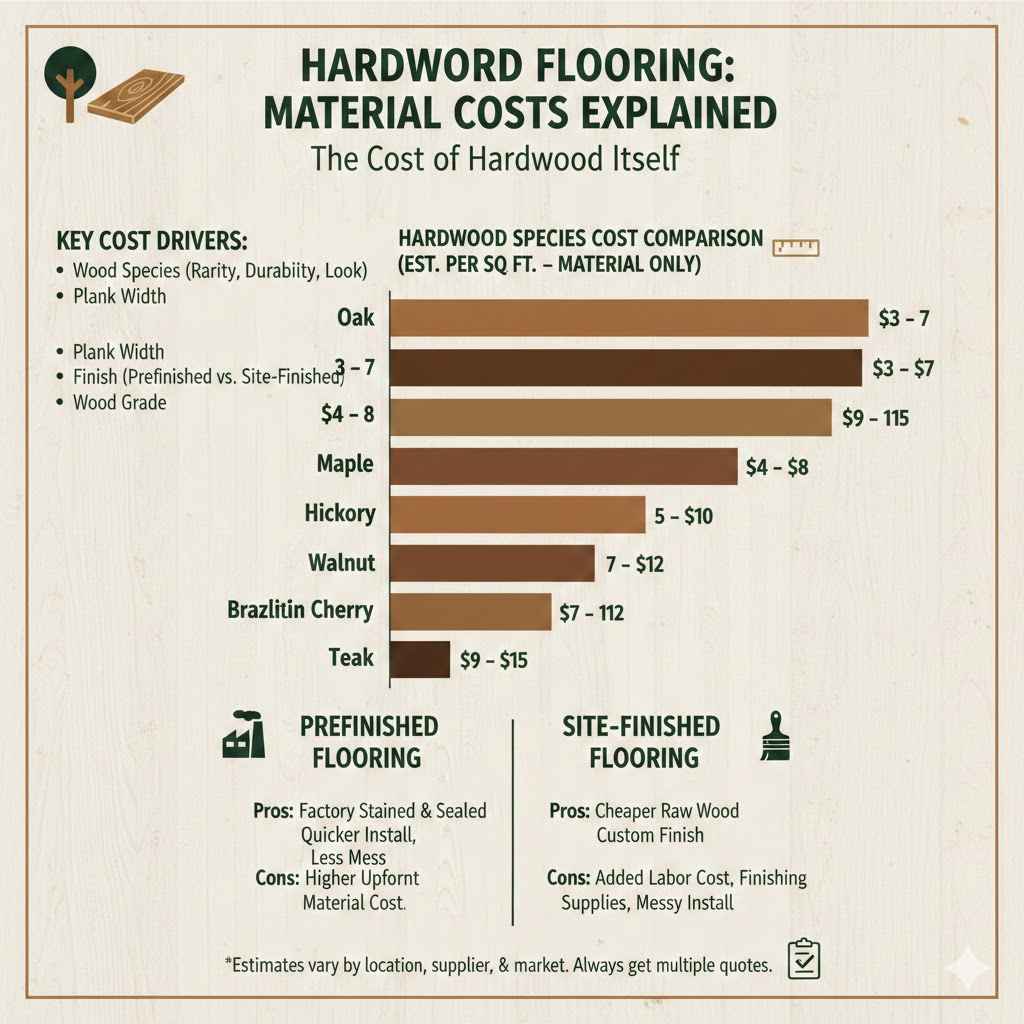
The type of hardwood you choose is a primary driver of cost. Different wood species have varying price tags due to their rarity, durability, and visual appeal. For instance, oak and maple are generally more affordable and widely available.
Exotic woods like Brazilian cherry or teak can be significantly more expensive. The width of the planks, the finish applied (prefinished or site-finished), and the grade of the wood also play a role in the overall material expense.
Prefinished flooring comes with the stain and sealant already applied in the factory. This often means a higher upfront material cost but can save on labor and the mess associated with site finishing. Site-finished flooring is installed raw, and then sanded, stained, and sealed in your home.
While the raw wood might be cheaper, the added labor and finishing supplies increase the total cost.
Hardwood Species Cost Comparison (Estimate Per Square Foot)
| Wood Species | Estimated Cost (Material Only) |
|---|---|
| Oak (Red or White) | $3 – $7 |
| Maple | $3 – $7 |
| Hickory | $4 – $8 |
| Walnut | $5 – $10 |
| Brazilian Cherry | $7 – $12 |
| Teak | $9 – $15 |
These prices are just estimates and can vary based on your location, the supplier, and current market conditions. It’s always wise to get several quotes from different lumber yards.
Plank Width and Thickness
Standard plank widths typically range from 2.25 inches to 3.25 inches. Wider planks, such as 5 inches or more, are often considered more premium and can carry a higher price tag. Similarly, the thickness of the hardwood can vary, with ¾-inch being a common and durable standard.
Thicker planks may offer more longevity but also come at a greater cost. The visual impact of wider planks can justify the additional expense for some homeowners seeking a specific aesthetic.
Grade of Wood
Hardwood is graded based on its appearance, such as the number of knots, streaks, and color variations. Common grades include Clear, Select, #1 Common, and #2 Common. Clear and Select grades have fewer imperfections and a more uniform look, making them the most expensive.
1 and 2 Common grades have more natural character and are typically more budget-friendly. Choosing a lower grade can significantly reduce the material cost for your 1000 sq ft project.
Labor Costs: The Installation Process
Labor is a substantial portion of the total cost when you consider how much to install 1000 sq ft of hardwood flooring. The average cost of installation can range from $5 to $15 per square foot, but this figure can fluctuate based on your geographic location, the complexity of the installation, and the installer’s experience. Professional installers ensure the flooring is laid correctly, which is vital for its longevity and appearance.
The installation method also impacts labor costs. Traditional nail-down installations, where planks are fastened to a wooden subfloor, are common and usually fall within the standard labor rates. However, if your subfloor needs repair or replacement, or if you are installing over concrete, this can add to the labor expense.
Glue-down installations, often used over concrete, might have different pricing structures.
The installer’s skill and reputation matter. Highly experienced professionals might charge more, but their expertise can prevent costly mistakes and ensure a superior finish. It’s recommended to get multiple quotes from different flooring contractors.
Ask for references and check their reviews to ensure you’re hiring someone reliable and skilled.
Subfloor Preparation
A crucial but often overlooked aspect of labor costs is subfloor preparation. The existing subfloor must be level, clean, and dry for hardwood to be installed properly. If the subfloor is uneven, it will need to be sanded down or have leveling compounds applied, adding to the labor time and cost.
If the subfloor is damaged or old, it might need to be replaced entirely, which is a significant additional expense.
For example, if you have an old house with uneven plywood subflooring, a contractor might need to spend several hours leveling it before laying the hardwood. This extra time directly translates into higher labor charges. In some cases, especially with concrete subfloors, a special underlayment or moisture barrier might be required, adding to both material and labor costs.
Installation Method
The way hardwood is installed affects the labor involved.
- Nail-down: This is the most traditional method for solid hardwood floors installed over a wood subfloor. The installer uses a special flooring nailer to drive nails through the tongue of the plank into the subfloor. This method is secure and provides a solid feel underfoot. The labor is typically straightforward.
- Glue-down: This method is often used for engineered hardwood flooring or when installing over concrete. A specialized adhesive is spread onto the subfloor, and the planks are then pressed into it. This can be more time-consuming for the installer as they must ensure proper adhesion without excess glue oozing up.
- Floating floor: With this method, planks are joined together but not attached to the subfloor. They can expand and contract as a single unit. This is common for engineered hardwood and laminate flooring. It can sometimes be faster to install but requires a good underlayment.
The specific method chosen will influence the installer’s time and the tools they need, directly impacting the labor quote.
Additional Costs to Consider
Beyond the wood and installation labor, several other expenses can add up. These are often essential for a finished and professional look. Ignoring these can lead to budget surprises when you’re figuring out how much to install 1000 sq ft of hardwood flooring.
Underlayment
An underlayment is a layer placed between the subfloor and the hardwood. It serves multiple purposes, including moisture protection, sound dampening, and adding a cushion for comfort. Different types of underlayment exist, such as foam, felt, or cork.
The cost of underlayment typically ranges from $0.20 to $1.00 per square foot. For 1000 sq ft, this could add $200 to $1000 to your project cost.
A high-quality underlayment is especially important if you’re installing hardwood over a basement or on a second story, where sound transmission can be a concern. It also helps protect the hardwood from moisture that might seep up from below, particularly over concrete slabs. Choosing the right underlayment based on your specific situation is key to the long-term performance of your floors.
Trim and Molding
New baseboards, quarter-round, or shoe molding are often needed to finish the edges of the room where the hardwood meets the walls. If you’re replacing old trim, you’ll need to factor in the cost of new materials and the labor to install them. Simple wooden trim can range from $1 to $5 per linear foot, depending on the material and style.
For a 1000 sq ft room, this could mean hundreds of dollars for trim alone.
This is also where the aesthetic of your home comes into play. Some homeowners opt for more decorative or custom-molded trim to complement their new hardwood floors, which will naturally increase the cost. The installer will also need to cut and fit these pieces precisely, adding to the labor time.
Removal of Old Flooring
If you have existing flooring that needs to be removed, this is an additional cost. Carpet removal is typically less expensive than removing tile or old hardwood. The price can range from $0.50 to $2.00 per square foot, depending on the type of flooring and whether disposal fees are included.
For 1000 sq ft, this could add $500 to $2000.
Consider also what lies beneath the old flooring. If you’re tearing out carpet and find damaged subflooring, that cost will be added to the subfloor preparation phase discussed earlier. It’s wise to budget for potential surprises when removing old materials.
Stairs and Transitions
Installing hardwood on stairs is significantly more labor-intensive and costly than on a flat surface. Each step requires careful cutting and fitting of planks, and stair nosing (the protective edge of the step) needs to be installed. This can add $50 to $150 per step.
Transitions between different flooring types in adjoining rooms also require specialized molding and careful installation, adding to the overall project cost.
How Much to Install 1000 Sq Ft Hardwood Flooring A Detailed Breakdown
Let’s put all these pieces together to get a realistic idea of the cost. When asking how much to install 1000 sq ft of hardwood flooring, we are looking at a range that accounts for various choices. A basic installation with common wood species and standard labor could be on the lower end.
A more premium wood, complex installation, and higher labor rates will push the cost upwards. Understanding this range helps in budgeting and making informed decisions about your flooring project.
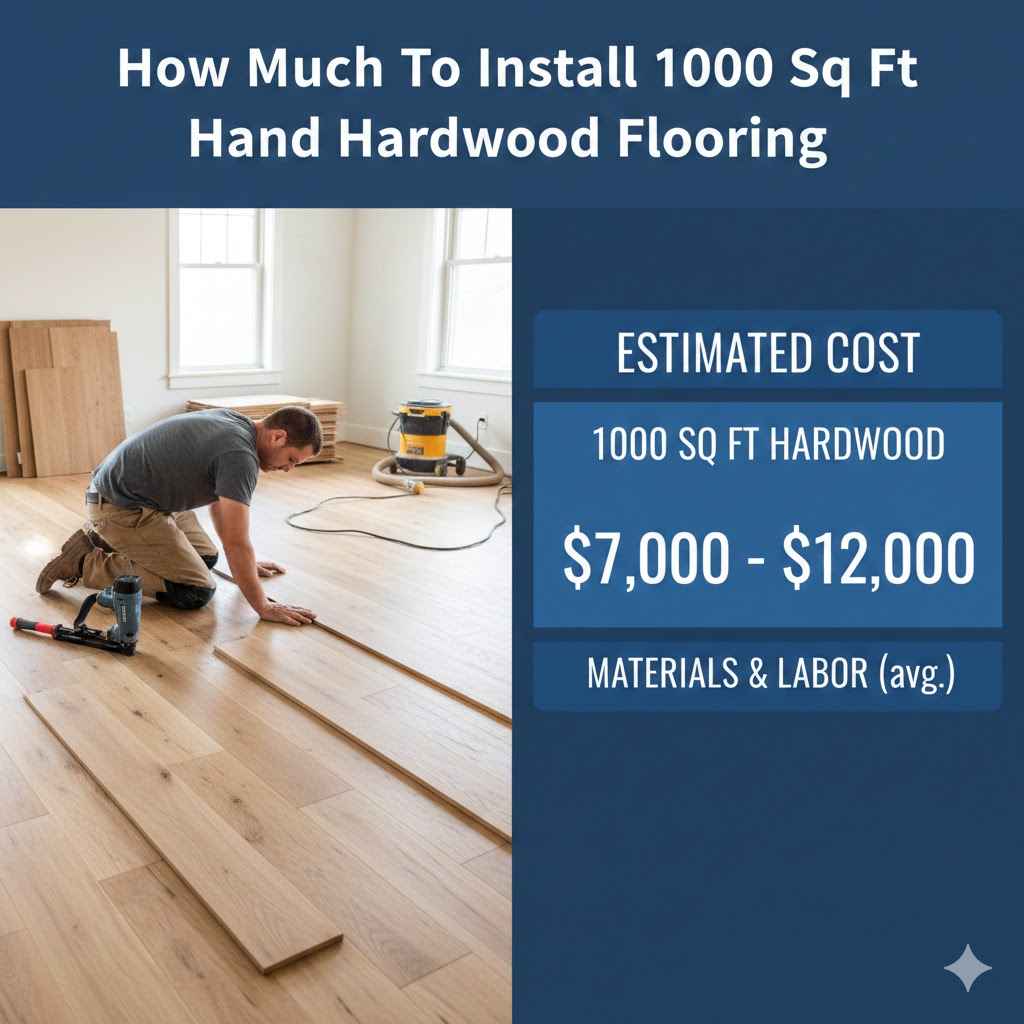
The price per square foot for installed hardwood flooring generally falls between $7 and $20. For 1000 square feet, this translates to a total project cost ranging from $7,000 to $20,000. This wide range reflects the many variables we’ve discussed, from the type of wood to the contractor’s fees.
A significant portion of this cost is labor, which can be 50-70% of the total. Material costs, including the hardwood itself, underlayment, and finishes, make up the remaining 30-50%. It’s essential to get itemized quotes from contractors to see exactly where your money is going.
Estimating Your Total Project Cost
To estimate your total project cost, you need to consider the specific choices you will make. Start by selecting your preferred hardwood species and understanding its material cost per square foot. Then, find out the average labor cost for installation in your area.
Add in the cost of underlayment, trim, and any necessary subfloor preparation or old flooring removal.
Let’s say you choose red oak, which costs about $5 per square foot for the material. For 1000 sq ft, that’s $5,000 for the wood. If labor is $7 per square foot, that’s another $7,000.
Add $500 for underlayment and $1,000 for trim and installation of those. If there’s no old flooring to remove and no major subfloor issues, your estimated total could be around $13,500.
Alternatively, if you opt for a more expensive wood like Brazilian cherry at $10 per square foot ($10,000 for material) and labor costs $10 per square foot ($10,000 for labor), plus $1,000 for underlayment, $1,500 for trim, and $1,000 for minor subfloor work, your total could reach $23,500. This illustrates the significant impact of material and labor choices.
Sample Scenario 1: Budget-Friendly Installation
Imagine you want to install 1000 sq ft of hardwood flooring on a budget. You choose a common domestic hardwood like red oak, which is known for its durability and attractive grain. You find a good deal on prefinished oak planks for $4 per square foot.
This totals $4,000 for materials.
For installation, you get quotes from local contractors and find one who charges $5 per square foot for labor. For 1000 sq ft, this is $5,000. You opt for a basic foam underlayment that costs $0.30 per square foot, adding $300.
You also plan to reuse your existing baseboards and have simple transitions. Assuming your subfloor is in good condition and you’re not removing old flooring, your estimated total cost would be:
- Hardwood Material: $4,000
- Installation Labor: $5,000
- Underlayment: $300
- Total: $9,300
This scenario represents a more affordable way to achieve beautiful hardwood floors, focusing on cost-effective material choices and straightforward labor.
Sample Scenario 2: Mid-Range Installation
For a mid-range installation, you might choose a slightly more premium wood species or a wider plank. Let’s consider hickory, a durable and attractive wood, costing $6 per square foot for material. For 1000 sq ft, this is $6,000.
You decide on a contractor who charges $7 per square foot for labor, totaling $7,000.
You opt for a higher-quality underlayment with better sound dampening and moisture resistance, costing $0.70 per square foot, which adds $700. You also decide to
- Hardwood Material (Hickory): $6,000
- Installation Labor: $7,000
- Premium Underlayment: $700
- New Baseboards: $1,200
- Carpet Removal: $800
- Total: $15,700
This mid-range option offers a good balance of quality materials and professional installation without reaching the highest price points.
Sample Scenario 3: High-End Installation
For a high-end installation, you might select an exotic hardwood like Brazilian cherry, or a premium grade of domestic wood with a custom finish. Let’s use Brazilian cherry at $9 per square foot for material, totaling $9,000 for 1000 sq ft. You hire a highly reputable installer known for their fine craftsmanship, who charges $12 per square foot for labor, amounting to $12,000.
You choose a top-tier underlayment for superior comfort and acoustic performance at $1.00 per square foot, adding $1,000. You also decide on custom-profile hardwood trim and intricate stair nosing. This could add $3,000 or more.
If you have old tile that needs to be removed, this could cost $2.00 per square foot, adding $2,000. You might also need professional subfloor leveling, adding another $1,000.
- Hardwood Material (Exotic): $9,000
- Installation Labor (High-End): $12,000
- Premium Underlayment: $1,000
- Custom Trim & Stairs: $3,000
- Tile Removal: $2,000
- Subfloor Leveling: $1,000
- Total: $28,000
This high-end scenario reflects the costs associated with premium materials, specialized labor, and intricate details, resulting in a luxurious finished product.
Factors Influencing Price Variations
The price you pay for installing 1000 sq ft of hardwood flooring is not fixed. Many factors can cause these prices to vary significantly. Understanding these elements helps you anticipate costs and make informed decisions for your specific project.
It’s like shopping for a car; the base model is one price, but adding features increases it.
Geographic Location
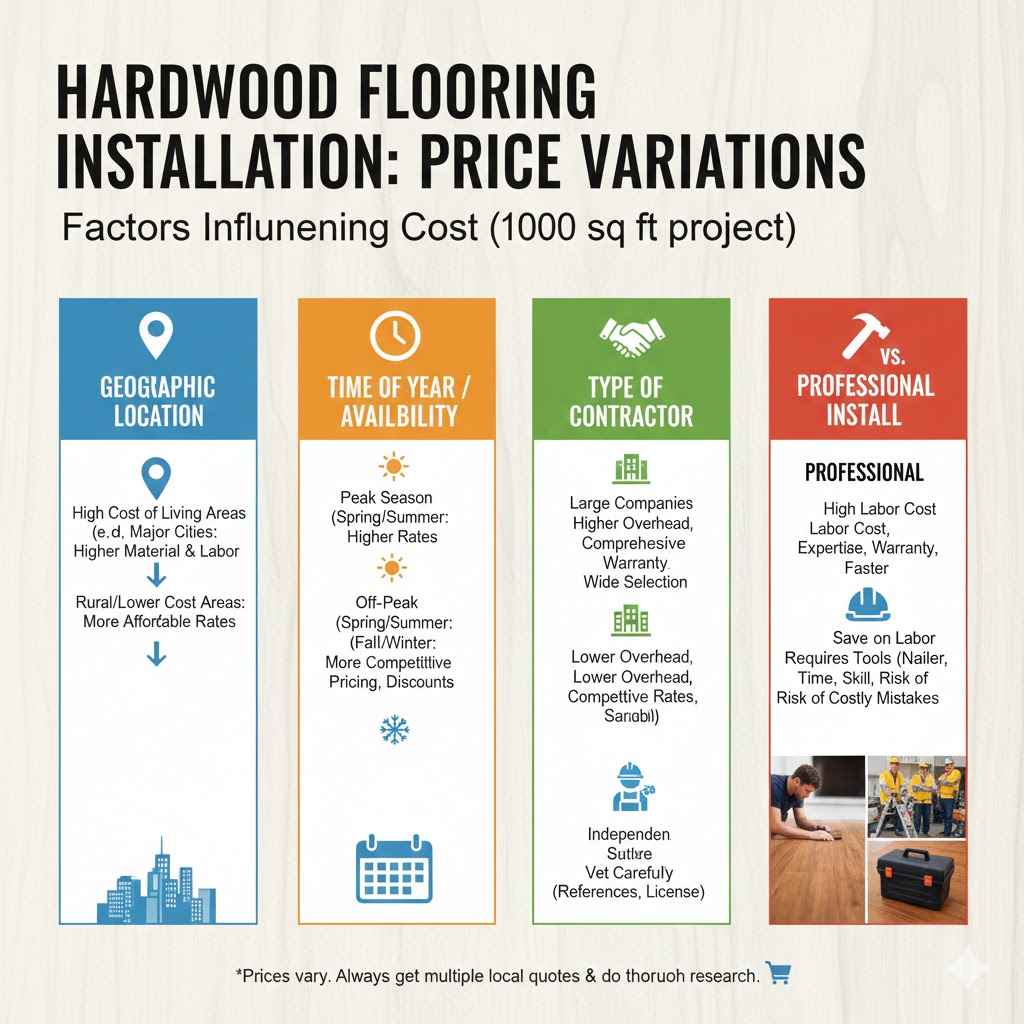
Where you live plays a big role in pricing. In major metropolitan areas or regions with a high cost of living, you’ll likely pay more for both materials and labor. Contractors in these areas have higher overhead costs, which they pass on to consumers.
Conversely, in more rural areas or regions with a lower cost of living, you might find more affordable rates.
For instance, hardwood installation costs in California might be considerably higher than in the Midwest. This is not just about labor; material suppliers may also have different pricing structures based on regional demand and distribution costs. It’s always best to get local quotes to understand the pricing in your specific area.
Time of Year and Contractor Availability
Contractor availability can also influence prices. During peak seasons for home renovations (often spring and summer), contractors are in high demand. This can lead to higher labor rates or longer wait times.
If you can schedule your project during an off-peak season, you might be able to secure more competitive pricing or quicker service.
Some contractors might offer slight discounts to fill their schedules during slower months. Planning your project in advance, perhaps in the fall or winter, could lead to cost savings. It also gives you more time to research and vet contractors thoroughly.
Type of Contractor (Large Company vs. Independent Installer)
The type of contractor you choose can affect the price. Large flooring companies often have higher overhead costs (office space, staff, marketing) which can translate into higher prices. However, they may offer more comprehensive warranties and a wider selection of products.
Independent installers or small crews might offer more competitive rates as their overhead is typically lower.
When working with independent installers, it’s crucial to do thorough due diligence. Check their references, licenses, and insurance to ensure they are reputable and reliable. A slightly higher price from a well-established company might offer greater peace of mind for some homeowners.
DIY vs. Professional Installation
This is perhaps the biggest cost differentiator. While professional installation is part of the “how much to install 1000 sq ft hardwood flooring” equation, doing it yourself can save a significant amount on labor. However, DIY installation requires specialized tools, considerable time, effort, and a certain level of skill.
Mistakes made during a DIY installation can be costly to fix.
Tools like a flooring nailer, miter saw, flooring stapler, and various hand tools can be rented or purchased, adding to the initial expense. The learning curve can be steep, and the process is physically demanding. For a 1000 sq ft project, the time commitment alone can be substantial, potentially taking weeks for an inexperienced DIYer.
Frequently Asked Questions
Question: What is the average cost to install 1000 sq ft of hardwood flooring
Answer: The average cost to install 1000 sq ft of hardwood flooring typically ranges from $7,000 to $20,000. This includes materials like the wood itself, underlayment, and labor for installation. The final price depends heavily on the type of wood, the installer’s rates, and any additional services needed.
Question: Does the type of hardwood significantly impact the price
Answer: Yes, the type of hardwood significantly impacts the price. Common domestic woods like oak and maple are generally more affordable than exotic hardwoods such as Brazilian cherry or teak. The grade of the wood and the width of the planks also affect the material cost.
Question: How much does labor typically cost for installing 1000 sq ft of hardwood
Answer: Labor costs for installing 1000 sq ft of hardwood usually range from $5 to $15 per square foot. This means for 1000 sq ft, labor alone could cost between $5,000 and $15,000. This rate can vary by region and the complexity of the installation.
Answer: Yes, potential hidden costs include subfloor preparation or repair, removal of old flooring, new trim and molding, stair installation, and the purchase or rental of specialized tools if doing a DIY installation. It’s important to factor these into your budget.
Question: Can I save money by choosing prefinished hardwood
Answer: Prefinished hardwood might have a higher material cost upfront compared to unfinished wood. However, it can save on labor costs associated with sanding, staining, and sealing in your home. The total cost can be comparable or even less than site-finished hardwood, especially if you account for the time and mess of finishing on-site.
Conclusion
Understanding how much to install 1000 sq ft of hardwood flooring involves looking at material choices, labor rates, and other essential costs. You now have a clear view of the factors that determine your project’s budget. You can confidently plan for beautiful new hardwood floors.