How to Fix Mattress Indentation: Quick Repair Steps
If the dip is relatively shallow and springs back after time off the bed, fix the support first; if it’s deeper, lumpy, or one-sided, consider a warranty claim or replacement. Leave it alone and you’ll keep sleeping crooked, loading the frame unevenly, and shortening the mattress’s life. This guide shows how to tell temporary compression from a support failure, then gives the fastest fixes and the point where repair stops making sense.
What kind of mattress dip are you dealing with?
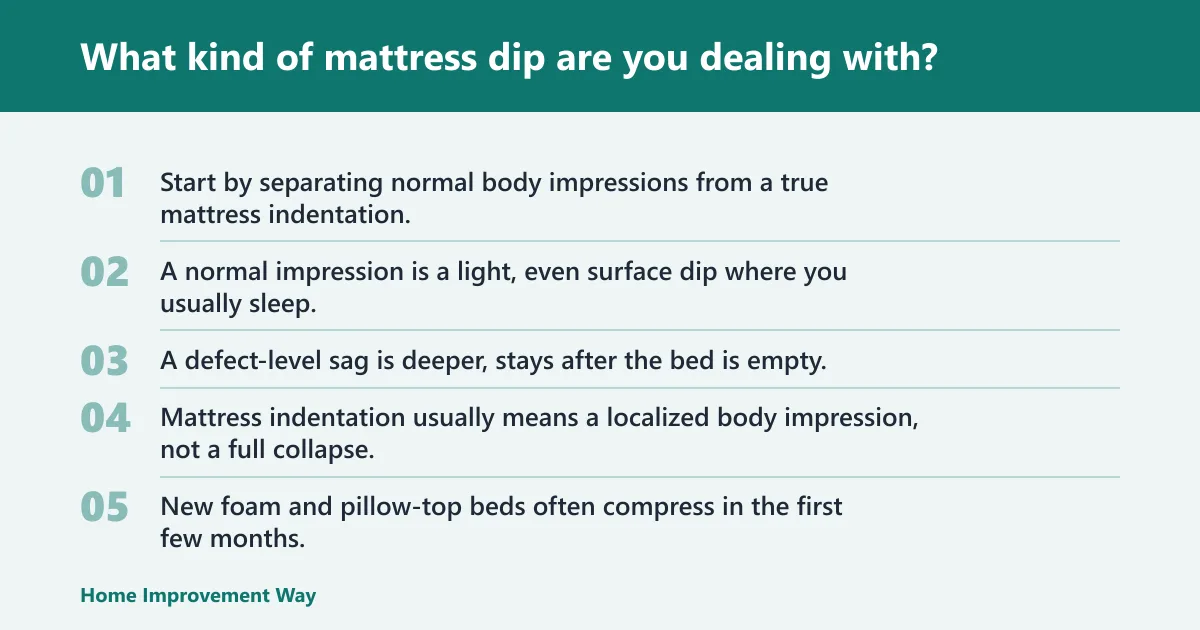


Start by separating normal body impressions from a true mattress indentation. A normal impression is a light, even surface dip where you usually sleep, and it should feel more like soft compression than a trench. A defect-level sag is deeper, stays after the bed is empty, and often points to worn coils, failing foam, or a bad support setup.
Normal body impressions versus a true indentation
Mattress indentation usually means a localized body impression, not a full collapse. New foam and pillow-top beds often compress in the first few months, especially in common pressure areas. That is different from a sharp dip, a hump beside the low spot, or a body impression that keeps getting deeper after rotation.
Natural wear and tear can create a softer sleep surface over time. The problem is when that softening turns into a dip that pulls your spine out of line or leaves you rolling to the middle. That is a support issue, not just comfort loss.
How mattress type changes what counts as wear
Foam, hybrid, innerspring, and pillow-top mattresses fail in different ways. Foam beds can compress where weight sits most. Hybrids may sag when the comfort layer breaks down over the coils. Innersprings often show worn-out coils or a weak center section. Pillow-top beds can trap lumps inside the loose comfort layer, which makes the surface look worse than the core actually is.
If the dip is more pronounced on one side, if the bed tilts toward the middle, or if the same low spot returns after a rotation, inspect the base. Bowed slats, a broken center rail, missing center support, or a mismatched frame can make a good mattress look worn out. A firm base helps carry body weight and slow sagging.
📊 A 180-degree rotation can give the mattress a new start. Source: The Best Ways to Fix Mattress Indentations and Sagging.
Use this 4-step decision checklist before you try a fix

This checklist keeps the repair choice tied to the mattress, the dip, and the base. It also helps separate a temporary compression problem from a mattress that is already beyond useful repair. If the answer points to structural failure or a claimable defect, stop treating it as a surface issue.
- Identify the mattress type. Check whether it is foam, hybrid, innerspring, pillow-top, or flippable. That decides whether rotation, flipping, or only a temporary surface fix makes sense.
- Judge the dip depth and spread. A shallow, broad impression behaves differently from a narrow crater. A deeper or sharply localized dip is more likely to be a support failure or material breakdown.
- Inspect the foundation or frame. Look for bowed slats, missing center support, loose feet, a warped platform, or an uneven surface. Plywood or a new base can help only when the current support is the weak point.
- Check warranty age and claim limits. If the mattress is still within the coverage window, gather photos, measurements, purchase details, and a note on the foundation used. Warranty terms usually care about age, depth, and proper support conditions.
| What you find | Most likely issue | Best next move |
|---|---|---|
| Light impression that rebounds after rest | Normal compression | Rotate, improve support, monitor |
| Dip follows one sleeper and stays shallow | Wear in the comfort layers | Try rotation and a topper |
| Dip returns after rotation, base looks uneven | Foundation failure | Repair or replace the frame or base |
| Deep, persistent sag in warranty period | Possible defect-level sag | Document and file a claim |

How do I fix a mattress indentation fast?

The fastest fix is to start with the support system, then move to the surface. Rotate the mattress 180 degrees if the model allows it, correct any frame or slat issue, and use a topper only as a temporary smoothing layer. That sequence can reduce the dip quickly without hiding a real failure.
Rotate the mattress 180 degrees
Turn the mattress head-to-foot 180 degrees so the worn zone moves away from the heaviest loading area. I’ve done this many times on beds that started to form a soft spot at the shoulders or hips. Rotate the mattress about once every six months to help prevent indentations. This works best before the dip becomes deep or permanent.
Flip only if the mattress is designed for it
Does flipping a mattress help with sagging? Only for flippable models. A true two-sided mattress can help redistribute wear by turning the whole build over. Many one-sided beds are not made for flipping, and forcing them can damage the comfort layers or leave the sleep surface wrong-side-up and unusable.
Add a topper for a temporary surface fix
A mattress topper can add support and extend mattress lifespan, but it does not rebuild the core. It is best for softening a shallow dip or smoothing a pressure point while you sort out the real cause. Many add-ons use elastic bands at the corners to keep them in place.
Reset the support system under the bed
If the base is the weak link, no surface fix will hold. Tighten the frame, replace broken slats, add center support, or move the mattress to a sturdy flat foundation. Poor support can make sagging worse over time, even on a new mattress.
Can rotating a mattress fix a dent?
Rotation can reduce a mild dent when the issue is uneven wear, but it will not repair broken coils or crushed foam. A 180-degree turn can buy time on a mattress with light body impressions. If the same dip returns quickly, the problem is deeper than wear pattern alone.
When rotation helps and when it will not
Rotation helps when the dip is shallow and the mattress still has recovery. It will not help much if the comfort layers have collapsed, if the core is warped, or if the base is uneven. That is why repeat sag after rotation usually points to a support failure or a mattress at the end of its useful life.
How often to rotate to prevent repeat wear
Rotate the mattress about once every six months to help prevent indentations. That timing spreads body weight more evenly and can slow pressure-point wear. If the bed is new, heavy, or used by one sleeper most nights, staying on schedule matters even more.
Why pillow-top and one-sided beds behave differently
Pillow-top mattress models have a loose comfort layer that can trap lumps and shift under load. A quick vacuuming can sometimes redistribute filling and smooth lumps, but only when the issue is surface clustering rather than a broken core. One-sided beds usually need rotation, not flipping.
What can I put under a mattress to support a dip?
A plywood board can help when the mattress is fine but the base is weak. It creates firmer, flatter support under the bed and may reduce a shallow dip. If the mattress itself has lost structure, though, under-bed support only changes how the failure feels, not whether the failure exists.
When a plywood board is worth trying
Plywood can be used to reinforce the mattress foundation or frame, especially when slats are too far apart or a platform flexes in the middle. It is a temporary support fix, not a repair to the mattress. It makes the most sense when the dip shows up because the base is too soft or uneven.
When plywood is a bad idea
Some foam mattresses should not sit on a very hard or unsupported base without checking manufacturer guidance. A solid sheet under the mattress can trap moisture, change airflow, or make an already firm bed feel harsher. If the mattress was designed for flexible slats, the wrong board can create a new problem.
Signs the frame or slats are the weak point
If the indentation is most obvious in the middle, the frame is worth checking first. Look for bowed slats, a broken center rail, loose fasteners, or a platform that rocks. If the mattress seems fine off the bed but sags once placed on the frame, the support system is the main issue.
Will a mattress topper hide sagging?
A mattress topper can hide a shallow dip and make the surface feel more even, but it does not fix lost support underneath. A mattress pad is thinner and usually offers less structural support, with more light cushioning. Use either as a comfort aid, not as proof the mattress has been repaired.
What a topper can smooth out
Mattress toppers are used both to soften a pressure point and to slow the feel of wear. They can soften a pressure point, disguise a mild body impression, and add some support where the surface feels tired. Memory foam or padded variants are common choices when the goal is contouring rather than firmness.
How a mattress pad differs from a topper
A mattress pad is a thin cushioning layer. It can improve comfort and contouring, but it will not meaningfully change a sagging core or a bowed base. If the dip is structural, a pad may make the bed feel nicer for a night and do very little after that.
Why toppers do not repair lost support
If the mattress has worn-out coils or crushed foam, the topper sits on top of the problem. That can slow the feeling of the dip, but the spine still drops into the same low zone. When the body sinks through the topper and into the sag, replacement or warranty action makes more sense.
When is a mattress indentation too deep to repair?
An indentation is too deep to keep patching when it stays visible after rest, keeps returning after rotation, or throws off alignment in a way a topper cannot mask. Deep, recurring sag points to structural loss. At that stage, replacement is usually smarter than stacking temporary fixes.
Depth, age, and repeat sagging as replacement clues
If the dip is deep enough that one side of the body settles lower than the other, the mattress has moved past a simple maintenance problem. Age matters too. Once the same spot keeps collapsing after every attempt to redistribute weight, the comfort layers are likely spent.
When a warranty claim makes more sense than another fix
Is an indentation covered under the mattress warranty? Sometimes, but not always. Coverage usually depends on depth, age, and whether the mattress was supported correctly. Before filing, gather photos, a straightedge or measurement of the dip, purchase records, and proof of the frame or foundation used.
What to document before filing a claim
Take pictures in daylight, including the whole mattress and the low spot. Record where the dip is located, how long it has been visible, and whether rotation changed anything. If the frame has center support or slat issues, document those too. A poor foundation can sometimes affect a claim.
Frequently asked questions
How do I fix a mattress indentation fast?
For a fast fix, rotate the mattress 180 degrees, check the frame, and add a topper only if the dip is shallow. If the mattress is flippable, flipping can help redistribute weight. If the dip is deep, lumpy, or returns quickly, the mattress may need replacement or a warranty claim.
Can rotating a mattress fix a dent?
Rotation can help with mild dents caused by uneven loading, especially when done about once every six months. It will not repair broken coils, collapsed foam, or a damaged base. If the same low spot comes back after rotation, the mattress or foundation has a larger problem.
Will a mattress topper hide sagging?
A topper can hide a shallow sag and improve comfort, especially on a mattress with light body impressions. It is not a structural repair. If the core is failing, the topper only masks the feel for a while and the dip will still come through under body weight.
What can I put under a mattress to support a dip?
A plywood board can help when the frame or slats are too soft or uneven, and a sturdier foundation may be the better long-term fix. Check for bowed slats, missing center support, or a warped platform first. If the mattress itself is failing, under-bed support will not solve it.
When is a mattress indentation too deep to repair?
A dent is usually too deep to keep repairing when it remains obvious after rest, keeps returning after rotation, or makes sleep alignment feel off even with a topper. Deep recurring sag means the support layers are gone. At that point, replacement is often the most practical choice.
Is an indentation covered under the mattress warranty?
It might be, if the dip meets the brand’s terms and the mattress was used on a proper foundation. Warranty decisions often depend on depth, age, and support conditions. Measure the sag, photograph it, and confirm the frame is compliant before filing, or the claim can be denied.
Sponsored / affiliate links. As an Amazon Associate I earn from qualifying purchases. I may earn additional commission from eligible campaigns.