How Wooden Roller Coasters Stay Safely on Track
Ever wondered how those classic wooden roller coasters keep riders safe while still giving them an amazing thrill? It might seem tricky to figure out, especially if you’re new to how these old-school rides work. But don’t worry!
It’s actually simpler than you think. We’ll walk you through everything step-by-step. Get ready to learn the secrets behind How Wooden Roller Coasters Stay Safely on Track.
The Ingenious Engineering of Wooden Roller Coasters
Wooden roller coasters are marvels of engineering, relying on fundamental physics and clever design to provide thrilling rides while ensuring guest safety. Unlike their modern steel counterparts that often feature loops and inversions, wooden coasters focus on airtime hills, sharp turns, and unique layouts. Their construction demands a deep understanding of gravity, momentum, and friction.
The very material, wood, presents unique challenges and advantages that designers must consider carefully. These iconic structures have delighted park-goers for decades, and their continued operation is a testament to the brilliance of their original creators and the ongoing maintenance they receive.
The Essential Role of Track Design
The track is the heart of any roller coaster, and for wooden coasters, its design is both an art and a science. Unlike steel tracks which are often computer-modeled with incredible precision for complex shapes, wooden tracks are built with lumber, typically laminated wood for strength. The track itself is a double-rail system, with one rail for the wheels to roll on and another lower or side rail for safety wheels.
This dual-rail system is fundamental to keeping the train on course through turns and over hills. The radius of curves and the height of hills are calculated to manage the forces acting on the train and its passengers. Too sharp a turn or too steep a drop without proper design can lead to excessive forces that could be unsafe.
- Precision Woodworking: The wooden planks that form the riding surface and the side rails are shaped and attached with great care. These are not just random pieces of wood; they are precisely cut and angled to guide the train smoothly. Carpenters and engineers work together to ensure every piece fits perfectly. This precision prevents jarring movements and helps the train stay centered on its path.
- The Banked Turn Principle: Turns on wooden coasters are often banked, meaning the outside of the turn is higher than the inside. This banking helps counteract the centrifugal force that tries to push the train outward. By leaning the track, a portion of this outward force is redirected downwards into the track, helping to keep the train pressed against the rails rather than wanting to fly off. The angle of the bank is crucial and depends on the speed the train is expected to enter the turn.
- Airtime Hills and Gravity: Wooden coasters are famous for their airtime hills, where the track dips and then rises sharply. As the train crests the hill, gravity pulls the train down while inertia tries to keep it moving forward. This combination can lift riders out of their seats, creating the sensation of weightlessness or “airtime.” The shape of these hills is carefully sculpted to provide enjoyable airtime without ejecting passengers from their seats.
The Science of Wheels and Friction
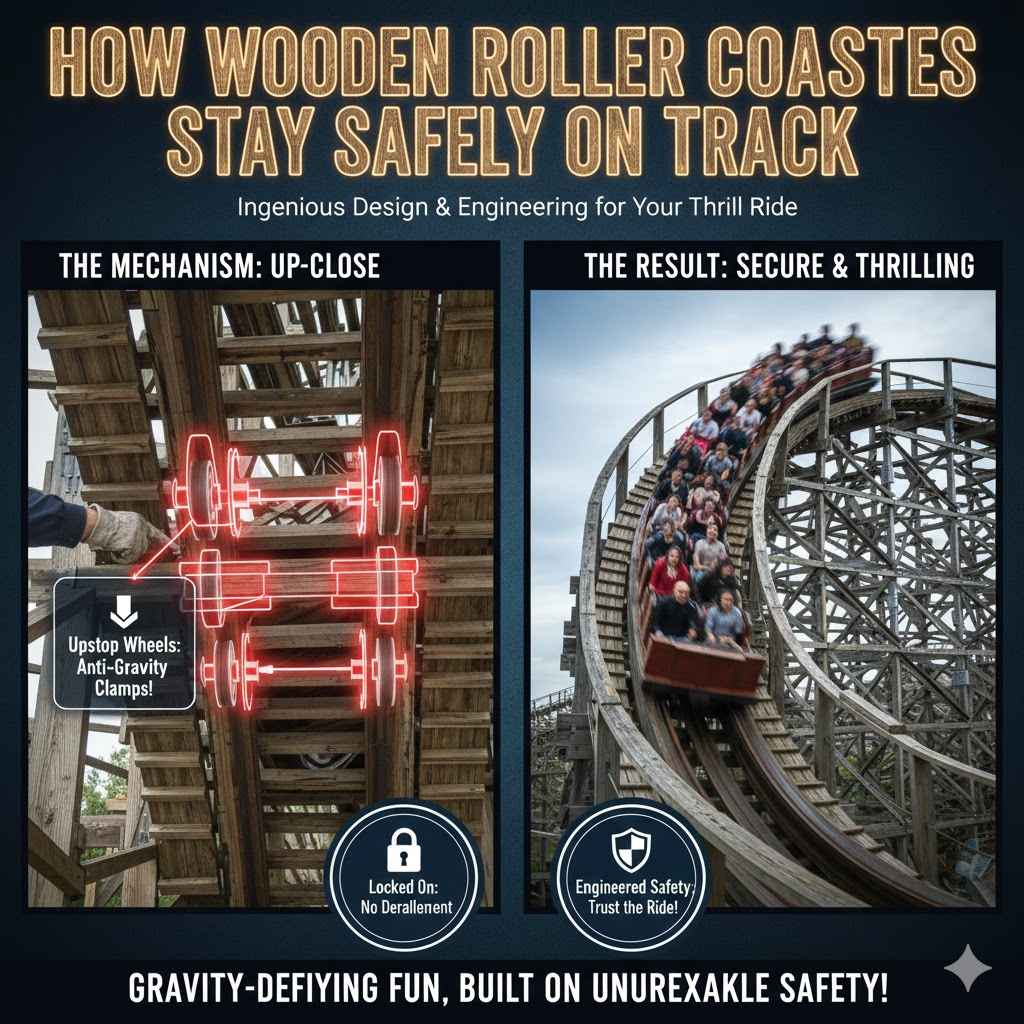
The wheels on a roller coaster train are not like car wheels. They are designed to grip and guide the track. Wooden coaster trains typically have several sets of wheels for each car: running wheels, side friction wheels, and up-stop or under-friction wheels.
The running wheels are what the train rolls on. The side friction wheels press against the side of the track, helping to keep the train centered and prevent it from veering off. The up-stop wheels are positioned beneath the track, acting as a safety mechanism to catch the train if it were to lift too high off the rails, which can happen over especially strong airtime hills.
- Running Wheels: These are usually made of a hard, durable material, often polyurethane, that provides a smooth ride and good grip on the wooden track. They are designed to withstand immense pressure and heat generated by friction.
- Side Friction Wheels: These wheels are mounted on the sides of the train cars and are designed to rub against the vertical side of the track. They are crucial for keeping the train from derailing on turns by providing lateral restraint. The pressure they exert is carefully calibrated.
- Up-Stop Wheels: These are often positioned below the running wheels and on the underside of the track. Their primary purpose is to prevent the train from lifting off the track. While airtime hills are designed to lift riders, the train itself must remain securely on the track, and these wheels are a key part of that safety system.
The Critical Role of Maintenance and Inspection
Even the most brilliant design needs diligent care. For wooden roller coasters, maintenance is paramount. Regular inspections, repairs, and replacements ensure that the wood remains sound and that all mechanical components are functioning correctly.
This isn’t a “set it and forget it” kind of ride; it requires constant attention from dedicated crews.
Structural Integrity of the Wood
Wood, by its nature, is susceptible to weathering, rot, and insect damage. To combat this, roller coaster tracks are built with high-quality, treated lumber. The wood is chosen for its strength and durability, and it’s often laminated together to create incredibly strong beams and supports.
Regular inspections are conducted to check for any signs of decay, splintering, or weakness in the wood.
- Wood Treatment and Sealing: Modern roller coasters use pressure-treated lumber that is infused with chemicals to resist rot and insect infestation. Additionally, the track surface and supporting structures are often sealed and painted to protect them from moisture and UV rays, both of which can degrade wood over time.
- Regular Inspections: Crews visually inspect the entire track structure daily, looking for any cracks, splits, or signs of wear. They also use specialized tools to detect moisture content and structural weaknesses that might not be visible to the naked eye. Any detected issues are immediately addressed.
- Component Replacement: Over time, even the strongest wood can wear down. Specific sections of the track, especially high-wear areas like curves and braking sections, may need to be replaced periodically. This ensures the ride surface remains smooth and the structural integrity is maintained.
Mechanical Systems and Safety Checks
Beyond the wood itself, the mechanical systems of a wooden roller coaster are vital for its safe operation. This includes the braking system, the lift hill mechanism, and the restraint systems on the trains. These systems undergo rigorous testing and maintenance schedules.
- Braking Systems: Wooden coasters use various braking systems, often including friction brakes that press against the side of the track or magnetic brakes. These systems are designed to reliably slow and stop the train at the end of the ride or in emergency situations.
- Lift Hill Mechanism: The chain lift that pulls the train up the initial hill is a critical component. It must be strong, well-maintained, and equipped with safety catches to prevent the train from rolling backward if the chain were to fail.
- Train Restraints: The lap bars or harnesses that secure riders are checked for proper function and locking mechanisms. These are essential to prevent riders from falling out, especially during moments of intense airtime or rapid turns.
The Physics That Keep It All Together
Understanding the physics at play is key to grasping how wooden roller coasters stay safely on track. It’s a constant interplay of forces that engineers carefully balance. The most important forces are gravity, inertia, centripetal force, and friction.
Gravity and Inertia
Gravity is the force that pulls everything towards the Earth’s center. On a roller coaster, gravity is what pulls the train down hills, increasing its speed. Inertia is the tendency of an object to resist changes in its state of motion.
If an object is moving, it wants to keep moving in a straight line at the same speed. These two forces work together. As the train goes up a hill, gravity slows it down, and as it goes down, gravity accelerates it.
Inertia plays a role in how riders feel lifted out of their seats on airtime hills; their bodies want to continue moving upwards while the coaster track drops away.
- Gravity’s Pull: The initial climb on a lift hill is overcome by a motor, but once the train is at the top, gravity takes over. It is the primary force that drives the coaster through its entire course, converting potential energy (height) into kinetic energy (speed).
- Inertia in Action: When a coaster train makes a sharp turn, your body, due to inertia, wants to continue in the direction it was going. This is why you feel pushed outwards against the side of your seat or restraint. The coaster’s design must account for this force.
- Airtime and Negative G-Forces: The thrilling sensation of airtime is a result of inertia and gravity. On an airtime hill, the train’s upward trajectory is momentarily faster than the gravitational pull. Your body, still wanting to move upwards due to inertia, experiences a feeling of lightness or even negative G-forces, as if you’re about to float away.
Centripetal Force and Friction
Centripetal force is the force that keeps an object moving in a circular path. On a roller coaster, this force is provided by the track pushing inwards on the train. In turns, the wheels of the train press against the side of the track, or the banked nature of the track itself pushes the train inwards.
Friction, while sometimes seen as an unwanted force, is also harnessed. The friction between the wheels and the track, and between the friction wheels and the side of the track, helps to control speed and keep the train aligned.
- Centripetal Force in Curves: For a train to make a turn, there must be a force pulling it towards the center of that turn. This is centripetal force. In wooden coasters, the side wheels pressing against the track provide this force. Without it, the train would simply slide off in a straight line (due to inertia).
- Banking for Safety: To help provide centripetal force and reduce uncomfortable forces on riders, turns are banked. The inward slope of the track helps redirect the outward forces (which riders perceive) into forces that push the train down into the track.
- Friction as a Control Mechanism: Friction is present everywhere, and while it slows things down, it’s also used deliberately. The braking systems rely on friction. The friction wheels on the side of the train also provide a controlled amount of friction to keep the train stable and on course during lateral movements.
Here’s a look at how these forces are managed in different scenarios:
| Scenario | Primary Forces Involved | How It Stays Safe |
|---|---|---|
| Going down a steep hill | Gravity, Inertia | Track shape guides descent; up-stop wheels prevent excessive lift. |
| Making a sharp turn | Inertia, Centripetal Force, Friction | Banked track and side friction wheels provide inward force. |
| Riding an airtime hill | Gravity, Inertia | Track contour manages upward forces; up-stop wheels prevent derailment. |
Real-World Examples and Safety Innovations
The principles governing wooden roller coasters have been refined over decades. Many classic rides are still operational and beloved, a testament to sound engineering and continuous care. Modern innovations often focus on enhancing safety features and improving rider comfort while preserving the authentic wooden coaster experience.
Consider the historic ‘Cyclone’ roller coaster at Coney Island, New York. Opened in 1927, it’s a prime example of early wooden coaster design. Its steep drops and sharp turns are legendary, relying heavily on gravity, inertia, and precisely engineered track banking to keep riders in their seats and on the rails.
Despite its age, it continues to operate, undergoing regular structural assessments and track maintenance by experienced teams.
Another notable example is the ‘Texas Giant’ at Six Flags Over Texas, which was later re-tracked with steel, but its original wooden structure demonstrated the challenges and triumphs of wooden coaster engineering. When it first opened, it featured what was then a revolutionary design that provided intense airtime. The success of such rides relies on careful calculations of the forces involved and robust construction that can withstand them repeatedly.
Here are some examples of how safety is ensured through design and maintenance:
- The ‘GhostRider’ at Knott’s Berry Farm: This coaster underwent a major refurbishment. While the track was replaced, the original wooden structure and its inherent safety principles were maintained. The refurbishment focused on reinforcing the wooden structure and ensuring the track surface was smooth and true to the original design, emphasizing the importance of preserving the ride’s integrity while enhancing safety.
- The ‘Colossus’ at Six Flags Magic Mountain: This dual-tracked racing wooden coaster, though now retired, was a marvel of its time. Its structure was massive, designed to handle the forces of two trains racing side-by-side. The immense wooden structure provided a stable foundation, and the maintenance teams worked tirelessly to keep the intricate track and wheel systems in perfect working order.
Sample Scenario 1: A train enters a tight, unbanked turn at high speed.
- The inertia of the train and riders wants to continue in a straight line.
- Without sufficient centripetal force, the train would slide outwards.
- The side friction wheels press hard against the track, providing the necessary inward force.
- If the force is too great or the wheels are worn, the train could derail. However, in a well-maintained coaster, this is prevented by the wheel design and track alignment.
Sample Scenario 2: A train goes over a large airtime hill.
- As the train crests the hill, gravity pulls it downwards.
- Riders, due to inertia, tend to continue moving upwards relative to the descending track.
- The up-stop wheels, positioned underneath the track, engage if the train attempts to lift too far.
- This engagement prevents the train from leaving the track, ensuring it follows the designed path.
Frequently Asked Questions
Question: How are wooden roller coaster tracks made to last so long?
Answer: Wooden roller coaster tracks are made to last through the use of high-quality, pressure-treated lumber that resists rot and insects. They are also sealed and painted for protection against weather. Regular inspections and timely replacement of worn-out sections are crucial for their longevity and safety.
Question: What happens if a wooden roller coaster’s wheels break?
Answer: Roller coaster trains have multiple sets of wheels (running, side friction, up-stop). If one set malfunctions, other systems are in place to compensate. For example, up-stop wheels are a critical backup to prevent derailment.
Plus, the trains are equipped with brakes that can stop the train safely.
Question: Do wooden roller coasters need special weather considerations?
Answer: Yes, extreme weather can affect wooden roller coasters. Heavy rain can saturate the wood, while ice can make the tracks slippery. High winds can also pose a risk.
Operators monitor weather conditions closely and will close rides if conditions are unsafe.
Question: How is the speed of a wooden roller coaster controlled?
Answer: Speed is controlled by the design of the track itself, using gravity and inertia. Brakes, often friction or magnetic, are used to slow the train down at specific points or to bring it to a complete stop at the end of the ride or in emergencies.
Question: Are wooden roller coasters safe compared to steel ones?
Answer: Both wooden and steel roller coasters are designed to very strict safety standards. Wooden coasters offer a different, often more thrilling, ride experience due to their unique construction and the forces they create. Safety depends on proper design, rigorous maintenance, and adherence to operational procedures for either type.
Wrap Up
Wooden roller coasters stay safely on track through a smart blend of physics, precise construction, and constant upkeep. Engineers use forces like gravity and inertia to shape the ride experience. Robust wood, multiple wheel systems, and well-tested brakes are all key.
Regular checks and timely repairs by dedicated teams ensure these thrilling classics continue to operate safely for everyone to enjoy.