Is Plywood Under Fireplace Hearth a Fire Hazard
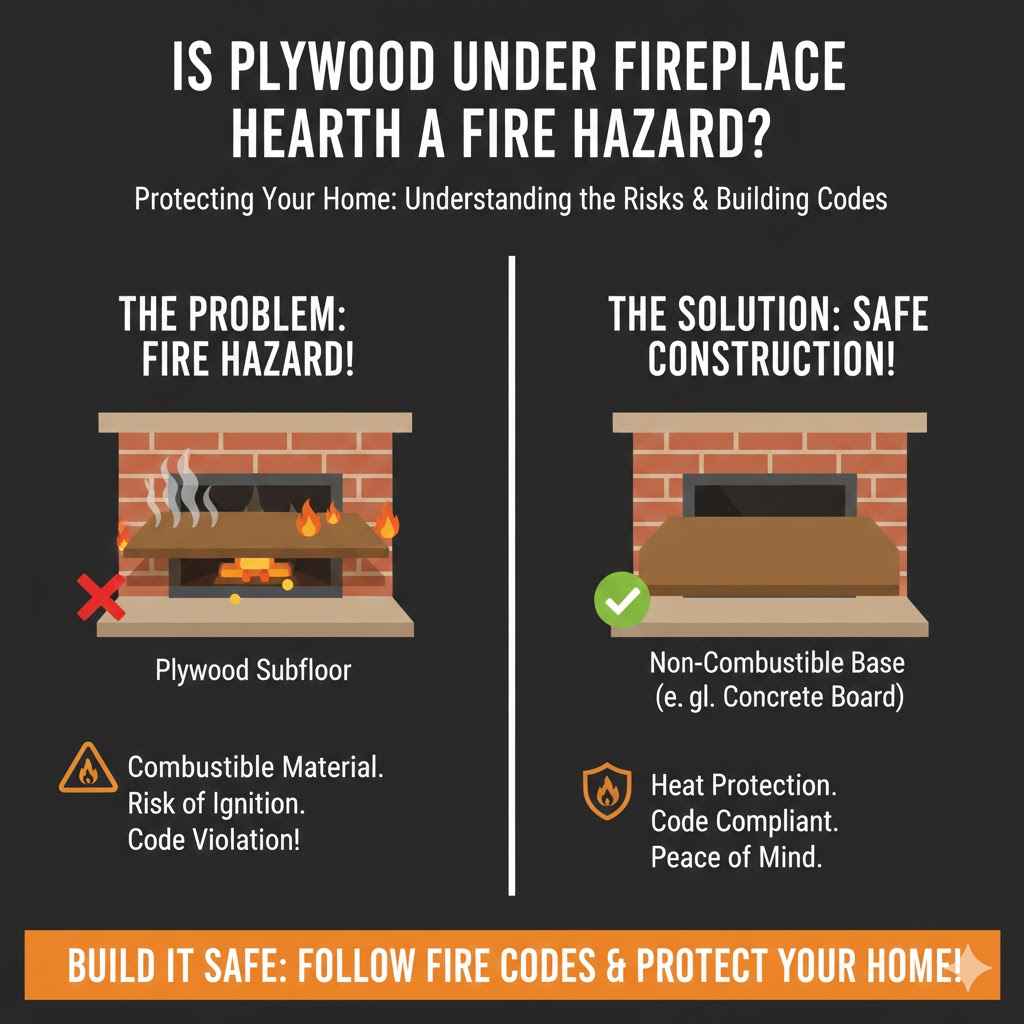
Many people wonder about building a fireplace hearth. They ask, Is Plywood Under Fireplace Hearth a Fire Hazard? This is a common question, especially for folks just starting home improvement projects.
It can seem tricky to know what’s safe. This post will make it super clear. We’ll go step by step so you can feel good about your fireplace.
Get ready to learn the simple facts and make your home safe and cozy.
Understanding Fireplace Hearth Safety
When building or renovating a fireplace, safety is the top concern. One of the areas that often comes up for discussion is the material used directly beneath the hearth. People often wonder, Is Plywood Under Fireplace Hearth a Fire Hazard?
This question arises because wood, in general, is flammable. However, the context of its use, local building codes, and proper installation practices are key to determining safety. This section will explore the fundamental principles of fireplace construction that impact material choices and safety.
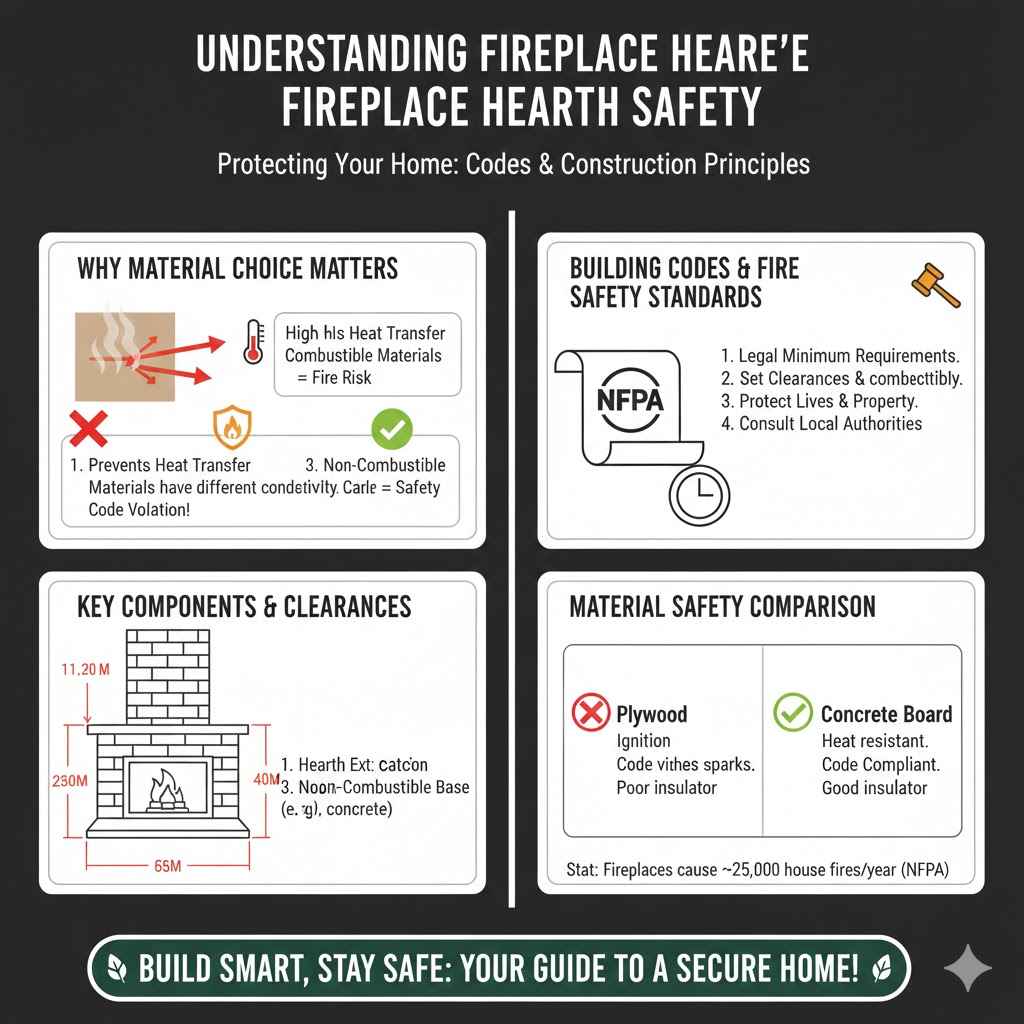
Why Material Choice Matters
The materials chosen for a fireplace and its surrounding structure play a vital role in preventing fires. Heat from a fire can transfer through materials, and if those materials are too close to flammable substances, a fire can start. This is why building codes exist.
They set standards for what materials can be used and how they should be installed to ensure safety. Understanding these principles helps us evaluate specific materials like plywood.
Different materials conduct heat differently. Some are excellent insulators, meaning they don’t get very hot on their side facing away from the fire. Others are poor insulators and can transfer heat easily.
The goal is always to create a barrier between the heat of the fire and any combustible materials in the home’s structure. This barrier ensures that surrounding materials stay below their ignition temperature.
Local building codes are based on extensive research and historical fire data. They are designed to protect lives and property. When you’re working on a fireplace project, always consult your local building department.
They can provide specific requirements for your area that you must follow.
Building Codes and Fire Safety Standards
Building codes are legal documents that set minimum requirements for construction. For fireplaces, these codes are particularly strict because of the inherent fire risk. They specify clearances, material types, and structural integrity needed to ensure a safe installation.
Codes are developed by experts and regularly updated to reflect new knowledge and technologies in fire safety. They are the foundation upon which safe fireplace construction is built.
These codes address everything from the type of mortar used in the chimney to the distance from combustible materials like walls and floors. They also dictate how hearth extensions must be constructed. A hearth extension is the part of the hearth that projects out in front of the fireplace opening.
Its purpose is to catch sparks and embers.
Fireplaces are categorized based on their design and fuel type, such as wood-burning or gas. Each type may have slightly different code requirements. For instance, a gas fireplace typically produces less radiant heat than a wood-burning one, which can sometimes influence material specifications.
However, the principle of separating heat from combustibles remains the same.
Codes often reference standards set by organizations like the National Fire Protection Association (NFPA). These standards provide detailed guidelines on fire prevention and safety practices. Adhering to these codes and standards is not just a recommendation; it’s a legal requirement in most places.
Is Plywood Under Fireplace Hearth a Fire Hazard
The direct question, Is Plywood Under Fi
Plywood’s Properties and Flammability
Plywood is an engineered wood product. It’s made by gluing together thin layers, or veneers, of wood. These veneers are typically cross-laminated, meaning the grain direction of each layer alternates.
This structure makes plywood stronger and more stable than solid wood of the same thickness. However, it is still wood, and wood burns.
The flammability of plywood depends on several factors. These include the type of wood used, the thickness of the veneers, and the type of glue. Generally, plywood will ignite and burn if exposed to a sufficient heat source for a prolonged period.
The rate at which it burns can also vary. Thicker plywood might take longer to ignite than thinner sheets.
When considering its use near a fireplace, the key is to understand its ignition temperature. This is the temperature at which wood will start to burn. If plywood is exposed to temperatures below its ignition point, even for a long time, it won’t catch fire.
The challenge is ensuring that no part of the plywood ever reaches this critical temperature.
It’s also important to note that some plywood can be treated with fire retardants. This treatment makes the wood more resistant to ignition and slows down the spread of flames. While fire-retardant plywood offers enhanced safety, it does not make regular plywood a suitable material for direct contact with fireplace heat.
The Role of Non-Combustible Barriers
Non-combustible barriers are essential in fireplace construction. They act as a shield between heat sources and any combustible materials. Common non-combustible materials include concrete, brick, stone, and cement board.
These materials do not burn and have a high resistance to heat.
When building a hearth, these barriers are placed between the firebox and any flammable building components. If plywood is part of the subfloor or framing beneath the hearth, a substantial layer of non-combustible material must separate it from the fireplace’s heat. This separation is critical to prevent the plywood from reaching its ignition point.
The thickness and type of the non-combustible barrier are usually specified by building codes. For example, a certain thickness of concrete or a specific type of cement board might be required. The gap between the heat source and the combustible material is also crucial.
Codes often specify minimum distances or clearances that must be maintained.
These barriers work by absorbing and dissipating heat. They also create an air gap, which can further help to insulate. Without these barriers, the heat from the fireplace would directly transfer to the plywood, leading to a dangerous situation.
The non-combustible layer is the most important factor in answering the question Is Plywood Under Fireplace Hearth a Fire Hazard.
When Plywood Might Be Acceptable
Plywood can be used in the construction of a fireplace hearth area, but only under strict conditions. It is generally not permitted as a surface that is directly exposed to heat or sparks. This means it cannot be the visible hearth material or the material immediately surrounding the firebox opening.
Instead, plywood might be used as part of the subfloor structure beneath the hearth. In this scenario, there must be a significant layer of non-combustible material between the plywood and the fireplace. This non-combustible layer might include a concrete slab, a thick layer of mortar, or specialized cement boards designed for fireproofing.
Building codes will specify the exact requirements for this protective layer. For instance, they might require a minimum thickness of concrete or a specific type of fire-rated sheathing. The distance from the firebox to the combustible materials is also critical.
Codes will detail how far the non-combustible materials must extend to protect the surrounding structure.
If you are planning to use plywood in your hearth construction, always consult your local building codes and potentially a qualified builder or architect. They can confirm whether your specific plan meets all safety regulations and ensure that the plywood is adequately protected from any fire risk.
Fireplace Hearth Construction and Plywood Use
Building a safe fireplace hearth involves careful consideration of materials and construction techniques. When the question arises, Is Plywood Under Fireplace Hearth a Fire Hazard?, the answer lies in the specifics of its placement and protection. This section details the typical construction methods for fireplace hearths and where plywood might fit into the picture safely, emphasizing the non-negotiable need for protective layers.
Hearth Structure Explained
A fireplace hearth typically consists of several layers. At the very bottom, you might have joists and subflooring, which are standard parts of a home’s structure. These are usually made of wood.
Directly above the subfloor, a non-combustible layer is installed. This layer serves as the foundation for the visible hearth surface.
The non-combustible layer is crucial. It acts as a thermal barrier, preventing heat from the fire from reaching the wooden subfloor and joists below. This layer can be made of concrete, a thick mortar bed, or specialized cement board.
The thickness and type of this material are dictated by building codes to ensure adequate fire resistance.
On top of the non-combustible layer, the visible hearth surface is installed. This is the part you see and stand on. Common materials for the visible hearth include brick, stone, tile, or concrete.
These materials are chosen for their durability, aesthetic appeal, and, most importantly, their fire-resistant properties.
The firebox itself is constructed from firebricks and refractory mortar, which are designed to withstand extreme heat. The hearth extension, which is the part of the hearth that extends out in front of the fireplace opening, also needs to be constructed of non-combustible materials and provide adequate protection against sparks and embers.
Understanding this layered approach is key. It shows how combustible materials can be part of the overall structure, provided they are separated from direct heat by protective, non-combustible layers. This layered approach is what makes a fireplace safe, even when wood framing is present in the home’s structure.
Protective Layers in Detail
The effectiveness of a fireplace hearth system hinges on the strength and continuity of its protective layers. These layers are not just an optional addition; they are mandated by safety regulations for a reason. They are the primary defense against ignition of surrounding combustible materials.
Understanding their composition and function is vital for anyone concerned about whether plywood under a fireplace hearth is a fire hazard.
A common protective layer involves a concrete slab. This slab can be poured directly onto a subfloor if the subfloor is adequately reinforced and protected. Alternatively, a cement board product designed for fire applications can be installed over the subfloor.
These cement boards are typically made of Portland cement, reinforcing fibers, and other inert materials, making them inherently non-combustible and resistant to heat and moisture.
The thickness of these protective layers is a critical factor. Building codes will specify a minimum thickness. For example, a concrete slab might need to be at least 4 inches thick, while specific cement boards will have their own thickness requirements based on their fire-resistance ratings.
This thickness provides a buffer against heat transfer.
Beyond just thickness, the installation method is also important. The protective layer must be continuous and free of gaps or cracks. Any opening could allow heat to penetrate to the combustible materials below.
Therefore, careful sealing and finishing of these layers are necessary. Sometimes, a layer of fireproofing material, such as mineral wool insulation rated for high temperatures, might be used in conjunction with these barriers, especially in older homes or more complex installations.
These protective layers are the unsung heroes of fi
Common Construction Scenarios
Let’s look at some typical ways fireplace hearths are built and how plywood fits in. In many modern homes, the hearth might be built over a concrete slab foundation. In such cases, there’s no wood directly beneath the hearth structure, so the plywood question under the hearth itself doesn’t really apply.
The concrete slab acts as the primary non-combustible base.
In homes with a framed floor structure, a more layered approach is necessary. A common method is to build a wooden frame for the hearth’s base. This frame might use plywood as its subfloor.
However, this plywood is never left exposed. A substantial layer of non-combustible material, such as a concrete mortar bed or fire-rated cement board, is installed on top of the plywood before the final hearth surface (like tile or stone) is laid.
Another scenario involves a raised hearth. This is a hearth that is elevated above the main floor level. Even in a raised hearth, the underlying structure must be fireproof.
If the raised hearth is framed with wood and sheathed with plywood, a non-combustible material will be used as the interior surface of the hearth’s enclosure and as the base for the hearth topping. This ensures that any heat generated within the raised hearth structure is contained and does not reach the combustible plywood.
In all these cases, the rule is consistent: combustible materials like plywood must be separated from direct heat by at least one, and often multiple, layers of non-combustible materials. This separation is the key to safe construction and answers the question Is Plywood Under Fireplace Hearth a Fire Hazard?
Fire Safety Best Practices and Plywood
Ensuring fire safety around your fireplace is paramount. The question, Is Plywood Under Fireplace Hearth a Fire Hazard?, brings to light the importance of understanding fire safety best practices. This section will explore practical advice for safe fireplace construction and maintenance, specifically addressing the role and limitations of plywood in such settings.
Importance of Clearances
Clearances are the distances specified by building codes between combustible materials and heat sources. For fireplaces, these clearances are critical. They ensure that wood framing, insulation, and other flammable materials are kept far enough away from the heat generated by the fire to prevent them from igniting.
Codes typically define minimum clearances for the fireplace itself, the chimney, and the hearth extension. For example, there might be a requirement for a certain distance between the back of the firebox and any wooden studs in the wall. Similarly, the combustible floor structure beneath the hearth needs specific protection.
These clearances are not arbitrary. They are based on extensive testing and understanding of how heat transfers. When a fire burns, it radiates heat in all directions.
Without adequate clearance or protective barriers, this heat can warm combustible materials over time. If they reach their ignition temperature, a fire can start without any direct flame contact.
When installing a hearth, especially if using plywood in the sub-structure, ensuring these clearances are met is non-negotiable. This often involves creating a barrier of non-combustible material that extends a specified distance beyond the firebox opening. This barrier increases the distance and provides thermal protection.
Adhering strictly to these clearance requirements, as outlined in your local building codes, is the best way to prevent fires originating from your fireplace. It’s a fundamental principle of safe fireplace construction that directly addresses the question Is Plywood Under Fireplace Hearth a Fire Hazard?
Ventilation and Air Gaps
Ventilation and air gaps are often misunderstood but are vital components of fireplace safety. While it might seem counterintuitive, controlled air movement can help prevent overheating. An air gap between a heat source and a combustible material can act as an insulator, dissipating heat and preventing it from accumulating.
In fireplace construction, building codes might specify the need for air gaps in certain areas. For example, there might be requirements for air circulation around certain components of the chimney or hearth. This circulation helps to keep temperatures down and prevent the buildup of heat.
When plywood is used in the subfloor beneath a hearth, the non-combustible barrier installed on top of it is designed to prevent heat transfer. However, the structural integrity of the framing beneath also matters. Ensuring that there is adequate ventilation within the floor structure can prevent heat from becoming trapped and potentially igniting the wood.
It’s important to note that while air gaps can help, they are not a substitute for proper non-combustible barriers. The primary defense against fire is a solid barrier that heat cannot easily penetrate. Air gaps are often a secondary measure to enhance safety.
They help manage residual heat that might transfer through even the best barriers.
When consulting building codes for fireplace construction, pay close attention to any requirements for ventilation or air gaps. Proper implementation ensures that heat is managed effectively, contributing to overall safety and answering the question Is Plywood Under Fireplace Hearth a Fire Hazard?
Maintenance and Inspection
Regular maintenance and inspection of your fi
Inspect the visible hearth materials regularly for cracks or damage. If tiles are loose, bricks are crumbling, or the grout is breaking down, heat can potentially find pathways to the underlying structure. Repairing these as soon as they are noticed is important.
Look at the mortar joints in the firebox and chimney. If they are deteriorating, hot gases and embers could escape. This is a serious fire risk that requires professional attention from a chimney sweep or mason.
Check the area around the fireplace opening. Ensure that the non-combustible material continues to provide adequate protection. If you notice any signs of heat damage or deterioration in the materials surrounding the hearth, it needs immediate investigation.
While inspecting the visible parts is straightforward, checking the hidden components, like the plywood subfloor beneath the hearth, requires a different approach. If you’re concerned about potential issues with the hidden layers, it’s best to have a qualified professional conduct a thorough inspection. They can identify any problems that aren’t readily apparent, ensuring that the question Is Plywood Under Fireplace Hearth a Fire Hazard?
remains a non-issue for your home.
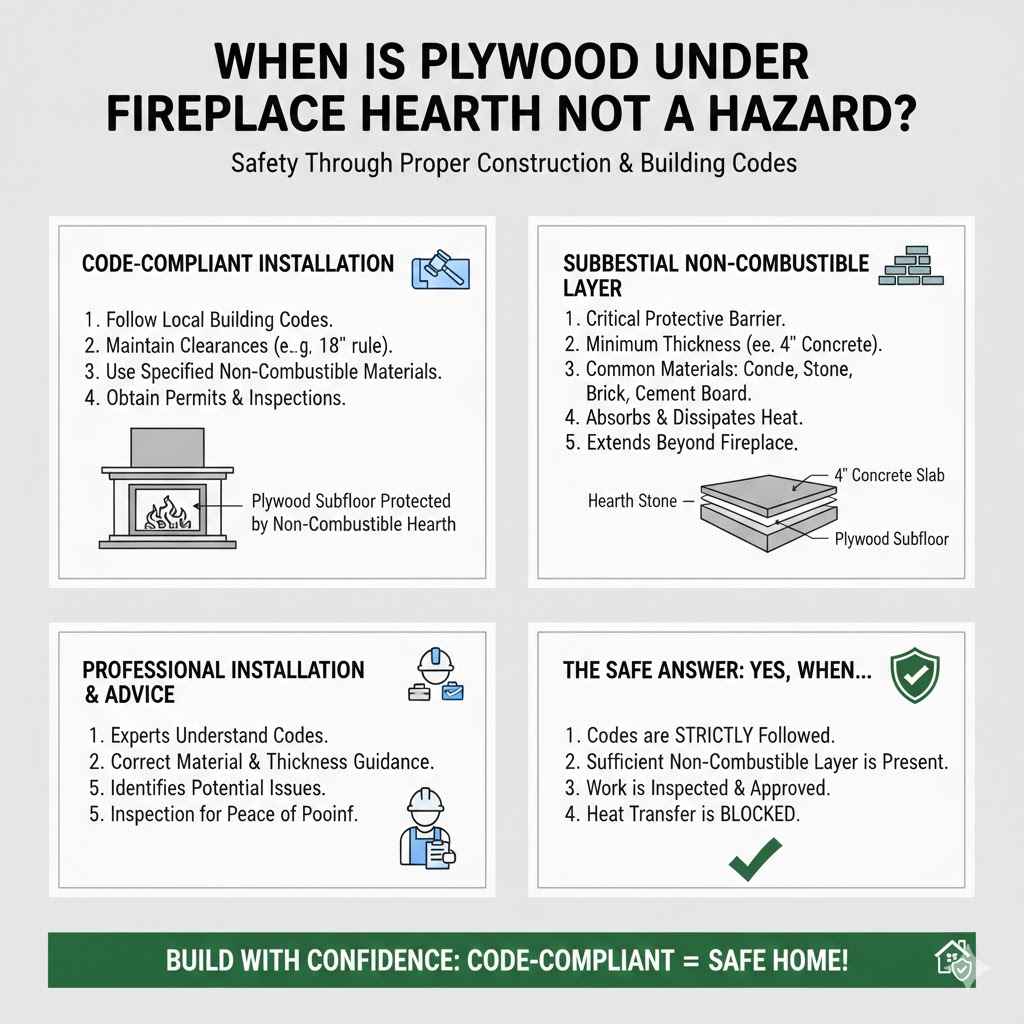
When Is Plywood Under Fireplace Hearth NOT a Hazard
The core of the question Is Plywood Under Fi
Code-Compliant Installation
The most critical factor in determining if plywood under a fi
For example, a code might state that any combustible material like plywood must be at least 18 inches away from the back and sides of the firebox, or separated by a specific thickness of non-combustible material, such as a 4-inch concrete slab. If these specifications are followed precisely, the plywood is protected from the heat.
This includes the hearth extension, which must project a certain distance in front of the fireplace opening to catch sparks. The material supporting this extension also needs to be non-combustible or adequately protected. If plywood is used in the framing for this extension, it must be covered by sufficient fire-resistant material.
When you build according to these guidelines, you are creating a safe environment. The plywood is essentially shielded from the fire by layers designed to absorb and block heat. Therefore, a code-compliant installation is the most direct answer to Is Plywood Under Fireplace Hearth a Fire Hazard?
Always remember to obtain necessary permits and have your work inspected by the local building department. This ensures that your project meets all safety standards and provides peace of mind.
The Role of a Substantial Non-Combustible Layer
The presence and adequacy of a non-combustible layer are paramount when considering plywood beneath a fi
Building codes typically specify the type and minimum thickness of this protective layer. Common materials include concrete, stone, brick, or specialized cement boards designed for high-temperature applications. For instance, a concrete slab might need to be at least 4 inches thick, or a fire-rated cement board might be required to meet specific performance standards.
The key is that this non-combustible material forms a continuous barrier between the heat source (the fireplace and its embers) and the plywood. It absorbs and dissipates heat, keeping the plywood well below its ignition temperature. Even if the surface of the non-combustible layer gets hot, the underlying plywood remains cool enough not to ignite.
This layer must also extend beyond the footprint of the fi
When planning your hearth construction, investing in and correctly installing this protective layer is non-negotiable for safety and compliance.
Professional Installation and Expert Advice
For projects involving fireplaces and hearths, especially when considering materials like plywood, professional installation and expert advice are invaluable. These professionals understand the intricacies of building codes, material properties, and fire safety principles. Their expertise ensures that the question Is Plywood Under Fireplace Hearth a Fire Hazard?
is addressed correctly.
A qualified builder or fireplace installer will know the specific local building codes that apply to your project. They can advise on the correct type and thickness of non-combustible materials needed to protect any underlying plywood. They will also ensure that all required clearances are maintained, creating a safe buffer zone around the fireplace.
Furthermore, professionals have experience with different construction methods and can identify potential challenges specific to your home’s structure. They can recommend the best approach to ensure your hearth is both functional and safe. This might involve suggesting alternative materials or construction techniques if plywood is not the ideal choice for a particular situation.
Consulting with a chimney sweep or a fire safety expert can also provide valuable insights. They can conduct inspections of existing structures or offer guidance on new installations. Their knowledge can help you avoid common mistakes that could lead to a fire hazard.
Ultimately, relying on the knowledge of experienced professionals is the surest way to guarantee that your fireplace hearth is constructed safely, making the question Is Plywood Under Fireplace Hearth a Fire Hazard? a concern of the past.
Frequently Asked Questions
Question: Can I use plywood as the visible surface of my fireplace hearth
Answer: No, you should never use plywood as the visible surface of your fi
Question: What is the minimum thickness for a concrete hearth base
Answer: The minimum thickness for a concrete hearth base varies depending on local building codes. However, a common requirement is at least 4 inches thick. This thickness is necessary to provide adequate insulation and prevent heat from transferring to the combustible materials below.
Question: Are cement boards safe to use under a fireplace hearth
Answer: Yes, certain types of cement boards are safe and designed for use under fireplace hearths. These are specifically fire-rated cement boards made from materials like Portland cement and reinforcing fibers. Always ensure the cement board you choose meets local building code requirements for fire resistance.
Question: How far should a hearth extension extend
Answer: Building codes specify the required size of a hearth extension to protect the floor from sparks and embers. Generally, it must extend at least 16 inches in front of the fireplace opening and at least 8 inches to each side of the opening. Always check your local codes for exact dimensions.
Question: Do I need a permit to build or renovate a fireplace hearth
Answer: Yes, in most jurisdictions, you will need a building permit to construct or significantly renovate a fireplace hearth. This ensures that the work is inspected by local authorities to confirm it meets all safety standards and building codes, protecting your home and family.
Summary
So, Is Plywood Under Fireplace Hearth a Fire Hazard? Only if it’s not properly protected. Plywood is safe when installed correctly with adequate non-combustible barriers and clearances, as required by building codes.
Always follow professional advice and local regulations for safe fireplace construction.