What Are The Exact Measurements Of A Rick Of Firewood
Figuring out the size of a rick of firewood can be tricky, especially when you’re new to buying it. People often wonder, What Are the Exact Measurements of a Rick of Firewood? because it’s not a standard size everywhere. This can lead to confusion and sometimes, not getting the amount you expected.
Don’t worry, we’ll break it down simply so you know exactly what you’re getting. Let’s clear up the confusion and get you informed about firewood measurements.
Understanding A Rick Of Firewood
A rick of firewood is a common way to measure and sell wood for burning. However, its exact dimensions can be a bit fluid, leading to common questions about What Are the Exact Measurements of a Rick of Firewood?. Unlike a cord, which has a standardized volume, a rick’s size can vary depending on where you are and who is selling it.
This post will clarify the typical dimensions and help you understand how to measure it yourself. We will explore the standard measurements and how they relate to other firewood units.
What Is A Rick Of Firewood
A rick of firewood is a stack of wood. It is often used in certain regions, particularly in New England. The term is less formal than a “cord.”
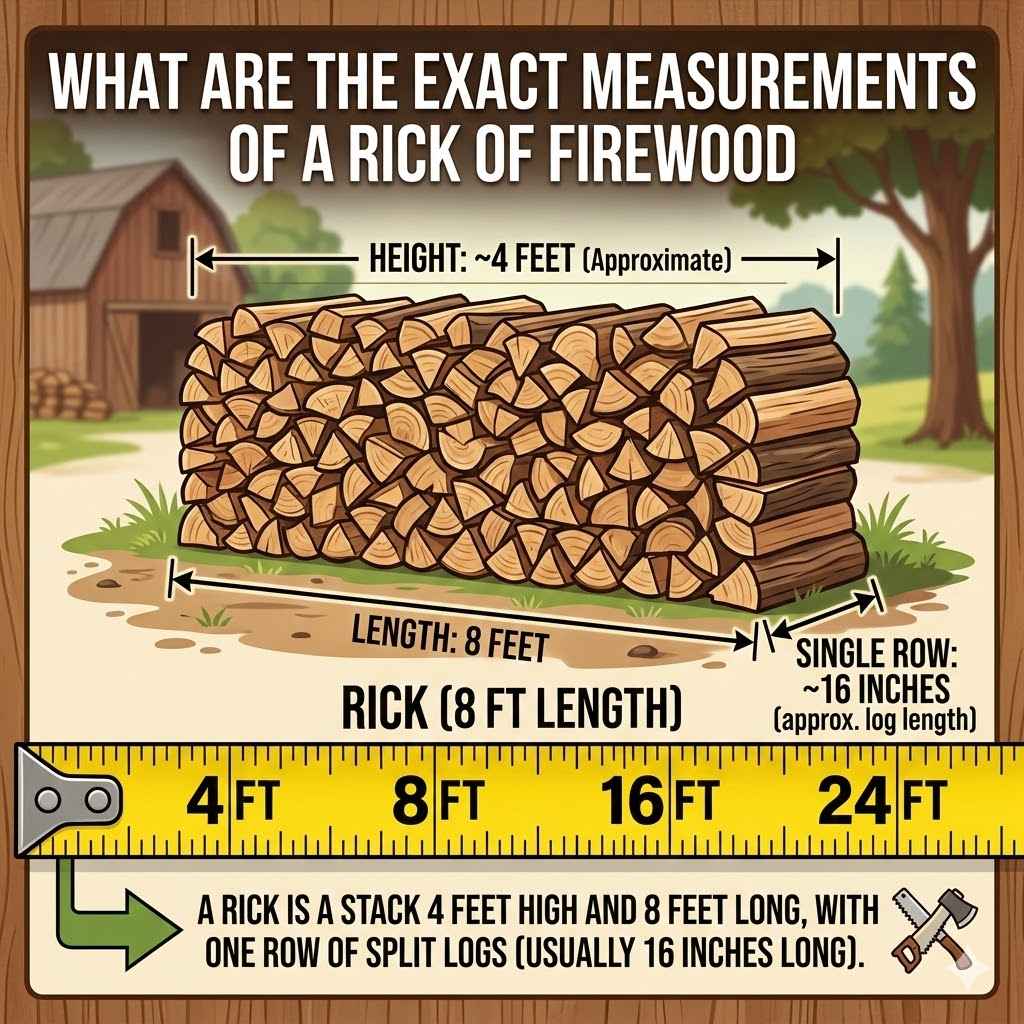
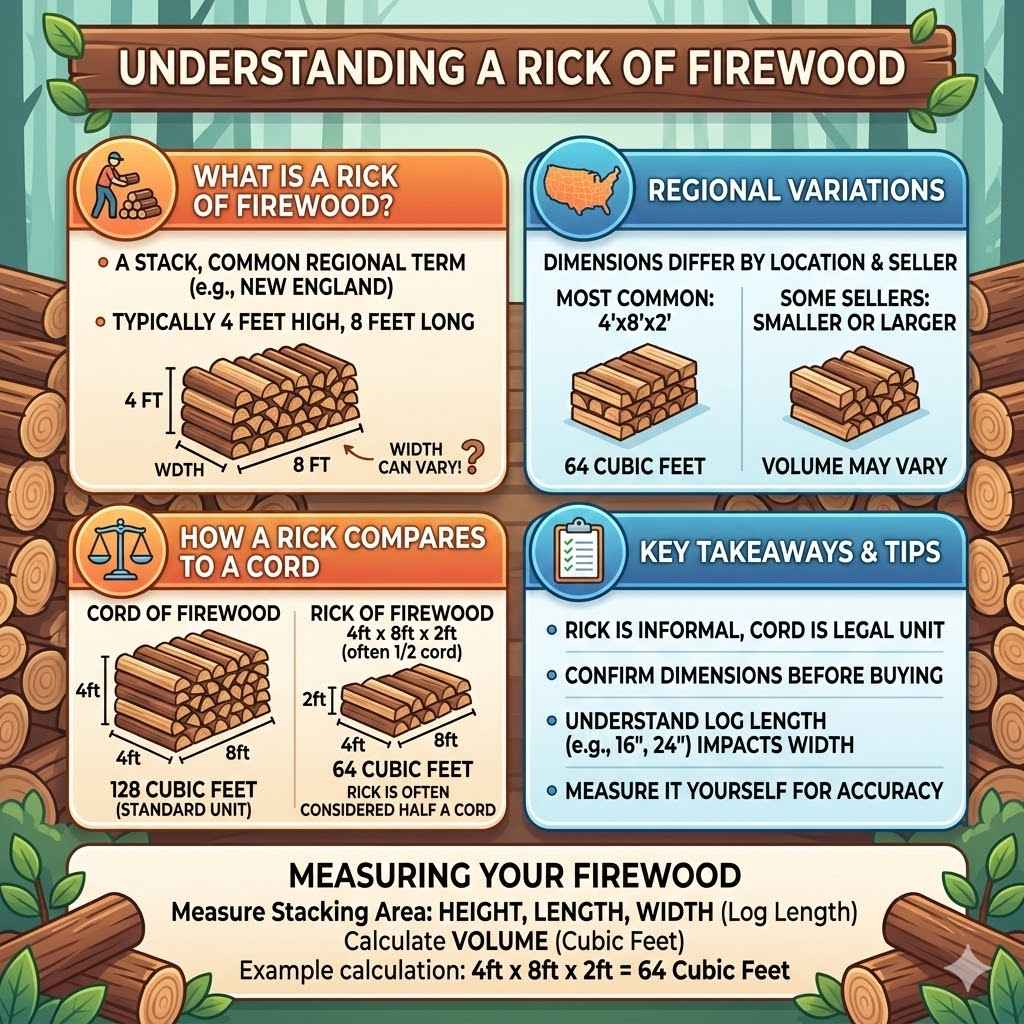
The term “rick” itself refers to a stack of wood that is typically 4 feet high and 8 feet long. The width can vary significantly, which is the main reason for confusion.
When you buy firewood, especially if it’s sold by the rick, it’s important to confirm the dimensions. This ensures you are getting the quantity you anticipate. A rick is a regional term, and its definition can differ.
Regional Variations Of A Rick
In many parts of the United States, a rick is often considered to be a stack of wood that is 4 feet high, 8 feet long, and 2 feet wide. This creates a volume of 64 cubic feet (4 x 8 x 2). However, this is not universally agreed upon.
Some areas might define a rick differently. For example, some might consider a rick to be half a cord. A cord of firewood is a very specific measurement.
It’s a stack of wood that is 4 feet high, 8 feet long, and 4 feet wide, totaling 128 cubic feet (4 x 8 x 4).
If a rick is considered half a cord, it would then be 4 feet high, 8 feet long, and 2 feet wide, resulting in 64 cubic feet. This aligns with the previous definition. However, some sellers might stack wood to a different width, making their “rick” smaller or larger.
Always clarify before purchasing.
How A Rick Compares To A Cord
The most important comparison for a rick is to a cord of firewood. A standard cord is a legally recognized unit of volume for firewood. It is a stack of wood that measures 4 feet high, 8 feet long, and 4 feet wide.
This results in a total volume of 128 cubic feet.
This volume includes the space between the logs, also known as air space. The actual wood content within a cord is less than 128 cubic feet because of these gaps.
Often, a rick is informally considered to be half a cord. This would make a rick 4 feet high, 8 feet long, and 2 feet wide, equaling 64 cubic feet of stacked wood. This is the most common interpretation when a rick is used as a unit of sale.
Understanding this relationship is key to knowing What Are the Exact Measurements of a Rick of Firewood? in relation to the standard cord. If you buy a rick, you are likely getting about half the amount of wood as a full cord.
The Standard Rick Dimensions Explained
Let’s get down to the specifics of what most people mean when they talk about a rick of firewood. This section focuses on the most common understanding of the dimensions involved. We will break down the height, length, and width as they are typically defined.
Height Of A Rick
The height of a standard rick of firewood is almost always 4 feet. This measurement is consistent because firewood is typically cut to lengths that fit well within this height when stacked.
This 4-foot height allows for efficient stacking and transport. It also aligns with the standard height of a cord of firewood. So, if you see a stack of wood that’s 4 feet tall, you’re on the right track to identifying it as a potential rick or cord.
Imagine stacking logs one on top of another. A 4-foot height is manageable and provides a good base for the woodpile. It’s a universal measurement that makes it easy to visualize the stack.
Length Of A Rick
The length of a standard rick of firewood is usually 8 feet. This is also a common measurement for firewood bundles and stacks.
This 8-foot length is convenient for many reasons. It fits easily onto standard truck beds and trailers, making delivery and transport simpler. Like the height, it matches the standard length of a cord of firewood.
When you see a stack of firewood measuring 8 feet long, it’s a good indicator of standard firewood stacking practices. This consistent length helps in calculating volume more accurately.
Width Of A Rick
The width is where the definition of a rick becomes less standardized, but the most common measurement is 2 feet. This is the crucial dimension that differentiates a rick from a full cord.
If a rick is 4 feet high, 8 feet long, and 2 feet wide, its volume is 64 cubic feet (4 x 8 x 2 = 64). This is why it’s often considered half a cord.
However, some sellers may stack wood only 18 inches wide, or perhaps even 3 feet wide. This variation is why it’s vital to ask about the width when purchasing. The width directly impacts the total amount of wood you receive.
Calculating The Volume Of A Rick
To calculate the volume of a rick, you multiply its height, length, and width. Using the most common dimensions:
- Height: 4 feet
- Length: 8 feet
- Width: 2 feet
Volume = Height x Length x Width
Volume = 4 feet x 8 feet x 2 feet = 64 cubic feet.
This 64 cubic feet is the volume of the stacked wood, including the air spaces between the logs. This is a practical measurement for how much space the wood takes up.
If you are comparing prices, knowing the volume in cubic feet is essential. It allows you to compare the cost per cubic foot, ensuring you get a fair deal. For instance, if a cord (128 cubic feet) costs $300, then 64 cubic feet (a rick) should ideally cost around $150, assuming consistent wood quality and stacking.
How To Measure And Verify Your Firewood
It’s always a good idea to verify the amount of firewood you receive. This section provides practical steps to help you measure and confirm your rick of firewood. Knowing What Are the Exact Measurements of a Rick of Firewood? empowers you to check what you’ve bought.
Tools You Might Need
To measure your firewood accurately, you’ll need a few simple tools. These are readily available at most hardware or home improvement stores.
- Measuring Tape: A standard retractable tape measure, at least 10 feet long, is essential.
- Pencil and Paper or Phone App: To jot down the dimensions.
- Optional: A T-square or Level: To help ensure your measurements are straight and square, especially if you want to be very precise.
Having these tools handy means you can quickly check the stack before the seller leaves, or shortly after they have delivered it. This is a proactive step to ensure you are getting the quantity you paid for.
Step-By-Step Measurement Process
Here’s how to measure your rick of firewood to confirm its dimensions:
- Measure the Height: Place your measuring tape against the side of the stack. Measure from the bottom of the lowest log to the top of the highest log. Aim for the tallest point of the stack.
- Measure the Length: Measure along the longest side of the stack, from one end to the other. Ensure you are measuring the full length of the stacked logs.
- Measure the Width: This is the trickiest, as stacks can be uneven. It’s best to measure the width at a few points (e.g., the front, the middle, and the back) and take an average. Measure from the very front face of the wood to the very back face.
Record these three measurements clearly. For example, you might find your rick is 4 feet high, 8 feet long, and 1.8 feet wide. This allows you to calculate the actual cubic feet of wood.
Calculating Actual Volume
Once you have your recorded measurements, you can calculate the actual volume. Use the same formula:
Volume = Height x Length x Width
For our example measurements (4 ft height, 8 ft length, 1.8 ft width):
Volume = 4 ft x 8 ft x 1.8 ft = 57.6 cubic feet.
This actual volume is what you’re getting. If you paid for a standard 64 cubic foot rick, and you measured 57.6 cubic feet, you can have a polite conversation with the seller about the discrepancy.
What To Do If The Measurements Are Off
If you find that the measurements are significantly less than what you agreed upon, don’t hesitate to address it. A difference of a few inches might be acceptable, but a foot or more is a problem.
Here are some steps:
- Politely Point Out The Discrepancy: Show the seller your measurements and ask for clarification. They might have made an honest mistake.
- Request Additional Wood: Ask for the difference to be made up. This could be in the form of more logs or a partial refund.
- Refer To Your Agreement: If you had a specific agreement on dimensions, refer back to that.
Most reputable firewood sellers want to maintain good customer relations. Open and honest communication usually resolves these issues amicably. It’s about ensuring fair exchange.
Factors Affecting Rick Size And Value
Several factors can influence the size and perceived value of a rick of firewood beyond just its cubic feet. Understanding these can help you make a more informed purchase.
Wood Type And Quality
The type of wood significantly impacts its value and how much heat it provides. Hardwoods like oak, maple, and hickory are denser and burn longer and hotter than softwoods like pine or fir.
A rick of dense hardwood will be more valuable than a rick of light softwood. This is because you get more energy from the same volume of hardwood. When comparing prices, consider the wood species.
High-quality firewood is also dry and seasoned. Wet or “green” wood is harder to light, produces less heat, and can create more smoke and creosote, which is bad for chimneys.
Seasoning And Moisture Content
Firewood should be seasoned, meaning it has been dried for at least 6-12 months. The ideal moisture content for burning is between 15% and 20%.
Wet wood weighs more due to water content. So, a rick of green wood might be the correct dimensions but contain less actual burnable material by weight. This is why seasoned wood is more valuable.
You can use a moisture meter to test the wood if you’re concerned. A lower moisture content means more efficient burning and better heat output.
Stacking Method
The way the wood is stacked can affect the amount of air space within the rick. A tightly stacked rick will have less air space than a loosely stacked one.
This means that while two ricks might have the same external dimensions, one might contain slightly more actual wood volume. For the most accurate comparison, it’s always best to consider the cubic feet of the solid wood.
However, for practical purposes, the standard stacked volume is what’s usually measured. Just be aware that slight variations in stacking can occur.
Local Market Prices
Firewood prices can vary greatly depending on your location, local supply, and demand. In areas where firewood is abundant, prices might be lower. In regions with higher demand or fewer suppliers, prices can be higher.
The cost of a rick of firewood can range from $100 to $250 or more. This depends on the factors mentioned above, like wood type, seasoning, and local economics.
When you inquire about What Are the Exact Measurements of a Rick of Firewood?, also ask about the price and what that price includes. This helps you budget and compare offers effectively.

Frequently Asked Questions
Question: Is a rick of firewood the same everywhere?
Answer: No, a rick of firewood is not the same everywhere. While a common understanding is 4 feet high, 8 feet long, and 2 feet wide (64 cubic feet), this can vary by region and seller. It’s always best to confirm the dimensions before buying.
Question: How much is a rick of firewood usually?
Answer: The price of a rick of firewood typically ranges from $100 to $250, but this can vary significantly based on wood type, seasoning, delivery fees, and your local market conditions.
Question: Can I stack my own firewood into a rick?
Answer: Yes, you can. If you are processing your own wood or buying logs, you can stack them into a rick measuring 4 feet high, 8 feet long, and 2 feet wide to achieve the standard 64 cubic feet volume.
Question: How many logs are in a rick of firewood?
Answer: There isn’t a set number of logs because log sizes vary greatly. The amount of wood is measured by volume (cubic feet), not by log count. A standard rick is about 64 cubic feet.
Question: What is the difference between a rick and a face cord?
Answer: A face cord is another term that can be confusing. It is often used interchangeably with a rick and typically refers to a stack that is 4 feet high and 8 feet long, but only 1 foot wide (32 cubic feet). However, definitions can overlap, making it essential to clarify dimensions for both terms.
Summary
When asking What Are the Exact Measurements of a Rick of Firewood?, remember the most common size is 4 feet high, 8 feet long, and 2 feet wide, totaling 64 cubic feet. This is often considered half a cord. Always verify dimensions with your seller and consider wood quality.
This knowledge helps you get the firewood you need.