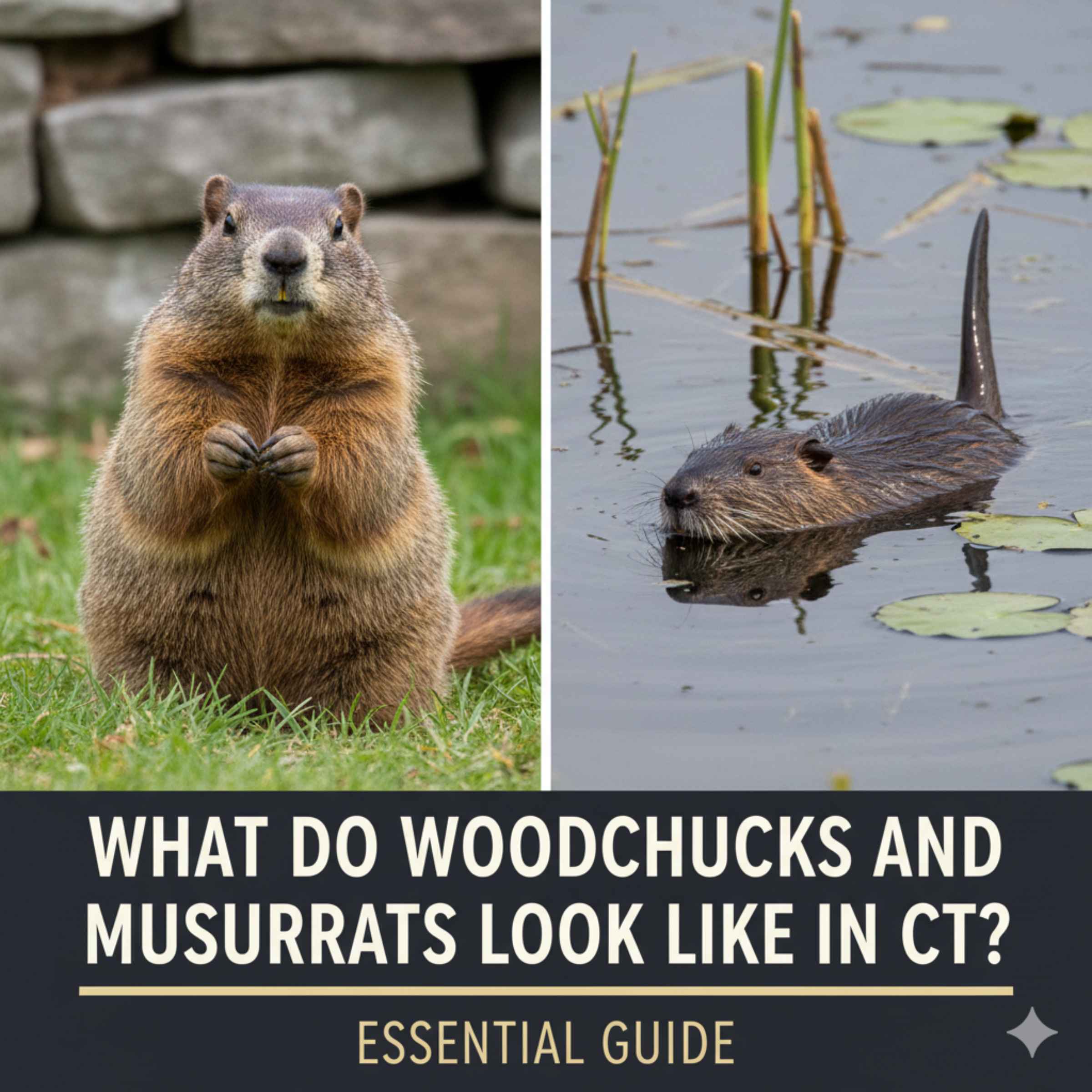
What Do Woodchucks And Muskrats Animals Look Like In CT? Essential Guide
Woodchucks (groundhogs) in CT look like large, brownish-gray, stout rodents often seen near burrows, while muskrats look like smaller, dark brown, semi-aquatic rodents with long, flattened tails, usually near water sources.
It’s easy to mix up wildlife when you see movement in your yard or near a local pond here in Connecticut. Two common critters that often cause confusion are the woodchuck and the muskrat. Are those tracks near your garden from a big ground-dweller or a sleek swimmer? Knowing the difference is key, especially if you need to manage wildlife around your home or just want to appreciate nature safely. Don’t worry; distinguishing these animals is simpler than you think once you know what to look for. We will walk through their looks, sizes, and where you are most likely to spot them right here in CT. Let’s get these two critters clearly identified!
Identifying Woodchucks (Groundhogs) in Connecticut
The woodchuck, also famously known as the groundhog, is a chunky, sturdy animal that loves digging. If you have a well-manicured lawn or a vegetable patch, you might already be familiar with their handiwork! In Connecticut, these are common sights, especially in open fields and suburban yards.
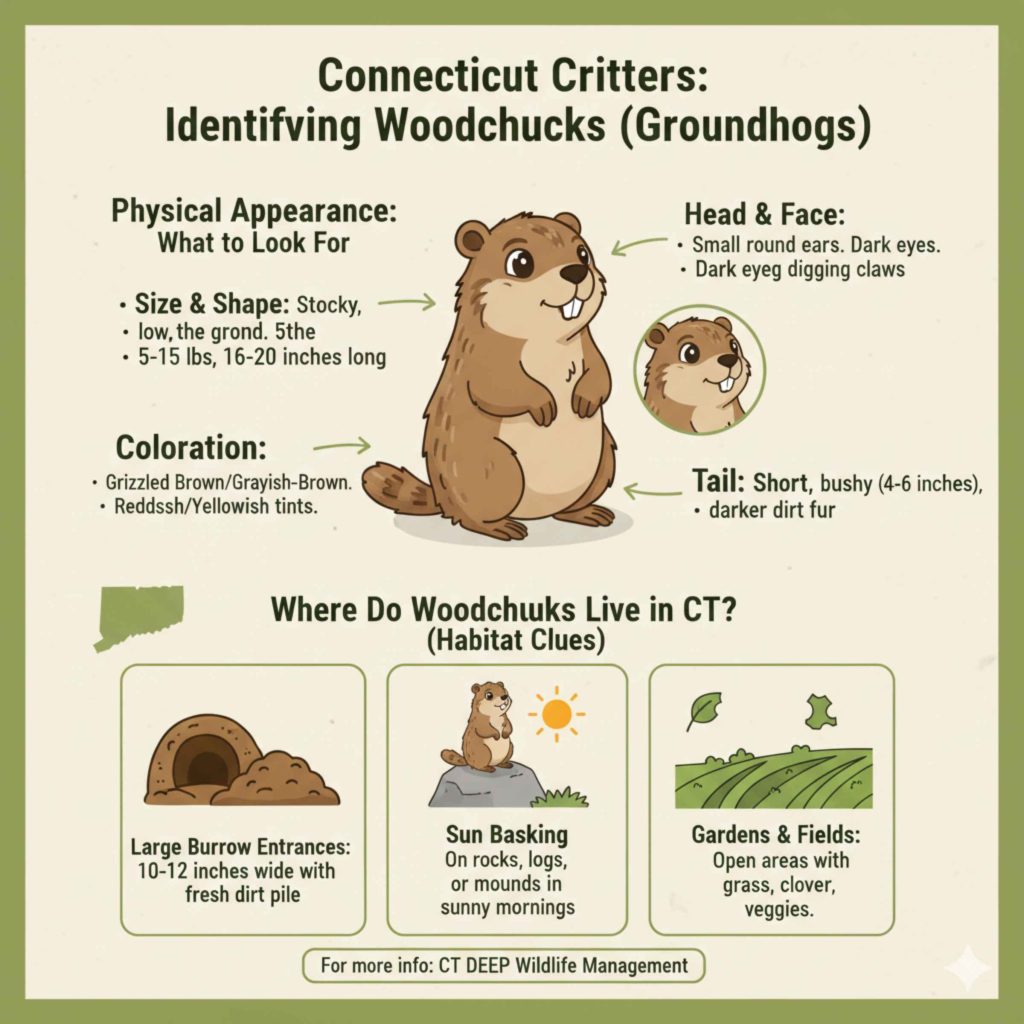
Woodchuck Physical Appearance: What to Look For
When trying to identify a woodchuck, think “stocky.” They are built low to the ground, perfect for digging impressive tunnel systems. They are not graceful; they are powerful and built for ground life.
- Size and Shape: Woodchucks are large rodents. An adult can weigh between 5 to 15 pounds and measure about 16 to 20 inches long, including their short, bushy tail. They look much heavier than they are because they are so densely built.
- Coloration: Their fur is generally coarse and shaggy. The color is usually a grizzled brown or grayish-brown. Sometimes, you might see reddish or yellowish tints mixed in, depending on the light and the individual animal.
- Head and Face: They have small, rounded ears that blend into their fur. Their eyes are small and dark. They have strong claws perfect for excavating soil.
- Tail: The tail is relatively short (only about 4 to 6 inches) and bushy, often darker than the body fur.
Where Do Woodchucks Live in CT? (Habitat Clues)
Habitat is a huge giveaway. If you see an animal near your foundation, under a shed, or munching on clover in a sunny, open area, it’s probably a woodchuck. They are terrestrial (land-dwelling).
Look for these signs:
- Large Burrow Entrances: A woodchuck hole is usually quite large—often 10 to 12 inches wide—and typically has a mound of freshly dug dirt piled up beside the entrance.
- Sun Basking: They love to sit up high on rocks, logs, or mounds of dirt on sunny mornings to survey their territory.
- Gardens and Fields: They prefer open spaces with easy access to food like grasses, clover, and vegetables. They are rarely found deep in dense forests or far from open land.
For more official information on wildlife management in the state, you can always check resources from the Connecticut Department of Energy and Environmental Protection (CT DEEP) regarding local mammal populations.
Identifying Muskrats in Connecticut
Muskrats are entirely different creatures, built for water. If you see something swimming quickly or sitting near the edge of a pond, marsh, or slow-moving stream, you are likely looking at a muskrat, not a woodchuck.
Muskrat Physical Appearance: Spotting the Differences
Muskrats are often mistaken for beavers or large rats, but they have distinct features that set them apart, especially their tail.
- Size and Shape: Muskrats are medium-sized rodents. They are much sleeker than woodchucks, typically weighing between 2 to 4 pounds and measuring 16 to 25 inches long, including their long tail. They look more streamlined for swimming.
- Coloration: Their fur is dense, glossy, and dark brown to blackish. This thick coat helps keep them waterproof.
- Head and Face: They have smaller ears that are often hidden in their fur, and their eyes are small. Their snout is slightly pointed.
- Tail: This is the biggest identifier! A muskrat’s tail is long (up to 11 inches), thin, flattened vertically (side-to-side), and scaly, not bushy like a woodchuck’s. They use this tail like a rudder when swimming.
Where Do Muskrats Live in CT? (Water Clues)
Muskrats are semi-aquatic. You will almost never find a muskrat far from a reliable water source in Connecticut.
Look for these signs near water:
- Lodges: They build dome-shaped huts (lodges) out of aquatic vegetation, mud, and sticks, often in the middle of a pond or marsh.
- Bank Burrows: They also dig burrows into stream or pond banks, but these entrances are usually right at the waterline, often partially submerged.
- Feeding Evidence: Look for partially eaten cattail stalks or lily roots floating near the water’s edge.
- Swimming Trails: They create visible trails through reeds and tall grass as they move between their lodge and feeding areas.
Side-by-Side Comparison: Woodchuck vs. Muskrat
To make things crystal clear, especially for those quick glances you get when looking out the window, here is a direct comparison of the key features. This table will help you instantly determine which animal you are observing in your Connecticut yard or near your local stream.
| Feature | Woodchuck (Groundhog) | Muskrat |
|---|---|---|
| Primary Habitat | Dry land, fields, yards, open areas. | Ponds, marshes, streams, ditches (near water). |
| Body Build | Stocky, heavy, low to the ground. | Sleek, streamlined, built for swimming. |
| Tail Appearance | Short, bushy, covered in fur. | Long, thin, vertically flattened, scaly (like a rat’s, but flatter). |
| Color | Grizzled brownish-gray, shaggy fur. | Dark brown to black, glossy, dense fur. |
| Tracks/Signs | Large, conspicuous dirt mounds near burrows. | Floating vegetation debris or lodges in the water. |
Behavioral Differences That Help Identification
Appearance isn’t the only way to tell them apart. Their daily activities and how they react to you or your presence are very different. Think about what the animal was doing when you saw it.
Woodchuck Activity Patterns
Woodchucks are diurnal, meaning they are most active during the day. This is when they leave their burrows to feed, bask in the sun, and scout for predators.
If you see one:
- They will usually freeze briefly if they spot you, then quickly retreat into their nearest hole, often letting out a loud whistle (hence the tongue-twister!).
- They spend a lot of time eating vegetation above ground.
- They are true hibernators and will be absent from late fall through early spring.
Muskrat Activity Patterns
Muskrats are primarily crepuscular, meaning they are most active at dawn and dusk. While you might see them during the day, especially if they are disturbed or hungry, evening is prime viewing time.
If you see one:
- They are usually seen swimming, often with only their head and back visible above the water line.
- They will often dive quickly if startled, disappearing underwater for several minutes.
- When feeding on land, they tend to stay very close to the water’s edge, chewing on reeds or grasses.
Beginner’s Guide to Dealing with Both Animals Safely
As a homeowner in Connecticut, you might find that either of these animals is causing issues, whether it’s burrowing under a patio (woodchuck) or chewing on pond liners or ornamental plants near the water (muskrat). Here is some simple, DIY-friendly advice on handling these situations.
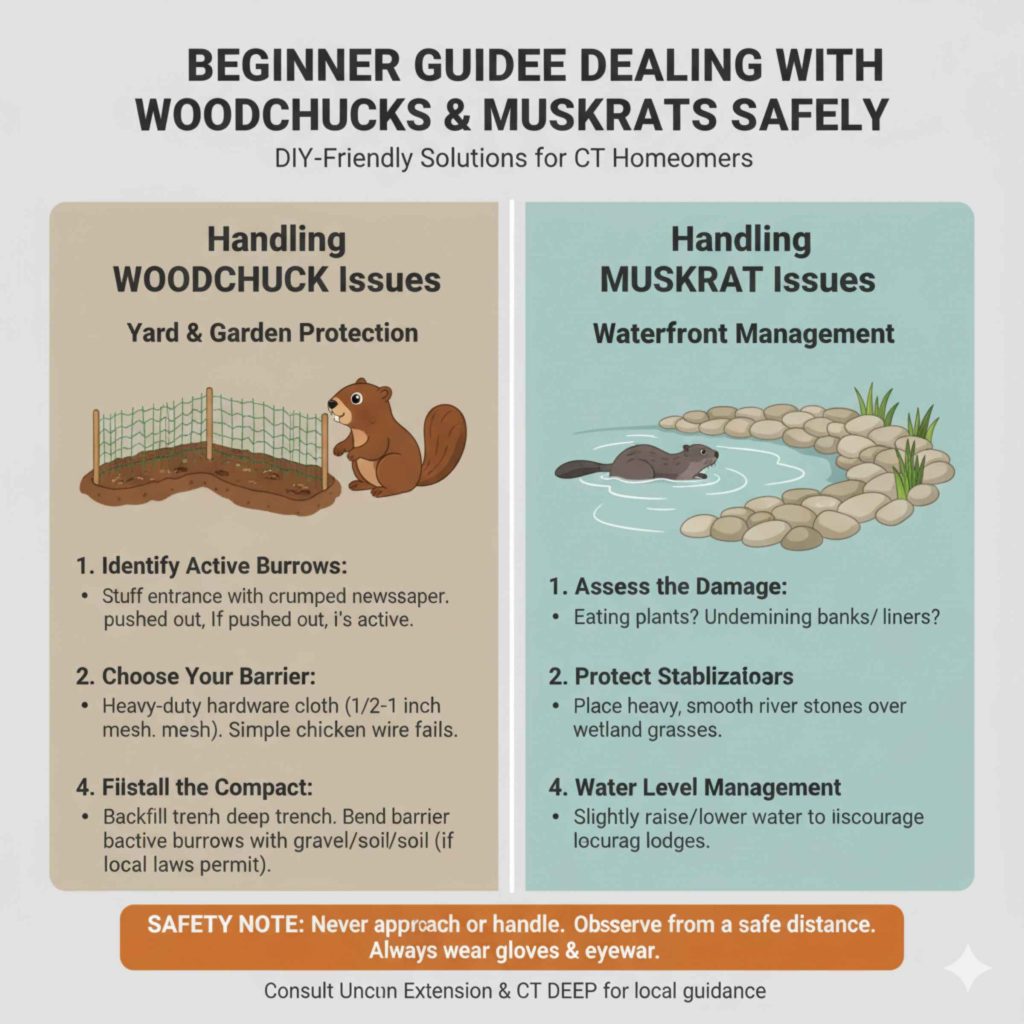
Handling Woodchuck Issues (Yard & Garden Protection)
Woodchucks love digging, and those large holes can be safety hazards, especially if they undermine structures. Before you start any exclusion project, remember that safety comes first. Always wear gloves and protective eyewear.
Steps for Safe Woodchuck Exclusion:
- Identify Active Burrows: Make sure the burrow is currently in use. Stuff the entrance lightly with crumpled newspaper. If the paper is pushed out by morning, the burrow is active.
- Choose Your Barrier: Woodchucks are strong diggers. Simple chicken wire won’t work. You need heavy-duty hardware cloth (1/2-inch or 1-inch mesh) buried deep.
- Install the Barrier: Dig a trench around the area you want to protect (like a garden bed or shed foundation) that is at least 18 inches deep. Bend the hardware cloth outward in an “L” shape away from the burrow entrance to discourage them from digging right next to the barrier.
- Fill and Compact: Backfill the trench. If you are filling an existing, active burrow (only do this if local regulations permit and you are certain it is empty of young), fill it with gravel or soil and compact it firmly.
For more information on wildlife control techniques that are humane and effective for homeowners, resources from university extension offices, such as those available through the University of Connecticut (UConn) Extension, often provide state-specific guidance on managing common pests.
Handling Muskrat Issues (Waterfront Management)
Muskrats cause problems by digging into earthen banks (leading to erosion or dam failure) or damaging aquatic plants or plastic liners in decorative ponds.
Steps for Water Edge Protection:
- Assess the Damage: Are they eating plants, or are they undermining a retaining wall or pond edge?
- Protect Pond Liners: If you have a liner, place heavy, smooth river stones or concrete blocks over the edges where they try to enter. Muskrats prefer soft entry points.
- Bank Stabilization: For eroding banks, planting native, deep-rooted wetland grasses can often discourage burrowing by making the bank too dense to dig easily.
- Water Level Management: If possible, slightly raising or lowering the water level can sometimes discourage them from building lodges, as they prefer stable water depths for construction.
Safety Note: Never attempt to approach or handle either animal. Woodchucks can bite fiercely, and muskrats, though generally timid, can carry diseases. Always observe from a safe distance.
Tool Check: What You Might Need for Yard Work Related to These Critters
While we aren’t building a shed today, dealing with burrowing animals often means digging and securing barriers. Having the right tools makes the job much easier and safer. Think of this as essential groundwork for any future DIY project!
| Tool | Why You Need It | Pro Tip for Digging |
|---|---|---|
| Round Point Shovel | Essential for digging the deep trenches needed to bury exclusion fencing. | Keep the edge sharp! A dull shovel makes digging clay soil twice as hard. |
| Heavy-Duty Work Gloves | Protects hands from sharp rocks, roots, and potential bites/scratches. | Get leather gloves that go up past your wrist for extra protection. |
| Hardware Cloth (1/2″ or 1″) | The only reliable barrier material against determined woodchucks. | Use galvanized steel to prevent rust when buried in damp soil. |
| Wire Cutters/Tin Snips | Needed to cut the hardware cloth to size for fitting around corners or obstacles. | Use long-handled cutters for better leverage when cutting thick wire mesh. |
Frequently Asked Questions (FAQ) for CT Homeowners
Q1: Can woodchucks and muskrats coexist on my property?
A: Yes, they can, but they rarely interact because they use different areas. A woodchuck will stay on dry land near its burrow, while a muskrat will stick to the pond or stream bank. If you have both, you are likely near both dry open space and water.
Q2: Do woodchucks hibernate in Connecticut?
A: Yes, they do! Woodchucks are true hibernators. They typically enter their deep sleep around October or November and emerge when the weather consistently warms up, usually late February or March. You won’t see them active in the middle of a harsh CT winter.
Q3: Are muskrats dangerous to dogs or cats?
A: While muskrats prefer to avoid conflict and flee into the water, they will defend themselves if cornered or if their young are threatened. They can bite. It is best to keep pets away from muskrat lodges or feeding areas, especially if you see kits (baby muskrats).
Q4: How can I tell if a hole in my yard belongs to a woodchuck or another animal like a fox?
A: Woodchuck holes are large (often 10 inches wide) and almost always have a significant mound of loose dirt piled right next to the entrance. Fox or coyote dens are usually smaller and less messy on the outside, as they often use existing holes or dig in less conspicuous spots.
Q5: I saw an animal swimming that looked like a small beaver. Was it a muskrat?
A: Most likely, yes! Muskrats are often confused with young beavers. The key difference is the tail. A beaver has a large, flat, paddle-shaped tail covered in scales. A muskrat has a long, thin, vertically flattened tail. If the tail looks like a thin rudder, it’s a muskrat.
Q6: Are woodchucks protected wildlife in Connecticut?
A: Woodchucks are classified as furbearers and are generally treated as common wildlife. They are not protected in the way endangered species are, but homeowners must still follow state and local regulations regarding trapping or relocation. Always check local ordinances before taking action.
Conclusion: Confidence in Identification
Now you have the tools and the knowledge to confidently tell the difference between a woodchuck and a muskrat right here in Connecticut. Remember the simple clues: Woodchucks are the chunky, daytime diggers of the dry fields, characterized by their bushy tails and large dirt piles. Muskrats are the sleek, dark swimmers of the water, instantly identifiable by their long, flattened, scaly tails.
Understanding which critter you are dealing with means you can choose the right, safe, and effective solution for your property—whether that means reinforcing a garden fence against a groundhog or stabilizing a pond bank against a muskrat. Taking the time to learn about our local wildlife helps us all live better alongside them. Go ahead, take a confident look outside, and enjoy knowing exactly what you are seeing!