When Does Festool Domino Patent Run Out? Key Dates Guide
The original Festool Domino is not covered by one worldwide patent. Older utility patents have expired or are expiring in some countries, but each patent family and each market still needs separate checking before anyone copies or sells compatibles. Miss that, and sales can get blocked, stock can get seized, or tools and tenons can turn out not to fit the legal or technical rules you assumed. This guide explains what patent expiration changes for woodworkers, dealers, and aftermarket makers, plus what still stays off-limits.
What the Festool Domino is and why people care about the patent


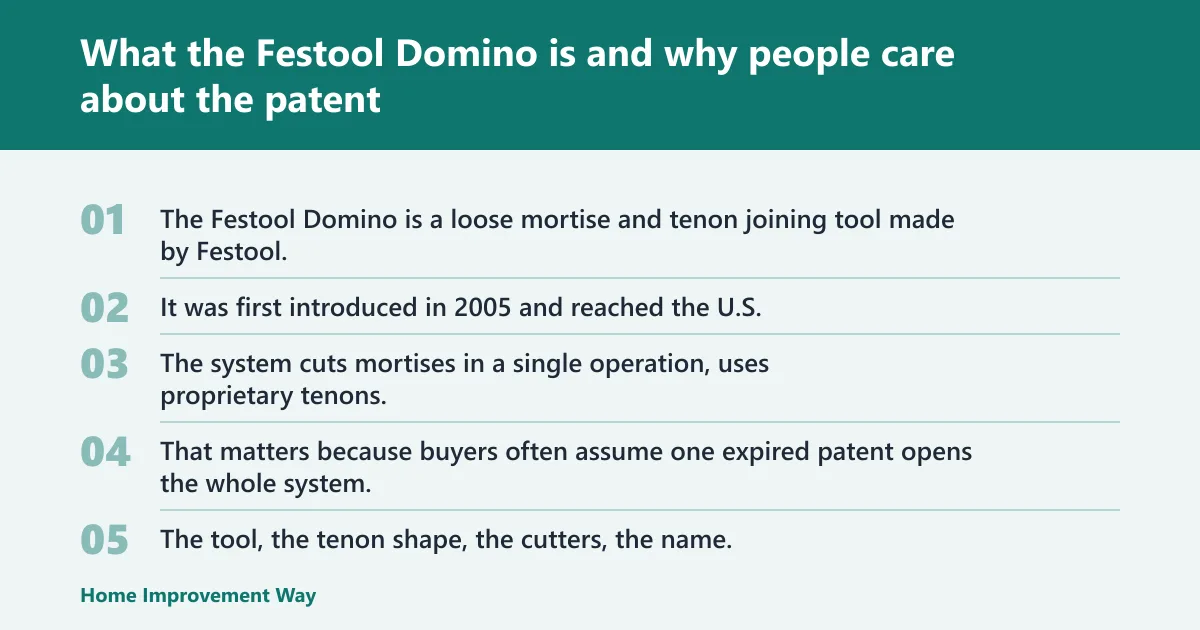
The Festool Domino is a loose mortise and tenon joining tool made by Festool. It was first introduced in 2005 and reached the U.S. market in 2007. The system cuts mortises in a single operation, uses proprietary tenons, and is stronger than a biscuit joiner in the joint types it targets.
That matters because buyers often assume one expired patent opens the whole system. It does not. The tool, the tenon shape, the cutters, the name, and the supply rules can each sit under different legal or commercial limits.
How the Domino differs from biscuits and dowels
A biscuit joiner makes a shallow slot for a wafer. A Domino cuts a mortise for a floating tenon, so the connection behaves more like traditional loose mortise and tenon joinery. Dowels can work well, but they need more layout care and usually more positioning steps.
The practical difference shows up in cabinet work, face frames, and light structural furniture parts. I see the Domino earn its keep because it speeds alignment without turning the joint into a simple glued butt joint.
Why proprietary tenons matter to buyers
Festool proprietary tenons are part of the ecosystem lock-in. The tenons use a standardized oval-shaped cross section, and the machine is built around that geometry. If you cannot buy the exact tenon or a true compatible substitute, the tool still works, but the system costs more and gives you less room to source parts.
That is why patent timing is only one part of the buying decision. Supply, dealer support, and aftermarket parts matter just as much.
📊 The Domino was first introduced in 2005. Source: Domino joiner.
When does the Festool Domino patent run out?
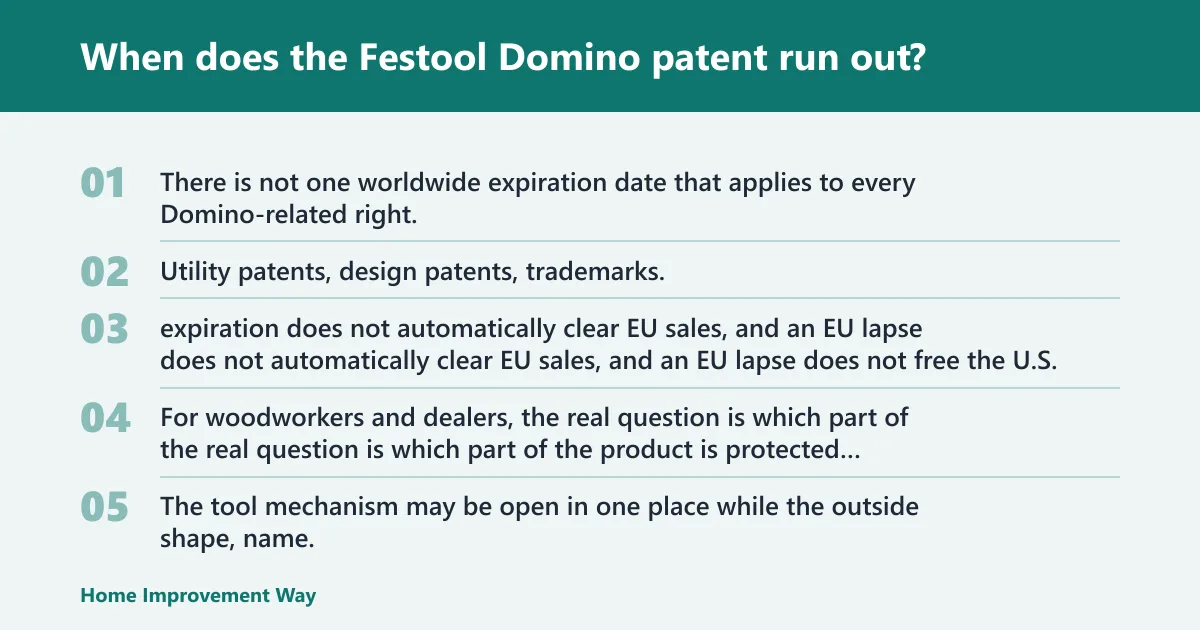
There is not one worldwide expiration date that applies to every Domino-related right. Utility patents, design patents, trademarks, and supply contracts can run on different timelines, and those timelines may vary by country. A U.S. expiration does not automatically clear EU sales, and an EU lapse does not free the U.S. market.
For woodworkers and dealers, the real question is which part of the product is protected in which market. The tool mechanism may be open in one place while the outside shape, name, or replacement supply chain stays protected elsewhere.
Why there may be more than one patent date
Manufacturers often file a family of patents, not a single filing. One can cover the internal cutter and mortise-making method. Another can cover the housing shape or fence arrangement. A third may cover a later size range or accessory detail.
That means the answer changes with the exact claim being discussed. Patent law looks at claims, not the marketing name on the box.
U.S. versus EU timing differences
Patents are territorial. A right that expires in the United States can still be alive in Europe, the United Kingdom, or another country with its own filing and term rules. The same product may also be treated differently if a later filing covers a change to the larger Domino system.
Buyers importing aftermarket parts need to check the destination market, not just the source market. Sellers need the same discipline in reverse.
Why an expired patent does not always mean open copying
When one patent expires, only the claims in that patent fall away. Trademark rights can still bar use of the Festool name or confusingly similar branding. Design rights can still limit the look of the machine. Contract terms can still control authorized dealer supply and warranty coverage.
So “expired” should be read as “one layer of protection may be gone,” not “everything is free.”
What the original Domino patent likely covered
The core coverage centered on the mechanism that cuts a mortise in a single operation and the system built around a floating-tenon joint. The concept came from German master cabinetmaker Vitus Rommel, and Festool turned that idea into a compact hand-operated joinery system with controlled fence, depth, and angle settings.
Patent readers should separate the method from the machine body and the accessories. That distinction matters when someone tries to copy the joiner, sell compatible tenons, or make a machine that behaves similarly without using the same protected claims.
Tool mechanism versus cutter geometry
A utility patent can cover how the cutter moves, how the fence registers, or how the mortise is formed. It may also cover combinations of those steps. Cutter geometry is different. A specific bit shape, arbor interface, or wear profile can be claimed separately or not at all.
If a competitor changes the mechanism but keeps the same general result, the legal outcome depends on the exact claims and jurisdiction. That is why clone tools are rarely a simple copy-paste issue.
Tenon shape and accessory claims
The original Domino series used cutter sizes from 4 mm to 10 mm, with tenon sizes from 4×20 mm up to 10×50 mm. The later large Domino system allowed tenon sizes up to 14×140 mm. Those size ranges can matter for patent scope, and they also matter for compatibility and dealer stock. (en.wikipedia.org)
Accessory claims may cover only certain cutter bodies, fence stops, depth settings, or dust-extraction interfaces. A part can be technically useful and still not legally safe to sell under the Festool name.
Utility patent, design patent, and trademark distinctions
A utility patent protects how something works. A design patent protects how it looks. A trademark protects the brand name, logo, and source identity. These rights can overlap on the same product, which is why one expired filing does not turn the whole line into public property.
In practical sourcing terms, a finished clone tool might avoid the utility claims but still risk a design-right problem if it copies the housing too closely or a trademark problem if it uses Domino branding.
Did the Domino patent expire in 2025?
A 2025 date could be correct for one patent in one country, but it should not be treated as the universal end of protection. The right question is which patent, filed where, on what date, and for which claims. The market impact also depends on whether that filing was utility, design, or something narrower.
If someone says “the patent expired in 2025,” ask for the jurisdiction and patent number. Without that, the statement is too vague to guide a purchase or a product launch.
How to check patent records before buying or copying
- Identify the exact product feature in question: body shape, cutter design, tenon geometry, or accessory fit.
- Search the patent family, not just a single record.
- Check the filing country and the destination country separately.
- Confirm whether the relevant claim is utility, design, or trademark-related.
- Review whether the seller also depends on contract supply or dealer authorization.
That sequence avoids the common mistake of treating a search result as a green light for sale.
What still may be protected after one patent ends
Even after one patent ends, the branded tenons can remain tied to proprietary sourcing. Replacement parts may still be distributed only through authorized channels. The name “Domino” can remain a protected brand identifier. And the original series may still depend on external dust extraction, which is a technical constraint rather than a patent issue.
Those limits affect real-world buying more than people expect. A part can be legal to make and still hard to sell profitably.
Patent-status decision table: what can change for tools, tenons, and accessories
This table shows the most likely practical changes by intellectual property type. It does not guarantee legality in any one market, but it does show what usually becomes possible and what usually stays restricted.
| IP type | What may change | Tools | Tenons | Compatible accessories |
|---|---|---|---|---|
| Utility patent expires | The claimed cutting method or mechanism may be copied where no other right blocks it. | Clone joiners may appear with similar function. | Aftermarket tenons may be easier to justify if they do not infringe other claims. | Bits, fences, and stops may become available in closer-fit third-party versions. |
| Design patent expires | The outer appearance may be copied more freely. | More visually similar housings may enter the market. | Usually little direct effect unless the package design matters. | Accessory styling may also become more open. |
| Trademark remains | The brand name and confusing look-alike marketing stay restricted. | Tools cannot be sold as Festool or as likely-to-confuse look-alikes. | Tenons cannot be branded as genuine Festool unless they are. | Packaging and listing language remain policed. |
| Contract or supply lock-in stays | Authorized channels still control dealer access, warranties, and some parts. | Original tool sales may stay tied to dealer networks. | Original tenons may still be sold only through chosen channels. | Some parts remain unavailable outside official supply. |
What changed for woodworkers after patent expiration or time passage
When patent pressure drops, the first visible changes are usually in accessories and price competition, not in a flood of perfect clones. Some aftermarket makers start offering compatible tenons or replacement parts. Others produce cutters or setup aids that fit the workflow without copying the whole machine.
For buyers, that can mean lower prices, more availability, and more choice. It does not automatically mean the same fit, finish, or dealer support.
Compatible tenons and aftermarket parts
Compatible tenons are the most likely after-market opportunity because the original system requires proprietary tenons. If the legal path clears in a given market, makers can target the standardized sizes and shapes that woodworkers already use. That said, fit matters. Loose stock can weaken the joint and oversized stock can jam.
Replacement dust ports, fences, depth stops, and case inserts may also appear. Some will work well. Others will be copies in name only.
Clone tools and what they can legally copy
Clone tools can borrow the general idea of a floating-tenon joiner if the relevant claims have expired or do not apply in that market. They still cannot copy protected branding, and they may need to alter the outside design, controls, and accessory interface to stay clear of active rights.
That is why two tools can do similar work while looking and feeling very different. Legal clearance and engineering choices are linked.
Dealer pricing, warranties, and support
After patent expiration, pricing often shifts unevenly. Dealers may discount original stock to defend share. Aftermarket sellers may undercut on tenons and wear parts. Warranties and factory support usually stay tied to the original brand, not the copied function.
For a buyer, the cheapest tenon is not always the cheapest system if fit problems waste time or cause joint failure.
What sizes does the Domino system use and which jobs fit each one?
The original Domino cutter sizes ran from 4 mm to 10 mm, with tenon sizes from 4×20 mm up to 10×50 mm. The larger Domino system expanded the range to tenon sizes up to 14×140 mm. Those size bands are what make the tool useful for both small cabinet parts and heavier carpentry work.
Choosing the right size is a workflow decision, not a brand-loyalty one. Small parts need a different approach than door frames, casework, or structural furniture members.
Original Domino sizes for cabinetmaking and casework
The smaller range fits face frames, shelf pins in some workflows, drawer parts, and light furniture joinery. Smaller mortises preserve more material around the joint and are easier to place in narrow stock. They also put less demand on extraction and clamping than larger work.
Because the system uses proprietary tenons, the size you choose also determines what you need to keep in inventory.
Large Domino sizes for carpentry use cases
The larger tool extends the system into heavier joinery, including bigger cabinet parts and carpentry applications. Tenons up to 14×140 mm give more glue surface and more holding area where stock thickness allows it. That is one reason the system moved beyond hobby cabinet work.
For the buyer, the larger system raises a separate sourcing issue. Bigger stock means fewer compatible third-party options at first, even when patent timing improves.
External dust extraction and operating limits
The original series cannot operate without external dust extraction. That is not a small footnote. It affects portability, jobsite setup, and how attractive the tool is for users who want a simple grab-and-go joiner.
When comparing clones or alternatives, check whether extraction is built in, optional, or mandatory. That constraint often tells you more about the real-world workflow than the brochure does.
Frequently asked questions
When does the Festool Domino patent run out?
There is no single worldwide date. The Domino involves multiple rights that can expire at different times in different places. A utility patent may end before a design or trademark issue does. Before copying or selling compatibles, check the exact patent family and the country where you want to sell.
Is the Festool Domino still patented?
It may still be protected by some patents, design rights, trademarks, or supply restrictions depending on the jurisdiction and the feature in question. One expired filing does not free the whole product. Buyers and sellers need to separate the tool mechanism, appearance, branding, and accessory chain.
What did Festool Domino patent cover?
The core coverage focused on the joinery mechanism that cuts a mortise in a single operation and works with a floating-tenon joint. Other claims may have covered the fence, cutter arrangement, housing, or size-specific accessories. The exact answer depends on the claim language, not the product name alone.
Did the Domino patent expire in 2025?
That can apply to one filing, in one country. That is not enough to say the system is open everywhere. Patent terms vary by jurisdiction, and different filings can cover different parts of the tool. A 2025 date should be treated as a clue, not a final answer.
What changed after the Festool Domino patent expired?
Where protection has lapsed, woodworkers may see more compatible tenons, replacement parts, and clone tools. Prices can soften, and aftermarket choices can grow. But the brand name, some design elements, and dealer-controlled supply can still remain restricted, so the whole ecosystem does not become free overnight.
What sizes does the Domino system use?
The original tool supported cutter sizes from 4 mm to 10 mm, with tenons from 4×20 mm up to 10×50 mm. The larger Domino system later allowed tenon sizes up to 14×140 mm. Those ranges cover fine cabinet work and much heavier carpentry tasks.
Who invented the Festool Domino concept?
The concept came from German master cabinetmaker Vitus Rommel. Festool turned that idea into the Domino system sold today. That distinction matters because an idea originator, a patent holder, and a manufacturer are not always the same party in practical legal terms.
Sponsored / affiliate links. As an Amazon Associate I earn from qualifying purchases. I may earn additional commission from eligible campaigns.
 Rain Guard Wood Sealer Concentrate | Makes 2 Gallon | Protects Wood from Water Damage, Rotting, and Stains | Water Based Silane/Siloxane | Eco-Friendly | VOC-Free | Natural Finish
 YUCHENGTECH Ionizing Air Blower Static Eliminator Fan Desktop Ionizer Air Blower with Detachable Cord ESD Ionizer Electrostatic Discharge Fan 110V