Who Is Responsible For Street Lights: Essential Guide
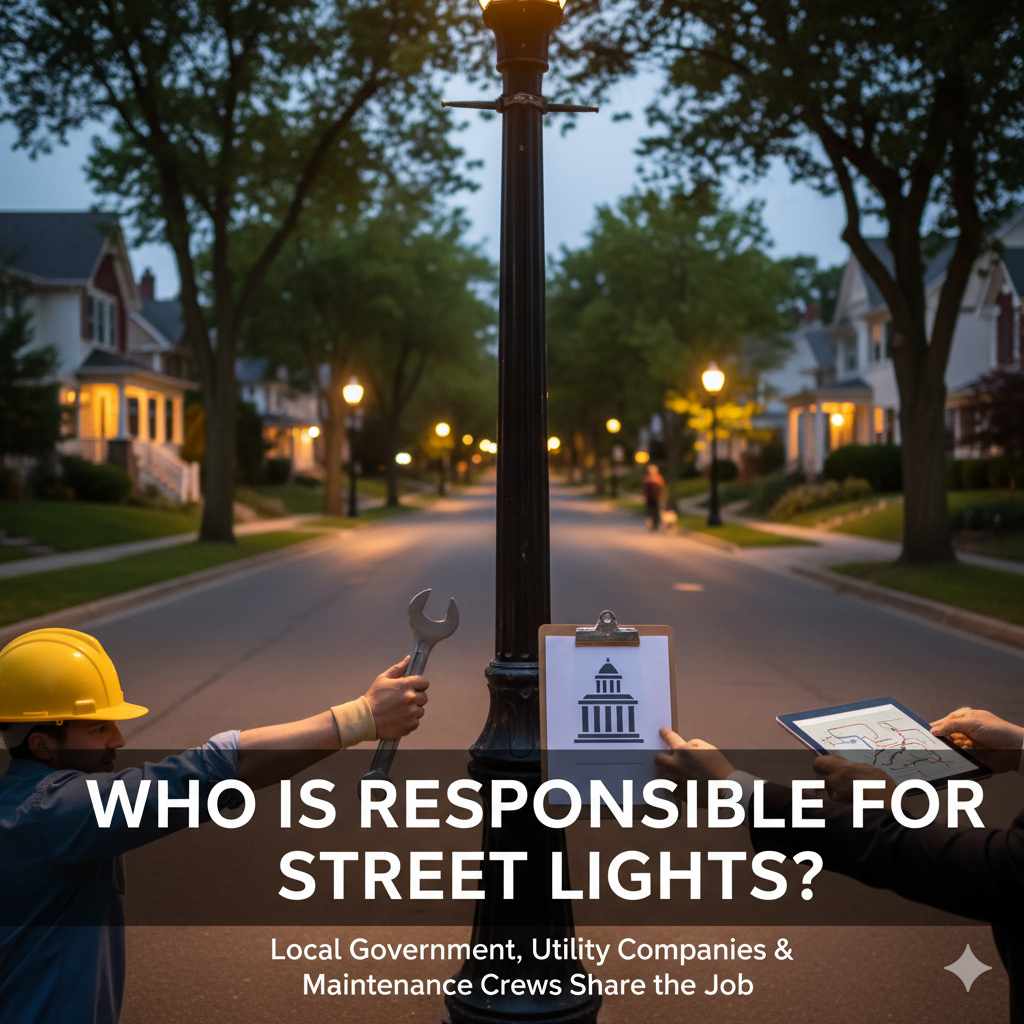
Quick Summary: Typically, the local government or a designated utility company is responsible for street lights in a neighborhood. This guide breaks down who handles installation, maintenance, and reporting issues to ensure your streets stay safely lit.
Ever find yourself wondering who to call when a street light flickers out or stays on all day? It’s a common question, and the answer can sometimes feel a bit murky. Living in a well-lit neighborhood contributes to our sense of safety and security, especially when we’re out for an evening stroll or returning home after dark. When those lights aren’t working, it’s not just an inconvenience; it can be a real concern. But don’t worry! We’re going to shine a light on who’s actually in charge of those glowing sentinels above us, making it easy for you to know exactly what to do if you spot a problem. Let’s get this sorted out, so you feel confident about keeping your neighborhood bright.
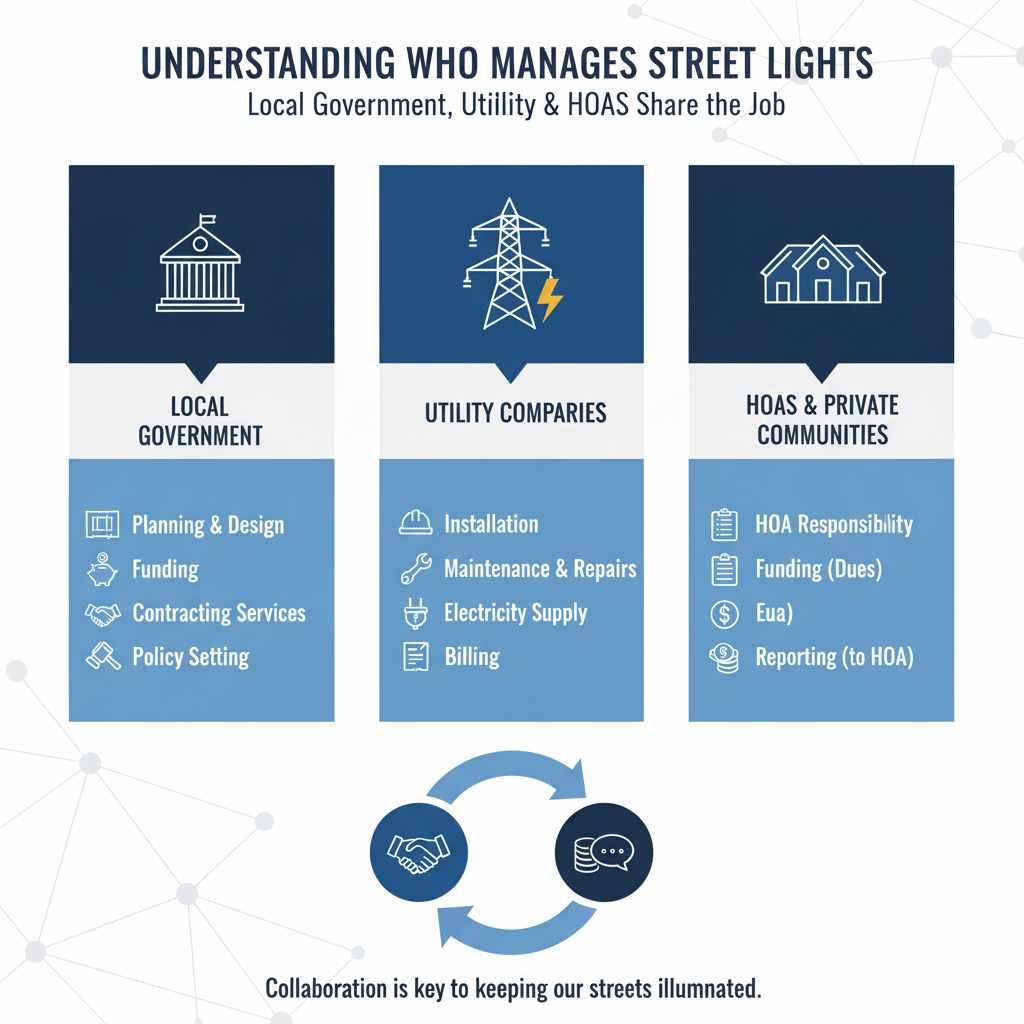
Understanding Who Manages Street Lights
The responsibility for street lights usually falls into a few main categories, depending on where you live and the specific setup of your area. It’s not always as simple as just one entity. Think of it like different tools for different jobs in your workshop – each has its purpose and its owner. Most often, you’ll find that your local municipality (like your city or town council) or a regional power utility company is the primary caretaker of street lights. They work together, or one takes the lead, to ensure these essential fixtures are installed, maintained, and kept in good working order.
This division of responsibility ensures that the infrastructure is managed by those with the expertise and resources to do so effectively. It’s about keeping things running smoothly, much like how you’d expect a professional to handle complex electrical work in your home. Let’s break down the typical players involved.
The Role of Local Government
Your local government, whether it’s a city, town, or county, often plays a significant role in street lighting. They are usually responsible for the initial decision-making process regarding where street lights are needed, the type of lights to be installed, and the overall lighting plan for public roads and areas. This includes:
- Planning and Design: Deciding on the placement and type of street lights to ensure adequate illumination for safety and security.
- Funding: Allocating budget for the installation, operation, and maintenance of street lights. This often comes from local taxes.
- Contracting Services: In many cases, local governments contract with utility companies or specialized lighting contractors to perform the actual installation and maintenance work.
- Policy Setting: Establishing policies related to light pollution, energy efficiency, and operational hours of street lights.
Think of them as the project managers for your neighborhood’s street lights. They set the standards and ensure the work gets done, even if they don’t do all the hands-on tasks themselves. This is a common approach, similar to how a homeowner might hire a contractor for a big renovation project.
The Utility Company’s Involvement
The local power company, also known as an electric utility, is almost always involved in street lighting. They own and maintain the poles, the electrical infrastructure, and often the lights themselves. Their involvement is crucial because they manage the power supply and the physical equipment.
Here’s what they typically handle:
- Installation: Physically installing the street lights on their poles or dedicated lighting poles.
- Maintenance and Repairs: Responding to outages, replacing bulbs, fixing damaged fixtures, and performing regular inspections.
- Electricity Supply: Providing the power necessary for the lights to operate.
- Billing: They typically bill the municipality or a designated authority for the electricity consumed and the maintenance services provided.
It’s important to note that while the utility company maintains the lights, the decision to install or repair them often comes from a request or order from the local government or the public reporting an issue. They are the skilled technicians who keep the lights burning bright.
Homeowners Associations (HOAs) and Private Communities
In some planned communities or private developments, a Homeowners Association (HOA) might be responsible for street lighting. This is more common in newer developments or areas where the infrastructure is privately owned rather than being adopted by the municipality.
If your neighborhood has an HOA:
- HOA Responsibility: The HOA board or management company may contract with a lighting service or utility company for the installation and upkeep of street lights.
- Funding: Costs are usually covered by HOA dues.
- Reporting: You would typically report issues directly to your HOA management.
This setup is similar to how an HOA might manage other community amenities like pools or landscaping. They are responsible for maintaining the shared spaces and services for the residents.
How to Report a Street Light Problem
Spotting a street light that’s out, flickering, or on during the day can be frustrating. Knowing who to contact is the first step to getting it fixed. The process is usually straightforward, and many municipalities and utility companies have made it easier than ever with online tools.
Step-by-Step Guide to Reporting an Issue
Here’s a general guide on how to report a faulty street light:
- Identify the Location: Note the exact address or intersection where the street light is malfunctioning. If there’s a pole number, even better! It’s often printed on a small metal tag on the pole itself.
- Determine the Responsible Party: This is the trickiest part, but we’ll cover how to figure it out. In most cases, it’s either your city/town hall or your local power utility.
- Gather Information: Have the location details ready. If you have the pole number, include that. Describe the problem (e.g., “light is out,” “light is flickering,” “light stays on during the day”).
-
Contact the Right Authority:
- Option A: Your Local Government Website: Many cities and towns have a “Report a Problem” or “Public Works” section on their official website. This is often the best starting point. Look for options related to “street lights,” “lighting issues,” or “public infrastructure.”
- Option B: Your Utility Company Website: If you know your local power provider, check their website. They often have a dedicated portal for reporting street light outages. You can usually find this under “Outages,” “Street Lights,” or “Report an Issue.”
- Option C: Phone Call: If online reporting isn’t available or you prefer to speak to someone, find the non-emergency phone number for your city’s public works department or your utility company’s customer service line.
- Submit Your Report: Follow the instructions provided by the website or representative. Be clear and concise.
- Note Your Report Number: If you receive a confirmation or reference number, keep it handy. This can be useful if you need to follow up.
It’s helpful to know that utility companies often have specific teams dedicated to maintaining street lights, and they usually track these reports to prioritize repairs. Your report helps them identify problems quickly and efficiently.
Finding the Right Contact Information
Figuring out who to contact can sometimes feel like a treasure hunt. Here are some tips to help you:
- Check Your Utility Bill: If you receive electricity from a local utility, their name and contact information will be on your bill. Visit their website.
- Visit Your City/Town Website: Search for “[Your City/Town Name] street lights” or “[Your City/Town Name] public works.” You’ll likely find a dedicated page or contact form. For example, the New York City Department of Transportation has a detailed page on their street lighting system and how to report issues.
- Look at Nearby Poles: Sometimes, there’s a sticker or plaque on the street light pole itself with contact information or a unique identifier.
- Ask Your Neighbors: If you’re unsure, your neighbors might know who to contact, especially if they’ve reported issues before.
Remember, a well-lit street benefits everyone. Reporting a problem is a great way to contribute to your community’s safety and well-being.
Factors Influencing Street Light Responsibility
The exact entity responsible for street lights isn’t always set in stone and can vary based on several factors. It’s like choosing the right wood for a project – different types are suited for different needs and situations.
Ownership of Infrastructure
A key factor is who owns the physical infrastructure – the poles and the electrical lines. In most areas:
- Utility Company: The power company typically owns the poles and the underground or overhead electrical distribution system. This makes them the logical choice for maintaining the lights attached to their infrastructure.
- Municipality: In some older cities or specific public works projects, the municipality might own dedicated street light poles and underground conduits, contracting out the maintenance.
This ownership dictates who has the primary right and responsibility to access and work on the equipment.
Type of Road or Area
The classification of the road or area can also determine responsibility:
- State Highways: Lights on state highways are often maintained by the state’s Department of Transportation (DOT), not the local city or town.
- Local Streets: Lights on residential streets and local roads are typically the responsibility of the city or town.
- Private Roads: Lights on private roads within gated communities or commercial parks are usually the responsibility of the property owner, HOA, or a private management company.
Understanding the road type helps you direct your report to the correct agency.
Contracts and Agreements
Local governments and utility companies have formal agreements outlining their respective roles and responsibilities for street lighting. These contracts specify:
- Who pays for the electricity.
- Who is responsible for maintenance and repair response times.
- The types of lighting fixtures to be used.
- The service level agreements.
These contracts are crucial for ensuring coordinated service and accountability.
Maintenance and Repair Processes
Once a problem is reported, a process kicks in to get the street light fixed. This process is designed to be efficient, ensuring that essential public infrastructure is restored quickly.
How Repairs Are Typically Handled
When you report a street light issue, here’s what generally happens:
- Report Logging: Your report is logged into a system, often by a customer service representative or through an online portal.
- Assignment: The issue is assigned to a specific crew, usually within the utility company or a contracted maintenance provider.
- Scheduling: Repairs are often scheduled based on urgency and crew availability. Critical issues or areas with multiple outages might be prioritized.
- Dispatch: A technician or crew is dispatched to the location to diagnose and fix the problem. This could involve replacing a bulb, a ballast, a photocell, or repairing wiring.
- Confirmation: Once the repair is complete, it’s usually marked as resolved in the system.
Response times can vary. Some municipalities or utilities guarantee a certain response time for reported outages, especially in areas where poor lighting could pose a safety risk. The U.S. Department of Energy provides information on advancements in street lighting technology and efficiency, which can influence maintenance practices.
Common Causes of Street Light Malfunctions
Street lights can fail for a variety of reasons. Understanding these can help you describe the problem more accurately:
- Bulb Failure: Like any light bulb, street light bulbs have a lifespan and eventually burn out.
- Ballast Issues: The ballast is a device that regulates voltage to the lamp. If it fails, the light won’t work.
- Photocell Malfunction: The photocell (or dusk-to-dawn sensor) tells the light when to turn on and off. If it’s faulty, the light might stay on constantly or not come on at all.
- Wiring Problems: Damage to the electrical wiring, either from weather, accidents, or wear and tear, can cause outages.
- Power Surges or Outages: Electrical disturbances can sometimes damage components or cause lights to go out.
- Vandalism or Accidental Damage: Unfortunately, lights can be damaged by vehicles or deliberate acts.
Knowing these common causes can help you communicate the issue effectively when you report it.
Table: Who is Responsible for Street Lights?
Here’s a handy table summarizing who typically handles different aspects of street lights:
| Aspect | Local Government (City/Town) | Utility Company | HOA/Private Management |
|---|---|---|---|
| Planning & Policy | Primary | Consultative | Primary (within private areas) |
| Installation | Contracts out / Oversees | Performs / Owns infrastructure | Contracts out / Oversees |
| Maintenance & Repair | Oversees / Funds | Primary (on their infrastructure) | Contracts out / Oversees |
| Electricity Supply | Pays for usage (via contract) | Provides | Pays for usage (via contract) |
| Reporting Issues (Public) | Often first point of contact / directs to utility | Direct contact for outages on their infrastructure | Direct contact |
This table provides a general overview. Always confirm with your local authorities or utility provider for the most accurate information in your specific area.
Modern Street Lighting and Technology
Street lighting technology has come a long way! We’re moving beyond simple incandescent bulbs to more efficient and smarter solutions. These advancements can also influence who is responsible for maintenance and upgrades.
LED and Smart Lighting
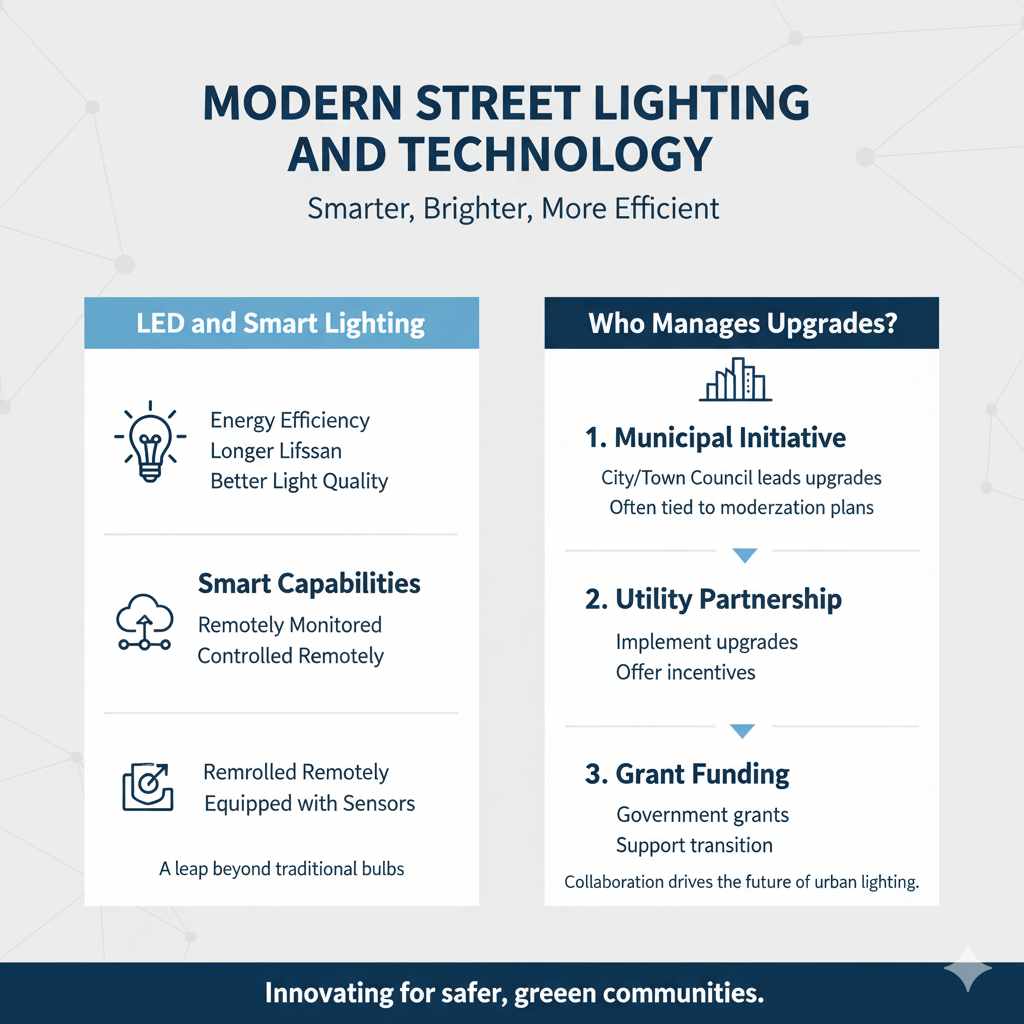
Many municipalities are transitioning to Light Emitting Diode (LED) street lights. LEDs offer:
- Energy Efficiency: They use significantly less electricity than traditional bulbs, saving money and reducing environmental impact.
- Longer Lifespan: LEDs last much longer, meaning fewer replacements and less frequent maintenance.
- Better Light Quality: They provide brighter, more uniform light, improving visibility.
Beyond LEDs, “smart” street lights are becoming more common. These lights can be:
- Remotely Monitored: Allowing utility companies to detect outages instantly.
- Controlled Remotely: Dimming or brightening lights based on traffic or time of day.
- Equipped with Sensors: Gathering data on traffic, air quality, or even acting as Wi-Fi hotspots.
The implementation of these advanced systems often involves new contracts and responsibilities between the city and the utility provider. The Smart Cities Dive website often covers news and trends in smart city technologies, including lighting.
Who Manages Upgrades?
When it comes to upgrading to newer technologies like LEDs or smart lighting:
- Municipal Initiative: Often, the city or town council will initiate and fund these upgrades as part of a broader plan to modernize infrastructure and improve energy efficiency.
- Utility Partnership: Utility companies are frequently involved in the implementation, either by performing the work or partnering on the project. They may also offer incentives or programs to help municipalities make the switch.
- Grant Funding: Governments at various levels may offer grants to help cities and towns fund these technological transitions.
These upgrades represent a significant investment, and the responsibility for managing them typically lies with the local government, working in close collaboration with their utility partners.
Frequently Asked Questions (FAQ)
Q1: How do I know if my street light is on my property or public property?
A1: Street lights are almost always installed on public property or easements. The pole and the light fixture itself are typically owned and maintained by the municipality or the local utility company, not the homeowner. If it’s on a pole along the street, it’s almost certainly public infrastructure.
Q2: What if a street light is shining directly into my bedroom window?
A2: While you can report it, addressing light pollution or glare can be complex. Your first step is to contact your local municipality’s public works or planning department. They may have policies on light trespass or be able to adjust the light’s direction or intensity if feasible. Sometimes, solutions like planting trees or using window coverings are recommended.
Q3: How long does it usually take to get a street light fixed?
A3: Response times vary. Simple fixes like bulb replacements might be done within a few days. More complex issues or those requiring specialized equipment could take longer. Urgent safety concerns, like a light out in a dangerous intersection, are usually prioritized. Your local government or utility company can provide an estimated timeframe.
Q4: Can I report a street light issue anonymously?
A4: Many online reporting systems allow for anonymous submissions, or you can request anonymity when calling. However, providing your contact information can be helpful if the repair crew needs clarification on the location or problem.
Q5: Who is responsible for decorative street lights in historic districts?
A5: Responsibility for decorative street lights can vary. In some cases, the municipality manages them as part of their public works. In others, especially in designated historic districts, a special management district or historical society might oversee their maintenance, often in coordination with the local government and utility company.
Q6: What should I do if a street light is damaged by a car accident?
A6: If a street light pole is damaged due to an accident, you should report it immediately to both the police (for the accident report) and your local public works department or utility company. They will need to assess the damage and ensure the area is safe before repairs can be made. If you were involved in the accident, this reporting would be part of the process.
Conclusion
Navigating the world of street lights might seem like a small detail, but it’s an important part of keeping our communities safe and welcoming. We’ve seen that the responsibility for these glowing fixtures typically rests with your local government and/or the local utility company, with HOAs playing a role in private communities. They work together, managing everything from planning and installation to the crucial tasks of maintenance and repair.
Knowing who to call when a light is out – usually your city’s public works department or your power utility – is key to getting it fixed promptly. Whether it’s a simple bulb change or a more complex technological upgrade to LEDs or smart lighting, these entities are dedicated to keeping our streets illuminated. So, the next time you notice a flickering light or a dark patch on your street, you’ll know exactly who to reach out to. Your simple report can make a big difference in ensuring safety and visibility for everyone in your neighborhood. Keep those streets bright!