Cost to Remove Carpet Install Hardwood
Many folks wonder about the Cost to Remove Carpet and Install Hardwood. It can seem like a big project, and figuring out prices can be tricky if you’re new to home improvements. You might feel unsure where to start or what factors affect the total cost.
Don’t worry, though! We’ll walk through it step by step, making it easy to understand. Get ready to see how simple it can be to plan your beautiful new hardwood floors.
Understanding The Cost to Remove Carpet and Install Hardwood
This section breaks down the main expenses involved when you decide to swap out your old carpets for a new hardwood floor. Knowing these costs upfront helps you budget wisely and avoid surprises. We’ll look at the price of taking out the carpet, preparing the subfloor, buying the hardwood, and the labor to put it all down.
This overview will give you a clear picture of what you’re paying for.
Carpet Removal Expenses
Removing old carpet might seem simple, but it has its own costs. You might pay for the labor to pull it up, especially if it’s glued down or in large sections. Disposal fees are also common; you’ll need to get rid of the old carpet and padding.
Some companies charge extra if there’s heavy furniture that needs to be moved. The type of carpet and how it was installed can also affect how long removal takes and how much it costs.
For example, carpet tiles can be easier to remove than a large, wall-to-wall glued carpet. The more difficult the removal, the higher the labor cost will be. Think about whether you can do some of this work yourself to save money.
Sometimes, the flooring installer will include carpet removal in their quote, but it’s always good to check if it’s a separate line item.
Factors Affecting Carpet Disposal Costs
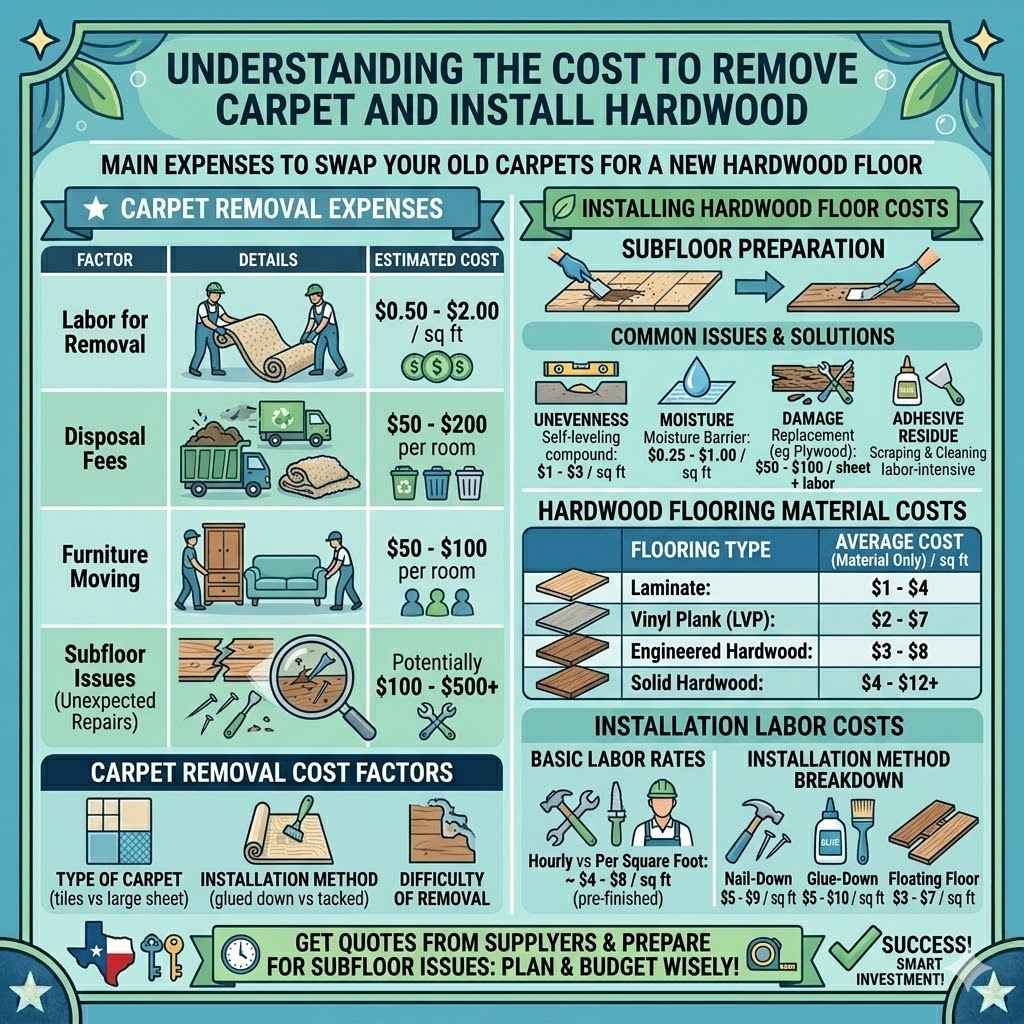
Labor for Removal: This is the hourly rate charged by professionals to take up the carpet.
Professional installers will charge for their time to carefully remove the carpet and any underlayment. This can range from $0.50 to $2.00 per square foot, depending on the complexity of the removal and your location.
Disposal Fees: Charges for taking the old carpet to a landfill or recycling center.
Landfills often charge by weight or volume for construction debris. Expect to pay anywhere from $50 to $200 for the disposal of a typical room’s worth of carpet and padding.
Furniture Moving: Additional cost if installers need to move heavy items.
If you can’t move furniture yourself, the installers might charge an extra $50 to $100 per room for this service.
Subfloor Issues: Unexpected repairs needed after carpet removal.
Sometimes, removing carpet reveals damage to the subfloor, like warped wood or nail pops. Repairing these issues adds to the overall cost, potentially another $100 to $500 or more.
Subfloor Preparation
Before laying down hardwood, your subfloor needs to be in great shape. This means it should be level, clean, and free from any damage. If there are old nails sticking up, they need to be hammered down or removed.
If the subfloor isn’t smooth, you might need to sand it or even add a new layer of plywood. A good subfloor is key for a beautiful and long-lasting hardwood floor.
Sometimes, the subfloor is just fine after the carpet is gone. Other times, you might find old adhesive or debris that needs scraping. For floating floors, a very flat subfloor is essential.
For floors that are glued or nailed down, a sturdy and even surface is also very important. Skipping proper subfloor prep can lead to squeaky floors or boards that warp over time.
Common Subfloor Issues and Solutions
Unevenness: The subfloor isn’t perfectly flat.
An uneven subfloor can cause hardwood boards to creak or shift. Installers might use a self-leveling compound, which costs about $1 to $3 per square foot, to smooth out dips and bumps.
Moisture: Dampness in the subfloor.
Moisture can ruin hardwood. A moisture barrier, often a plastic sheeting or a specialized underlayment, is crucial. This usually adds $0.25 to $1.00 per square foot to the cost.
Damage: Rotted wood, loose boards, or significant cracks.
Damaged subfloor sections may need to be replaced. This can cost $50 to $100 per sheet of plywood, plus labor.
Adhesive Residue: Old glue from previous flooring.
Scraping and cleaning adhesive can be labor-intensive. Some adhesives might require special solvents, adding to material costs.
Hardwood Flooring Material Costs
The price of hardwood flooring itself varies a lot. You can find cheaper options like laminate or vinyl that look like wood, or you can go for real solid hardwood. Engineered hardwood, which has a real wood top layer over plywood, is often a good middle ground.
The species of wood, its grade, and the finish also play a big role in the price. Popular woods like oak and maple are usually less expensive than exotics like walnut or cherry.
When you’re looking at hardwood, consider the width of the planks. Wider planks can sometimes cost a bit more. Also, think about pre-finished floors versus unfinished floors.
Pre-finished floors are ready to walk on right after installation, while unfinished floors need to be sanded and finished on-site, which adds labor time and cost.
| Flooring Type | Average Cost (Material Only) |
|---|---|
| Laminate | $1 – $4 |
| Vinyl Plank (LVP) | $2 – $7 |
| Engineered Hardwood | $3 – $8 |
| Solid Hardwood | $4 – $12+ |
These are just estimates, and prices can go up significantly for premium brands, exotic woods, or unique finishes. Always get quotes from a few different suppliers.
Installation Labor Costs
The cost of installing hardwood floors is a major part of the total price. This is the labor charge for professionals to lay down your new flooring. It’s usually priced per square foot.
Factors like the type of hardwood (solid vs. engineered), the installation method (nail-down, glue-down, or floating), and the complexity of the room (lots of corners, doorways, or small spaces) will affect the labor rate.
A simple, rectangular room with a floating engineered hardwood floor will be cheaper to install than a large room with solid hardwood that needs to be nailed down and then sanded and finished on-site. Don’t forget that more intricate patterns, like herringbone or chevron, will significantly increase labor costs due to the extra time and skill required.
Breakdown of Installation Labor Rates
Hourly vs. Per Square Foot: Most installers charge per square foot.
A common rate for installing pre-finished hardwood is between $4 and $8 per square foot. This covers basic installation tasks like cutting boards to fit and securing them to the subfloor.
Nail-Down Installation: Securing boards with nails.
This method is typical for solid hardwood and some engineered wood. It often costs a bit more, perhaps $5 to $9 per square foot, because it requires specialized tools like a flooring nailer.
Glue-Down Installation: Adhering boards to the subfloor.
Glue-down is common for engineered hardwood and can sometimes be more expensive than nail-down, ranging from $5 to $10 per square foot, due to the cost of adhesive and the labor involved in ensuring a strong bond.
Floating Floor Installation: Boards lock together without being attached to the subfloor.
This is often the most affordable installation method, typically costing $3 to $7 per square foot. It’s best suited for engineered wood and laminate or vinyl planks.
Factors Influencing The Overall Cost to Remove Carpet and Install Hardwood
Several things can make your project cost more or less than you initially expect. We’ve touched on some of them, but let’s look at how they all add up. Your location, the specific products you choose, and any extra work needed can all change the final price.
Understanding these variables helps you get accurate quotes and make informed decisions about your flooring upgrade.
Think about the size of your space. A larger area means more materials and more labor, naturally increasing the total cost. However, some installers might offer a slightly lower per-square-foot rate for very large jobs.
Also, consider the complexity of the room’s shape and any existing features like fireplaces or built-in cabinets, which can add challenges and cost to the installation process.
Geographic Location and Market Rates
Where you live plays a big part in how much you’ll pay for flooring services. Labor costs are often higher in major cities or areas with a high cost of living. This is because the local economy influences wages for skilled tradespeople.
Similarly, the cost of materials might vary depending on shipping distances and local supplier markups.
For example, hiring a flooring installer in New York City will likely be more expensive than hiring one in a small town in the Midwest. It’s a good idea to get quotes from several local installers to understand the prevailing rates in your specific area. This helps you gauge whether a price is fair or unusually high.
Comparing Regional Cost Differences
Urban vs. Rural Areas: Higher wages in cities mean higher labor costs.
In bustling urban centers, you might find labor rates for hardwood installation averaging $6 to $12 per square foot. In smaller, more rural areas, these rates could be as low as $4 to $8 per square foot.
Cost of Living: Areas with a higher cost of living generally have higher service prices.
The general economic conditions of a region directly impact pricing. If daily living expenses are high, service providers will charge more to match local income levels.
Material Availability: Local access to flooring suppliers can affect pricing.
Proximity to hardwood suppliers can reduce shipping costs for materials. If you’re in an area with many flooring stores, you might find more competitive pricing.
Demand for Services: High demand can drive up prices.
In areas where home renovation is popular, installers may be in high demand, allowing them to charge more for their services.
Quality of Materials Chosen
The type and quality of hardwood you select will have a significant impact on the total cost. Solid hardwood, made from a single piece of wood, is generally more expensive than engineered hardwood. Engineered wood features a thin layer of real wood on top of several layers of plywood or high-density fiberboard.
This construction makes it more stable in varying humidity levels but often less expensive than solid wood.
Beyond the construction, the wood species itself matters. Common domestic woods like red oak and maple are usually more budget-friendly. Exotic hardwoods, such as Brazilian cherry or walnut, can command much higher prices.
The grade of the wood (clear, select, #1 common, #2 common) also influences cost, with fewer knots and imperfections meaning a higher grade and a higher price tag.
Examples of Material Quality Impact
Solid vs. Engineered Hardwood: Difference in construction and price.
Solid hardwood, typically 3/4-inch thick, can cost anywhere from $4 to $12 per square foot for the material alone. Engineered hardwood, which has a veneer of real wood over a core, often ranges from $3 to $8 per square foot for comparable looks.
Wood Species: Common vs. exotic woods.
Red oak might be $4-$7 per square foot, while a rare or exotic wood like Teak could be $10-$20+ per square foot.
Finish Type: Pre-finished vs. site-finished.
Pre-finished floors are coated in a factory and can cost slightly more per square foot upfront, but they save on installation labor. Site-finished floors are installed unfinished and then sanded and stained on-site, which requires additional labor costs but allows for custom color choices.
Plank Width and Length: Wider or longer planks can increase cost.
Standard 2.25-inch wide planks are common. Wider planks, like 5-inch or 7-inch, often add $1-$3 per square foot to the material cost because they use more wood and can be more challenging to install evenly.
Room Size and Complexity
Larger rooms naturally require more flooring material, leading to a higher overall cost. However, the complexity of the room’s layout can also affect pricing. Rooms with many angles, nooks, crannies, or built-in features require more precise cutting and fitting, which increases labor time and costs.
Even small rooms can become more expensive if they have awkward shapes or require intricate work around obstacles.
Consider a simple rectangular living room versus a room with a bay window, a fireplace hearth, and multiple doorways. The latter will almost certainly incur higher installation fees. installers often charge a premium for these complex cuts and fitting challenges because they demand more skill and take significantly longer to complete.
Scenarios of Room Complexity
Standard Rectangular Room: Simple layout, straightforward installation.
A 12×15 foot room (180 sq ft) with one entry and no significant obstacles would be the baseline for estimating costs. Installation here would be the most efficient.
Room with Angles and Alcoves: Requires extra cuts and fitting.
A room of the same 180 sq ft but with a small alcove or angled walls would add an estimated 10-15% to the labor cost due to the increased cutting and fitting time.
Room with Fireplace or Built-ins: Significant challenges around obstacles.
If that 180 sq ft room also features a stone fireplace hearth or built-in bookshelves, the labor costs could increase by 20-30% or more, as installers carefully cut around these features.
Additional Costs to Consider
Beyond the direct expenses of removing carpet and installing hardwood, there are other potential costs. These might include new baseboards or trim work if the old ones are damaged or if you want a different look. Transition strips are needed where the hardwood meets other flooring types, like tile or carpet.
You may also need to factor in the cost of underlayment or moisture barriers, depending on your subfloor and the type of hardwood installed.
Sometimes, homeowners decide to upgrade their existing baseboards to something more decorative, which adds to the budget. Similarly, if you’re installing hardwood on a second floor, you might want to add extra soundproofing underlayment. Always ask your installer about these potential add-ons to get a complete picture.
Potential Add-on Expenses
New Baseboards and Trim: Replacing or upgrading existing moldings.
New baseboards can cost $2 to $10 per linear foot for materials, plus $3 to $7 per linear foot for installation. If you need 100 linear feet, this could add $500 to $1700.
Transition Strips: For seamless changes to other flooring.
These are essential where hardwood meets carpet, tile, or vinyl. They typically cost $10 to $50 per strip, plus installation, depending on the material and complexity.
Underlayment and Moisture Barriers: Enhancing comfort and protection.
A basic foam underlayment might add $0.20-$0.50 per square foot. A high-quality acoustic or moisture-barrier underlayment can cost $0.50-$2.00 per square foot.
Stairs Installation: Often a separate, higher cost.
Installing hardwood on stairs is much more labor-intensive than on floors. Expect to pay $75 to $200 per stair, including materials and labor.
Calculating Your Total Cost to Remove Carpet and Install Hardwood
Now that we’ve explored all the components, let’s put it together to estimate your total expense. We’ll use a sample scenario to show you how these numbers might add up. Remember, this is an estimate, and your actual costs will depend on your specific choices and location.
Getting detailed quotes from several installers is the best way to get an accurate price for your project.
This part focuses on bringing all the estimated costs into a final project budget. We’ll walk through an example calculation so you can see how the different pieces fit together. This will give you a more concrete idea of what to expect financially.
Sample Cost Breakdown for a 12×15 Room
Let’s imagine a typical 12×15 foot room, which is 180 square feet. We’ll use mid-range estimates for our calculations. This will give you a realistic idea of the expenses involved in removing carpet and installing hardwood in a standard-sized space.
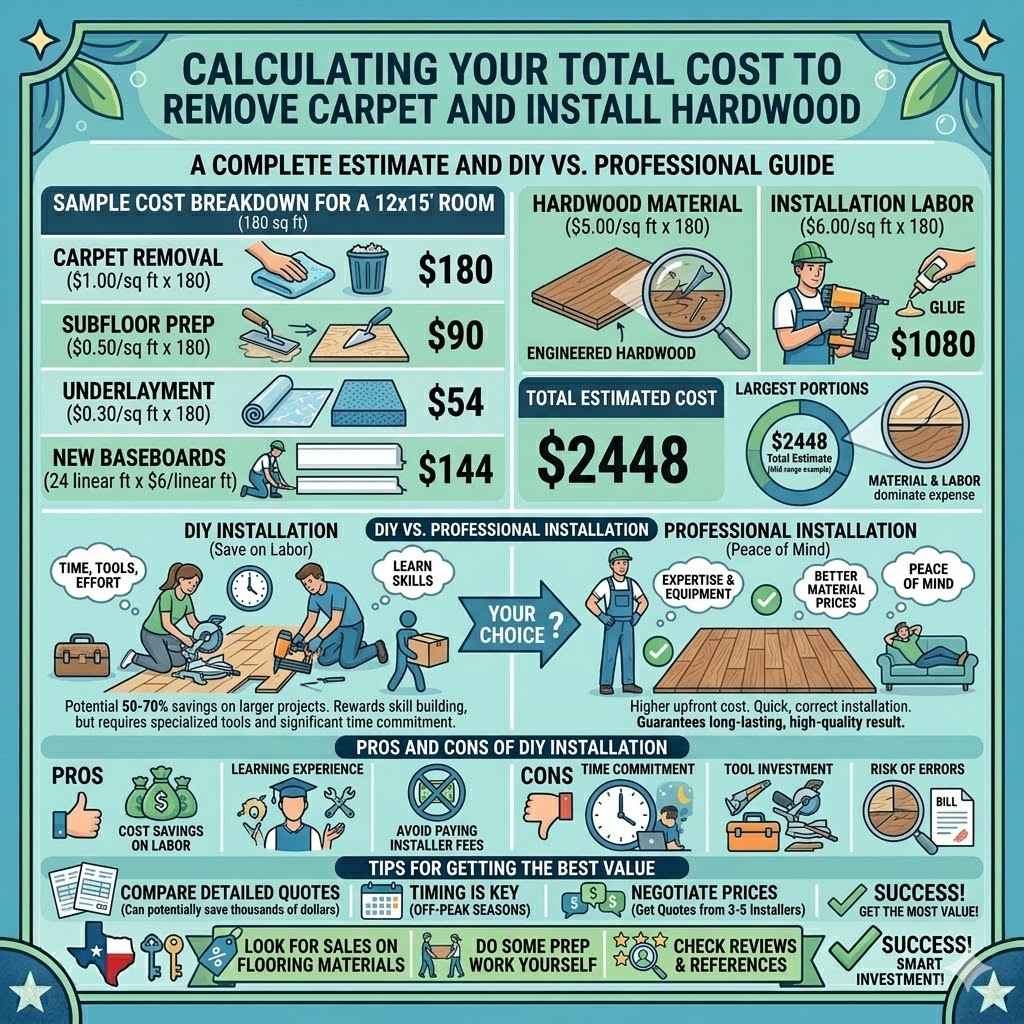
Carpet Removal: $1.00/sq ft x 180 sq ft = $180
This covers basic removal and hauling away of the old carpet and padding.
Subfloor Prep: $0.50/sq ft x 180 sq ft = $90
This assumes minor leveling and cleaning of the subfloor.
Hardwood Material: $5.00/sq ft x 180 sq ft = $900
This is for mid-grade engineered hardwood.
Installation Labor: $6.00/sq ft x 180 sq ft = $1080
This is for a standard glue-down or nail-down installation of pre-finished engineered hardwood.
Underlayment: $0.30/sq ft x 180 sq ft = $54
For a basic moisture barrier or acoustic underlayment.
New Baseboards (2 sides of room @ 12ft each): 24 linear ft x $6/linear ft (material + install) = $144
Assuming you replace the baseboards along two walls.
Total Estimated Cost: $180 + $90 + $900 + $1080 + $54 + $144 = $2448
This sample estimate falls within the common range for such projects. It highlights that the material cost and labor for installation are usually the biggest portions of the expense.
DIY vs. Professional Installation
Deciding whether to tackle this project yourself or hire professionals is a big choice. DIY can save you a lot on labor costs, which are often a significant chunk of the total price. However, it requires time, the right tools, and a good amount of physical effort.
If you’re not experienced, mistakes can end up costing you more in the long run due to damage or needing to hire someone to fix your work.
Professional installers have the expertise and equipment to do the job quickly and correctly. They can also often get better prices on materials. While hiring professionals increases the upfront cost, it can provide peace of mind and ensure a high-quality, long-lasting result.
Weigh the savings against the risks and your own comfort level with home improvement projects.
Pros and Cons of DIY Installation
Cost Savings on Labor: You avoid paying installer fees.
Labor can be 50-70% of the total project cost. By doing it yourself, you can potentially save thousands of dollars on a larger project.
Learning Experience: Gaining new skills.
Tackling a project like this can be very rewarding and teach you valuable skills that can be used for future home improvements.
Time Commitment: Requires significant personal time.
Installing hardwood floors can take days or even weeks for a DIYer, especially if you have a busy schedule or encounter unexpected issues.
Tool Investment: Need to buy or rent specialized tools.
You’ll likely need a miter saw, flooring nailer or stapler, tapping block, pull bar, and possibly a floor sander if you choose unfinished wood, which can be a substantial upfront cost.
Risk of Errors: Potential for mistakes impacting the final look or durability.
Incorrectly installed boards, gaps, or damage to the subfloor can lead to costly repairs or a less attractive finished product.
Tips for Getting the Best Value
To get the most for your money when removing carpet and installing hardwood, do your homework. Compare prices from multiple reputable flooring companies. Ask for detailed quotes that break down all costs, including removal, prep, materials, and labor.
Look for sales on flooring materials, and consider doing some of the prep work yourself if you’re comfortable, like moving furniture or removing old baseboards.
Timing can also be a factor. Sometimes, flooring companies offer discounts during off-peak seasons. Don’t be afraid to negotiate, especially if you’re getting quotes from several installers.
Always check reviews and ask for references to ensure you’re hiring a reliable professional.
Frequently Asked Questions
Question: How much does it typically cost to remove carpet per square foot?
Answer: The cost to remove carpet typically ranges from $0.50 to $2.00 per square foot, depending on labor rates in your area and if padding and disposal are included.
Question: Is engineered hardwood cheaper than solid hardwood?
Answer: Yes, generally engineered hardwood is less expensive than solid hardwood because it uses less premium wood on the surface and a plywood core.
Question: Does the cost to remove carpet and install hardwood include new baseboards?
Answer: No, the cost usually does not include new baseboards unless specifically stated in the quote. This is often an additional expense.
Question: How long does it take to install hardwood floors?
Answer: For a professional, installing pre-finished hardwood in a typical room can take 1-3 days. Installing unfinished hardwood that needs sanding and finishing on-site can take 5-10 days.
Question: Should I remove the old carpet myself to save money?
Answer: You can, especially if it’s a smaller area. However, if the carpet is glued down, heavy, or you don’t have the right tools, it can be a very difficult and messy job.
Summary
The Cost to Remove Carpet and Install Hardwood varies greatly, but by understanding material types, labor, and additional factors, you can budget accurately. Get multiple quotes, compare options carefully, and consider your DIY skills. You can achieve beautiful new hardwood floors without breaking the bank.