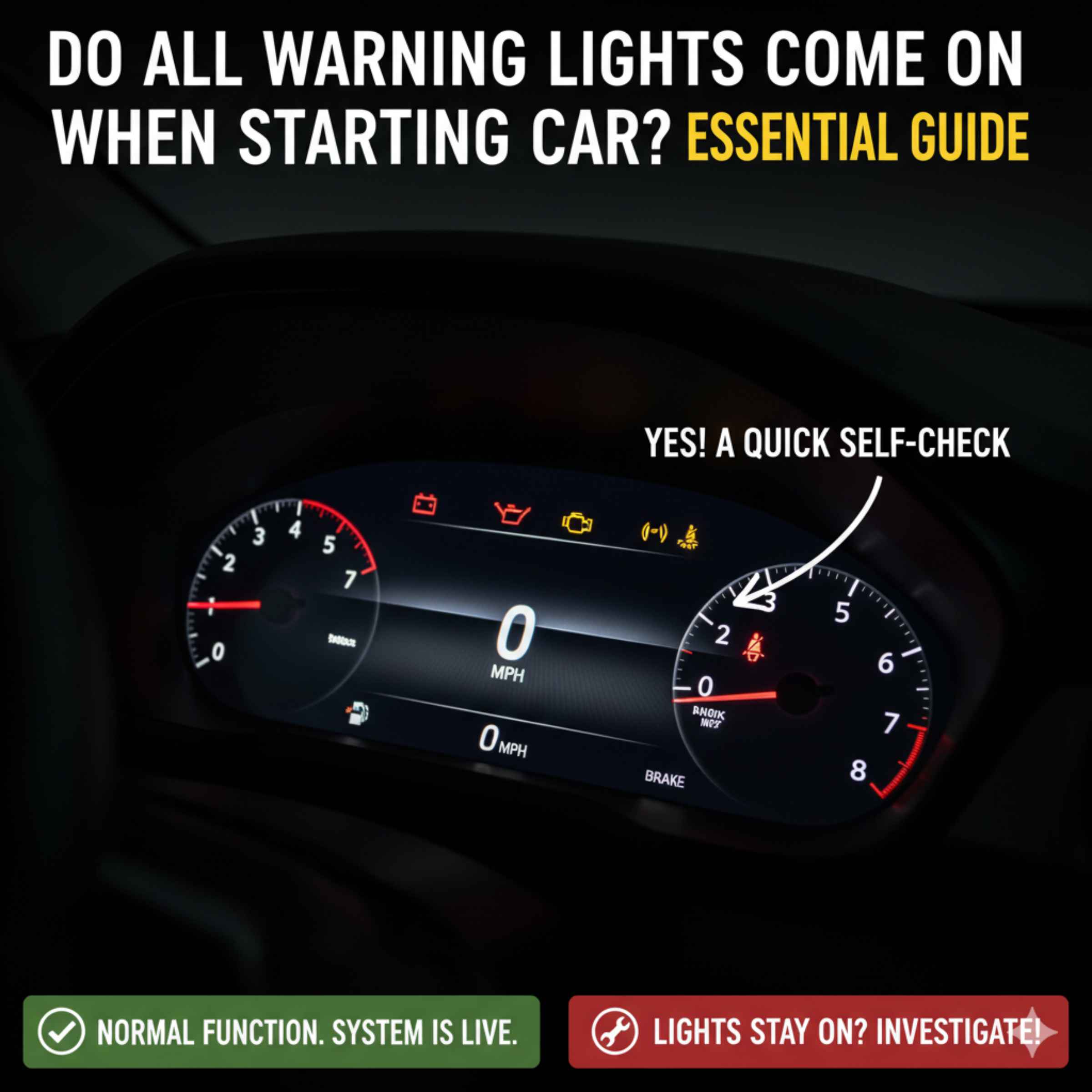
Do All Warning Lights Come On When Starting Car? Essential Guide
Bolded Quick Summary (Top of Article)
Yes, nearly all warning lights briefly illuminate when you first start your car. This is a normal system check, often called the bulb check or system diagnostic. If they all turn off quickly, your car is telling you the bulbs are working and the systems are ready.
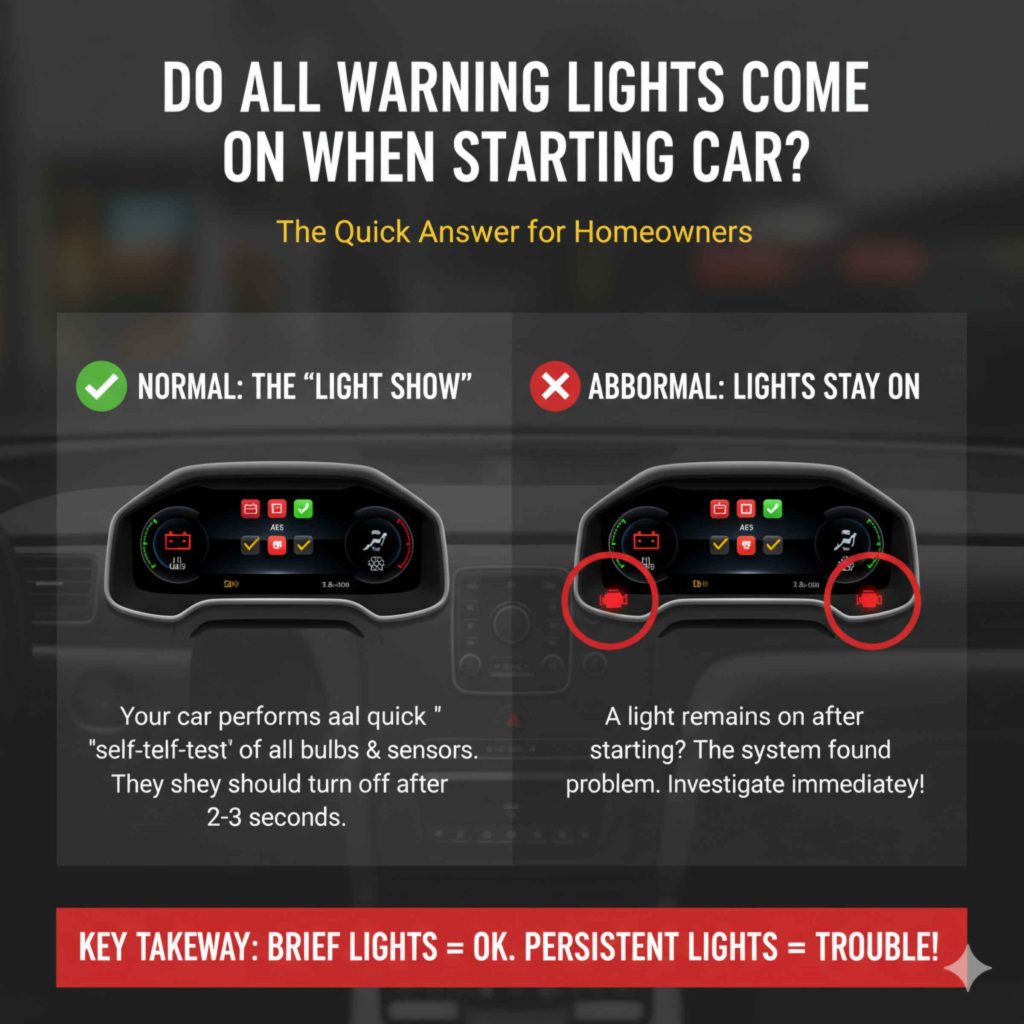
Do All Warning Lights Come On When Starting Car? The Quick Answer for Homeowners
Ever turn the key and see a dazzling light show on your dashboard? It can look alarming, especially if you are just heading out to pick up lumber or start a weekend project. You might wonder, “Is my car telling me something is terribly wrong?”
Don’t worry! For most vehicles, seeing all those colored symbols pop up for a few seconds right when you start the engine is perfectly normal. It’s your car’s way of quickly testing all the bulbs and sensors before you hit the road. Think of it like testing your power tools before making that first cut—you want to know everything is ready.
We’re going to walk through exactly what those lights mean, why they appear, and the one crucial thing you need to watch out for. By the end of this guide, you’ll feel confident knowing your dashboard is speaking clearly to you.
Understanding the Dashboard Light Check: Why the Show Starts
When you turn the ignition key to the “On” position (before the engine actually cranks over) or immediately after starting, your car runs a quick self-diagnostic test. This is crucial for safety and vehicle health.
The Bulb Check: Testing Your Safety Net
Your car relies on those little lights to warn you about serious issues, like low oil pressure or an engine problem. If a bulb is burned out, you won’t get the warning when you need it most. The initial startup sequence is designed to test every single bulb and indicator on your dashboard.
- Purpose: To confirm that all warning indicators are functional.
- Duration: This light sequence usually lasts only 2 to 5 seconds.
- The Goal: If the bulb works, it lights up. If it works correctly, it should turn off immediately after the system check passes.
System Initialization: Waking Up the Computers
Modern cars are packed with computers that control everything from your fuel mixture to your anti-lock brakes. When you start the car, these systems wake up and report their status to the main computer. If everything is nominal (meaning, everything is okay), the light associated with that system will extinguish.
If a light stays on after this initial check, it means that system requires your attention. This is the moment where you transition from “normal operation” to “pay attention.”
The Key Distinction: Temporary vs. Permanent Lights
This is the most important concept for any new driver or homeowner learning car maintenance. There are two main categories of warning lights when starting your car:
- The Checkers (Temporary): These lights flash on during startup for the diagnostic test and then immediately go out.
- The Alerts (Permanent): These lights stay illuminated after the initial startup check, indicating a current problem that needs addressing.
If all the lights come on and then go off within a few seconds, you are good to go. If one stays on, that’s your signal to investigate further. Think of it like testing your circular saw—if the blade brake engages correctly during the test, you move on. If it doesn’t, you stop work immediately.
Categorizing Dashboard Lights: What Do Those Colors Mean?
Automotive warning lights use a standardized color code to quickly communicate the urgency of the issue. Understanding these colors is like knowing the difference between a minor cosmetic fix and a major structural repair in your home project.
Table 1: Warning Light Color Codes and Urgency
| Color | Urgency Level | What It Usually Means |
|---|---|---|
| Red | Critical / Stop Immediately | Safety or engine damage risk. Pull over safely. |
| Yellow/Amber | Caution / Service Soon | A non-critical system needs attention soon (e.g., low tire pressure). |
| Green/Blue | Informational | System is active or ready (e.g., high beams on, cruise control set). |
When starting your car, you will likely see red, yellow, and sometimes green/blue lights flash on during the initial bulb check. The red and yellow ones are the most important ones to monitor after the check is complete.
The Usual Suspects: Lights That Almost Always Appear at Startup
While every manufacturer uses slightly different icons, there is a core group of essential safety and operational lights that nearly every vehicle checks during the ignition sequence. Seeing these confirms your basic safety systems are online.
Essential Lights That Should Flash and Vanish
- Oil Pressure Warning Light (Oil Can Icon): This is crucial. It checks that the oil pressure sensor and warning light are working. If it stays on, your engine has no oil pressure—stop driving immediately!
- Battery/Charging System Light (Battery Icon): This tests the alternator and the battery circuit. It should go off once the engine is running because the alternator starts charging.
- Brake System Warning Light (Circle with Exclamation Mark or ‘BRAKE’): This checks the light itself and confirms the emergency brake sensor is working. If your parking brake is off, this light must go out.
- Airbag/Supplemental Restraint System (SRS) Light (Person with Airbag): This verifies the airbag computer and sensors are communicating. If this stays on, your airbags might not deploy in a crash.
- ABS (Anti-lock Braking System) Light (Circle with ‘ABS’): This tests the specialized computer that manages your emergency braking.
- Check Engine Light (Engine Outline): This is the master light for the engine management system. It checks the bulb and confirms the primary connection to the Engine Control Unit (ECU).
If these lights illuminate briefly and then disappear, congratulate yourself! Your car has passed the basic pre-flight checklist. This process is similar to how a good carpenter checks their framing square and level before starting to assemble walls—it ensures the fundamental tools are ready.
What If a Light Stays On? A Step-by-Step Guide for Homeowners
If you see any of the Red or Yellow/Amber lights remain lit after the initial 5-second check, you need to pause and assess the situation. For DIYers, diagnosing these issues can often be the first step before calling a professional.
Step 1: Identify the Light and Note the Color
First, figure out exactly which icon is lit. Is it the oil can, the engine outline, or the tire symbol? The color tells you the urgency:
- Red Light On: Stop driving as soon as it is safe to do so. This usually indicates immediate danger to the vehicle or occupants.
- Yellow Light On: You generally have time to reach home or a service station, but you should address the issue soon.
Step 2: Check the Easiest Fixes First (The “Parking Brake Check”)
Many “brake system” lights stay on because the parking brake (or emergency brake) is still slightly engaged. Before panicking, firmly push down the parking brake lever or pedal and then release it completely. If the light goes off, the problem was simply the parking brake.
Step 3: Consult Your Owner’s Manual
Your car’s owner’s manual is your best friend, much like the manufacturer’s guide for your table saw. It will specifically define what each symbol means for your make and model. Look up the icon you see illuminated.
Step 4: Assess the “Check Engine Light” (CEL)
The CEL is perhaps the most common light that stays on. If the CEL is solid (not flashing):
- Check if the gas cap is tight. A loose gas cap can trigger the CEL because it affects the fuel vapor system. Tighten it until it clicks.
- If the light remains on, the next step is to read the diagnostic trouble code (DTC). You can purchase an inexpensive OBD-II scanner (On-Board Diagnostics, Second Generation) online or at most auto parts stores. These plug into a port usually found under the dashboard.
Learning to read these codes is a huge confidence booster for DIY maintenance. For example, a P0420 code often relates to the catalytic converter efficiency, while a P0301 relates to a cylinder misfire. Understanding the code lets you know if it’s a simple sensor replacement or something more complex.
Step 5: Dealing with Critical Red Lights (Oil or Temperature)
If the Oil Pressure Light stays on:
- Pull over immediately. Do not drive the car even a short distance.
- Turn the engine off.
- Check the oil dipstick. If the oil level is extremely low, add the correct type of oil.
- If the oil level is fine, the problem is likely the oil pressure sensor itself or a total failure of the oil pump. In this case, the car needs professional towing and repair. Driving with low oil pressure destroys an engine quickly.
For more information on understanding diagnostic codes, resources like those provided by the National Highway Traffic Safety Administration (NHTSA) offer general guidance on vehicle safety systems.
A Deeper Dive: Why Specific Systems Trigger Startup Checks
The sophisticated nature of modern vehicles requires more extensive pre-start checks than older cars. Here is a look at why systems like ABS and TPMS (Tire Pressure Monitoring System) run a diagnostic every time you start up.
The Anti-lock Braking System (ABS) Test
The ABS computer needs to verify that all four wheel speed sensors are communicating correctly and that the hydraulic pump is ready. If the ABS light stays on, it means the standard braking system still works, but the anti-lock feature is disabled. This is less urgent than the main brake light, but it needs attention before heavy rain or emergency stops.
Tire Pressure Monitoring System (TPMS)
The TPMS light (often an exclamation point inside a horseshoe shape) checks the sensors embedded in your tires. When you start the car, the system checks if all sensors are communicating. If it stays on, it might mean one tire is low on air, or, more commonly, the TPMS sensor battery has died, or the system needs to be reset after a tire change.
Emissions and Fuel System Checks (Evap)
Many lights relate to emissions controls (like the Check Engine Light). When you start the car, the onboard computer checks the seals and pressures within the Evaporative Emission Control (Evap) system. A small leak, often caused by a loose gas cap, can trigger this check instantly.
Tool Spotlight: The Essential OBD-II Scanner for Home Mechanics
If you are serious about saving money on simple repairs, an OBD-II scanner is an indispensable tool, much like a good tape measure is essential for accurate woodworking cuts.
Table 2: Why You Need an OBD-II Scanner
| Benefit | How It Helps You |
|---|---|
| Saves Diagnostic Fees | Auto parts stores often read codes for free, but owning one lets you check anytime without waiting. |
| Verifies Repairs | After you replace a sensor, you can clear the code and see if the light stays off. |
| Informs Buying Decisions | If a used car has the CEL on, the scanner tells you the issue before you buy it. |
| Clear Simple Codes | Allows you to clear non-critical codes (like those from a loose gas cap) yourself. |
You don’t need the most expensive model. Even a basic $30 scanner will pull the five-digit code that points you in the right direction. This takes the guesswork out of car repair, giving you the confidence to tackle minor fixes yourself.
Safety First: When to Pull Over and Call for Help
While most dashboard lights are minor nuisances, some demand immediate, safe action. As a DIY enthusiast, your safety and the safety of your vehicle are paramount. Never push a warning light if it indicates a critical fluid loss or overheating.
Situations Requiring an Immediate Stop:
- Flashing Check Engine Light: A flashing CEL indicates a severe engine misfire that is likely dumping raw fuel into the exhaust system, which can damage the expensive catalytic converter rapidly. Turn the car off immediately.
- Oil Pressure Light (Red): As mentioned, low oil pressure means metal-on-metal contact inside the engine. Stop driving immediately.
- Engine Temperature Light (Thermometer Icon): If this red light comes on, your engine is overheating. Pull over, turn the engine off, and let it cool down completely before attempting to check coolant levels. Never open a hot radiator cap!
- Brake Light (Red) While Driving: If this stays on and your parking brake is off, you may have critically low brake fluid. Do not drive until this is addressed, as your braking ability is compromised.
Remember, a car is a complex machine. Just like when you are using a router for the first time, taking a moment to respect the system’s warnings prevents costly, time-consuming failures down the line.
Troubleshooting Common Startup Light Quirks
Sometimes, lights behave strangely even when nothing seems wrong. Here are a few common scenarios that confuse new car owners:
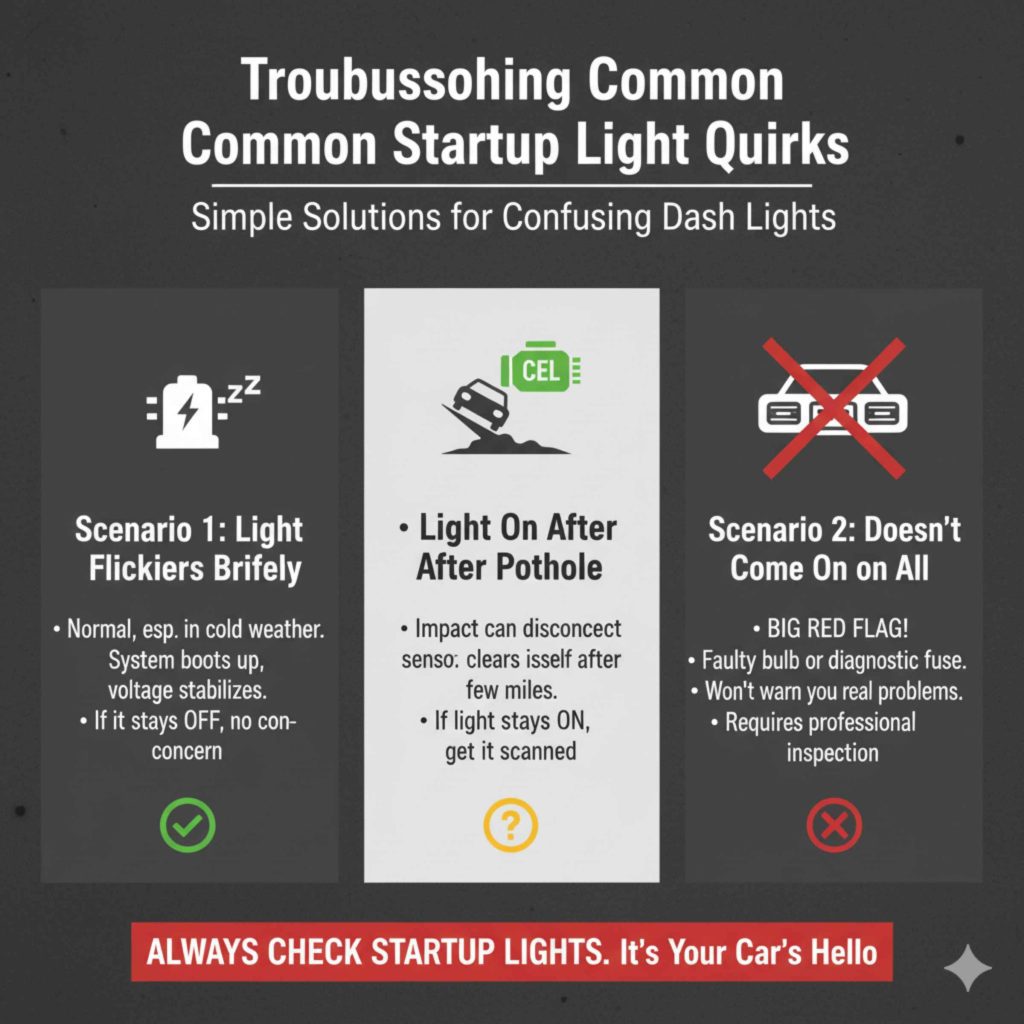
Scenario 1: The Light Flickers Briefly, Then Goes Out
This is usually normal, especially in colder weather. A slight flicker in the battery light or ABS light can happen while the system boots up and the voltage stabilizes. If it stays off, there is usually no concern.
Scenario 2: The Light Comes On After Hitting a Pothole
If you hit a large bump and the CEL or TPMS light illuminates, the impact might have temporarily disconnected a sensor or caused a momentary fault. Often, driving normally for a few miles will allow the system to re-test and clear the code itself. If the light stays on, scan it.
Scenario 3: The Light Doesn’t Come On During Startup Check
If you turn the key to the “On” position and none of the warning lights appear—not even the Check Engine Light—this is a red flag. It suggests the bulbs or the diagnostic fuse might be faulty, meaning you won’t get warnings when you actually need them. This requires professional inspection.
Always remember to check the state of your lights during the initial startup. It’s your car’s way of saying hello and confirming its operational status before you start using it for your next big home improvement haul.
Frequently Asked Questions (FAQ) for Beginner Drivers
Q1: How long should the dashboard warning lights stay on when I start my car?
A: They should stay on for only about 2 to 5 seconds while the vehicle performs its internal bulb and system check. If they stay on longer, it means a system has detected an issue.
Q2: If the Check Engine Light flashes while I am driving, what should I do?
A: A flashing Check Engine Light is serious. It usually indicates a severe engine misfire. You should pull over safely right away, turn the engine off, and have the vehicle towed or inspected, as continuing to drive can cause expensive damage.
Q3: Does the battery light always go off right after the car starts?
A: Yes, it almost always should. This light tests the battery connection and the alternator. Once the engine starts and the alternator begins generating electricity, the light should turn off. If it stays on, your car is running only on battery power, and it will soon die.
Q4: Can I reset warning lights without fixing the problem?
A: You can clear codes using an OBD-II scanner, which turns the light off temporarily. However, if the underlying problem (like a bad sensor or low fluid) is not fixed, the light will return shortly after the next diagnostic cycle.
Q5: Why does the TPMS light come on when it’s cold outside?
A: Air pressure drops as temperature drops. If your tires are slightly under-inflated, the cold weather can push the pressure below the threshold the TPMS system monitors, causing the light to illuminate. Inflate them to the level recommended on the sticker inside your driver’s door jamb.
Q6: Is it safe to drive if only the ABS light is on?
A: It is generally safe to drive short distances to a repair shop, but you should avoid sudden, hard braking. The standard brakes will still work, but the anti-lock feature will be disabled, meaning your wheels could lock up during an emergency stop.
Conclusion: Driving Confidently with Dashboard Knowledge
Learning how your car communicates is just as important as learning how to safely operate your new power miter saw or install drywall. The dashboard lights are your car’s primary communication system, and understanding their startup routine removes a lot of unnecessary anxiety.
Remember this simple rule: If all the lights flash on briefly and then disappear, your car is telling you, “I’m ready for work!” If any warning light (especially red ones) stays lit, it’s your signal to pause, check the manual, and safely address the issue before proceeding. With this knowledge, you can confidently handle your daily drives and your weekend DIY adventures, knowing you are paying attention to what truly matters under the hood.