Hot Dog on Table Saw: Safety Test Results Explained
The hot dog on table saw demo shows blade contact can be catastrophic, but it does not prove a saw is safe or unsafe by itself. Relying on it can create false confidence, finger injuries, and sloppy setup habits. This guide explains what the demo really measures, what it misses, and the real safety checks I use before any cut.
What the hot dog table saw test is actually showing
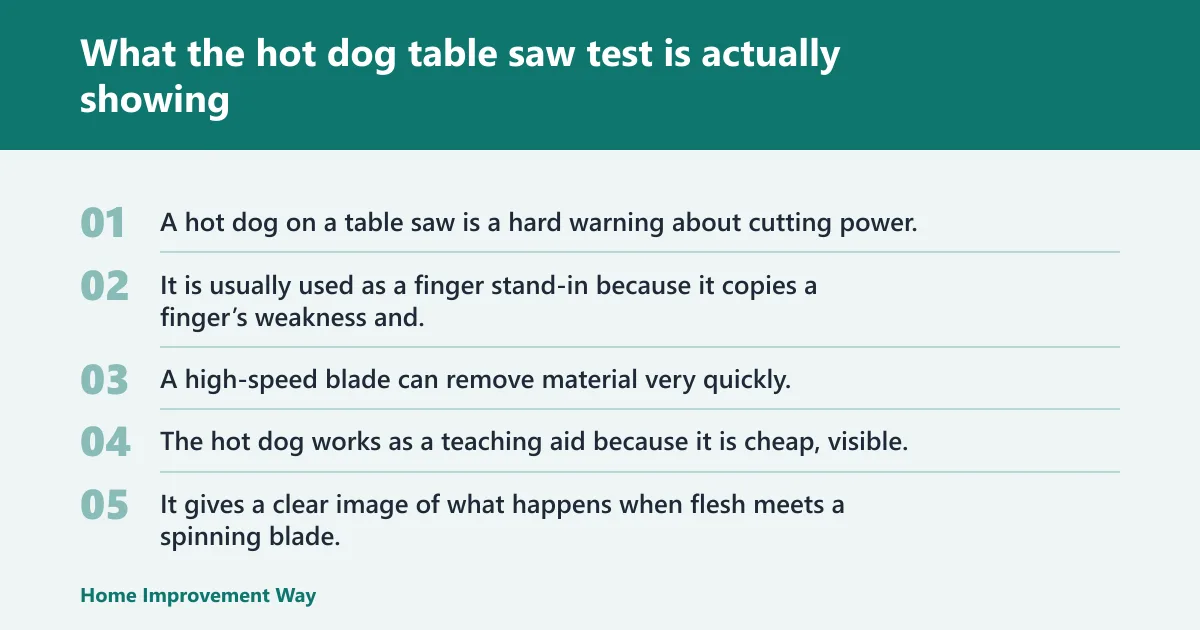


A hot dog on a table saw is a hard warning about cutting power. It is usually used as a finger stand-in because it copies a finger’s weakness and, in this odd test, its moisture and soft surface let the blade act on it in a way that is easy to see.
The visual lesson is plain. A high-speed blade can remove material very quickly, and a soft object can disappear before a beginner has time to react. That is useful as a warning. It is not enough to judge real saw safety.
Why a hot dog is used as a finger stand-in
The hot dog works as a teaching aid because it is cheap, visible, and steady enough to show blade contact. It gives a clear image of what happens when flesh meets a spinning blade. That is the point of the demo.
It does not act like a hand. Fingers move, flex, tense, and pull away. Hands also bring bone, joints, skin thickness, and reaction timing that the demo does not copy.
What the visual result can teach in one cut
The result can show how little warning a table saw gives once material reaches the blade. That matters. A table saw is a powerful tool with a fast-spinning blade, and it can cause serious harm in a split second if the setup or technique is wrong.
The demo can also reinforce why correct settings matter for the material being cut. Feed rate, fence position, blade height, and support all change how the cut behaves.
Why this is a demo, not a full safety test
A single hot dog cut is more of a lesson than a verdict. It does not account for saw condition, user skill, kickback risk, or whether every safety feature is working as expected under load. A clean-looking result can still hide serious hazards.
What happens when a hot dog touches a table saw?
When a hot dog touches a table saw blade, the blade can cut through it quickly because the material is soft and wet. That is why the demo is so dramatic. It shows contact danger in a way beginners can grasp fast.
What it does not show is the full injury picture. A human hand is not a hot dog. Real skin can tear differently, fingers can be pulled into the blade path, and panic can make a small mistake worse. The demo can create false confidence if the clean cut is mistaken for proof of control.
How the blade interacts with soft material
The blade’s teeth remove material at speed. Soft objects do not resist much, so the cut can look effortless. That ease is exactly why the demonstration works as a warning.
But a soft object also hides important variables. A hand may approach at an angle, slip, or meet the blade during a kickback event. None of that is copied by a stationary hot dog.
Where the demo can mislead
If the result looks tidy, a beginner may think the saw is safe as long as they are careful. That is the wrong lesson. Most serious table saw incidents come from setup errors, distraction, or stock movement, not from a calm, planned demo cut.
Why table saw safety matters before any test or cut
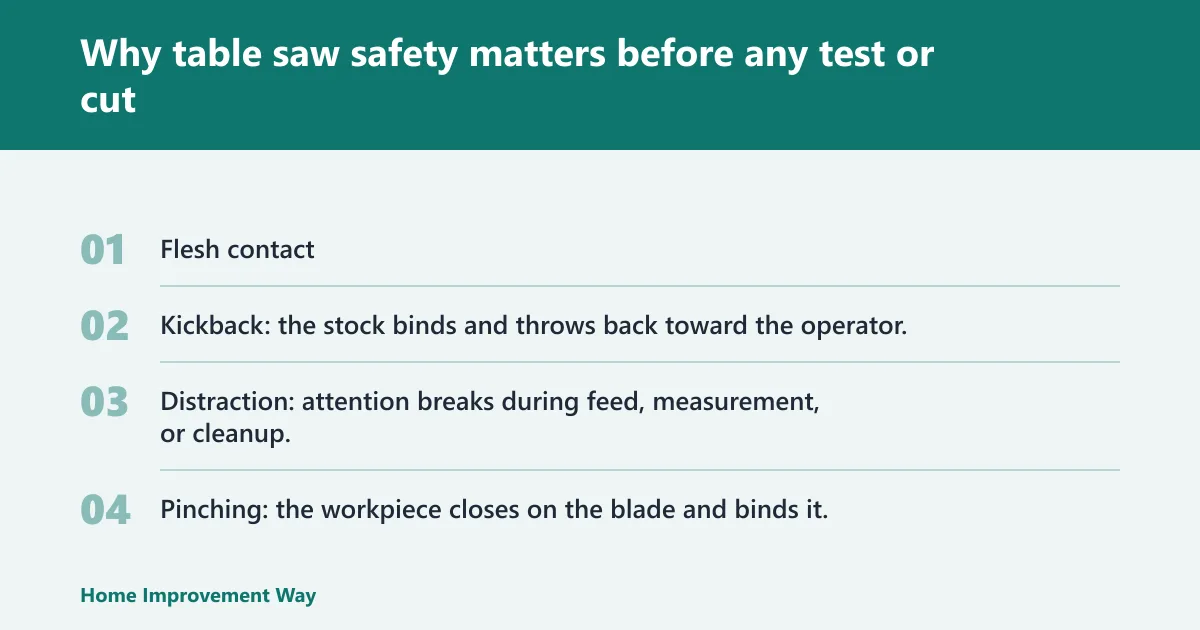
Table saws are dangerous because the blade is exposed, fast, and unforgiving. One bad moment can lead to contact injury or kickback. Correct setup for the material being cut matters every time, whether the task is a hot dog demo or a sheet of hardwood.
Accidents usually start with small errors. A fence set wrong, a missing guard, a warped board, or a hand placed too close can turn a normal cut into an emergency.
Common ways accidents happen
- Flesh contact: a hand gets too close to the blade path.
- Kickback: the stock binds and throws back toward the operator.
- Distraction: attention breaks during feed, measurement, or cleanup.
- Pinching: the workpiece closes on the blade and binds it.
Why correct settings matter for the stock being cut
A table saw setup has to match the material. Thick stock, narrow rip cuts, wet lumber, and warped boards all change the risk profile. The right fence position, blade choice, and support reduce the chance of binding or wandering.
What safety features should a table saw have?
A table saw should have features that address specific failure modes, not just general caution. Blade guards, riving knives, emergency stop controls, and push sticks each solve a different problem. Together they reduce contact risk, pinch risk, and reaction time loss.
Blade guard
A blade guard is a common safety feature that protects users from accidental contact with the blade. It does not make the saw harmless, but it creates a physical barrier between hands and teeth during many cuts.
Riving knife
A riving knife is a common safety feature that prevents wood from pinching the blade. That matters because pinching can lead to binding and kickback. It stays aligned with the blade as the cut opens and closes.
Emergency stop
An emergency stop is a common feature that quickly shuts down the saw in an emergency. It cannot prevent the first contact, and it cannot stop every injury in progress, but it can reduce the time the blade keeps moving after something goes wrong.
Push stick
A push stick is a common safety feature that keeps fingers away from the blade while cutting narrow or short stock. It changes hand position, which is one of the simplest ways to lower exposure.
Pre-demo safety checklist and failure-mode matrix
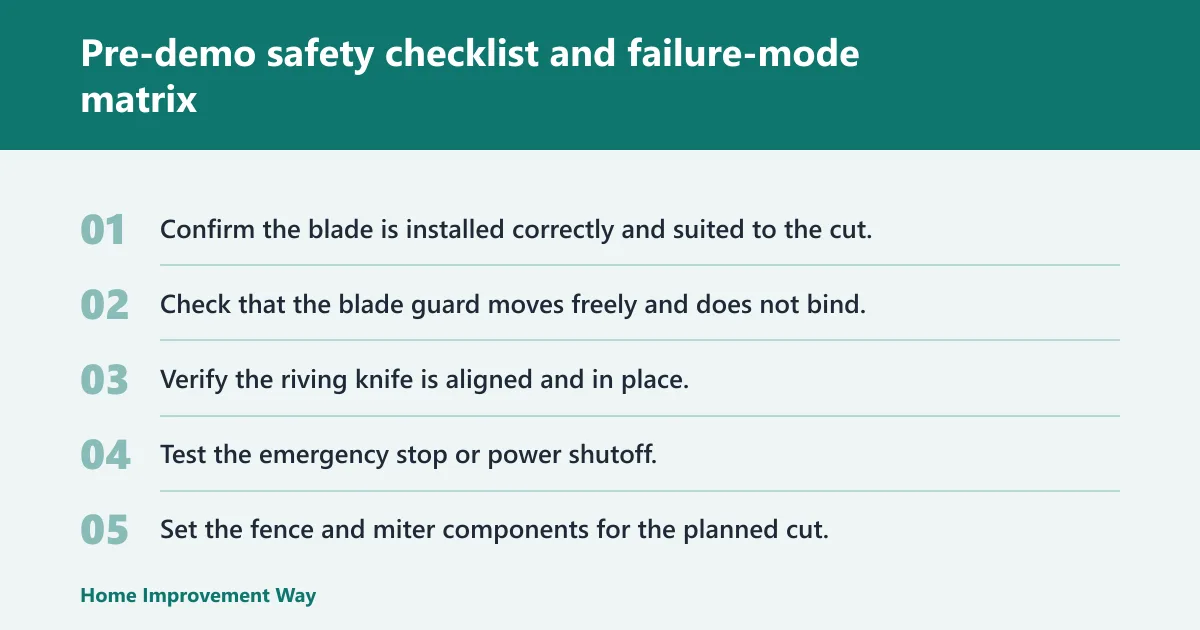
Before any hot dog demonstration, the saw should be checked like a real cutting task. A demo that skips setup verification can teach the wrong lesson. The checklist below is aimed at reducing contact, binding, and surprise movement before the saw is powered up.
Checklist before powering up the saw
- Confirm the blade is installed correctly and suited to the cut.
- Check that the blade guard moves freely and does not bind.
- Verify the riving knife is aligned and in place.
- Test the emergency stop or power shutoff.
- Set the fence and miter components for the planned cut.
- Prepare a push stick for any narrow or short work.
- Wear goggles and ear protection.
- Clear the table, floor, and outfeed area of loose material.
- Stand out of the direct kickback line.
- Do a dry run with the saw off.
Failure-mode matrix
| Safety feature | Risk addressed | What it helps prevent | What to verify before the demo |
|---|---|---|---|
| Blade guard | Accidental blade contact | Hands drifting into the cut zone | Guard moves freely and returns to position |
| Riving knife | Pinching and kickback | Stock closing on the blade | Knife is aligned with the blade and installed |
| Emergency stop | Run-on after a problem | Long blade spin after an emergency | Stop switch is reachable and functional |
| Push stick | Hand proximity | Fingers entering the danger zone | Push stick is within reach before the cut |
This matrix matters because one feature does not replace another. A guard does not stop kickback. A riving knife does not protect fingers that are already too close. An emergency stop does not reverse an error that already happened.
Does a hot dog really mimic a finger on a table saw?
A hot dog mimics a finger only in a narrow sense. Its moisture and softness can make blade contact easier to observe on flesh-like material. That makes it useful for a visual safety lesson.
The comparison breaks down when real injury risk is the question. Fingers have bone, joints, tendon tension, and movement. A human hand also reacts, flinches, and changes angle. The demo cannot reproduce those conditions, so it cannot predict injury severity.
Where the comparison breaks down
The demo does not show partial contact, slipping grips, sweaty hands on lumber, or the effects of panic. It also does not show how a finger can be caught by a spinning blade after a brief touch.
That is why the demo should be treated as a warning sign, not a safety verdict.
What the hot dog test does not prove
The test does not prove the saw is safe. It does not prove a blade guard works in every situation. It does not prove the emergency stop will save a bad setup. And it does not measure kickback, operator habits, or saw type differences.
What the hot dog test does not prove: It does not show measured performance, it does not compare saw designs, and it does not establish how the saw will behave on real lumber. A clean cut can still leave major hazards untouched.
This is the gap many viewers miss. No measured results are provided. It can claim the saw “stops instantly,” but that says little without data, conditions, or a test protocol. A dramatic video is not the same as a documented safety evaluation.
What should I wear before using a table saw?
Wear goggles and ear protection before using a table saw. Eye protection helps against chips and dust. Ear protection matters because the saw can be loud enough to fatigue concentration over time. Clothing should stay close to the body, and loose focus is a hazard too.
Good safety gear does not replace setup discipline. It buys time and cuts harm if something goes wrong.
Safety gear and attention
- Goggles or another form of eye protection.
- Ear protection.
- No loose sleeves, dangling jewelry, or untied cords near the saw.
- Full attention on feed direction, hand placement, and cutoff support.
Frequently asked questions
Why do people use a hot dog to test table saw safety?
People use a hot dog because it is a cheap finger stand-in that gives a clear visual lesson. Its texture and moisture make blade contact easy to see. The problem is that the demo is easy to overread. It teaches caution, not a final answer about saw safety.
How do blade guards and riving knives help prevent accidents?
A blade guard blocks accidental contact with the blade, which matters when hands drift during a cut. A riving knife stays behind the blade and helps prevent the stock from pinching it. That reduces the chance of binding and kickback, which are two of the most serious table saw hazards.
What should I check before doing a table saw safety demo?
Check the blade, guard, riving knife, emergency stop, fence position, and table clearance before any demo. Make sure a push stick is ready and eye and ear protection are on. Do not let a dramatic test skip setup verification, because the setup is what often determines whether the cut stays controlled.
Is a hot dog table saw test actually effective?
It is effective as a teaching aid because it makes blade danger visible in a split second. It is not effective as a full safety test because it does not measure kickback, guard performance under every condition, or operator behavior. Treat it as a warning, not a pass-fail exam.
Sponsored / affiliate links. As an Amazon Associate I earn from qualifying purchases. I may earn additional commission from eligible campaigns.
 Heavy Duty Roller Conveyor, Table Saw outfeed Table with Lockable Universal Casters, Adjustable Adjustable Roller Stand for Woodworking with 6 Widened Conveying Rollers
 Adjustable Conveyor Roller Stand, Table Saw Outfeed Roller with Adjustable Height Retractable Feature Braked Wheels & Practical Hooks Flexible Roller Conveyorfor for Logistics Automobile Manufacturing