How Do You Move a Tempurpedic Mattress Safely Without Damage
Move the mattress flat whenever possible; if you must stand it up, keep it vertical only for short periods, and avoid folding it. Bad handling can compress the foam, leave lasting body impressions, and void warranty coverage. This guide shows the right gear, flat-versus-side decision points, and when the move is too risky for the mattress.
What you’ll need before you start



- Mattress bag sized to the mattress; plastic is inexpensive and disposable, reusable covers are better for repeat moves.
- Furniture straps to help lift and guide the mattress with a helper.
- Ratchet straps for securing the mattress in a truck or van.
- Dolly or hand truck; a hand truck fits twin or full sizes better, while a dolly is better for larger sizes.
- Moving vehicle such as a truck or van that fits the mattress size.
- Bed frame tool kit with screwdrivers or hex keys needed for disassembly.
- Labeled bags for screws, brackets, and small parts.
- Cleaning cloth if the mattress needs a quick wipe before bagging.
📊 Mattresses can last about seven to 10 years on average. Source: My 6 Moving Hacks for Your Mattress.
Before you move a Tempur-Pedic mattress

Why foam recovery matters more than with innerspring beds
Memory foam mattresses are often heavy, and their pressure-relieving layers may keep a bent or compressed shape longer than an innerspring mattress. That is why long compression, tight folding, or upright storage for too long can leave permanent deformation.
Mattresses can last about seven to 10 years on average, so age matters too. If the mattress is already soft, sagging, or damaged, a rough move can cost more than replacing it.
When a move is worth it and when replacement may be cheaper
If the mattress still supports well and the move is local, careful transport usually makes sense. If it already has deep body impressions, torn cover seams, or repeated edge collapse, replacement may be the better call before you spend time and money on special handling.
What changes if the mattress is older, sagging, or already damaged
A worn mattress is less forgiving when it is tipped, strapped, or carried through stairs. The more the foam has broken down, the more likely a bend or pinch becomes a permanent crease. Treat those mattresses as high risk and reduce handling as much as possible.

How to prep the mattress and the route
- Strip off all bedding, pillows, and protectors.
- Bag loose accessories separately so they do not snag the cover.
- Wipe the mattress if it is dusty or stained, then let it dry.
- Place the mattress in a sized mattress bag to limit tears and stains.
- Move boxes, chairs, rugs, and wall decor off the route.
- Open doors fully and check stair landings, corners, and tight turns.
- Measure doorways and hallway pinch points before you lift.
Route prep is not busywork. It keeps you from dragging, twisting hard, or smashing the cover against a door jamb. On apartment moves, the landing turn is often the trouble spot, not the stairs themselves.
What orientation should you use while moving it?
When flat is the safest choice
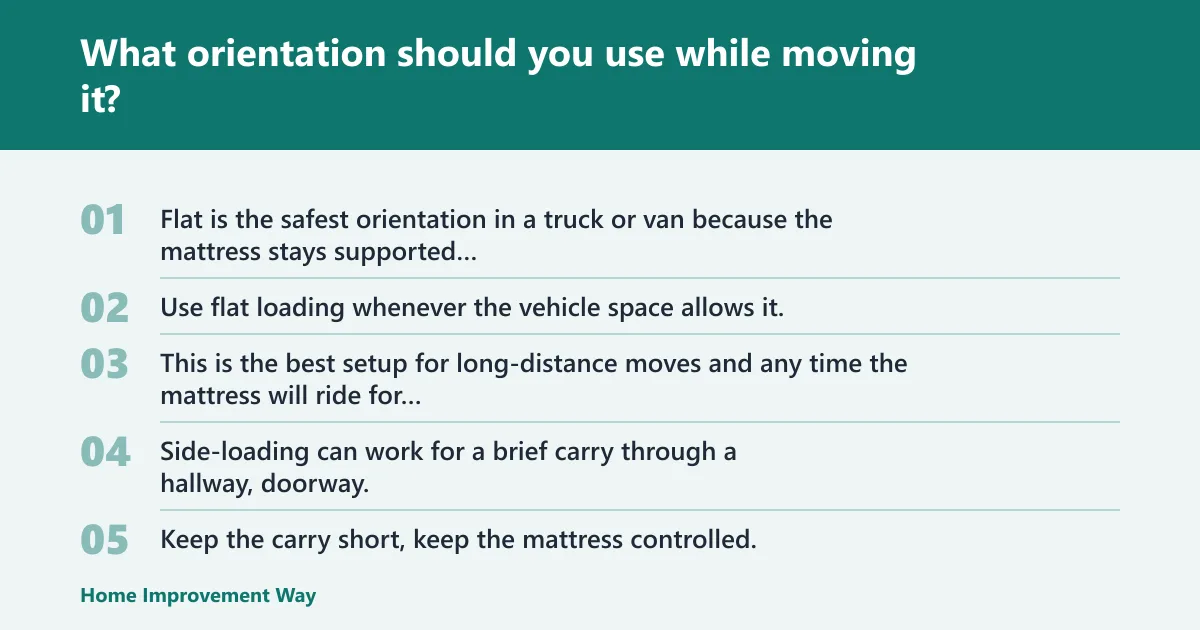
Flat is the safest orientation in a truck or van because the mattress stays supported across its full surface. Use flat loading whenever the vehicle space allows it. This is the best setup for long-distance moves and any time the mattress will ride for more than a short trip.
When side-loading is acceptable for a short carry
Side-loading can work for a brief carry through a hallway, doorway, or stair turn when flat movement is impossible. Keep the carry short, keep the mattress controlled, and get it back flat as soon as the obstacle is cleared.
Why standing it upright for long periods is risky
Standing a Tempur-Pedic mattress upright for long periods lets gravity work against the foam. The mattress can bow, crease, or hold a new shape if it stays that way too long, especially in a warm vehicle or storage space.
How to load and secure it in a truck or van
Best placement inside the vehicle
Put the mattress flat against a clean, stable surface inside the truck or van. Avoid rooftop transport as a normal option; it exposes the mattress to weather, wind, and repeated flexing. Make sure the vehicle actually fits the mattress size before loading.
How to use ratchet straps without crushing the foam
Ratchet straps help secure a mattress in a truck or van, but they should hold the mattress in place rather than squeeze it flat. Use enough tension to stop shifting during transport, then stop. If the foam visibly compresses hard under the strap, it is too tight.
Why rope and loose tie-downs are poor substitutes
Rope can loosen, rub or cut into the cover, or create uneven pressure points. Loose tie-downs let the mattress slide, which is how corners get crushed and seams tear. Ratchet straps are the better choice for transport control.
Tempur-Pedic moving decision checklist
| Scenario | Safest orientation | Helper count | Required gear | Main risk |
|---|---|---|---|---|
| Short local move | Flat in the vehicle; side only for brief doorway turns | At least 2 for queen or king | Mattress bag, furniture straps, truck or van | Dragging and corner damage |
| Stairs or apartment move | Side-loading only while carrying; return flat as soon as possible | 2 to 3, depending on turns and landings | Mattress bag, furniture straps, dolly or hand truck, gloves | Stair turns, pinch points, and flexing |
| Long-distance truck move | Flat, fully supported | 2 or more for loading and unloading | Mattress bag, ratchet straps, truck or van, bed frame hardware bags | Long compression and upright storage |
If the mattress cannot ride flat, if it must stay upright for hours, or if the route requires repeated tight bends, replacement may be cheaper than risking permanent foam deformation.
Common mistakes when moving a Tempur-Pedic mattress
Folding or cinching the foam too tightly: Tempur-Pedic memory foam should not be compressed or bent for long periods. A brief curve during a stair turn is one thing; a folded mattress in a moving truck is another.
Letting it stand upright too long: Vertical storage is a temporary move tactic, not a holding position. Get the mattress flat again as soon as the vehicle or room allows.
Dragging it through doors or across rough floors: Use furniture straps as lifting help, not dragging points. Dragging tears covers and grinds dirt into the mattress bag.
Skipping the bag, straps, or route check: A mattress bag protects against dirt and tears, ratchet straps reduce shifting, and a clear path prevents sudden drops.
What tools do you need to move a heavy mattress?
A moving plan needs a mattress bag, furniture straps, ratchet straps, and a truck or van that fits the bed. Add a dolly or hand truck if one person is doing the lift, and use a bed frame tool kit with labeled bags for screws and brackets.
For queen or king mattresses, help is usually needed. If the route includes stairs, tight corners, or an apartment hallway, add one more person before you start. That is the difference between a controlled carry and a bent frame.
Frequently asked questions
How do you move a Tempur-Pedic mattress without damaging it?
Keep it flat in a truck or van whenever possible, use a sized mattress bag, and avoid long periods upright or tightly bent. Strip the bedding first, clear the route, and use ratchet straps so the mattress cannot slide during transit.
Can you fold a Tempur-Pedic mattress for moving?
No. Folding risks lasting foam deformation and cover damage. A short side carry around a corner is fine, but the mattress should return to flat support as soon as possible and never be folded for transport or storage.
Do Tempur-Pedic mattresses have handles for moving?
Some models do, but handles on some Tempurpedic mattresses are not very strong. Treat them as positioning aids, not lifting anchors. Use furniture straps and a helper instead of trusting the handles to carry the load.
How do you transport a memory foam mattress in a truck?
Place it flat inside the truck or van, then secure it with ratchet straps so it does not shift. Avoid rope if possible. Do not stack heavy items on top, and keep the mattress away from sharp edges that can cut the cover.
Do you need a mattress bag to move a Tempur-Pedic mattress?
Yes. A mattress cover can limit tears and stains, and a plastic mattress cover is inexpensive and disposable if the move is one-time. Choose a cover sized to the mattress so it stays in place during stairs and loading.
Can you move a Tempur-Pedic mattress by yourself?
Only the smallest sizes with short, simple routes are practical alone, and even then a dolly or hand truck helps. Queen or king mattresses may need help moving, and stairs usually turn a solo move into a bad idea fast.
What tools do you need to move a heavy mattress?
Start with a mattress bag, furniture straps, and ratchet straps. Add a dolly for larger sizes or a hand truck for twin or full, plus a tool kit for bed frame disassembly and labeled bags for screws and hardware.
Sponsored / affiliate links. As an Amazon Associate I earn from qualifying purchases. I may earn additional commission from eligible campaigns.