How Many Recessed Lights: Essential Circuit Guide
Quick Summary:
You can typically install 10-12 standard 50-watt recessed lights on a single 15-amp circuit, or 15-20 on a 20-amp circuit. Always account for the total wattage, wire gauge, and local electrical codes to ensure safety and proper function.
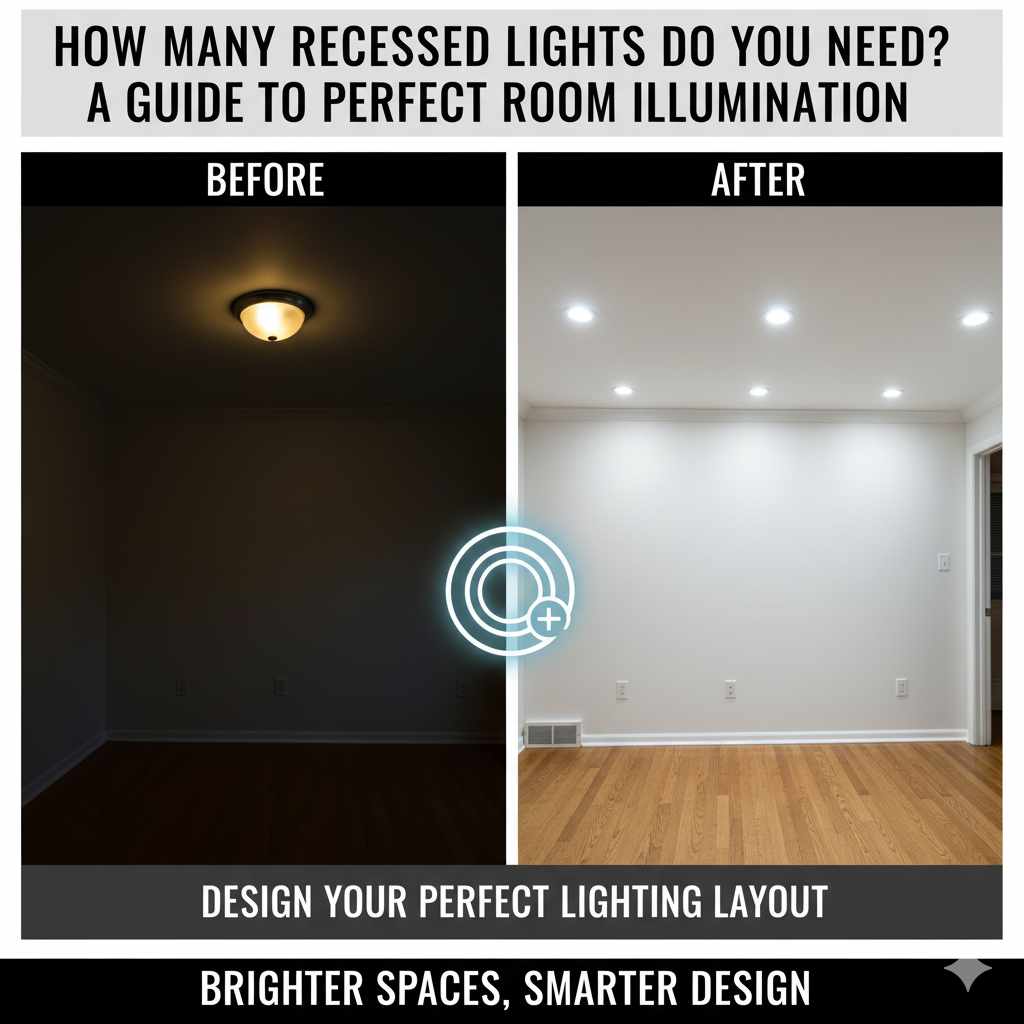
Planning to add recessed lighting to your home? It’s a fantastic way to brighten up your space and give it a clean, modern look. But a common question pops up: “How many recessed lights can I put on one circuit?” It’s easy to get a little lost in the technical details, and the last thing you want is to overload a circuit, causing flickering lights or, worse, a tripped breaker. Don’t worry! I’m here to walk you through it step-by-step, just like we’d plan out a woodworking project. We’ll break down exactly what you need to know to figure out the right number of lights for your circuits, safely and confidently. Let’s get your home beautifully lit!
Understanding Your Electrical Circuit
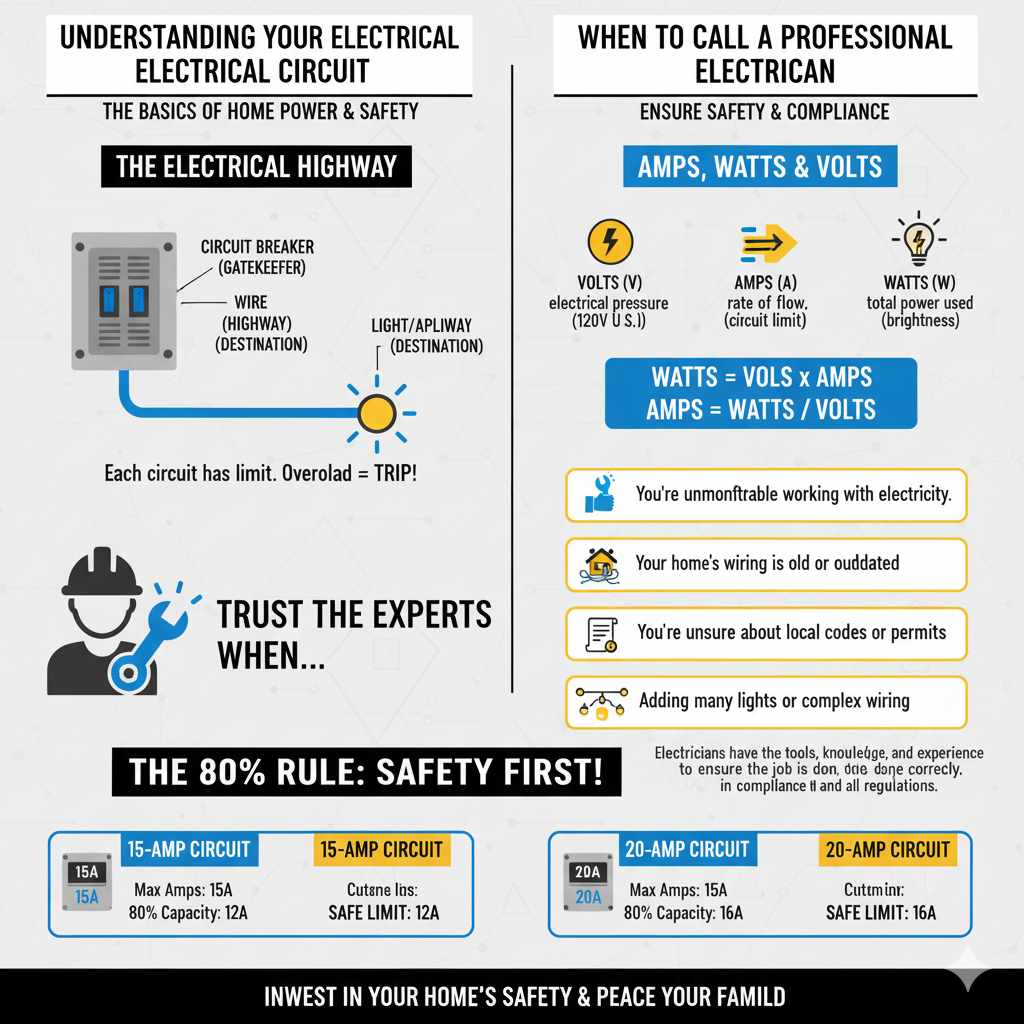
Before we start placing lights, it’s super important to understand what an electrical circuit is. Think of it like a highway for electricity in your home. Each circuit breaker in your electrical panel is like a gatekeeper for one of these highways. When you turn on a light or an appliance, you’re asking for electricity to travel down that highway. The circuit breaker’s job is to make sure not too much electricity tries to go down at once. If too many things are plugged in or too many lights are on, it can overheat the wires and cause a fire. That’s why we have these breakers – they “trip” (shut off) to protect your home.
For most homes, the common circuits are either 15 amps or 20 amps. You can usually tell which is which by looking at your electrical panel. The breaker will have a number on it. A 15-amp breaker is designed to handle a maximum of 15 amps, and a 20-amp breaker handles a maximum of 20 amps. It’s like knowing the weight limit on a bridge – you don’t want to overload it!
Amps, Watts, and Volts: The Magic Numbers
To figure out how many lights fit on a circuit, we need to talk about three key electrical terms: amps, watts, and volts. They’re all related, like the length, width, and height of a piece of wood.
- Volts (V): This is the electrical pressure or force. In the U.S., most homes have 120 volts.
- Amps (A): This is the rate of electrical flow. It’s like how much wood is being cut per minute. Your circuit breaker is rated in amps.
- Watts (W): This is the total power used by a device, like a light bulb. It’s the result of the pressure and the flow – how much work is getting done.
The formula that ties them together is simple:
Watts = Volts x Amps
We can also rearrange this to find out how many amps a device uses:
Amps = Watts / Volts
This is the key to our lighting calculation. We know our voltage (usually 120V) and our circuit breaker’s amp limit. We can then figure out the total wattage a circuit can safely handle.
The 80% Rule: Safety First!
Now, here’s a crucial safety tip that’s standard practice in electrical work: the 80% rule. You should never load a circuit to its maximum capacity. For continuous loads (like lighting that might be on for 3 hours or more), you should only use 80% of the circuit’s capacity. This leaves a buffer, prevents the breaker from tripping unnecessarily, and keeps the wires from getting too hot over time. Think of it as not pushing your tools to their absolute limit all day long – it helps them last longer and stay safer.
So, for a 15-amp circuit:
- Maximum amps: 15A
- 80% of capacity: 15A 0.80 = 12A
And for a 20-amp circuit:
- Maximum amps: 20A
- 80% of capacity: 20A 0.80 = 16A
This 80% rule is a fundamental safety guideline recommended by the National Electrical Code (NEC) to prevent overheating and potential fire hazards. You can learn more about safe electrical practices at the National Fire Protection Association (NFPA), a great resource for home safety.
Calculating Recessed Light Capacity
Okay, let’s put this knowledge to work for your recessed lights! The most common type of recessed lights use bulbs that have a wattage rating. Older incandescent bulbs used to be around 50W or 60W each. However, most people are now using LED recessed lights, which are much more energy-efficient. An LED bulb that provides the same amount of light as a 60W incandescent might only use 8W to 10W.
Step 1: Find the Wattage of Your Recessed Lights
This is the first piece of information you need. Look at the light bulbs themselves or the packaging they came in. It will clearly state the wattage (W).
- Incandescent Bulbs: These are less common now but might be around 50W, 60W, or even 75W.
- Halogen Bulbs: Similar to incandescent, often in the 50W-65W range.
- LED Bulbs/Fixtures: This is where it gets tricky, as “wattage” for LEDs is often presented as an equivalent to older bulbs. For example, a “9W LED (60W equivalent)” means the bulb actually uses 9 watts. You need the actual wattage the bulb consumes. Look for the “Watts” or “W” specification, not the “equivalent” wattage.
Let’s assume for our examples that you’re using LED bulbs that consume 10 watts each. This is a common and energy-efficient choice.
Step 2: Determine the Circuit Amperage
As we discussed, most home circuits are either 15 amps or 20 amps. Check your electrical panel. If you’re unsure, it’s best to consult an electrician or a knowledgeable friend who can help you identify the breakers.
Step 3: Calculate Total Wattage Capacity (Using the 80% Rule)
Now we combine the 80% rule with the circuit amperage to find out the safe total wattage your circuit can handle for lighting.
For a 15-amp circuit:
- Safe amperage: 12 amps (15A 0.80)
- Safe wattage: 12 amps 120 volts = 960 watts
For a 20-amp circuit:
- Safe amperage: 16 amps (20A 0.80)
- Safe wattage: 16 amps 120 volts = 1920 watts
Step 4: Calculate the Number of Lights Per Circuit
This is where we finally answer the big question! Divide the safe total wattage of the circuit by the wattage of each individual light fixture (or bulb).
Formula:
Number of Lights = Safe Circuit Wattage / Wattage Per Light
Let’s use our example of 10-watt LED bulbs:
On a 15-amp circuit (safe capacity 960 watts):
- Number of lights = 960 watts / 10 watts/light = 96 lights
On a 20-amp circuit (safe capacity 1920 watts):
- Number of lights = 1920 watts / 10 watts/light = 192 lights
Whoa, 96 or 192 lights? That seems like a lot, right? This calculation is based purely on the maximum theoretical capacity. In reality, you’ll rarely, if ever, need that many lights on a single circuit, and other devices might also be on the same circuit.
Real-World Considerations: What Else is on the Circuit?
This is where the theoretical calculation meets practical application. Most circuits in your home don’t only power lights. A lighting circuit might also power:
- Outlets in the same room or area.
- A ceiling fan.
- A smoke detector.
- Other decorative lighting.
You need to account for the wattage of everything that could potentially be running on that circuit simultaneously. If you’re adding recessed lights to a circuit that already has several outlets powering lamps, TVs, computers, or other devices, you’ll need to subtract the estimated wattage of those devices from your circuit’s safe capacity before you start calculating lights.
Example: Let’s say you have a 15-amp circuit (960-watt safe capacity) for your living room. You plan to install 10-watt LED recessed lights. But you also know that there are two lamps (each 60W) and a TV (around 150W) that might be on at the same time.
- Existing load wattage: (2 lamps 60W) + 150W (TV) = 120W + 150W = 270W
- Remaining wattage for lights: 960W (total safe capacity) – 270W (existing load) = 690W
- Number of 10W lights you can add: 690W / 10W/light = 69 lights
Even with other devices, you can still add a good number of lights! But if those devices were higher wattage, or if you had more of them, the number of lights would decrease significantly.
Table: Estimated Lights Per Circuit (10W LED Bulbs)
Here’s a quick guide based on common scenarios, assuming 10W LED bulbs and that the circuit is dedicated to lighting (meaning no outlets or other appliances are on it). Remember, this is for estimation only!
| Circuit Amperage | 80% Safe Amps | 80% Safe Wattage (at 120V) | Estimated Number of 10W LED Lights |
|---|---|---|---|
| 15 Amps | 12 Amps | 960 Watts | Up to 96 lights |
| 20 Amps | 16 Amps | 1920 Watts | Up to 192 lights |
Important Note: These numbers are theoretical maximums for a dedicated circuit. In practice, you’ll likely use far fewer lights per circuit for better control and to avoid overloading if other devices are present.
Factors Affecting Your Decision
Beyond the raw electrical calculations, several other things influence how many recessed lights you should put on a circuit:
1. Room Size and Layout
The physical size of the room is a primary driver. A large open-plan living area will need more light than a small hallway. However, you don’t necessarily need to put all those lights on one circuit. It’s often better to break up larger areas into multiple circuits for more control and safety.
2. Light Fixture Type and Wattage
As we’ve seen, the wattage of your bulbs is critical. If you choose higher-wattage bulbs (like older incandescent types) or brighter LEDs, you’ll fit fewer lights per circuit. Always use the actual wattage consumed, not the “equivalent” wattage for LEDs.
3. Dimmer Switches
Dimmers are fantastic for controlling ambiance, but they have their own wattage limits. A dimmer switch is rated for a maximum wattage it can handle. You must ensure the total wattage of the lights connected to a dimmer does not exceed the dimmer’s rating. Often, dimmers have lower ratings than standard switches, especially for LED lights, so check the packaging carefully. For example, a dimmer might be rated for 600W incandescent but only 150W LED. If you’re dimming 10W LEDs, you could dim up to 15 lights on a 150W LED dimmer.
4. Control and Zoning
Do you want to control all your lights at once, or have different zones? For example, you might want the lights over the kitchen island on one switch/circuit, and the general ceiling lights on another. This is called zoning. Breaking lights into different zones allows for more flexibility and often means fewer lights per circuit, which is easier to manage.
5. Wire Gauge and Circuit Breaker Type
While standard home wiring for lighting circuits is usually 14-gauge wire for 15-amp circuits and 12-gauge wire for 20-amp circuits, using thicker wire (like 12-gauge) on a 15-amp circuit provides an extra layer of safety and reduces voltage drop over longer runs. The type of breaker also matters; GFCI (Ground Fault Circuit Interrupter) or AFCI (Arc Fault Circuit Interrupter) breakers are required in certain areas (like bathrooms, kitchens, or bedrooms) and can be more sensitive, though they don’t change the fundamental wattage calculation.
The National Electrical Code (NEC) provides detailed guidelines on wire sizing and circuit protection. For instance, NEC Article 210 covers branch circuits, which include your lighting circuits.
6. Local Electrical Codes
Always remember that local building codes can be more stringent than national standards. It’s wise to check with your local building department or consult a qualified electrician to ensure your installation complies with all local regulations.
Step-by-Step Guide: Planning Your Recessed Lighting Circuits
Let’s walk through how to plan your recessed lighting circuits like you’re planning a project cut list.
Step 1: Sketch Your Room Layout
Grab a piece of paper and draw a simple floor plan of the room you’re working in. Mark where windows, doors, furniture, and any existing light fixtures or outlets are. This helps visualize where you’ll place your new lights.
Step 2: Decide on Light Placement and Quantity
Determine how many lights you need and where they should go for optimal illumination. Common spacing is 4-6 feet apart, but this can vary based on ceiling height and the beam angle of the lights.
Step 3: Identify Existing Circuits (If Applicable)
If you plan to add lights to an existing circuit, carefully identify which breaker controls that circuit. Note down what other devices or outlets are on that same circuit. You can test this by turning on a light or plugging a small lamp into an outlet and then flipping breakers one by one until the light goes out. Make sure to turn the breaker back on when you’re done testing!
Step 4: Choose Your Recessed Lights and Bulbs
Select the type of recessed light fixtures and the bulbs you’ll use. Make sure you know the actual wattage each bulb consumes. For LEDs, this is usually printed on the bulb itself.
Step 5: Calculate Available Wattage Per Circuit
For each circuit you plan to use (either new or existing):
- Identify its amperage (15A or 20A).
- Calculate the safe wattage using the 80% rule (e.g., 15A circuit 0.80 120V = 960W).
- If it’s an existing circuit, estimate the wattage of all other devices that might run on it simultaneously and subtract this from the safe wattage.
Step 6: Determine How Many Lights Fit
Divide the available wattage for lighting on that circuit by the wattage of your chosen light bulbs. This gives you the maximum number of lights that can safely be on that circuit. Round down to the nearest whole number.
Example: A 20-amp circuit (1920W safe capacity) is dedicated to lighting. You’re using 12W LED bulbs. 1920W / 12W/bulb = 160 bulbs. This is still a very high number. Realistically, you might plan for 10-15 lights on this circuit, leaving plenty of room and allowing for easy control.
Step 7: Plan for Control (Switches and Dimmers)
Decide where you want your switches. If you’re using dimmers, check their maximum wattage ratings (especially for LEDs) and ensure the total wattage of the lights connected to them doesn’t exceed the dimmer’s limit.
Step 8: Consult an Electrician (Recommended)
Especially if you’re new to electrical work, or if you’re dealing with complex layouts or existing wiring, it’s always a good idea to have a qualified electrician review your plan or perform the installation. They can ensure everything is up to code and safe.
Example Scenarios
Let’s look at a couple of common scenarios to make this even clearer.
Scenario 1: Small Kitchen Island
- Room: Kitchen
- Lights: 3 pendant lights or recessed lights over an island.
- Bulb Wattage: 10W LED each.
- Circuit: You want to put these on a new, dedicated lighting circuit. Let’s use a 15-amp breaker.
- Calculation: Safe wattage for 15A circuit = 960W. Total wattage for lights = 3 lights 10W/light = 30W.
- Result: 30W is far less than 960W. This is perfectly safe. You could even add many more lights or other fixtures to this circuit if needed, but for just the island, this is fine. You’d need a single-pole switch for these.
Scenario 2: Large Living Room
- Room: Living Room (approx. 20ft x 20ft)
- Lights: Plan for 12 recessed lights (15W LED each) for general illumination.
- Existing Load: The circuit also powers two wall outlets where a TV (150W), sound system (100W), and occasional lamp (60W) might be used.
- Circuit: Let’s use a 20-amp breaker.
-
Calculation:
- Safe wattage for 20A circuit = 1920W.
- Estimated existing load wattage = 150W (TV) + 100W (Sound) + 60W (Lamp) = 310W.
- Available wattage for recessed lights = 1920W – 310W = 1610W.
- Total wattage for planned lights = 12 lights 15W/light = 180W.
- Result: 180W for lights is well within the 1610W available. This is a safe configuration. You might put these 12 lights on one dimmer switch, ensuring the dimmer is rated for at least 200W (to be safe).
When to Call a Professional Electrician
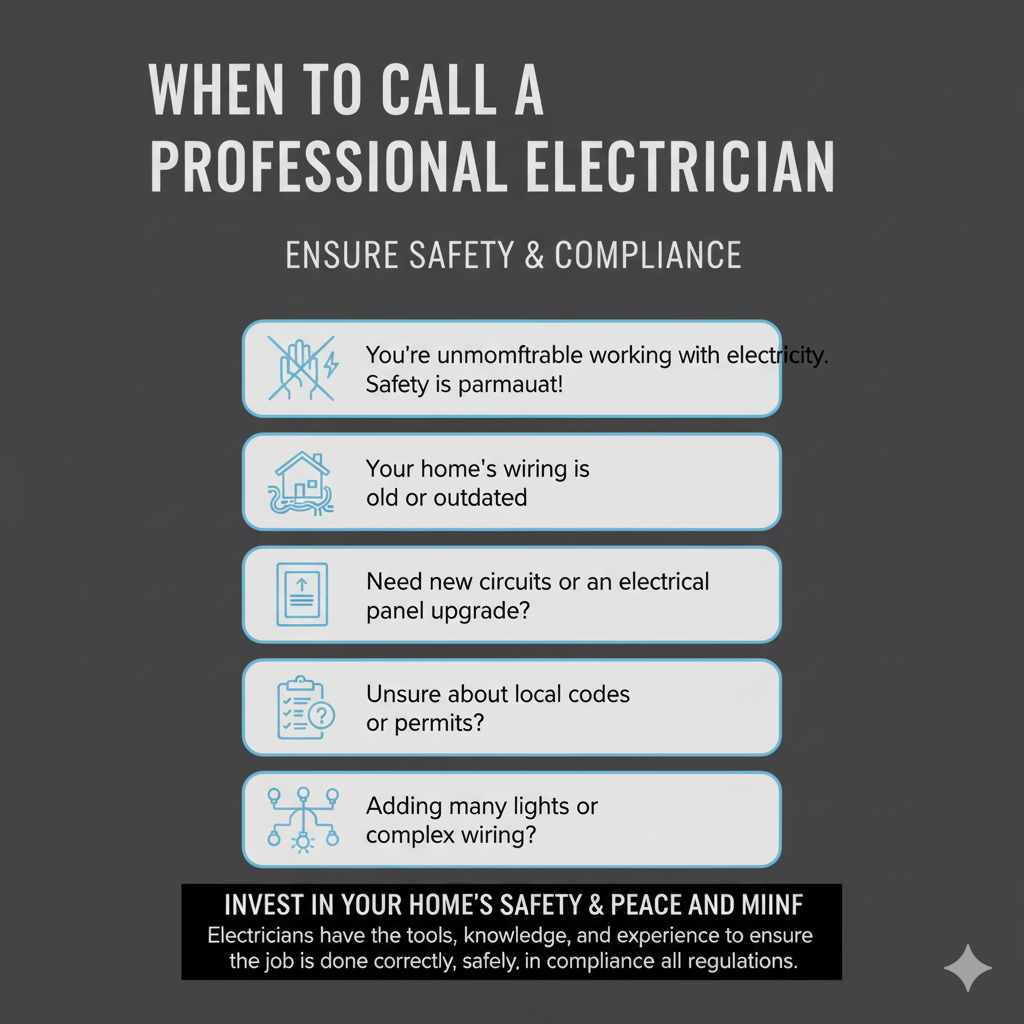
While this guide helps you understand the basics, there are times when calling a professional is the smartest move. Don’t hesitate to reach out if:
- You’re uncomfortable working with electricity. Safety is paramount!
- Your home’s wiring is old or you suspect it’s not up to modern standards.
- You need to install new circuits or upgrade your electrical panel.
- You’re unsure about local codes or permit requirements.
- You’re adding a significant number of lights or dealing with complex wiring.
- You’re adding lights to a circuit that already has many devices or a heavy load.
Electricians have the tools, knowledge, and experience to ensure the job is done correctly, safely, and in compliance with all regulations. It’s an investment in your home’s safety and your peace of mind.
Frequently Asked Questions (FAQ)
Q1: How many 60-watt incandescent recessed lights can I put on a 15-amp circuit?
For a 15-amp circuit, the safe capacity is about 960 watts (80% of 15A 120V). Each 60-watt incandescent bulb uses 60 watts. So, you could theoretically install 960W / 60W/light = 16 lights. However, it’s very unlikely a single lighting circuit would only have lights and nothing else. If other devices are on the circuit, you’d need to subtract their wattage, significantly reducing the number of lights.
Q2: Can I mix LED and incandescent bulbs on the same circuit?
Yes, you can technically mix them on the same circuit. However, you must calculate the total wattage based on the actual wattage of each bulb. Since incandescent bulbs use much more energy, they will limit the number of lights you can install on that circuit faster than LEDs would. It’s generally recommended to stick to one type of bulb per circuit for simplicity and efficiency.
Q3: What’s the difference between a 15-amp and 20-amp circuit for lighting?
A 20-amp circuit can safely handle more power than a 15-amp circuit. Using the 80% rule, a 15-amp circuit can safely power about 960 watts, while a 20-amp circuit can safely power about 1920 watts. This means you can install more lights (or higher wattage devices) on a 20-amp circuit.
Q4: Do I need a dedicated circuit for recessed lighting?
It’s highly recommended, especially for larger installations. A dedicated circuit means that only the lights are on that circuit, preventing you from accidentally overloading it with appliances or other devices. This ensures consistent power and maximum safety. For smaller projects, like a few lights over a kitchen island, adding them to an existing circuit might be feasible if you carefully calculate the total load.
Q5: How do I know if my lights are on the same circuit?
The best way is to check your electrical panel. All the breakers should be labeled. If not, you can test them by turning on the lights you’re concerned about, then flipping breakers one by one until the lights go off. You can also plug a small lamp into outlets and do the same test. If multiple lights or outlets go off when you flip a single breaker, they are on the same circuit.
Q6: What are “waffle” or “grid” lighting layouts?
These terms refer to a uniform spacing of lights across a ceiling, often in a grid pattern, to provide even general illumination. The number of lights in such a layout depends on the room size, ceiling height, and the light output and beam spread of the fixtures used. While you can calculate the maximum number per circuit, practical layouts often use fewer lights per circuit for better control and zoning.
Conclusion
Figuring out how many recessed lights can go on a circuit might seem a bit technical at first, but with a clear understanding of wattage, amps, volts, and the 80% safety rule, it’s a manageable task. Remember, the goal is not just to fit as many lights as possible onto a circuit, but to do so safely and effectively. By carefully calculating the load, considering what else is on the circuit, and planning for control, you can ensure your new lighting not only looks great but also functions reliably for years to come.
Whether you’re adding a few accent lights or planning a whole-room overhaul, taking the time to get the circuit calculations right is a crucial step. Don’t hesitate to consult the resources from organizations like the NFPA or, for absolute peace of mind and guaranteed safety, bring in a qualified electrician. Happy lighting!