Impact Driver Power vs Drill Power Explained
Many people wonder about the difference between impact drivers and drills. It can be a bit confusing for beginners, especially when they see how fast an impact driver works. This post will clear things up easily.
We will show you exactly what makes an impact driver stronger. Get ready for a simple explanation that makes everything easy to understand. Let’s explore the power behind these tools.
Compared to a Drill, What Makes an Impact Driver More Powerful? We will break it down step by step.
Understanding the Core Difference: Power Transfer
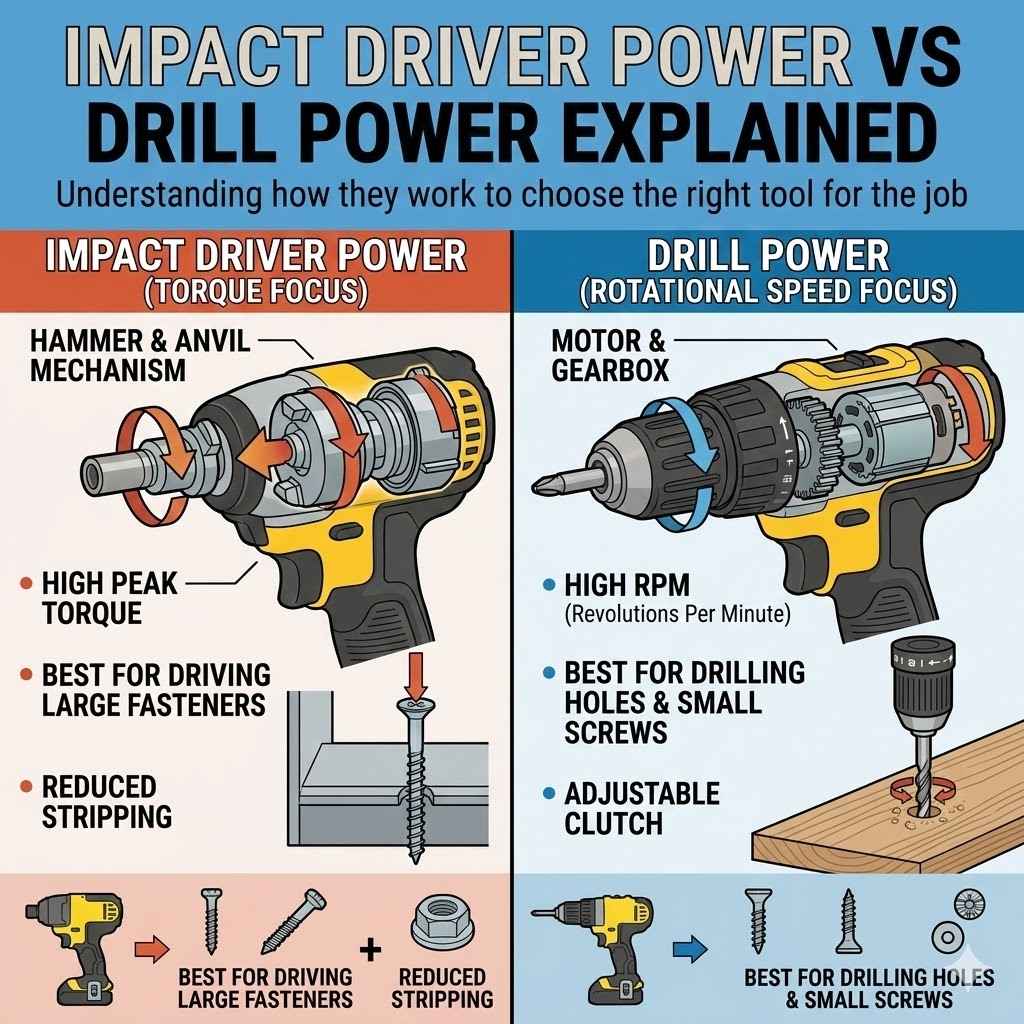
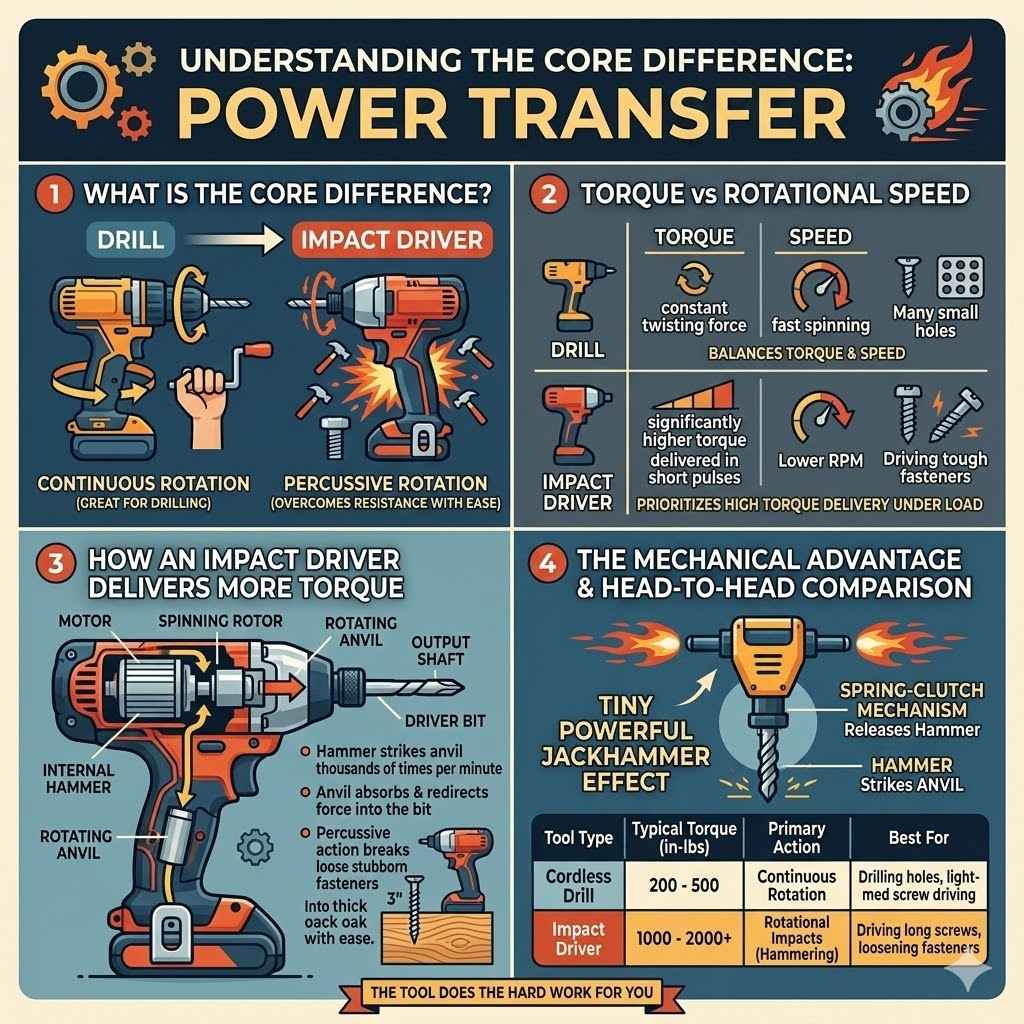
The main reason an impact driver feels so much more powerful than a drill is how it delivers its force. Drills use continuous rotational force, much like a hand crank. This is great for drilling holes or driving screws slowly. However, when you need to sink a long screw into hard wood or loosen a stubborn bolt, the drill can bog down. It relies solely on the motor’s torque and your grip to keep turning.
An impact driver, on the other hand, adds a unique percussive action to its rotation. When the driver senses resistance, it engages an internal hammer mechanism. This hammer strikes a rotating anvil, creating rapid, powerful bursts of rotational force. Think of it like hitting a stubborn screw with a tiny hammer while simultaneously trying to twist it. This hammering action, combined with the rotational torque, allows the impact driver to overcome much greater resistance with less effort from the user. This is the key to its enhanced power.
Torque Versus Rotational Speed
It is important to understand torque and rotational speed separately. Torque is the twisting force. It is what allows a tool to turn something. Rotational speed, often measured in revolutions per minute (RPM), is how fast the tool spins. A drill typically has a higher maximum RPM than an impact driver. This means a drill can spin faster, which is good for making clean holes.
However, an impact driver excels in delivering higher torque, especially when needed most. While a drill’s torque is constant and relies on its motor, an impact driver’s torque is delivered in short, powerful pulses. This makes it much better at starting and finishing tough jobs. For example, when driving a large lag screw, a drill might struggle to get it started or will strain as it goes deeper. An impact driver, with its hammering action, can drive that same screw with surprising ease.
- Torque is the twisting strength of the tool. It’s the ability to turn something. Think of it like how hard you can turn a jar lid. An impact driver has significantly higher peak torque than a standard drill. This is due to its internal hammer and anvil system.
- Rotational speed is how fast the tool spins. It’s measured in RPM. A drill usually has a faster maximum RPM than an impact driver. This makes drills better for tasks that require fast spinning, like making many small holes.
- The combination of torque and speed matters for different jobs. For basic drilling, speed is often more important. For tough fastening tasks, high torque is essential. An impact driver prioritizes high torque delivery, especially under load.
How an Impact Driver Delivers More Torque
The secret to an impact driver’s power lies in its internal mechanism. It’s not just a motor; it’s a system designed for brute force. Inside, a spinning rotor is connected to a hammer. This hammer is designed to strike an anvil. When the trigger is squeezed and the tool encounters resistance, the motor spins the rotor and the hammer. The hammer then hits the anvil, which is attached to the output shaft.
This impact, or hammering, happens thousands of times per minute. Each impact delivers a sharp burst of rotational force. This is very different from a drill’s continuous rotation. The anvil is designed to absorb and redirect the hammer’s force into the bit. This means the rotational energy is applied in short, powerful pulses rather than a smooth, steady flow. This percussive action is what allows impact drivers to break loose stubborn fasteners and drive screws into dense materials with less user effort.
Consider driving a 3-inch screw into a thick piece of oak. A standard drill might stall, overheat, or require you to apply a lot of downward pressure. An impact driver, with its percussive blows, will drive that screw in much faster and with less strain on your arm.
The tool does the hard work for you.
The Mechanical Advantage of the Hammer and Anvil System
The hammer and anvil system within an impact driver is a marvel of mechanical engineering. It translates the continuous rotation of the motor into intermittent, high-torque impacts. Here’s a simple way to picture it: imagine a tiny, powerful jackhammer attached to a drill bit. When the motor spins, it winds up a spring or a clutch mechanism. As resistance increases, this mechanism releases the hammer.
The hammer then violently strikes the anvil. The anvil is designed to deliver this striking force directly to the output shaft, which holds the driver bit. This sequential striking action is incredibly efficient at transferring rotational force. The speed of these impacts is crucial. Most impact drivers deliver between 2,000 and 4,000 impacts per minute (IPM). This high frequency of blows, combined with the mechanical leverage, creates the signature power of an impact driver.
Comparing Impact Drivers and Drills Head-to-Head
When you look at the specifications, the differences become clear. A typical cordless drill might offer around 200-500 inch-pounds of torque. In contrast, a good cordless impact driver can deliver anywhere from 1,000 to well over 2,000 inch-pounds of torque. This is a massive difference.
Let’s visualize this. Imagine trying to unscrew a rusted bolt on a car. You might try with a wrench (like a drill), but it’s hard work. An impact wrench (the automotive equivalent of an impact driver) would make quick work of it with its hammering action. The same principle applies to woodworking and construction.
| Tool Type | Typical Torque (in-lbs) | Primary Action | Best For |
|---|---|---|---|
| Cordless Drill | 200 – 500 | Continuous Rotation | Drilling holes, light to medium screw driving |
| Impact Driver | 1000 – 2000+ | Rotational Impacts (Hammering) | Driving long screws, loosening stubborn fasteners, heavy-duty tasks |
This table clearly shows the power disparity. The impact driver’s higher torque rating directly translates to its ability to handle tougher jobs.
When to Choose an Impact Driver Over a Drill
Knowing when to use which tool is key to efficient work. If you’re assembling furniture, drilling small pilot holes for screws, or using a hole saw for drywall, a standard drill is usually sufficient and offers better control. Its variable speed and clutch settings allow for precise work without stripping screws or damaging materials.
However, if your task involves driving long screws into hardwoods, sinking lag bolts, or working with large fasteners, an impact driver is the superior choice. It reduces user fatigue because the tool is doing most of the hard work. It’s also excellent for removing old, rusted, or over-tightened bolts and screws that a regular drill might struggle with. Think about building a deck or a fence; these projects often involve many long screws that an impact driver can handle much faster and more effectively.
Specific Tasks Benefiting from Impact Driver Power
Several common tasks are made significantly easier and faster with an impact driver’s power.
- Driving Long Screws: When you need to drive screws that are several inches long, especially into dense wood, an impact driver is invaluable. The hammering action helps to overcome the resistance as the screw penetrates deeper, preventing stalling and stripping. You can drive them in straight and true with minimal effort.
- Working with Lag Bolts: Lag bolts are large, heavy-duty screws used in construction for framing and structural connections. They require a lot of torque to drive. An impact driver, with its high torque output, is often the only practical tool for quickly and effectively installing lag bolts.
- Loosening Stubborn Fasteners: Rusted bolts, seized nuts, or screws that have been overtightened can be a nightmare to remove with a standard drill. The percussive action of an impact driver can effectively break the seal of corrosion or thread lock, allowing the fastener to be loosened with ease.
- Assembling Decking and Framing: These projects often involve hundreds of screws, many of them long. An impact driver can significantly speed up the process, reducing the physical strain on the user. It makes repetitive fastening tasks much more manageable.
Real-Life Scenarios: Impact Driver vs. Drill in Action
Imagine you are building a simple bookshelf. You need to attach the shelves to the sides. Using a drill, you might set your clutch to a low setting to avoid stripping the small screws. You’ll likely need to apply steady downward pressure.
Now, imagine you are framing a wall for a deck. You have to drive 3-inch deck screws every few inches. If you used a drill, you would struggle with the resistance. Your arms would get tired quickly. You might even strip out the screw heads.
An impact driver makes this second scenario effortless. You can set the screw in place, pull the trigger, and the impact driver drives it home in seconds with a satisfying whirring sound and rhythmic thudding. The tool handles the heavy lifting, leaving you to move to the next screw. This difference in efficiency is enormous.
Consider a study by Tool Reviewer Magazine that tested various fastening tasks. They found that driving 20 identical 3-inch screws into pressure-treated lumber took an average of 2 minutes and 30 seconds with an impact driver. The same task with a standard drill took an average of 7 minutes and 15 seconds, with significant user fatigue noted.
This highlights the practical advantage in speed and effort.
The Role of Rotational Force and Impact Combined
The true power of an impact driver comes from the synergy of its two actions: rotation and impact. It’s not just about hitting hard; it’s about hitting hard while also turning. The continuous rotational force from the motor keeps the bit engaged with the fastener, while the percussive impacts break through resistance.
This combination is particularly effective for tasks where a standard drill would simply spin its bit without making progress. The impact dislodges the material that is binding the fastener, allowing the rotation to continue its work. Without this combined action, the tool would stall, and the user would have to force it, often leading to stripped screw heads or damaged materials. The impact driver essentially “loosens” the resistance with each blow, allowing the rotation to advance.
Understanding the Types of Impact Tools
While we’ve focused on the cordless impact driver commonly used for DIY and construction, there are other types.
- Impact Wrenches: These are similar in principle but are designed specifically for automotive and heavy-duty mechanical work. They use a different socket system and often have even higher torque ratings for loosening lug nuts and other very tight bolts.
- Corded Impact Drivers: While less common for consumers, corded versions exist and offer consistent power without battery concerns. However, the portability of cordless models is a major advantage.
- Manual Impact Drivers: These are a simpler, non-powered tool. You strike the end of the tool with a hammer, and it converts the linear impact into a powerful rotational force. They are useful for loosening very stubborn fasteners by hand.
All these tools share the fundamental principle of using impact to enhance rotational force, but they are optimized for different applications.
Safety and Control Considerations
While impact drivers are powerful, it’s important to use them safely. Because of the sudden bursts of force, it’s crucial to maintain a firm grip on the tool. You should stand balanced and be prepared for the tool to lurch slightly when an impact occurs.
A standard drill, with its continuous rotation and often a clutch, offers more fine-tuned control for delicate tasks. The clutch allows you to set a limit on the torque applied, preventing over-tightening or stripping screws. Impact drivers typically do not have this clutch feature. Instead, they rely on the user’s trigger control to manage the power. Learning to feather the trigger is essential for controlling the impact driver’s strength.
Proper Grip and Stance
Maintaining a proper grip and stance is vital when using an impact driver. Always hold the tool with both hands if possible. One hand on the grip and the other on the auxiliary handle or the body of the tool for stability. Ensure your footing is secure.
When driving screws, position yourself so you can apply steady, controlled pressure. Be aware that the tool can twist or jump if it suddenly encounters less resistance after a period of high load. This sudden release of force is why a firm grip is so important.
For example, if you are driving a screw and it suddenly breaks through a thin piece of material, the impact driver will momentarily spin much faster. Without a strong grip, the tool could twist your wrist. This is why using the right bit and the correct technique is as important as the tool itself.
Bit Selection and Material Compatibility
Using the correct bit for the job is critical for both effectiveness and safety. Impact drivers require specialized impact-rated bits. These bits are made from stronger steel and are designed to withstand the repeated shocks and torque. Using regular drill bits in an impact driver can cause them to break, potentially causing injury.
Furthermore, consider the material you are working with. For softwoods, you can often drive screws directly without a pilot hole. For hardwoods or very dense materials, a pilot hole might still be beneficial, even with an impact driver, to prevent splitting. Always check the manufacturer’s recommendations for your specific tools and materials.
A common scenario involves attempting to drive a screw into particle board without a pilot hole. The impact driver’s power can easily cause the brittle material to crumble around the screw, leading to a weak connection. A small pilot hole guides the screw and prevents this damage, even with an impact driver.
Controlling Power with the Trigger
The trigger on an impact driver is your primary control for managing its immense power. Unlike a drill’s trigger that offers smooth, linear control over speed, an impact driver’s trigger is more about controlling the frequency and duration of the impacts.
Squeezing the trigger gently allows the tool to spin slowly, and you can feel the impacts start to engage as resistance increases. Pulling the trigger harder engages the motor and hammer mechanism more aggressively, delivering rapid, powerful blows. Mastering this trigger control is essential for tasks requiring precision, like starting a screw without it wandering off course. It takes practice, but it’s achievable for most users.
When NOT to Use an Impact Driver
Despite their power, impact drivers are not suitable for every job. For tasks requiring delicate touch, such as working with very small fasteners or soft materials where over-tightening is a risk, a standard drill with a clutch is a better choice.
- Precision Drilling: For making very clean, accurate holes, especially in delicate materials or where appearance is critical, a drill offers better control over the bit’s speed and depth.
- Working with Small Screws: Tiny screws can easily be stripped or snapped by the sheer force of an impact driver, even with careful trigger control. A drill’s adjustable clutch is ideal for preventing this.
- Countersinking: While an impact driver can drive screws, achieving a flush or slightly recessed screw head (countersinking) without overdoing it is much harder than with a drill’s clutch.
Consider a scenario where you are assembling a delicate piece of electronics. Using an impact driver here would be disastrous. The slightest over-tightening could crack a circuit board or strip a minuscule screw.
A small electric screwdriver with torque settings is far more appropriate for such tasks.
Comparing Impact Drivers and Drills on Specific Features
Let’s look at some features that differentiate these tools beyond raw power.
Chuck Type and Bit Holders
A standard drill typically has a three-jaw chuck that can grip a wide variety of drill bits, including twist bits, spade bits, and hole saws, as well as screwdriver bits. This chuck is tightened and loosened by hand or with a chuck key.
An impact driver, however, usually features a quick-release collet. This collet is designed specifically to hold hex-shank screwdriver bits and driver bits. The bit simply snaps into place. This makes bit changes incredibly fast and secure. While convenient, this means impact drivers are generally limited to using hex-shank accessories. You cannot use a standard round-shank drill bit directly in an impact driver collet. Adapters exist, but they can add length and reduce efficiency.
Speed Settings and Adjustments
Most modern drills offer multiple speed settings (e.g., low speed for high torque, high speed for drilling) and an adjustable clutch. This clutch allows you to dial in the exact amount of torque needed for a specific screw and material. Once the set torque is reached, the clutch slips, preventing over-tightening.
Impact drivers usually have simpler power adjustments, often a variable speed trigger and sometimes electronic speed settings (e.g., low, medium, high). They lack the adjustable clutch of a drill because their power delivery is inherently percussive. Control is primarily managed through trigger finesse and the speed settings.
Battery Life and Tool Weight
Both drills and impact drivers come in cordless versions, powered by rechargeable batteries. Battery life can vary significantly based on the battery’s amp-hour (Ah) rating and the intensity of the work being done. Generally, for similar tasks, an impact driver can be more battery-efficient because it completes tasks faster.
Weight is also a factor. Impact drivers are often lighter and more compact than comparable drills. This is because they have fewer internal gears and a simpler mechanism, focusing on delivering rotational force directly through the hammer and anvil. Their smaller size and lighter weight make them easier to handle in tight spaces and reduce user fatigue during extended use.
A common observation is that while a drill might have a slightly larger battery, the impact driver can sometimes complete more tasks before needing a recharge simply because it finishes each task so much quicker.
Noise and Vibration
Impact drivers are generally louder than drills due to the percussive nature of their operation. The hammering action creates a distinct whirring and thudding sound. Drills produce a more continuous motor noise.
Vibration is also more pronounced with an impact driver. The rapid hammer strikes transmit vibrations through the tool and into the user’s hands. While this is part of how they generate power, it’s something to be aware of, especially during prolonged use. Wearing anti-vibration gloves can help mitigate this.
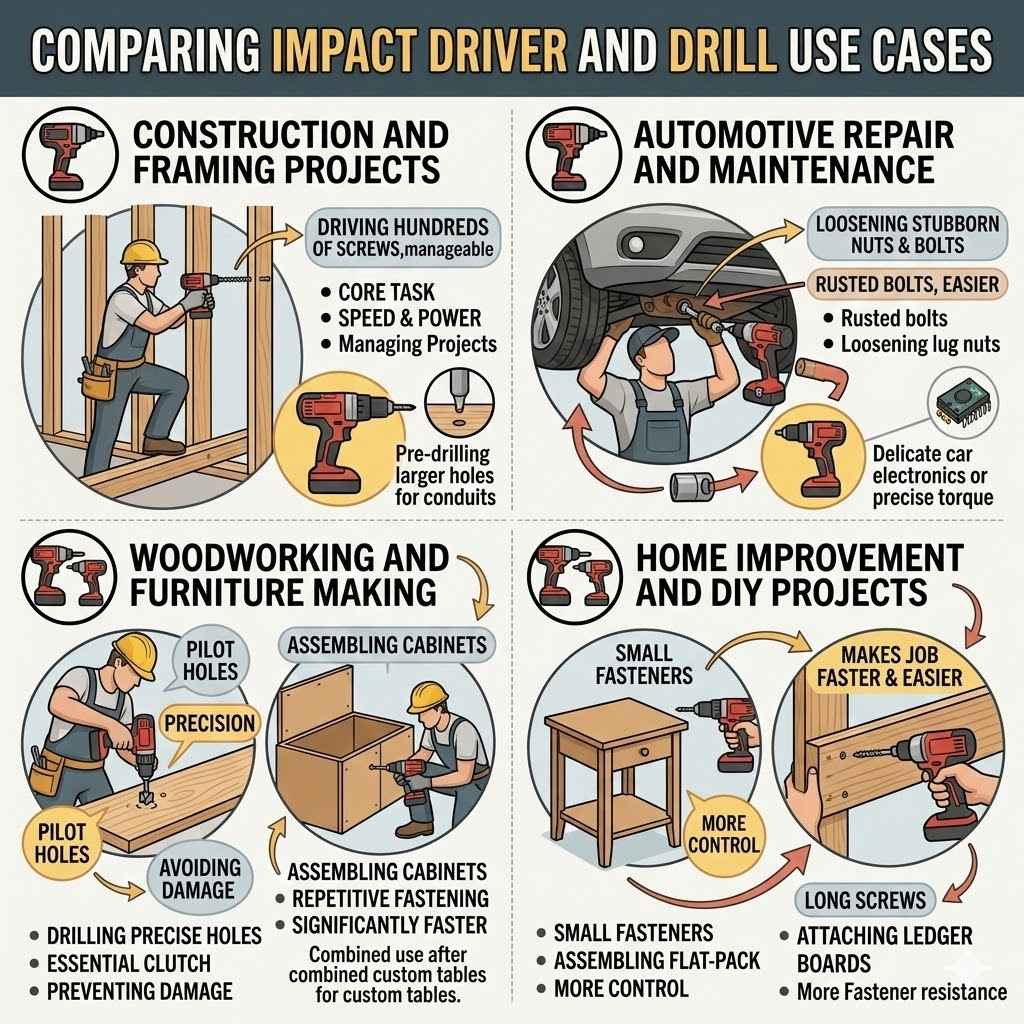
Comparing Impact Driver and Drill Use Cases
Let’s look at common scenarios where one tool clearly shines over the other.
Construction and Framing Projects
In construction, especially framing, an impact driver is king. Driving hundreds of screws into studs, joists, and beams is a core task. The speed and power of an impact driver make these projects manageable.
A drill might be used for pre-drilling larger holes for plumbing or electrical conduits, but for the bulk of screw fastening, the impact driver is the go-to tool. Its ability to sink long screws quickly without bogging down is invaluable in this demanding environment.
Automotive Repair and Maintenance
While specialized impact wrenches are common in auto shops, a good impact driver can be incredibly useful for many automotive tasks. Loosening stubborn lug nuts (with the proper socket adapter) or removing rusted bolts from the chassis can be made much easier.
However, for delicate work on car electronics or anything requiring precise torque, a drill with a clutch and appropriate bits would be preferred. It’s about matching the tool to the task’s specific needs.
Woodworking and Furniture Making
For general woodworking, both tools have their place. A drill is excellent for drilling precise holes, using Forstner bits or dowel jigs. Its clutch is essential for avoiding over-tightening screws in fine furniture, preventing damage to expensive wood.
An impact driver is perfect for tasks like assembling cabinet boxes, installing drawer slides, or driving large screws in projects like workbenches or outdoor furniture. It speeds up repetitive fastening tasks significantly.
A craftsman building a custom dining table might use a drill to bore pilot holes and then switch to an impact driver to quickly sink the heavy-duty screws that hold the apron to the legs. This combination allows for both precision and efficiency.
Home Improvement and DIY Projects
For most home improvement tasks, like hanging shelves, assembling flat-pack furniture, or installing new hardware, both tools can work. However, if the task involves long screws, like attaching a ledger board for a shelf or assembling a large storage unit, an impact driver will make the job much faster and easier.
For simply screwing in a few drywall screws or assembling a small end table, a drill might offer more control. But for any task that involves more than a few fasteners or where resistance is expected, the impact driver’s power advantage is evident.
Frequently Asked Questions
Question: Can I use a drill bit in an impact driver?
Answer: You can use drill bits with a hex shank in an impact driver. Standard round-shank drill bits require an adapter. Using standard bits without an adapter can damage the impact driver’s chuck and the bit itself.
Question: Is an impact driver safer than a drill?
Answer: Both tools require careful handling. An impact driver’s sudden bursts of power can be jarring, so a firm grip is essential. A drill offers more control for delicate tasks due to its clutch and continuous rotation.
Question: Do I need both an impact driver and a drill?
Answer: For serious DIYers and professionals, yes, having both is ideal. A drill is versatile for drilling and fine fastening, while an impact driver excels at heavy-duty driving and loosening stubborn fasteners.
Question: Can an impact driver strip screws?
Answer: Yes, an impact driver can strip screws if not used carefully. Because it lacks an adjustable clutch, control comes from the trigger. Practicing trigger control is key to avoiding stripped screws.
Question: Are impact drivers really that much more powerful than drills?
Answer: Yes, impact drivers deliver significantly higher torque through their percussive action. This makes them much more effective for driving long screws or loosening tight fasteners compared to a standard drill.
Conclusion
The primary reason an impact driver feels more powerful than a drill is its unique hammering mechanism. This system delivers rotational force in rapid, high-torque bursts, allowing it to overcome significant resistance. While drills offer continuous rotational power and precise control with their clutches, impact drivers excel at tough fastening jobs, driving long screws, and loosening stubborn bolts. Understanding their distinct capabilities ensures you choose the right tool for maximum efficiency and ease.