Is Wood Rotting a Physical or Chemical Change
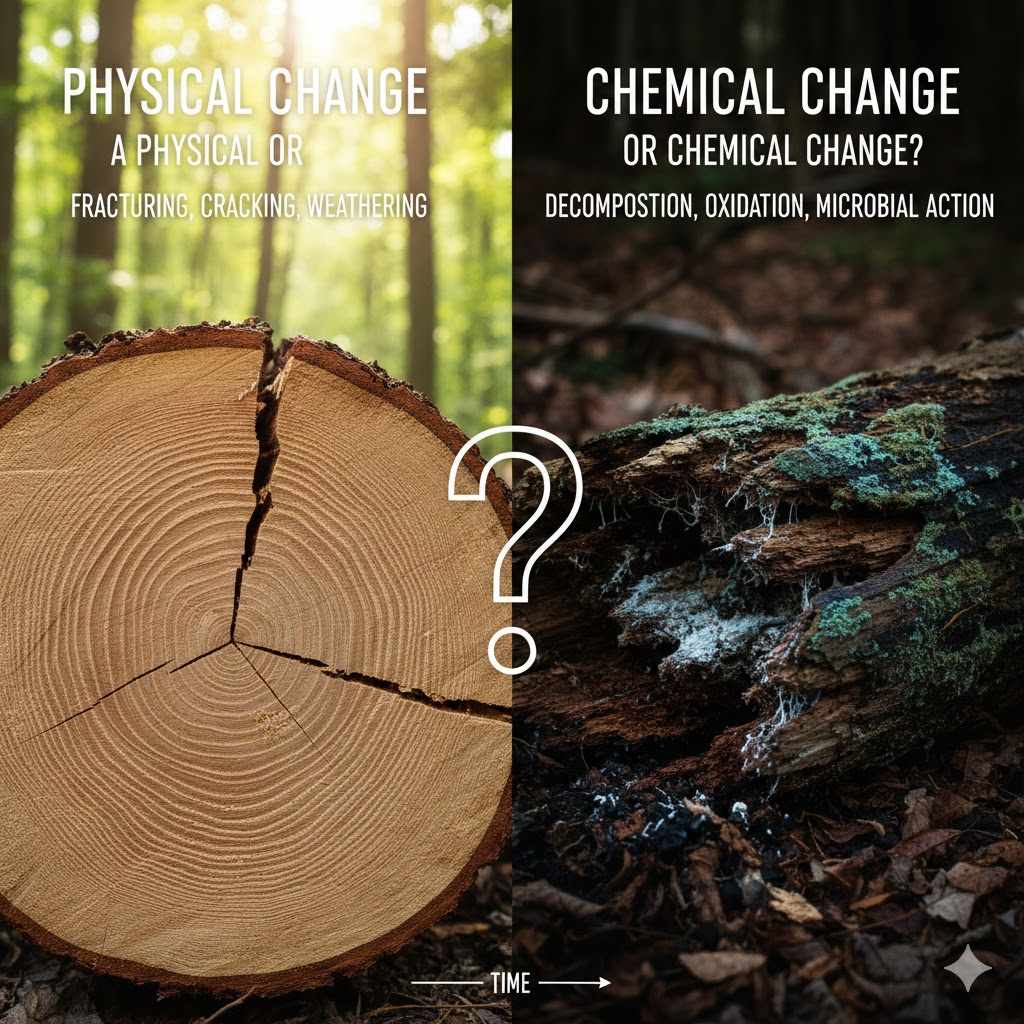
Sometimes, figuring out if something is a physical or chemical change can be tricky, especially when you’re just starting to learn about science. Wood rotting is one of those topics that often puzzles beginners. It looks like it’s just changing, but is it really changing in a way that makes it a totally new substance?
Don’t worry, we’ll break it down step-by-step so you can understand it easily. We’ll explore exactly what happens when wood rots and clarify if Is Wood Rotting a Physical or Chemical Change?
Understanding Physical vs. Chemical Changes
This section will help you get a clear picture of what makes a change physical and what makes it chemical. It’s important to know the basic rules before we look at wood rot. We’ll cover the main differences so you can spot them anywhere.
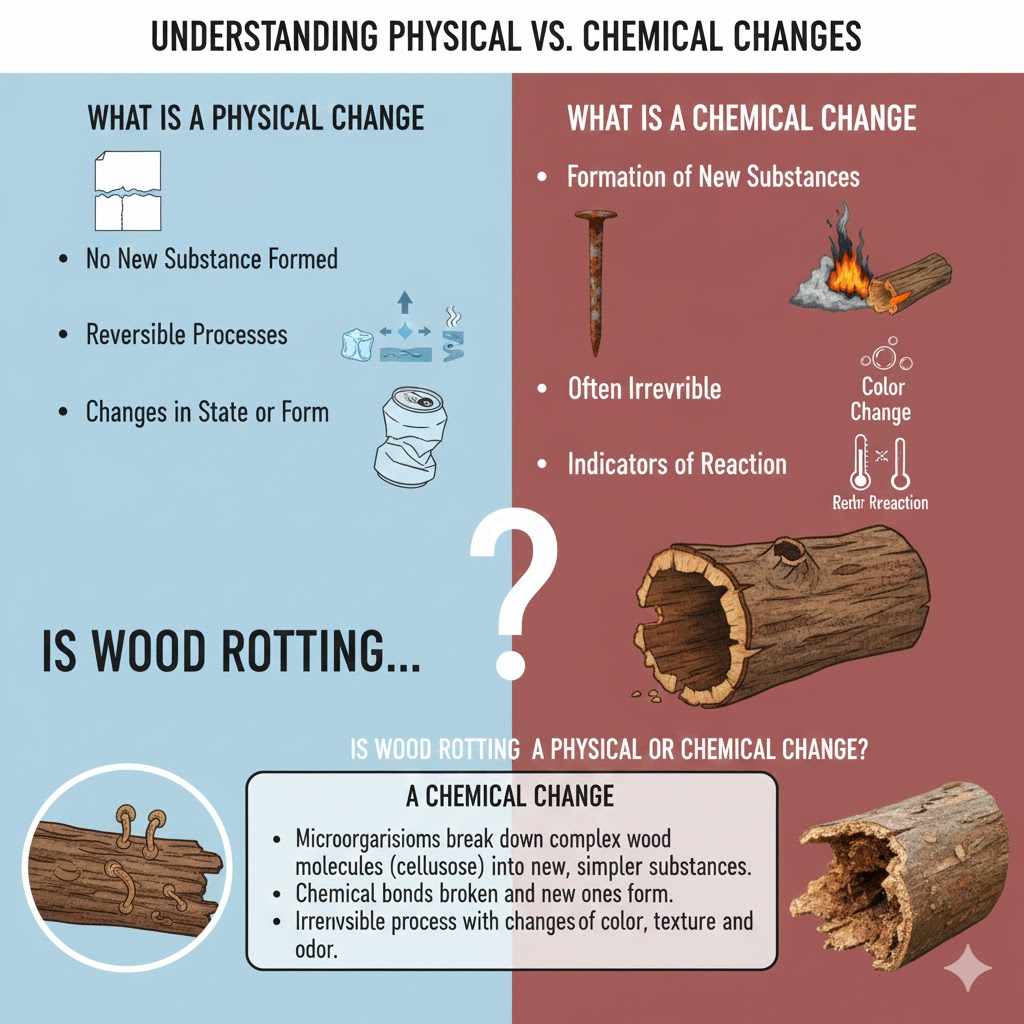
What Is a Physical Change
A physical change is when a substance changes its form or appearance but doesn’t change into a new substance. The stuff it’s made of stays the same. Think about water freezing into ice.
It looks different, feels different, but it’s still H2O. Its molecules haven’t rearranged to become something new.
Key ideas of physical changes include:
- No New Substance Formed: The original material remains the same at a molecular level. It might look different or be in a different state, but its chemical identity is unchanged. For example, when you rip a piece of paper, you have smaller pieces of paper, not something entirely new.
- Reversible Processes: Many physical changes can be reversed. Ice can melt back into water, and water can be boiled back into steam. This reversibility is a strong indicator that it’s a physical change, as the original state can often be restored by altering conditions like temperature or pressure.
- Changes in State or Form: This includes melting, freezing, boiling, condensing, sublimating, and depositing. It also covers changes in shape, size, and texture, like crushing a can or cutting hair. The substance itself, however, retains its chemical properties.
What Is a Chemical Change
A chemical change, also known as a chemical reaction, is different. Here, the original substance turns into one or more completely new substances. These new substances have different properties.
A good example is burning wood. The wood turns into ash, smoke, and gases, which are all different from the original wood.
Key ideas of chemical changes include:
- Formation of New Substances: The hallmark of a chemical change is the creation of entirely new chemical compounds with different properties. When iron rusts, it forms iron oxide, which is reddish-brown and brittle, unlike the shiny, strong iron metal it started as.
- Often Irreversible: While some chemical changes can be reversed with significant effort, most are practically irreversible under normal conditions. You can’t easily turn ash back into wood. This difficulty in reversing the process is a key characteristic.
- Indicators of Reaction: Several signs can tell you a chemical change has happened. These include a change in color, the release of gas (bubbles), the formation of a precipitate (a solid forming in a liquid), a change in temperature (heat is produced or absorbed), or a change in odor.
Is Wood Rotting a Physical or Chemical Change
Now, let’s get to the main question. When wood rots, it’s breaking down. It becomes soft, crumbly, and often changes color.
It might even start to smell musty. This breakdown involves complex processes that alter the wood’s original structure and composition, leading us to consider its nature.
The process of wood rot is primarily driven by microorganisms like fungi and bacteria. These organisms secrete enzymes that break down the complex organic molecules in wood, such as cellulose and lignin, into simpler compounds. This breakdown isn’t just changing the wood’s shape; it’s altering its chemical makeup.
The enzymes act as catalysts, speeding up reactions that transform the wood’s components. Cellulose and lignin, which give wood its strength and structure, are converted into sugars, acids, and other organic molecules. This transformation means the chemical bonds within the wood are broken and new bonds are formed, creating new substances.
Therefore, Is Wood Rotting a Physical or Chemical Change? The answer leans heavily towards a chemical change.
The Science Behind Wood Rot Decomposition
This section dives deep into what actually happens when wood starts to decay. We’ll explore the role of tiny organisms and how they change the wood’s makeup. It’s a fascinating process that shows how nature recycles materials.
Role of Fungi and Bacteria
Wood-rotting organisms, mainly fungi but also some bacteria, are the main culprits behind decay. They don’t just eat the wood; they digest it. They release special chemicals called enzymes that break down the tough parts of wood into smaller, simpler molecules that they can absorb for food.
These microorganisms are essential for ecosystems. They break down dead trees and other plant matter, returning nutrients to the soil. Without them, forests would be piled high with undecomposed wood.
This recycling process is a fundamental part of nature’s cycle.
- Enzyme Secretion: Fungi and bacteria release extracellular enzymes. These enzymes are like tiny molecular scissors that cut apart the long chains of cellulose and lignin. Cellulose gives wood its strength, while lignin acts like a glue, holding the cellulose fibers together.
- Breakdown Products: As the enzymes work, cellulose is broken down into sugars like glucose. Lignin is broken down into various phenolic compounds and acids. These are all new substances with properties very different from cellulose and lignin.
- Nutrient Cycling: The simple sugars and acids produced are then absorbed by the fungi and bacteria for energy and growth. This process effectively recycles carbon and other nutrients from the wood back into the environment, making them available for new life.
Cellulose and Lignin Breakdown
Cellulose and lignin are the two main components that give wood its structure and strength. They are complex molecules made up of repeating units of sugar and aromatic rings, respectively. When wood rots, these complex structures are dismantled.
Cellulose is a polysaccharide, a long chain of glucose units. Fungi use enzymes like cellulases to break these long chains into smaller sugars. Lignin is a more complex polymer made of aromatic units.
Breaking down lignin requires a different set of enzymes, often involving oxidative reactions.
- Cellulase Action: Enzymes like endoglucanases, exoglucanases, and beta-glucosidases work together to break down cellulose. This is a multi-step process that liberates glucose molecules from the cellulose polymer. This glucose can then be used by the organisms.
- Lignin Depolymerization: Lignin’s complex structure makes it harder to break down. Organisms employ enzymes like laccases and peroxidases. These enzymes use oxygen or other oxidants to break the chemical bonds holding the lignin polymer together, forming simpler aromatic compounds.
- Impact on Wood Structure: As cellulose and lignin are broken down, the wood loses its structural integrity. The wood becomes soft, weak, and brittle because the very materials that gave it strength are being chemically altered into new substances.
Types of Wood Rot
Wood decay is often categorized by the appearance and the types of wood components primarily affected. The main types are brown rot, white rot, and soft rot. Each type is caused by different types of fungi and results in distinct changes to the wood.
Understanding these types helps us see how the chemical breakdown manifests visually and structurally. It’s not just one way wood decays; different fungi target different parts of the wood’s chemistry.
- Brown Rot: This type of rot is caused by fungi that primarily degrade cellulose and hemicellulose, leaving the lignin largely intact. This process results in the wood shrinking and cracking into a dark brown, crumbly mass. It often leaves a distinct cube-like pattern as the wood breaks along the grain. The loss of cellulose means the wood loses its structural strength rapidly.
- White Rot: White rot fungi degrade both cellulose and lignin, or primarily lignin. This breakdown often leaves the remaining wood stringy and fibrous, with a bleached or whitish appearance. Lignin degradation is key here, as it’s a very stable molecule and its removal allows the fungus to access the cellulose more easily. The wood becomes tough and spongy.
- Soft Rot: This occurs in wood that is consistently wet and often in wood with a high lignin content. Soft rot fungi create microscopic cavities within the wood cell walls, leading to a softened, often dark-colored surface layer. This type of rot can occur where other types of rot are inhibited due to conditions like waterlogging.
Evidence of Chemical Change in Rotting Wood
This part will show you the specific signs that prove wood rot is a chemical transformation. We’ll look at observable changes that signal new substances are being made, confirming it’s not just a physical event.
Color Changes
When wood rots, its color often changes dramatically. Fresh wood might be light brown, white, or reddish. As it decays, it can turn darker brown, black, or even whitish or yellowish, depending on the type of rot and the fungi involved.
These color shifts are strong indicators of chemical alteration. The original pigments in the wood may be broken down, or new colored compounds may be formed during the decomposition process. For instance, the oxidation of lignin can lead to darker colors.
- Oxidation Products: Many color changes are due to oxidation reactions. As fungi break down lignin and other compounds, they can create new molecules that absorb and reflect light differently. This is similar to how an apple turns brown when it’s cut and exposed to air.
- Pigment Degradation: The natural pigments present in the wood can be chemically altered or destroyed by the enzymes and metabolic processes of the decay organisms. This leads to a loss of the original color.
- Formation of New Chromophores: Chromophores are parts of molecules that absorb light, thus giving a substance its color. The breakdown of complex wood polymers can create new, smaller molecules that act as chromophores, resulting in new colors.
Odor Production
Rotting wood often has a distinct smell. Fresh wood might have a pleasant, woody scent. However, as it decays, it can develop musty, earthy, sour, or even sweet odors.
These smells are the result of new chemical compounds being produced.
These volatile organic compounds (VOCs) are released into the air. The specific smell can often indicate the type of decay happening. For example, a sour smell might suggest acidic byproducts, while a sweet smell could come from certain volatile esters.
These odors are direct evidence of chemical reactions producing new, detectable substances.
- Volatile Organic Compounds (VOCs): The breakdown of complex organic molecules releases smaller, volatile compounds into the air. These are the molecules we detect as smells. They are entirely new chemical entities formed from the wood’s original components.
- Byproducts of Metabolism: Many of these odors are byproducts of the fungi’s or bacteria’s metabolic processes. As they consume and transform wood components, they release various gases and aromatic substances.
- Acids and Esters: Some common smells are due to the production of organic acids, like acetic acid, which can give a vinegary scent. Others may come from esters, which can produce fruity or sweet odors. These are all new chemical compounds.
Structural Weakening and Texture Change
As wood rots, it loses its strength and changes texture. It becomes soft, crumbly, spongy, or brittle, depending on the type of rot. This loss of structural integrity is a direct consequence of the chemical breakdown of its main components.
Imagine a strong piece of wood becoming so weak that you can poke your finger into it. This happens because the chemical bonds holding the cellulose fibers together and the lignin acting as a binder are being severed and transformed into different, less structural molecules. The wood is no longer the same material.
- Loss of Cellulose and Hemicellulose: These are the primary structural carbohydrates in wood. When they are degraded into sugars and acids, the wood loses its stiffness and tensile strength. This is why brown rot makes wood brittle and crumbly.
- Lignin Alteration: While lignin provides rigidity, its degradation also contributes to structural weakening. White rot, which targets lignin, can leave wood stringy and spongy, as the supportive matrix is broken down into different compounds.
- Cavitation and Cell Wall Degradation: Fungi create boreholes and cavities within the wood cells and degrade the cell walls themselves. This physical disruption is a result of chemical attack on the cell wall materials, weakening the overall structure at a microscopic level.
Case Studies and Real-World Examples
Let’s look at some real-world situations to see how wood rot happens and why it matters. These examples show the practical impact of this process.
Example 1 A Leaky Roof and Attic Decay
Imagine a house with a small leak in the roof that goes unnoticed for a long time. Water slowly drips into the attic, making the wooden beams and rafters damp. Over time, this constant moisture allows wood-rotting fungi to take hold.
The fungi break down the cellulose and lignin in the wood. The beams become soft and spongy, losing their ability to support the roof. If left unchecked, this can lead to serious structural damage, potentially causing parts of the roof to collapse.
This is a clear sign of chemical change turning strong wood into a weak, decayed material.
The process involves:
- Water from the leak saturates the wood.
- Fungal spores, always present in the environment, find a suitable home.
- Enzymes are secreted, breaking down cellulose and lignin into sugars and acids.
- The wood loses its strength and texture, becoming soft and crumbly.
- Eventually, the structural integrity of the roof beams is compromised, requiring costly repairs.
Example 2 A Fallen Log in a Forest
In a forest, when a large tree falls, it doesn’t just sit there forever. Over months and years, it becomes a home and food source for various organisms, including wood-rotting fungi. These fungi are nature’s recyclers.
They begin to break down the fallen log, turning its complex wood structures into simpler organic compounds. This process enriches the soil with nutrients, which are then used by new plants and trees to grow. The log transforms from solid wood into a mixture of decomposed material and soil.
The transformation can be observed in stages:
- Initially, the log is solid wood.
- Moisture and fungi begin their work, causing visible surface decay.
- The wood becomes softer, allowing insects and other organisms to penetrate more easily.
- Over time, the log breaks down into humus, a rich organic material that mixes with the soil.
- This decomposition is a chemical process, releasing carbon and nutrients back into the ecosystem.
Example 3 Wooden Furniture Left Outdoors
A wooden garden bench or table left outside is exposed to the elements. Rain, sun, and humidity create conditions favorable for wood decay. Over seasons, the wood can start to deteriorate.
You might notice the surface becoming rough, gray, and perhaps splintered. The wood might feel softer than it used to. This is the early stage of chemical breakdown by fungi and bacteria present in the environment.
If the wood is not protected or treated, the decay can progress deeper, eventually weakening the furniture.
The outdoor furniture example highlights:
- Environmental Exposure: Rain provides moisture, and high humidity keeps the wood damp, creating ideal conditions for microbial growth.
- Surface Degradation: UV rays from the sun can also break down the lignin on the wood’s surface, contributing to its graying and roughening.
- Penetration of Decay: While initial damage might be superficial, if moisture persists, fungi can colonize deeper into the wood, causing internal decay.
Distinguishing Rotting Wood from Other Changes
It’s important to know what’s really going on. Sometimes, wood might look like it’s rotting, but it could be something else entirely. This section helps you tell the difference.
Weathering vs. Rotting
Weathering is the process where wood breaks down due to exposure to sun, rain, wind, and temperature changes. It typically affects the surface of the wood, causing it to gray, warp, and splinter. The wood might look aged but is still structurally sound deep inside.
Rotting, on the other hand, is caused by living organisms (fungi and bacteria) that chemically break down the wood’s structure. This internal decay weakens the wood significantly. So, while both can make wood look old, the underlying cause and effect are different.
- Weathering Mechanisms: UV radiation from the sun can break down lignin, leading to surface graying and chalkiness. Moisture cycles cause expansion and contraction, leading to cracking and splintering. These are physical processes that degrade the surface.
- Rotting Mechanisms: Fungal enzymes actively digest cellulose and lignin, chemically altering the wood’s composition and leading to internal strength loss. This is a biological and chemical process that goes deeper than surface weathering.
- Structural Integrity: Weathered wood may look rough but often retains its core strength. Rotted wood becomes soft, crumbly, and structurally unsound, even if the surface appears superficially intact.
Mold vs. Rot
Mold is a type of fungus that grows on the surface of materials, including wood. It often appears as fuzzy or slimy patches of various colors like green, black, or white. Mold typically feeds on surface moisture and organic matter.
Wood rot is also caused by fungi, but these fungi penetrate deeper into the wood and break down its structural components (cellulose and lignin). Mold might be a sign of moisture that could eventually lead to rot, but mold itself is not the same as wood rot. Wood rot fundamentally changes the wood’s substance, while mold is more of a surface growth.
- Growth Location: Mold is primarily a surface growth, while wood rot fungi colonize and digest the interior of the wood.
- Impact on Structure: Mold may cause staining and odor but doesn’t significantly weaken the wood’s structure. Wood rot, however, leads to severe loss of strength and integrity.
- Feeding Habits: Some molds feed on surface mold, while rot fungi actively break down the complex polymers of cellulose and lignin for sustenance.
Is Wood Rotting a Physical or Chemical Change Summary
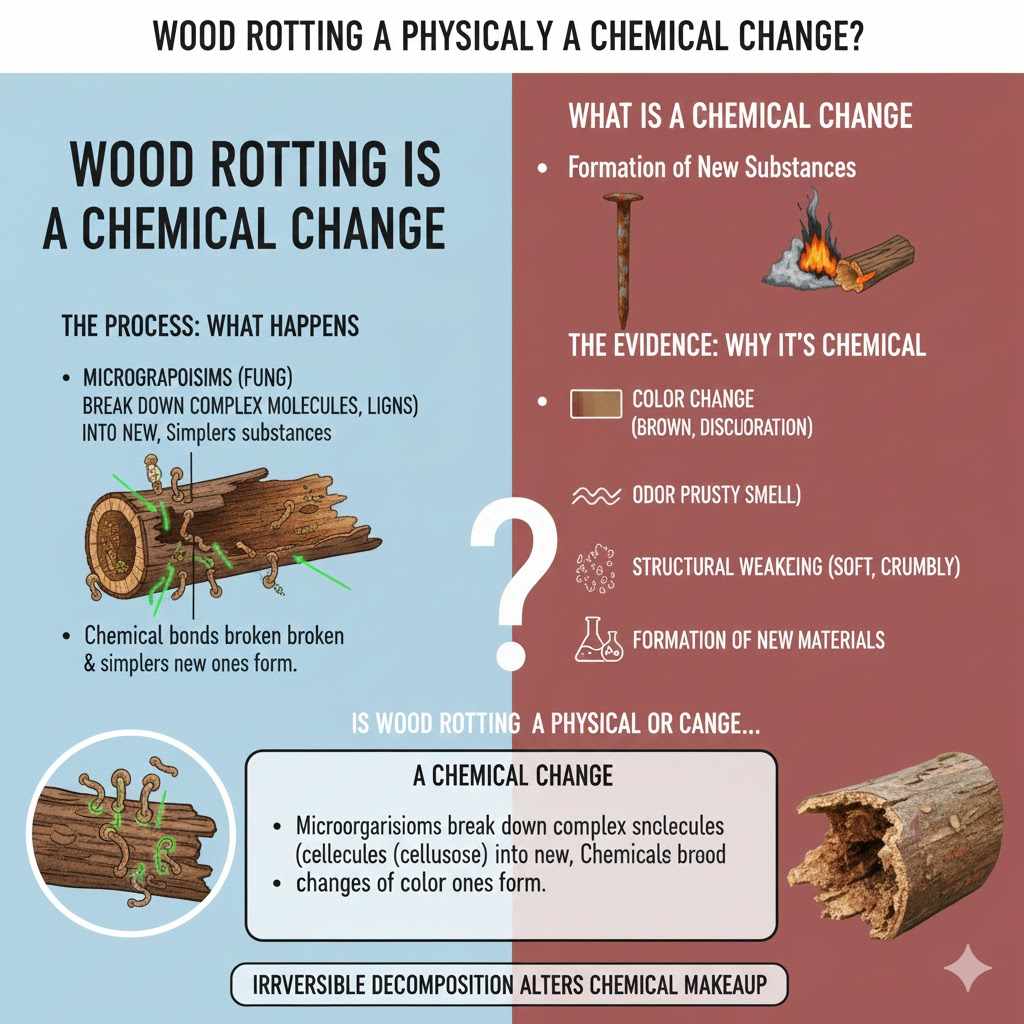
Wood rotting is definitively a chemical change. It involves microorganisms breaking down wood’s complex molecules like cellulose and lignin into new substances. Signs like color change, odor production, and structural weakening all point to chemical reactions and the formation of new materials, confirming the nature of this decomposition process.
Frequently Asked Questions
Question: Is wood burning a physical or chemical change
Answer: Wood burning is a chemical change. When wood burns, it reacts with oxygen to produce ash, smoke, and gases like carbon dioxide and water vapor. These are all new substances with different properties than the original wood.
Question: Can wood rot be reversed
Answer: Generally, wood rot cannot be easily reversed once it has occurred. The chemical breakdown of cellulose and lignin is difficult to undo. However, preventing further rot and treating affected areas can halt the process.
Question: Does temperature affect wood rot
Answer: Yes, temperature significantly affects wood rot. Most wood-rotting fungi thrive in moderate temperatures, typically between 70°F and 90°F (21°C to 32°C). Extreme cold or heat can slow down or stop fungal activity.
Question: What is the main cause of wood rot
Answer: The main cause of wood rot is the activity of fungi and, to a lesser extent, bacteria. These microorganisms need moisture, oxygen, and a food source (the wood itself) to survive and grow.
Question: Is painting wood a way to prevent rot
Answer: Painting wood can help prevent rot by sealing it and reducing its exposure to moisture. However, if moisture gets behind the paint or if the paint layer is damaged, rot can still occur.
Conclusion
Wood rotting is a clear chemical change. Microorganisms chemically break down wood into new substances. Observable signs like color changes, new smells, and loss of strength confirm this transformation.
Understanding this helps us manage and preserve wood effectively.