What Is Denatured Alcohol Used For in Painting
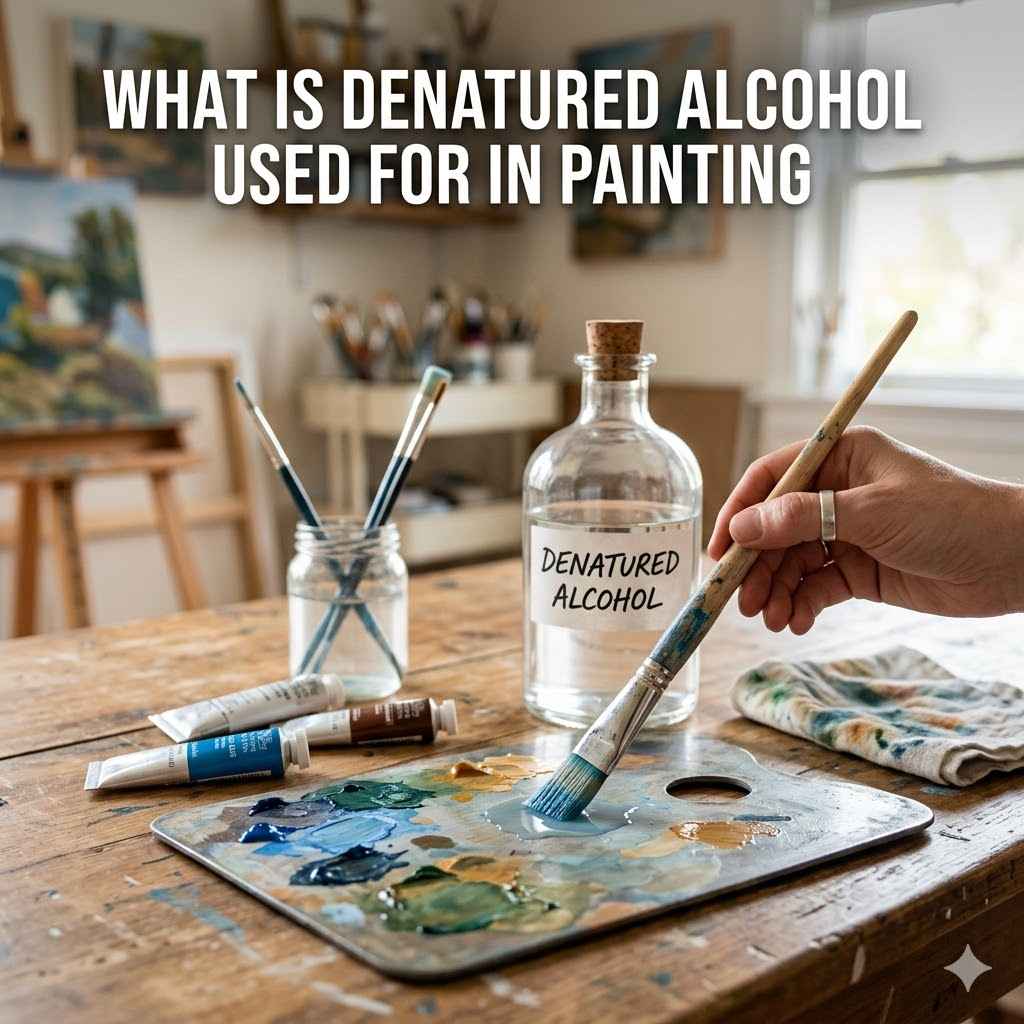
Many folks starting out with art wonder, “What Is Denatured Alcohol Used for in Painting?”. It’s a common question because this liquid pops up in art supply lists, but its purpose might not be crystal clear. Don’t worry, it’s simpler than it sounds.
We’ll break down exactly how it helps your painting projects in easy steps. Get ready to learn how this handy item can make your art process smoother.
Denatured alcohol is a versatile solvent that plays a few important roles in the world of painting. Primarily, it’s known for its ability to clean brushes, remove unwanted paint marks, and even act as a medium in certain techniques. Its rapid evaporation rate makes it ideal for quick cleanup and for achieving specific textural effects on a canvas.
Understanding its properties helps artists use it effectively without damaging their materials.
Brush Cleaning and Maintenance
One of the most frequent uses for denatured alcohol in painting is for cleaning brushes, especially those used with oil-based paints or varnishes. Oil paints, due to their oily nature, require a strong solvent to break them down completely. While turpentine or mineral spirits are often the first choice, denatured alcohol can be a good alternative or a follow-up cleaner.
When oil paint dries on brush bristles, it becomes hard and stiff, making the brush unusable. Denatured alcohol works by dissolving the oil and pigment components of the paint. This process loosens the dried paint, allowing it to be washed away.
It’s particularly useful for artists who want to switch colors quickly during a painting session without having to thoroughly clean their brushes with soap and water every time.
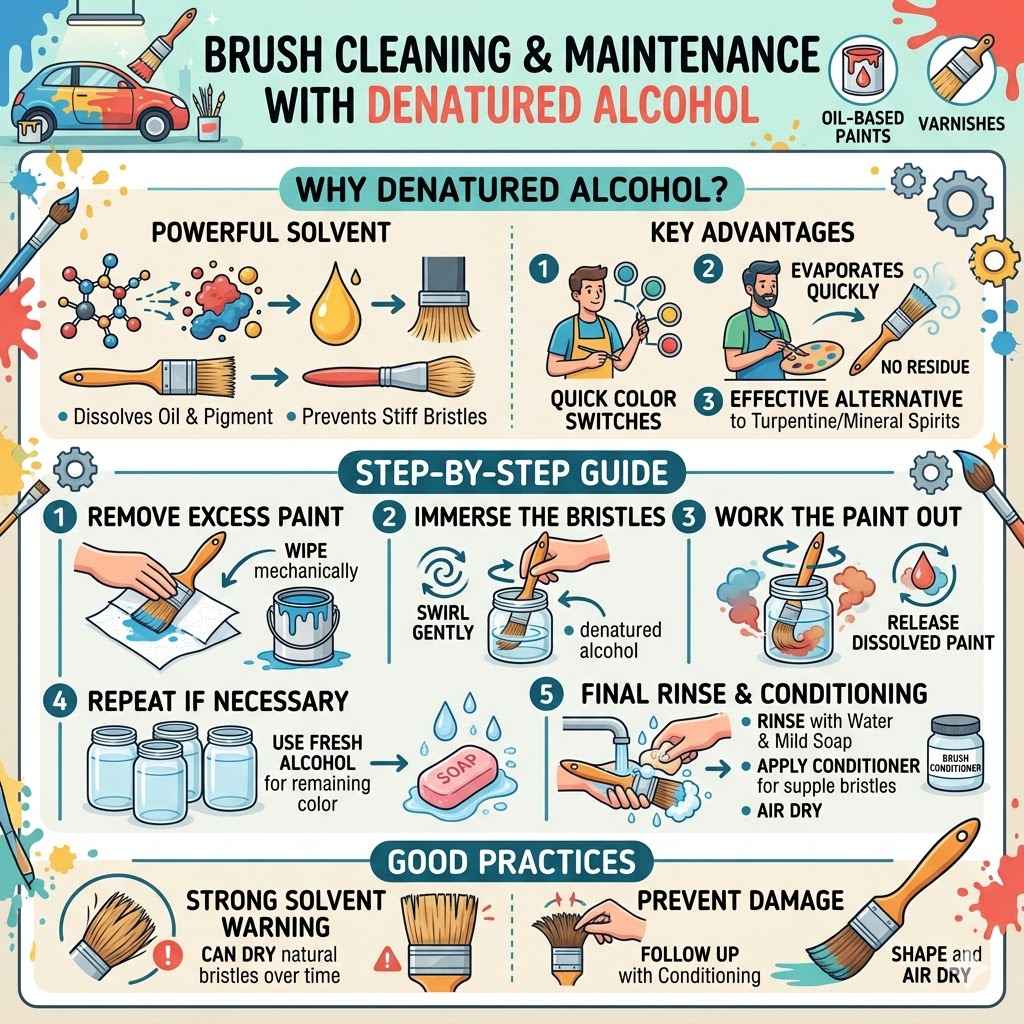
Here’s a step-by-step guide to cleaning brushes with denatured alcohol:
Remove excess paint: First, wipe as much wet paint as possible from the brush using a rag or paper towel. The more paint you remove mechanically, the less you’ll need the solvent to dissolve.
Immerse the bristles: Dip the brush bristles into a small container filled with denatured alcohol. Swirl the brush gently to help the alcohol penetrate the paint.
Work the paint out: Continue to swirl and lightly flick the brush against the side of the container or a clean rag to release the dissolved paint. You will see the color releasing into the alcohol.
Repeat if necessary: If significant color remains, repeat the immersion and swirling process with fresh denatured alcohol. It may take a few rinses to get the bristles completely clean.
Final rinse and conditioning: Once most of the paint is gone, rinse the brush thoroughly with water and a bit of mild soap. This removes any residual alcohol and ensures the brush is clean and conditioned. Shape the bristles and let the brush air dry.
Denatured alcohol evaporates very quickly. This means you don’t have to worry about leaving a residue on your brushes that could affect future paint applications. However, because it is a strong solvent, it can also dry out natural bristles over time.
It’s a good practice to always follow up with a brush conditioner or a bit of soap and water to keep them supple and prevent damage.
Paint Removal and Correction
Mistakes happen, and denatured alcohol can be a lifesaver for correcting them on various surfaces. Its effectiveness in dissolving paint makes it a go-to for artists looking to lift unwanted paint marks from canvases, palettes, or even surfaces that weren’t meant to be painted on.
When you need to remove a section of dried oil paint from a canvas, denatured alcohol can help. You’ll need to apply it carefully and work quickly. For subtle corrections, a cotton swab dipped in denatured alcohol can lift a thin layer of paint.
For larger areas or tougher marks, a cloth soaked in the solvent can be used, but caution is advised to avoid damaging the canvas or primer layer.
It’s also very useful for cleaning paint spills from hard surfaces. If you accidentally drip oil paint on a table, a floor, or your easel, denatured alcohol can often lift it before it sets. The key is to act fast.
The longer the paint sits, the harder it becomes to remove, and the more likely it is to stain the surface.
Consider this scenario: an artist is working on an oil portrait and accidentally smudges a dark shadow color into a lighter area that was already dry. Instead of repainting the entire section, which might lead to an uneven texture, the artist can use a fine brush or cotton swab dipped in denatured alcohol to gently lift the unwanted dark paint. This allows them to reapply the correct lighter color seamlessly.
This kind of targeted correction is invaluable for maintaining the integrity of the artwork.
For those working with acrylic paints, denatured alcohol can also be used, though its effectiveness might vary depending on the specific acrylic medium. It tends to be more effective on wet or freshly dried acrylic paint than on fully cured acrylics. It can help lift or thin acrylic paint for subtle adjustments or to create a softened edge.
The rapid evaporation of denatured alcohol is beneficial here. After you’ve made your correction, the alcohol disappears quickly, leaving the surface ready for the next step without long drying times or sticky residues. This allows for more fluid and responsive working sessions, especially when you need to make quick edits.
A helpful tip is to always test denatured alcohol on an inconspicuous area of your surface first. This is especially important if you are working on a delicate surface or a finished piece. Different primers, paints, and varnishes can react differently to solvents, and a test run ensures you won’t cause unintended damage or discoloration.
Use as a Solvent in Painting Techniques
Beyond cleaning and correction, denatured alcohol is also employed as a solvent within certain painting techniques to achieve unique visual effects. Its interaction with paints can alter their texture, flow, and drying properties, opening up new creative avenues for artists.
One common technique involves using denatured alcohol with acrylic paints. When alcohol is applied to wet acrylics, it can cause the paint to bead up or separate, creating interesting textures and patterns. This effect is often called “alcohol ink art” when applied to specialized surfaces, but it can be adapted to canvas as well.
The alcohol breaks the surface tension of the acrylic paint, causing it to pull away from itself and form small pools or cells.
Another application is in creating transparent glazes or washes with oil paints. While turpentine and mineral spirits are standard for thinning oil paints, denatured alcohol can be used in small quantities to create very thin, translucent layers. Because it evaporates quickly, it helps the glaze dry faster, allowing for quicker layering of colors.
This can be useful for building up depth and luminosity in a painting.
Denatured alcohol can also be used to create interesting “lifting” effects with oil pastels. By applying oil pastel and then gently brushing over it with denatured alcohol, you can soften the marks, blend them, or lift color to create highlights or textural variations. This technique requires a light touch and careful application to avoid overworking the medium.
The way denatured alcohol interacts with different paint binders is key. For acrylics, it disrupts the acrylic emulsion, causing the pigment particles to clump together. For oils, it thins the linseed oil or other drying oils, making the paint more fluid.
The speed at which it evaporates is a significant factor in controlling these effects. Artists can use this rapid evaporation to their advantage, allowing for quick drying times between layers or for specific textural outcomes.
It is important to note that while denatured alcohol can be a useful tool, its use as a painting medium should be approached with care. Overuse can lead to the paint binder being too diluted, potentially affecting the adhesion and longevity of the paint film. Always experiment on scrap surfaces to understand how the alcohol will react with your specific paints and chosen techniques before applying them to your final artwork.
Alcohol Ink Art Examples
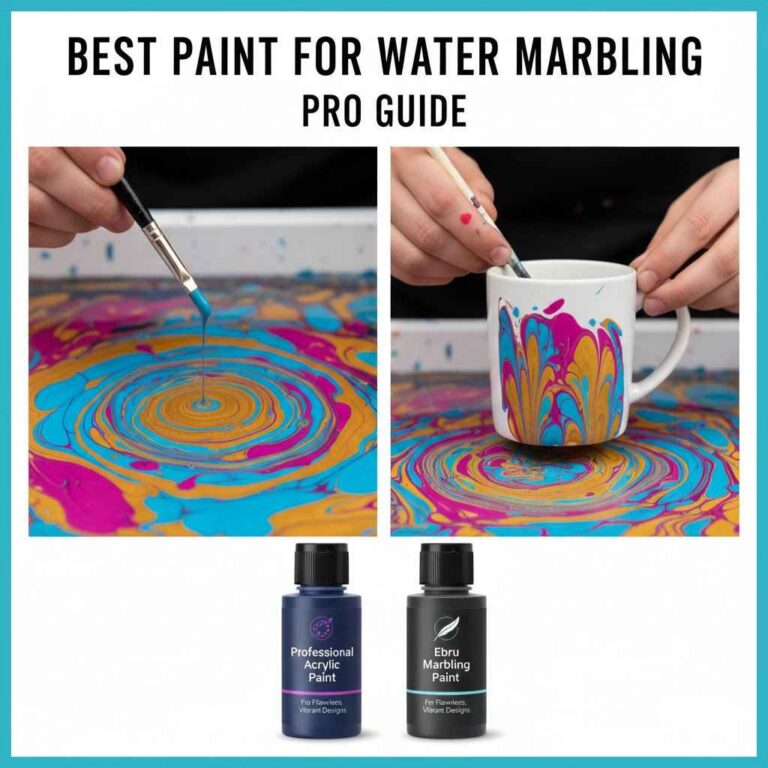
Alcohol ink art is a vibrant and popular form of abstract art created using specially formulated alcohol inks and denatured alcohol as a blending solution. The inks are highly fluid and translucent, and when combined with alcohol, they create mesmerizing patterns, gradients, and marbled effects. Artists can manipulate the inks by tilting the surface, blowing through straws, or using brushes and other tools to guide the ink flow.
The denatured alcohol acts as the primary medium, allowing the inks to move freely and blend in unpredictable yet beautiful ways. This technique is often done on non-porous surfaces like Yupo paper, ceramic tiles, or metal sheets, as these surfaces prevent the ink from soaking in, allowing for maximum blending and manipulation. The results are often ethereal and dynamic, with rich, saturated colors and organic shapes.
It’s a very intuitive and expressive art form.
One artist, Sarah, experimented with acrylic paints and denatured alcohol to create a series of abstract landscapes. She would apply thin layers of acrylic paint to her canvas and then liberally spray or drip denatured alcohol onto the wet paint. The alcohol would cause the acrylics to bloom and separate, forming organic, cloud-like patterns.
She discovered that by tilting her canvas, she could guide the flow of the alcohol and paint, creating sweeping lines and soft transitions. After the alcohol evaporated, she would go back in with brushes and other tools to refine the shapes and add details. The resulting pieces had a unique atmospheric quality, with a sense of depth and movement that would have been difficult to achieve with traditional acrylic techniques alone.
This demonstrates how denatured alcohol can be a powerful tool for generating unexpected and captivating visual effects.
Safety and Handling Considerations
When working with denatured alcohol, it’s crucial to prioritize safety. Denatured alcohol is flammable and can produce hazardous fumes. Proper handling ensures a safe working environment and prevents accidents.
Always work in a well-ventilated area. Open windows or use an exhaust fan to dissipate fumes. Avoid working near open flames, sparks, or heat sources, as denatured alcohol is highly flammable.
Store the alcohol in its original, tightly sealed container away from direct sunlight and heat.
When cleaning brushes or removing paint, wear protective gloves to prevent skin irritation. Avoid getting denatured alcohol in your eyes. If contact occurs, rinse immediately with plenty of water.
Do not ingest denatured alcohol; it is toxic.
When it comes to disposal, denatured alcohol should not be poured down drains. Check local regulations for proper disposal of solvents. Often, it can be left to evaporate completely in a safe, well-ventilated outdoor space before discarding the empty container.
Flammability of Denatured Alcohol
The primary hazard associated with denatured alcohol is its flammability. It has a low flash point, meaning it can ignite easily in the presence of an ignition source, such as a spark, open flame, or even static electricity. This is why it is essential to maintain a safe distance from any potential heat sources while working with it.
Proper ventilation helps to reduce the concentration of flammable vapors in the air, lowering the risk of ignition. Always store denatured alcohol in cool, well-ventilated areas, away from anything that could potentially start a fire. It is also wise to have a fire extinguisher suitable for flammable liquids nearby, just in case of an emergency.
Understanding and respecting its flammable nature is the first step in using denatured alcohol safely.
The vapors produced by denatured alcohol can also be harmful if inhaled in large quantities or over extended periods. While occasional use in a well-ventilated space is generally safe, prolonged exposure to high concentrations of fumes can lead to headaches, dizziness, and respiratory irritation. This is why using it in an open area or with a ventilation system is so important.
If you experience any discomfort while working, it’s a sign that you need to step away and get some fresh air.
Skin and Eye Irritation
Denatured alcohol is a solvent, and like many solvents, it can cause irritation if it comes into contact with skin or eyes. When it dries out the skin, it can lead to redness, itching, and a feeling of tightness. For artists who frequently use denatured alcohol for cleaning brushes or removing paint, wearing chemical-resistant gloves is highly recommended.
These gloves act as a barrier, protecting the skin from direct contact. If denatured alcohol does get on your skin, wash the affected area immediately with soap and water.
Eye contact is more serious and can cause significant discomfort and potential damage. If denatured alcohol splashes into your eyes, it’s important to rinse them thoroughly with clean water for at least 15 minutes. It’s also advisable to seek medical attention if irritation persists.
Keeping safety glasses on hand, especially when you are pouring or transferring the liquid, can provide an extra layer of protection against accidental splashes. Being mindful of these precautions helps ensure a safer and more enjoyable painting experience.
Alternative Solvents and Their Uses
While denatured alcohol is a useful tool, it’s not the only solvent available to artists. Different painting mediums and specific needs may call for alternative solutions. Understanding these alternatives helps artists choose the best product for their particular project.
For oil paints, the traditional solvents are turpentine and mineral spirits (also known as odorless mineral spirits). Turpentine is derived from pine trees and is a strong solvent that evaporates quickly, making it effective for thinning paints and cleaning brushes. Mineral spirits are petroleum distillates and are generally considered less toxic than turpentine, with odorless varieties offering a more pleasant working experience due to reduced fumes.
They are excellent for thinning oil paints, creating glazes, and cleaning up oil-based mediums.
When working with acrylic paints, water is the primary and safest solvent. Acrylics are water-based, so they can be thinned with water to achieve different consistencies, from milky washes to thicker applications. For more advanced acrylic techniques or to achieve specific effects, acrylic mediums can be used.
These mediums can alter the paint’s texture, gloss, and drying time, but they are not typically considered solvents in the same way as alcohol or turpentine. Some specialized acrylic solvents exist for removing dried acrylic paint, but they are often stronger and require more careful handling.
Watercolor artists use water as their main solvent. The pigment in watercolors is suspended in a binder that is water-soluble. Diluting watercolors with water allows for the creation of transparent washes, subtle color shifts, and delicate blending effects.
For cleaning watercolor brushes, water is usually sufficient.
Here’s a comparison of common solvents:
| Solvent | Primary Use | Paint Types | Pros | Cons |
|---|---|---|---|---|
| Denatured Alcohol | Cleaning, thinning, special effects | Oil, Acrylic (limited) | Evaporates quickly, good for lifting | Flammable, can dry out bristles |
| Turpentine | Thinning, cleaning | Oil | Strong solvent, quick evaporation | Strong fumes, can be irritating |
| Mineral Spirits | Thinning, cleaning | Oil | Less toxic than turpentine, odorless options | Slower evaporation than turpentine |
| Water | Thinning, cleaning | Acrylic, Watercolor | Safe, readily available, non-toxic | Not effective for oil paints |
Each solvent has its own set of properties that make it suitable for different applications. The choice of solvent often depends on the type of paint being used, the desired effect, and the artist’s personal preferences regarding safety and working conditions. Experimentation is key to finding the right tool for the job.
What is Denatured Alcohol Used For in Painting Related Effects
Denatured alcohol is a favorite among artists for its unique ability to create specific visual effects, especially when paired with acrylics or oil paints. It’s not just about cleaning; it’s about artistic expression and achieving looks that are hard to replicate otherwise.
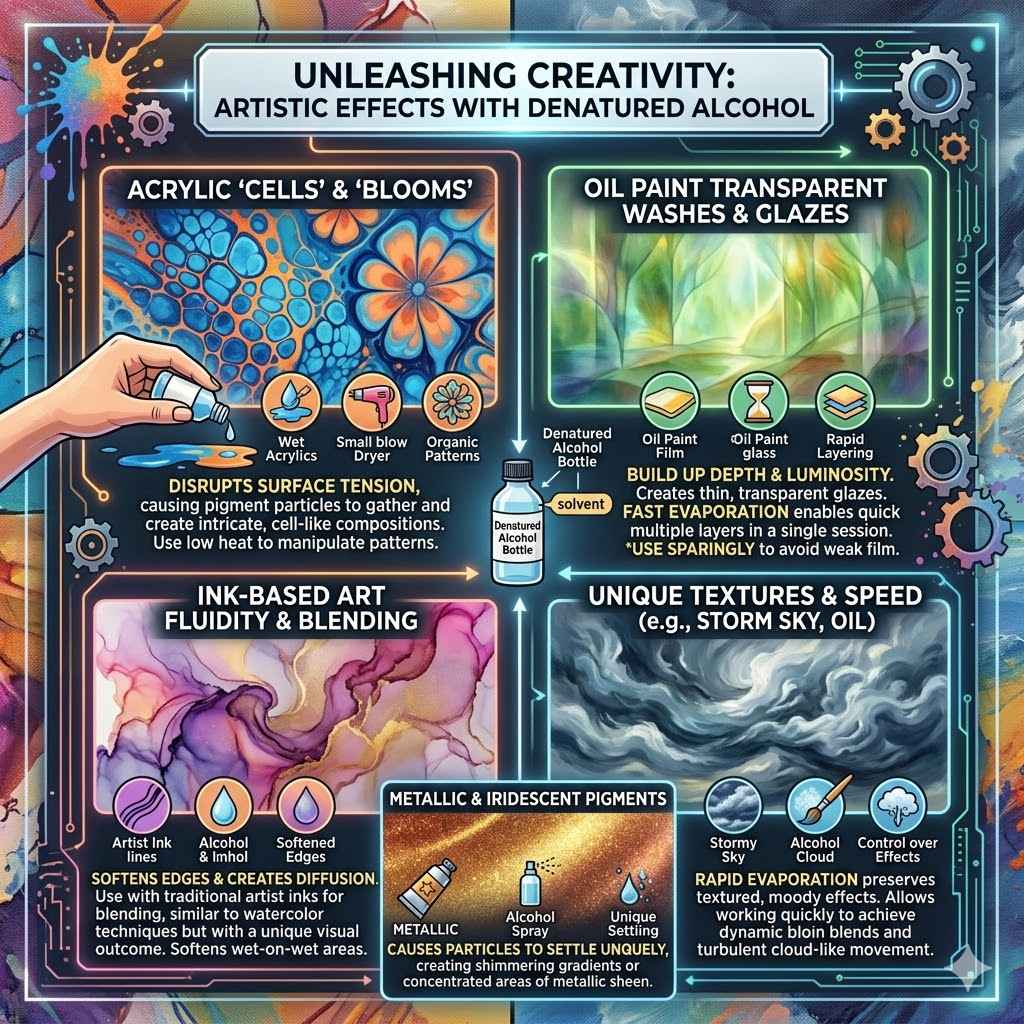
One of the most striking effects achievable with denatured alcohol is the creation of “cells” or “blooms” in acrylic painting. When applied to wet acrylics, the denatured alcohol disrupts the surface tension of the paint, causing the pigment particles to gather together. This creates fascinating, organic patterns resembling cells or flowers.
Artists often use a heat gun on a low setting or a blow dryer to gently push the alcohol around and further manipulate these patterns, leading to mesmerizing, abstract compositions.
For oil painters, denatured alcohol can be used sparingly to create thin, transparent washes or glazes. Because it evaporates so quickly, it allows for rapid layering of these thin paint films. This can build up depth, luminosity, and subtle color shifts in a painting.
It’s a way to achieve a stained-glass effect or a soft, ethereal glow. However, using too much alcohol can break down the oil binder too much, potentially leading to a weak paint film that could crack over time.
Denatured alcohol also plays a role in ink-based art. While specialized alcohol inks are designed for this purpose, denatured alcohol can be used with traditional artist inks to achieve similar fluidity and blending. Artists might drop denatured alcohol onto wet ink lines to soften edges, create diffusion, or blend colors in a wet-on-wet manner, similar to watercolor techniques but with a different visual outcome.
The speed at which denatured alcohol evaporates is crucial to controlling these effects. It allows artists to work quickly, build up layers without extensive drying times, and achieve textures that are unique to solvent-based applications. For example, in oil painting, quick-drying glazes mean an artist can complete multiple layers in a single session, significantly speeding up the process of building up complex color harmonies.
Consider a scenario where an artist wants to create a dramatic stormy sky effect in an oil painting. They might apply thin layers of grays and blues, and then, while the paint is still wet, gently dab or brush areas with denatured alcohol. This would cause the colors to swirl and blend in a turbulent, cloud-like manner, mimicking the dynamic movement of storm clouds.
The alcohol’s quick evaporation ensures the effect is somewhat preserved before it’s entirely lost, leaving a textured, moody sky.
Another interesting effect is achieved when used with metallic or iridescent pigments. The alcohol can cause these particles to settle in unique ways, creating shimmering gradients or concentrated areas of metallic sheen. This adds an extra dimension of visual interest to the artwork.
Frequently Asked Questions
Question: Can denatured alcohol be used to clean acrylic paint?
Answer: Yes, denatured alcohol can be used to clean acrylic paint, especially when it is wet or freshly dried. It helps to break down the acrylic binder, allowing the paint to be wiped away. However, it may be less effective on fully cured acrylic paint compared to oil paint.
Question: Is denatured alcohol safe to use around children and pets?
Answer: No, denatured alcohol is not safe to use around children and pets. It is flammable and can be toxic if ingested or inhaled. Always use it in a well-ventilated area away from children and pets, and store it securely.
Question: Will denatured alcohol damage my canvas?
Answer: Denatured alcohol can potentially damage the canvas or primer if used excessively or too aggressively, especially on delicate surfaces. It’s always recommended to test it on an inconspicuous area first and use it with a light touch.
Question: What is the difference between denatured alcohol and rubbing alcohol?
Answer: Denatured alcohol is ethanol with additives that make it unfit for consumption. Rubbing alcohol is typically isopropyl alcohol. While both are solvents, denatured alcohol is often used in industrial and artistic applications, whereas rubbing alcohol is more common for first aid and cleaning.
Question: Can I use denatured alcohol to thin oil paint?
Answer: Yes, denatured alcohol can be used to thin oil paint in small amounts to create very thin glazes or washes. Its rapid evaporation allows for quick drying, but overuse can weaken the paint film.
Summary
Denatured alcohol is a valuable tool for painters, serving as an effective brush cleaner, a means for paint removal and correction, and a medium for creating unique artistic effects. Its rapid evaporation and solvent properties make it particularly useful with oil paints and for certain acrylic techniques, offering artists a versatile way to enhance their creative process and achieve desired outcomes.