What Is The Difference Between A Redwood And Sequoia: Essential Guide
Quick Summary:
Redwoods and Sequoias are both giant coniferous trees native to California, but they are distinct species. The Coast Redwood (Sequoia sempervirens) is the tallest tree on Earth, found along the Pacific coast. The Giant Sequoia (Sequoiadendron giganteum) is the most massive tree by volume, living in the Sierra Nevada mountains.
Ever stood in awe of a towering tree and wondered if it was a redwood or a sequoia? It’s a common question, and honestly, it can be a little confusing because they are both incredibly large, majestic trees that call California home. They look similar at first glance, with their reddish bark and immense size. But knowing the difference can be a fun bit of nature trivia, and it helps us appreciate these natural wonders even more. Don’t worry, by the end of this guide, you’ll be able to spot the key differences like a pro!
Redwood vs. Sequoia: Unraveling the Giants
When we talk about “redwoods” and “sequoias,” we’re usually referring to two different, though related, types of trees. They belong to the same cypress family (Cupressaceae), which is why they share some family resemblances. However, they are distinct species with different characteristics, habitats, and even growth patterns. Think of them like cousins – related, but definitely not identical!
The Coast Redwood: Reaching for the Sky
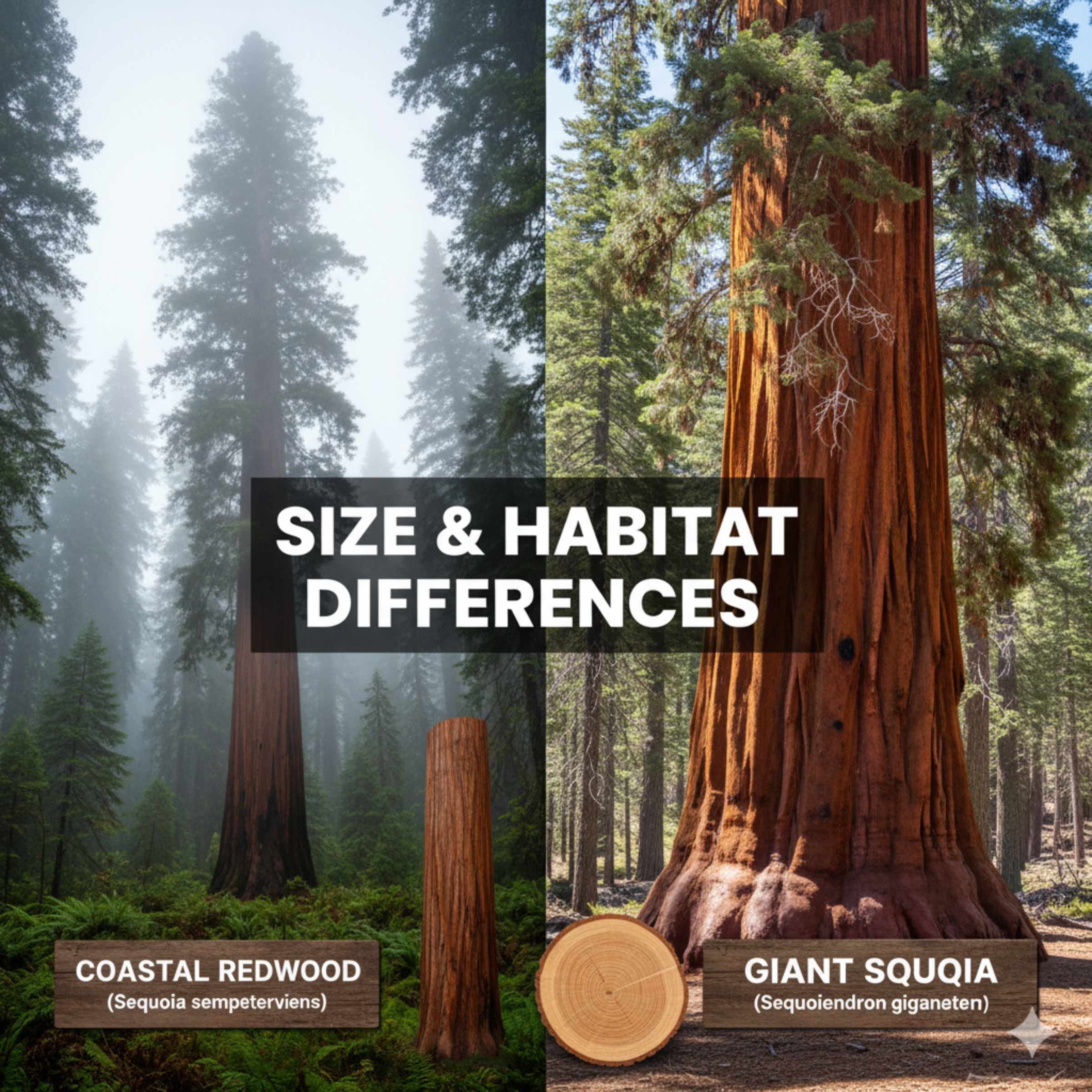
The tree most people think of when they hear “redwood” is the Coast Redwood, scientifically known as Sequoia sempervirens. These are the superstars when it comes to height. They are the tallest living things on the planet, with some individuals soaring over 370 feet (115 meters) into the air! Imagine looking up and not being able to see the top – that’s the Coast Redwood for you.
These magnificent trees are found in a narrow strip along the Northern California coast, extending slightly into southern Oregon. They thrive in the cool, moist environment created by the coastal fog. This fog is crucial for their survival, providing much-needed moisture, especially during the dry summer months. The fog condenses on their needles and drips down, essentially watering the tree from above.
Key Characteristics of the Coast Redwood:
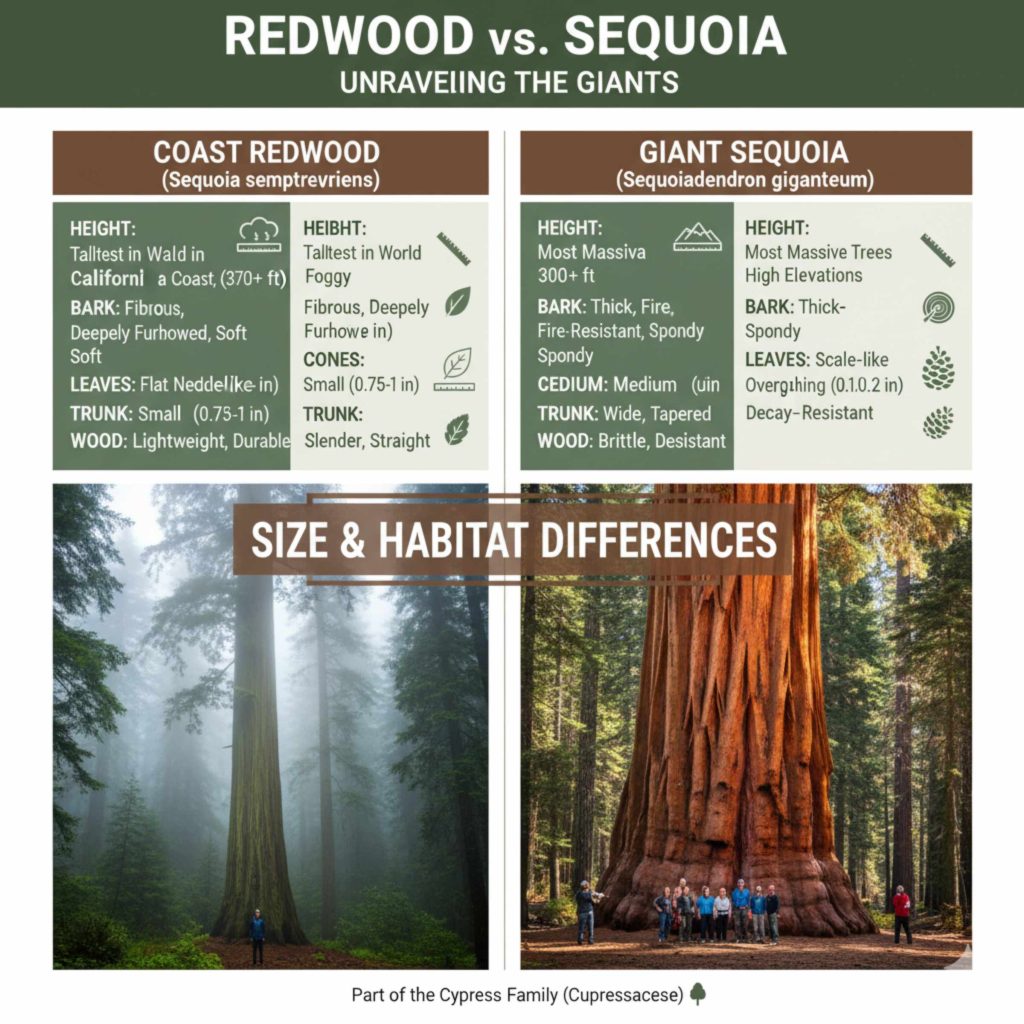
- Height: The tallest trees in the world, regularly exceeding 300 feet.
- Habitat: Coastal regions of Northern California and Southern Oregon, favoring foggy, moist environments.
- Bark: Reddish-brown, fibrous, and deeply furrowed, relatively soft.
- Leaves: Flat, needle-like, arranged in two rows along the twig, giving a feathery appearance. They are typically 0.5 to 1 inch long.
- Cones: Small, woody cones, about 0.75 to 1 inch long, resembling tiny footballs.
- Trunk Shape: Generally more slender and straight compared to Giant Sequoias.
- Wood: Lightweight, durable, and resistant to decay, making it highly valuable for construction and woodworking.
If you’ve ever visited places like Redwood National and State Parks, you’ve likely walked among these giants. Their sheer scale is breathtaking, and it’s a humbling experience to stand at the base of a tree that has lived for centuries, perhaps even over a thousand years.
The Giant Sequoia: The King of Mass
Now, let’s talk about the Giant Sequoia, or Sequoiadendron giganteum. While not as tall as their coastal cousins, Giant Sequoias are the most massive trees on Earth by volume. They are the undisputed heavyweight champions of the tree world! The largest Giant Sequoia, nicknamed “General Sherman,” has a trunk volume estimated at over 52,500 cubic feet (1,487 cubic meters). That’s enough wood to build about 125 average-sized homes!
Unlike the Coast Redwood, the Giant Sequoia is found in scattered groves on the western slopes of the Sierra Nevada mountains in Central California. They prefer higher elevations, typically between 4,000 and 8,000 feet (1,200 to 2,400 meters). They need deep, moist soil, often found on granite-based slopes, and rely on snowmelt for their water supply during the spring and summer.
Key Characteristics of the Giant Sequoia:
- Height: Very tall, but not as tall as Coast Redwoods, typically reaching up to 310 feet (94 meters).
- Mass/Volume: The most massive trees by volume in the world.
- Habitat: Western slopes of the Sierra Nevada mountains in Central California, at higher elevations.
- Bark: Reddish-brown, thick, fibrous, and deeply furrowed. It’s incredibly fire-resistant, a crucial adaptation for their environment.
- Leaves: Small, scale-like or awl-shaped, overlapping and clinging to the twig, giving a more bristly appearance. They are typically 0.25 to 0.5 inches long.
- Cones: Larger than Coast Redwood cones, woody, egg-shaped, about 2 to 3.5 inches long. They can remain on the tree for many years before opening to release seeds.
- Trunk Shape: Broad, massive trunks that taper significantly as they rise.
- Wood: Brittle and not as commercially valuable for lumber as Coast Redwood due to its tendency to shatter.
Visiting a Giant Sequoia grove, such as those in Sequoia National Park or Kings Canyon National Park, is an unforgettable experience. Standing next to these ancient, colossal beings makes you feel incredibly small and connected to the deep history of the Earth. Their sheer girth and presence are awe-inspiring.
Key Differences at a Glance
To help solidify the distinctions, let’s look at a direct comparison:
| Feature | Coast Redwood (Sequoia sempervirens) | Giant Sequoia (Sequoiadendron giganteum) |
|---|---|---|
| Primary Distinction | Tallest tree species | Most massive tree species (by volume) |
| Maximum Height | Over 370 feet (115 meters) | Up to 310 feet (94 meters) |
| Habitat | Coastal California and Southern Oregon (low elevation, foggy) | Sierra Nevada mountains, Central California (high elevation, drier slopes) |
| Leaf Shape | Flat, needle-like, feathery | Small, scale-like, bristly |
| Cone Size | Smaller (0.75-1 inch) | Larger (2-3.5 inches) |
| Trunk Shape | More slender, straight | Very broad, massive, tapering |
| Wood Value | High (durable, workable) | Low (brittle, shatters) |
| Scientific Name | Sequoia sempervirens | Sequoiadendron giganteum |
It’s easy to see why people mix them up. Both trees share:
- Reddish Bark: Their common name “redwood” comes from the distinctive reddish-brown color of their bark. This bark is also thick, fibrous, and deeply furrowed, offering protection.
- Immense Size: They are both among the largest trees in the world, making them stand out in any forest.
- Longevity: Both species are incredibly long-lived, with many individuals surviving for thousands of years.
- Native to California: Their geographic overlap in California contributes to the common confusion.
- Coniferous Nature: They are both cone-bearing evergreen trees.
Exploring the Habitats: Where They Live
The environments where these trees grow are as different as their primary characteristics. Understanding their habitats helps us appreciate their unique adaptations.
Coastal Redwood Habitat: The Fog Belt
The Coast Redwood’s home is a narrow band along the Pacific coast, typically within 50 miles of the ocean. This region is characterized by:
- High Humidity and Fog: The marine layer is their lifeblood, providing consistent moisture.
- Mild Temperatures: Winters are cool and wet, while summers are warm and dry, but the fog keeps temperatures from getting too extreme.
- Rich, Moist Soil: Often found in alluvial plains, riverbanks, and canyons where water is abundant.
- Competition: They often grow in dense stands, competing with other forest vegetation for light and resources.
The redwood forest ecosystem is a unique environment, supporting a diverse range of plants and animals that are adapted to the shade and moisture. You can learn more about these incredible ecosystems from the National Park Service.
Giant Sequoia Habitat: The Sierra Slopes
Giant Sequoias, on the other hand, are mountain dwellers. Their habitat in the Sierra Nevada is defined by:
- Higher Elevations: They are found on the western slopes, typically above 4,000 feet.
- Snowpack: They rely on winter snowpack, which melts slowly in spring and summer, providing a sustained water source.
- Granitic Soil: Often grow on well-drained, rocky soils derived from granite.
- Fire Adaptation: Their environment experiences periodic wildfires, which are actually essential for Giant Sequoia regeneration. The heat opens their cones, and the fire clears competing vegetation and prepares the soil for seeds.
These groves are often isolated, with Giant Sequoias growing in distinct stands separated by miles of other forest types. The adaptation to fire is a remarkable aspect of their life cycle, showcasing nature’s resilience.
Conservation and Importance
Both Coast Redwoods and Giant Sequoias are incredibly important for their ecosystems and hold significant cultural and scientific value. Sadly, both species face threats.
Threats to Coast Redwoods
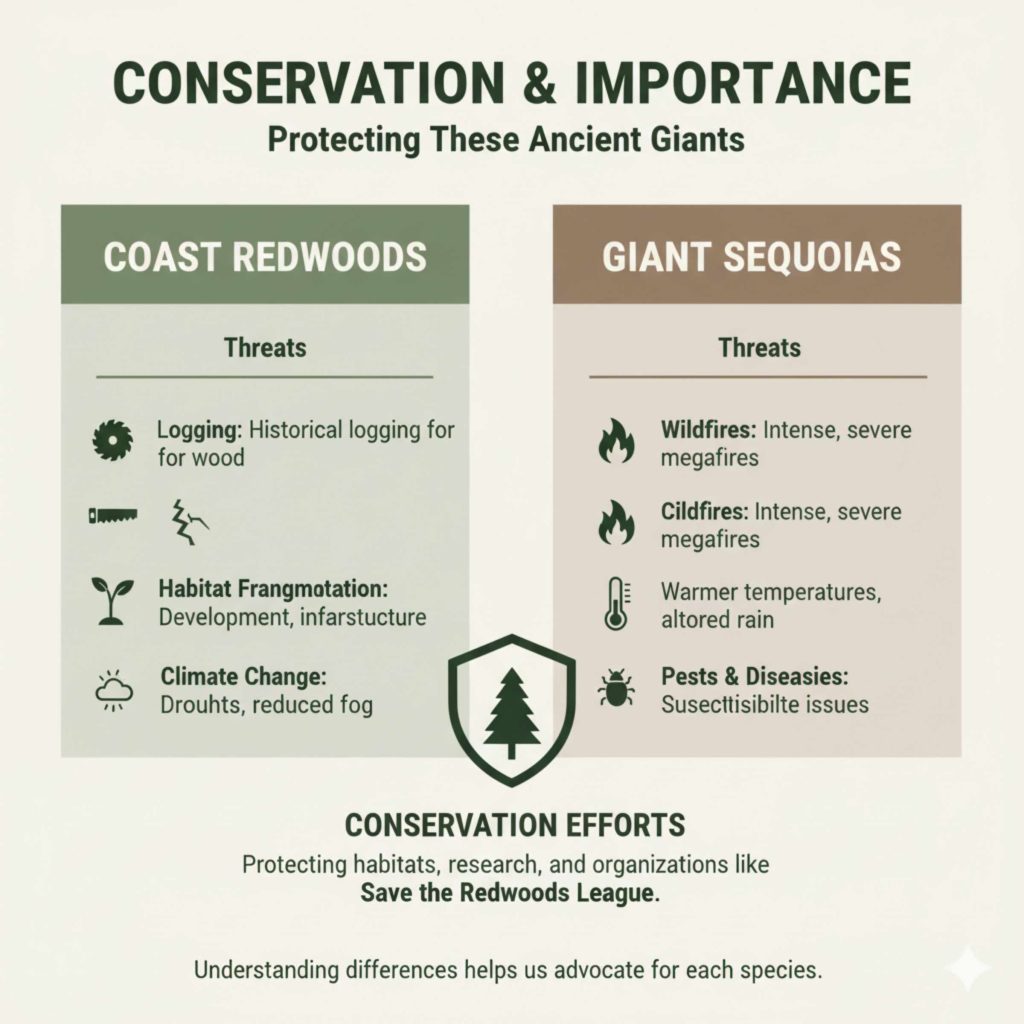
- Logging: Historically, Coast Redwoods were heavily logged for their valuable, decay-resistant wood. While many old-growth forests are now protected, logging continues in some areas.
- Habitat Fragmentation: Development and infrastructure can break up their natural habitats.
- Climate Change: Changes in rainfall patterns and increased drought severity could impact their ability to thrive, especially in areas that rely heavily on fog.
Threats to Giant Sequoias
- Wildfires: While they are fire-adapted, increasingly intense and severe wildfires, exacerbated by climate change and historical fire suppression, can overwhelm even their defenses. These megafires can kill even the largest giants.
- Climate Change: Warmer temperatures and altered precipitation patterns can stress these high-elevation trees.
- Pests and Diseases: While generally robust, they can be susceptible to certain issues.
Conservation efforts are underway to protect these ancient giants and their habitats. Organizations like the Save the Redwoods League work tirelessly to preserve these iconic trees for future generations. Understanding the differences helps us better advocate for the specific needs of each species.
Frequently Asked Questions (FAQ)
Q1: Are redwoods and sequoias the same tree?
No, they are not the same tree. While they are related and both are massive conifers native to California, the Coast Redwood (Sequoia sempervirens) is the tallest tree species, found along the coast. The Giant Sequoia (Sequoiadendron giganteum) is the most massive tree species by volume, found in the Sierra Nevada mountains.
Q2: Which is taller, a redwood or a sequoia?
The Coast Redwood (Sequoia sempervirens) is taller. They are the tallest trees on Earth, with individuals recorded at over 370 feet. Giant Sequoias are also very tall, but typically reach a maximum height of around 310 feet.
Q3: Which is bigger, a redwood or a sequoia?
The Giant Sequoia (Sequoiadendron giganteum) is bigger in terms of mass and volume. While not as tall as the Coast Redwood, their trunks are much wider and more massive, making them the largest trees by volume.
Q4: Where can I see Coast Redwoods and Giant Sequoias?
Coast Redwoods are found in a narrow strip along the Northern California coast and into southern Oregon. Famous locations include Redwood National and State Parks. Giant Sequoias are found in scattered groves on the western slopes of the Sierra Nevada mountains in Central California, notably in Sequoia National Park, Kings Canyon National Park, and Yosemite National Park.
Q5: What is the difference in their bark and leaves?
Coast Redwoods have reddish-brown, fibrous bark and flat, needle-like leaves that are about 0.5 to 1 inch long and arranged in two rows. Giant Sequoias have thicker, reddish-brown, fibrous bark and small, scale-like or awl-shaped leaves that are about 0.25 to 0.5 inches long and cling to the twig.
Q6: Is redwood wood valuable for woodworking?
Yes, Coast Redwood wood is highly valued for its durability, resistance to decay, and attractive appearance. It’s used in construction, outdoor furniture, decking, and fine woodworking. Giant Sequoia wood is more brittle and tends to shatter, making it less commercially valuable for lumber.
Conclusion
So, the next time you marvel at one of California’s giant conifers, you’ll know whether you’re looking at the sky-scraping elegance of a Coast Redwood or the monumental girth of a Giant Sequoia. They are both incredible testaments to nature’s power and resilience, each with its own unique story and place in the world. Whether it’s their impressive height or their staggering volume, these trees offer a profound connection to the natural world and a reminder of the importance of conservation. Keep exploring, keep learning, and keep appreciating these magnificent giants!