Will Dusk to Dawn Light Bulbs Work: Essential Guide
Yes, dusk to dawn light bulbs can work wonderfully in many common light fixtures, offering automatic convenience and energy savings. This guide will show you how to choose and use them effectively for your home.
Ever come home to a dark house or worry about leaving lights on all night? It’s a common frustration! You want your home to be safe and welcoming, but you also don’t want to waste electricity or deal with complicated setups. That’s where dusk to dawn light bulbs come in. They’re designed to turn on automatically when it gets dark and turn off when the sun comes up, making life a little easier. But will they work for you? Let’s find out together! We’ll break down exactly how they work, what you need to know, and how to get them set up without any fuss.
Understanding Dusk to Dawn Light Bulbs
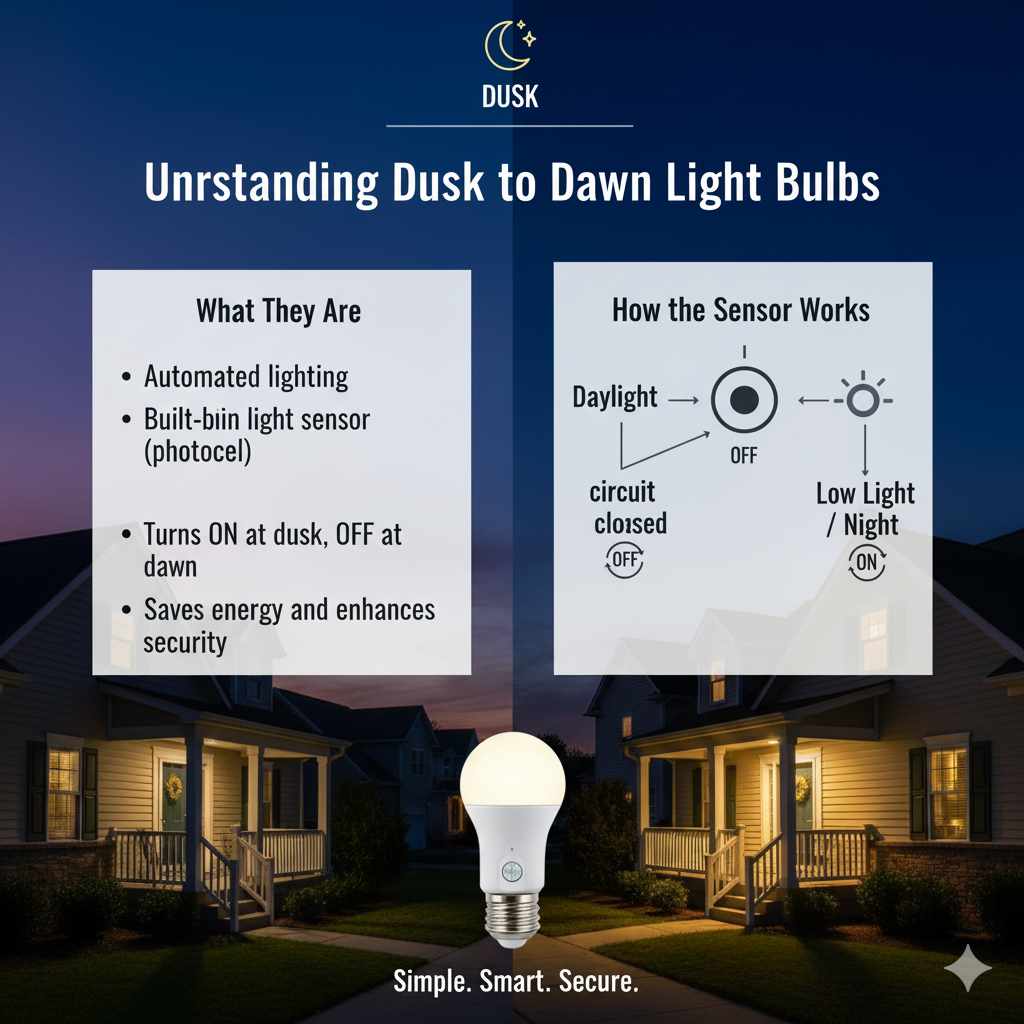
Dusk to dawn light bulbs are a clever invention that brings automation right to your lighting. They have a built-in sensor that detects changes in light levels. When the natural light outside fades to a certain point (dusk), the sensor triggers the bulb to turn on. Conversely, when the sun rises and the light level increases, the sensor tells the bulb to switch off.
This technology is fantastic for several reasons. It enhances security by illuminating pathways and entryways as soon as it gets dark, deterring potential intruders. It also adds a welcoming touch to your home, making sure you’re never greeted by darkness. Plus, by automatically turning off when there’s enough natural light, they help save energy and reduce your electricity bills. It’s a simple, smart upgrade for any home.
How the Sensor Works
At the heart of a dusk to dawn light bulb is a small, integrated sensor, often a photocell. This photocell is sensitive to ambient light. Think of it like a tiny eye that’s always watching the sky. When daylight is strong, the photocell registers a high light level and keeps the bulb off. As daylight fades and the light intensity drops, the photocell senses this change. When the light reaches a predetermined low threshold, it completes a circuit, allowing electricity to flow to the bulb’s filament or LEDs, and voilà – the light turns on.
The sensitivity of these sensors can vary slightly between bulbs, but they are generally calibrated to activate around twilight. They are designed to be reliable and require no manual intervention once installed. It’s this simple, yet effective, mechanism that makes them such a convenient lighting solution.
Will Dusk to Dawn Light Bulbs Work in Any Fixture?
This is a great question, and the answer is: mostly, yes, but with a few important considerations. The good news is that most standard household light fixtures are compatible with dusk to dawn bulbs. This includes things like porch lights, entryway lamps, garage lights, and even some indoor lamps where you want automatic illumination.
The key is to match the bulb’s base type (like E26, the most common screw-in base in North America) to the socket in your fixture. You also need to ensure the fixture itself isn’t already equipped with its own photocell or timer that might interfere with the bulb’s operation. Sometimes, if a fixture is on a dimmer switch, it can also affect how the dusk to dawn bulb functions, as dimmers constantly change the voltage and light output.
Fixture Compatibility Factors
Here’s a breakdown of what to check:
- Base Type: Ensure the bulb’s base (e.g., E26, E12) matches the socket in your fixture.
- Enclosed Fixtures: If the bulb is in a completely sealed, enclosed fixture, it might overheat, especially if it’s an older incandescent or high-wattage LED. Most modern LED dusk to dawn bulbs are designed for better heat dissipation, but it’s always wise to check the bulb’s specifications for maximum wattage and operational temperature in enclosed spaces.
- Dimmer Switches: Dusk to dawn bulbs are generally not compatible with dimmer switches. The sensor needs a consistent light level to operate correctly. A dimmer will continuously change the light, confusing the sensor and preventing it from working as intended.
- Overlapping Sensors: If your fixture is already connected to an external photocell or a smart home system that controls its on/off cycle, adding a dusk to dawn bulb might cause conflicts. The bulb’s internal sensor and the external control will be fighting to turn the light on or off.
- Shade Materials: For indoor use, ensure the lampshade material isn’t too opaque or colored. While the sensor is sensitive, extremely thick or dark shades could potentially diffuse enough light to keep the bulb from turning off during the day, or prevent it from turning on at night.
When They Might NOT Work
There are a few scenarios where a standard dusk to dawn bulb might not be the best fit, or might require a different approach:
- Fixtures on Dimmer Switches: As mentioned, this is a primary incompatibility.
- Fixtures Controlled by Motion Sensors: If your light fixture has a built-in motion sensor, a dusk to dawn bulb might not be necessary or could interfere with the motion sensor’s logic.
- Very Specific Lighting Needs: For situations requiring precise timing (e.g., only on between 10 PM and 5 AM), a programmable timer or smart bulb might be a better, more flexible option.
- Extreme Temperature Environments: While most bulbs are rated for a range of temperatures, extremely hot or cold conditions (like in an uninsulated shed in Alaska or a desert garage) could potentially affect sensor performance over time. Check the manufacturer’s specifications.
Types of Dusk to Dawn Light Bulbs
Just like regular light bulbs, dusk to dawn bulbs come in various types, each with its own pros and cons. Understanding these differences will help you pick the perfect bulb for your needs.
LED Dusk to Dawn Bulbs
LED (Light Emitting Diode) bulbs are the most popular and recommended choice for dusk to dawn lighting today. They are incredibly energy-efficient, long-lasting, and produce very little heat, making them ideal for most fixtures, including enclosed ones. They also offer excellent light quality and come in various color temperatures (warm white, cool white, daylight).
- Pros: Extremely energy-efficient, very long lifespan (up to 25,000 hours or more), durable, instant on, low heat output, available in many styles and colors.
- Cons: Higher upfront cost compared to incandescent, though the long-term savings are significant.
Incandescent Dusk to Dawn Bulbs
These are older technology and are becoming harder to find. They work similarly to traditional incandescent bulbs but have the added photocell. They consume significantly more energy and have a much shorter lifespan than LEDs.
- Pros: Lower upfront cost, familiar warm light quality.
- Cons: Very energy-inefficient, short lifespan, generate a lot of heat, fragile.
CFL Dusk to Dawn Bulbs
Compact Fluorescent Lamps (CFLs) were a step up from incandescent in terms of energy efficiency. However, they can take a moment to reach full brightness and contain a small amount of mercury, making disposal more complicated. They are also less common now with the rise of LEDs.
- Pros: More energy-efficient than incandescent, longer lifespan than incandescent.
- Cons: Can have a warm-up period, contain mercury, less energy-efficient than LEDs, not as durable as LEDs.
Choosing the Right Wattage and Brightness
When selecting a dusk to dawn bulb, you’ll need to consider its brightness (measured in lumens) and its energy consumption (measured in watts). The wattage of an LED bulb is much lower than its incandescent equivalent for the same brightness, which is part of why they are so efficient.
Here’s a simple guide:
- For entryways and porches: 800-1100 lumens is usually sufficient. This is often equivalent to a 60-75 watt incandescent bulb, but an LED might only use 9-12 watts.
- For garages or larger areas: 1100-1600 lumens might be better. This is like a 75-100 watt incandescent, with an LED using around 15-20 watts.
- For accent lighting or smaller areas: 450-800 lumens might be enough, comparable to a 40-60 watt incandescent.
Always check the packaging for the lumen output. The “wattage equivalent” on LED packaging is a helpful guide, but lumens are the true measure of brightness.
How to Install a Dusk to Dawn Light Bulb
Installing a dusk to dawn light bulb is as simple as changing any other light bulb. Safety first, always!
Tools You’ll Need
You likely won’t need many tools, but here’s what’s helpful:
- A new dusk to dawn light bulb
- A sturdy step stool or ladder (if needed)
- A dry cloth (to clean the socket if necessary)
- Safety glasses (optional, but good practice)
Step-by-Step Installation Guide
- Turn Off the Power: This is the most crucial step. Go to your electrical panel (breaker box) and find the breaker that controls the light fixture you’ll be working on. Flip it to the ‘OFF’ position. If you’re unsure which breaker it is, you can turn off the main breaker, but it’s usually best to isolate the specific circuit. For an indoor lamp, simply unplug it from the wall.
- Let the Old Bulb Cool: If the light was recently on, give the old bulb a few minutes to cool down to avoid burns.
- Remove the Old Bulb: Carefully unscrew the old light bulb from the socket. Turn it counter-clockwise. If it’s stuck, you can try using a rubber glove for better grip.
- Clean the Socket (Optional): If the socket looks dusty or corroded, you can gently wipe it with a dry cloth. Ensure it’s completely dry before proceeding.
- Install the New Bulb: Take your new dusk to dawn light bulb and screw it into the socket clockwise. Screw it in until it’s snug, but don’t overtighten.
- Restore Power: Go back to your electrical panel and flip the breaker back to the ‘ON’ position. For a plugged-in lamp, plug it back in.
- Test the Bulb: Now, for the exciting part! Cover the sensor on the bulb with your hand or a piece of dark cloth. The light should turn on. Remove your hand, and it should turn off once it detects enough ambient light. If you installed it in the evening, it should turn on automatically as it gets dark.
Pros and Cons of Using Dusk to Dawn Bulbs
Like any home improvement, dusk to dawn bulbs have their advantages and disadvantages. Weighing these will help you decide if they’re the right fit for your home.
Advantages
- Convenience: Automatic operation means you don’t have to remember to turn lights on or off.
- Security: Illuminates your property at night, deterring potential intruders and making your home look occupied.
- Energy Savings: By turning off automatically when not needed, they reduce electricity consumption compared to leaving lights on manually all night.
- Safety: Provides light for pathways and entryways, reducing the risk of trips and falls in the dark.
- Cost-Effective: While the initial purchase price might be slightly higher than a standard bulb, the energy savings and longevity (especially with LEDs) make them a cost-effective choice over time.
- Easy Installation: No wiring or complex setup required – just screw it in like a regular bulb.
Disadvantages
- Compatibility Issues: May not work with dimmer switches, certain enclosed fixtures, or fixtures with other automatic controls.
- Sensor Sensitivity: In some cases, extreme weather conditions or very bright streetlights might affect sensor performance, though this is rare with quality bulbs.
- Not Suitable for All Areas: If you need precise timing or control (e.g., for specific work areas or to avoid light pollution in sensitive areas), a simple dusk-to-dawn bulb might be too basic.
- Potential for Overlap: If a fixture is already controlled by a wall switch that’s frequently turned off, the dusk-to-dawn function will be interrupted until the switch is turned back on.
Where to Use Dusk to Dawn Light Bulbs
These smart bulbs are incredibly versatile. Here are some of the best places to install them:
Outdoor Applications
- Front Porch Lights: Creates a welcoming glow and illuminates your doorstep.
- Entryway Lights: Ensures your main entrance is always lit.
- Garage Lights: Provides light as you arrive or leave, and enhances security.
- Pathway Lights: Illuminates garden paths or walkways.
- Backyard Lights: Adds ambiance and security to your outdoor living spaces.
- Sump Pump / Utility Area Lights: For areas that need to be visible when you’re working outside after dark.
Indoor Applications
While primarily for outdoor use, dusk to dawn bulbs can also be useful indoors in specific situations:
- Hallway Nightlights: For a subtle, automatic glow that guides you through the house at night without being too bright.
- Stairwells: Provides a gentle light to navigate stairs safely in the dark.
- Basement or Attic Access Points: If you need a light to come on when you open the door or when it gets dark in that area.
- Guest Rooms: A gentle light can be helpful for guests who are unfamiliar with the house layout at night.
It’s important to note that for indoor use, especially in enclosed fixtures or where the bulb might be exposed to direct sunlight (even through a window), using an LED dusk to dawn bulb is highly recommended due to its low heat output and durability.
Comparing Dusk to Dawn Bulbs with Other Lighting Controls
Dusk to dawn bulbs are just one way to automate your lighting. It’s helpful to know how they stack up against other common solutions.
Dusk to Dawn Bulbs vs. Timers
Dusk to Dawn Bulbs: Turn on at dusk and off at dawn automatically, based on ambient light. They are simple and require no programming.
Timers: Allow you to set specific on/off times (e.g., 6 PM to 11 PM). You can use simple mechanical timers, digital timers, or even smart plugs/switches. They offer precise control but require programming and may need seasonal adjustments for sunrise/sunset times.
Dusk to Dawn Bulbs vs. Motion Sensors
Dusk to Dawn Bulbs: Provide continuous light from dusk till dawn.
Motion Sensors: Turn lights on only when movement is detected and usually turn off after a set period. They are excellent for security and energy saving as they only activate when needed. However, they won’t provide constant illumination, which might be desired in some areas.
Dusk to Dawn Bulbs vs. Smart Bulbs
Dusk to Dawn Bulbs: Offer basic automatic on/off functionality based on light levels.
Smart Bulbs: Offer a wide range of features, including app control, scheduling, dimming, color changes, and integration with smart home systems. Many smart bulbs can also be programmed with schedules that mimic dusk-to-dawn behavior, and some even have built-in light sensors. They offer the most flexibility but typically require a Wi-Fi connection and a smartphone or voice assistant.
For simple, set-it-and-forget-it convenience for general illumination at night, a dusk to dawn bulb is often the easiest and most affordable solution. For more granular control or integration with other smart devices, timers or smart bulbs might be better choices.
Maintaining Your Dusk to Dawn Bulbs
One of the best things about dusk to dawn bulbs is their low maintenance. However, a little care can ensure they perform optimally for years to come.
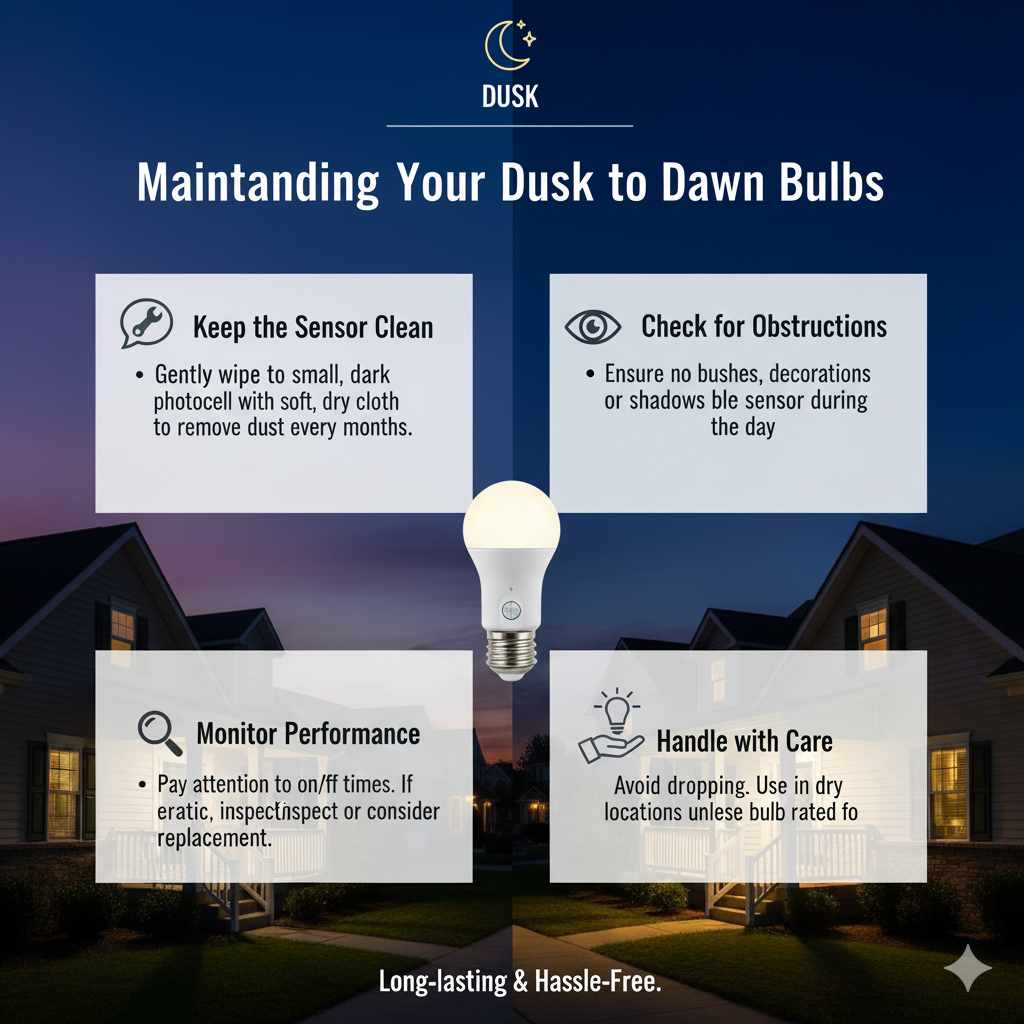
- Keep the Sensor Clean: The photocell sensor is usually a small, dark disc on the bulb. Dust or dirt buildup can obscure it, potentially affecting its ability to detect light levels accurately. Periodically (every few months or if you notice performance issues), gently wipe the sensor with a dry, soft cloth.
- Check for Obstructions: Ensure nothing is blocking the sensor. For example, if you’ve recently trimmed bushes or added decorations, make sure they aren’t casting shadows on the bulb during the day, which could trick it into staying on.
- Monitor Performance: Pay attention to how the bulb operates. Does it turn on and off at roughly the right times? If it seems erratic, it might be time to check the sensor or consider replacing the bulb.
- Handle with Care: While LEDs are durable, avoid dropping them or exposing them to excessive moisture (unless specifically rated for wet locations).
The lifespan of LED dusk to dawn bulbs is typically very long, often 15,000 to 25,000 hours or more. This means you might not need to replace them for many years, making them a hassle-free upgrade.
FAQ: Your Questions Answered
Q1: Can I use a dusk to dawn bulb in a totally enclosed outdoor fixture?
A: Yes, but it’s best to use LED dusk to dawn bulbs. They produce much less heat than incandescent bulbs, which can be crucial for preventing overheating and premature failure in enclosed fixtures. Always check the bulb’s specifications for suitability in enclosed fixtures.
Q2: My dusk to dawn bulb is staying on all day. What’s wrong?
A: This usually happens for a few reasons: the sensor might be dirty, there might be an obstruction casting a shadow on it, or it could be installed in a location with very low ambient light even during the day (e.g., under a deep porch overhang that rarely gets direct sun). Try cleaning the sensor and checking for shadows. If it’s still not working, the bulb might be faulty.
Q3: My dusk to dawn bulb isn’t turning on at night. Why?
A: This could be due to the sensor being too sensitive and not detecting darkness, or it might be wired incorrectly (though this is rare for a simple bulb). Another possibility is that the fixture’s power is off, or the bulb itself has burned out. Ensure the power is on and try testing the bulb in another known working fixture if possible.
Q4: Can I use a dusk to dawn bulb in a fixture that’s controlled by a regular wall switch?
A: Yes, you can, but with a caveat. The wall switch must be left in the ‘ON’ position for the dusk to dawn bulb to function. If you turn off the wall switch, you cut power to the bulb, and it won’t be able to operate its sensor or turn on automatically.
Q5: Will a dusk to dawn bulb work if it’s very close to another light source, like a streetlamp?
A: It depends on the brightness of the external light source and the sensitivity of the bulb’s sensor. Some bulbs might stay off if they detect enough ambient light from a nearby streetlamp. If this is an issue, you might need a bulb with adjustable sensitivity, a different type of timer, or a shielded fixture.
Q6: Do I need to worry about the color temperature of a dusk to dawn bulb?
A: You can choose the color temperature just like any other bulb! Warm white (around 2700K) is cozy for porches, while cool white or daylight (4000K-5000K) can be better for security lighting or garages where you need clear visibility. The sensor function is separate from the light color.
Conclusion
So, will dusk to dawn light bulbs work for you? Absolutely! They are a straightforward, effective, and budget-friendly way to add convenience, security, and a touch of modern automation to your home. By understanding how they work, choosing the right type for your fixture, and following simple installation steps, you can enjoy the benefits of lights that manage themselves.
Whether you’re looking to brighten up your porch for a welcoming arrival, enhance your home’s security, or simply avoid fumbling for switches in the dark, these smart bulbs are a fantastic DIY solution. They embody the spirit of making our homes more functional and enjoyable with minimal effort. Give them a try, and you’ll likely wonder how you ever managed without them!