Best Ceiling Fan With Long Downrod: Essential Guide
Quick Summary
Finding the best ceiling fan with a long downrod is crucial for optimal air circulation in rooms with high ceilings. A properly sized downrod ensures the fan operates efficiently and safely, distributing air evenly. This guide helps you select the perfect fan and downrod for your space, making your home more comfortable and stylish.
Hello there! I’m Md Meraj, your go-to guide for all things woodworking and home improvement. Ever felt that your ceiling fan just isn’t quite reaching the middle of your large room, or worse, feels too close to your head in a tall space? You’re not alone! Many homeowners struggle with getting ceiling fan height just right, especially with those grand, high ceilings. It can be frustrating when a beautiful fan doesn’t perform its best. But don’t worry, this is a common challenge with a straightforward solution. We’ll walk through everything you need to know to pick the best ceiling fan with a long downrod, ensuring perfect airflow and a stylish finish for your home. Get ready to transform your space!
Why Ceiling Fan Height Matters (Especially with Long Downrods)
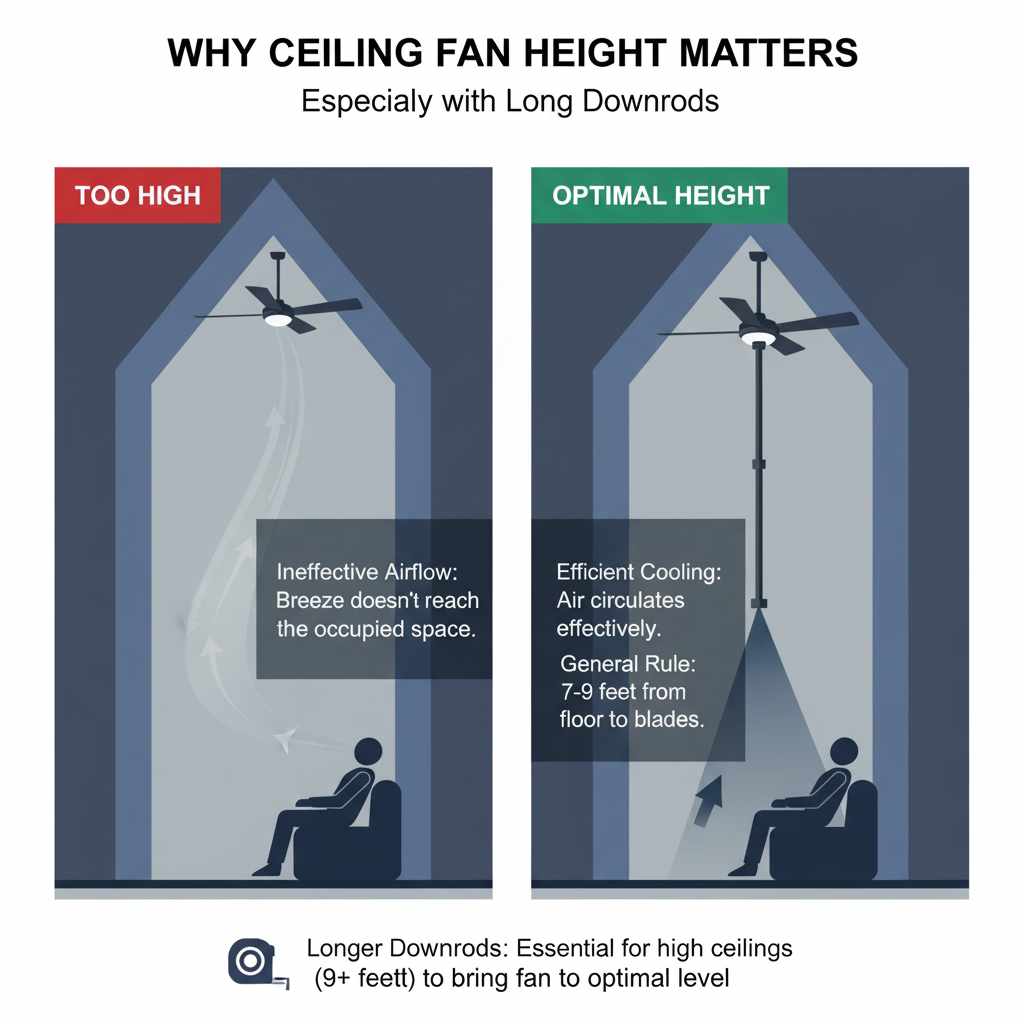
You might be wondering, “Why all the fuss about a ceiling fan’s height?” It’s all about airflow and safety! A ceiling fan’s primary job is to circulate air, creating a cooling breeze in the summer and helping to distribute warm air in the winter. For this to happen effectively, the fan blades need to be at the right distance from the floor and the ceiling. If a fan is mounted too high, the air it moves won’t reach the occupied space effectively. If it’s too low, it can be a safety hazard and look a bit awkward.
This is where the downrod comes in. The downrod is the pipe that connects the fan motor to the ceiling mounting bracket. Standard downrods are typically short, designed for average ceiling heights. However, for rooms with ceilings higher than 8 feet, a longer downrod is essential. It brings the fan down to a more optimal level for air distribution. Choosing the best ceiling fan with long downrod means considering both the fan’s performance and your room’s specific dimensions.
Understanding Ceiling Fan Downrods: The Basics
A downrod, sometimes called a downrod extension or canopy kit, is a simple but vital component. It’s essentially a metal rod that hangs the fan motor assembly from the ceiling. The length of the downrod directly impacts how low the fan hangs.
- Standard Downrods: Usually 3-6 inches long. Best for ceilings 8 feet or lower.
- Medium Downrods: Typically 12-18 inches. Suitable for ceilings around 9-10 feet.
- Long Downrods: 24 inches and longer. Essential for ceilings 11 feet and above.
Most ceiling fans come with a short downrod. If you need a longer one, it’s usually purchased separately. This gives you flexibility to customize the fan’s placement. When looking for the best ceiling fan with long downrod, you’ll often find that the fan itself is designed to work with various downrod lengths.
When Do You Need a Long Downrod?
The general rule of thumb for ceiling fan installation is to ensure the fan blades are at least 7 feet from the floor for safety and optimal airflow. They should also be at least 18-24 inches from any sloped or angled ceiling surface to avoid hitting it.
Here’s a simple guide based on ceiling height:
- Ceiling Height 8 ft or less: Use the short downrod that comes with the fan (usually 3-6 inches).
- Ceiling Height 9-10 ft: A downrod of 12-18 inches is usually needed.
- Ceiling Height 11-12 ft: Look for a downrod of 24-36 inches.
- Ceiling Height 13 ft or higher: You might need a downrod of 48 inches, 60 inches, or even longer. Custom downrods are also an option.
A key consideration for rooms with very high ceilings is that the fan needs to be low enough to effectively move air into the living space. If the fan is too high, the air it generates will simply circulate near the ceiling, doing little to cool you down. For sloped or vaulted ceilings, you’ll also need to ensure the downrod is long enough to keep the fan blades away from the ceiling surface. For more detailed installation guidelines, consult resources like those from the U.S. Consumer Product Safety Commission, which often provides safety information related to home installations.
Factors to Consider When Choosing the Best Ceiling Fan with Long Downrod
Selecting the right fan and downrod isn’t just about length; it involves several important factors to ensure you get the best performance, style, and value.
1. Room Size and Ceiling Height
This is the most critical factor. As we’ve discussed, your ceiling height dictates the necessary downrod length. Measure your ceiling height accurately from the floor to the ceiling. Also, consider the room’s square footage. Larger rooms generally require larger fans (52 inches or more in blade span) to move sufficient air. The combination of fan size and downrod length works together to ensure proper air circulation throughout the space.
2. Fan Size and Blade Span
The blade span (the diameter of the circle the fan blades make when rotating) should be appropriate for your room size.
- Small Rooms (up to 75 sq ft): 29-36 inch blade span
- Medium Rooms (75-150 sq ft): 36-42 inch blade span
- Large Rooms (150-300 sq ft): 44-54 inch blade span
- Great Rooms (over 300 sq ft): 56 inches or larger, or consider two fans.
For very high ceilings, you might opt for a larger fan diameter to help push air down more effectively, in addition to a long downrod.
3. Airflow (CFM)
CFM stands for Cubic Feet per Minute and is the standard measurement for how much air a fan moves. A higher CFM means more airflow. Look for fans with a CFM rating of at least 100 CFM per watt (an energy efficiency rating). For larger rooms with high ceilings, you’ll want a fan with a higher overall CFM to ensure the air reaches the living area.
4. Fan Motor Quality
A good quality motor is key to a quiet, durable fan. Look for fans with DC (Direct Current) motors. They are generally more energy-efficient, quieter, and offer more speed options than traditional AC (Alternating Current) motors. Brands known for reliable motors often use heavier-duty materials.
5. Style and Aesthetics
The best ceiling fan with a long downrod should also complement your room’s decor. Fans come in a huge variety of styles, finishes, and blade designs.
- Modern: Sleek designs, often with integrated LED lights, brushed nickel, or matte black finishes.
- Traditional: Wood blades, bronze or brass finishes, often with ornate details.
- Industrial: Large, robust designs, often with exposed bulbs or cages.
- Farmhouse: Matte white, distressed wood finishes, sometimes with cage lights.
Consider the finish of your other hardware (door knobs, light fixtures) and the overall style of your room when making your selection.
6. Lighting Options
Many ceiling fans come with integrated LED lights or can accommodate light kits. If the fan will be your primary light source in a room, ensure it has adequate lighting. Dimmable LEDs are a great feature for setting the mood.
7. Control Options
Fans can be controlled via pull chains, wall controls, or remote controls. Remote controls offer the most convenience, especially for fans installed high up with long downrods. Smart fans that connect to Wi-Fi and can be controlled via a smartphone app or voice assistant (like Alexa or Google Assistant) are also increasingly popular.
8. Downrod Compatibility and Material
Ensure the downrod you choose is compatible with the specific fan model. Most manufacturers offer downrods designed for their fans. Downrods are typically made of steel or aluminum. The finish should match the fan’s hardware. For very long downrods, ensure they are sturdy enough to support the fan’s weight without excessive wobbling.
How to Install a Ceiling Fan with a Long Downrod (Beginner’s Guide)
Installing a ceiling fan might seem daunting, but with careful steps and attention to safety, it’s a manageable DIY project. Remember to always turn off the power to the circuit at your breaker box before you begin!
Tools and Materials You’ll Need:
- New ceiling fan kit (including fan, blades, motor, and compatible downrod)
- Longer downrod (if not included or if you need a different length)
- Wire strippers/cutters
- Screwdrivers (Phillips and flathead)
- Adjustable wrench
- Voltage tester (non-contact is easiest)
- Ladder (tall enough to reach your ceiling safely)
- Safety glasses
- Wire nuts
- Electrical tape
- Stud finder (if mounting to a new electrical box)
- User manual for your specific fan model
Step-by-Step Installation Process:
- Safety First: Turn Off Power! Go to your home’s electrical panel and switch off the breaker that controls the circuit for the ceiling fixture you’re replacing. Use a voltage tester to confirm the power is off at the fixture location.
- Remove Old Fixture (if applicable): Carefully remove the old light fixture or ceiling fan. Disconnect the wiring, noting which wires are connected (usually black to black, white to white, and green/bare copper for ground).
- Prepare the Mounting Bracket: Your fan will come with a mounting bracket. This needs to be securely attached to the electrical box in the ceiling. For a fan, it’s crucial that the electrical box is rated for ceiling fan support. If it’s not, you’ll need to replace it with a fan-rated box, often requiring access to the attic or securing it to a ceiling joist using a stud finder.
-
Assemble the Fan Motor and Downrod:
- Thread the fan’s electrical wires through the chosen downrod.
- If your downrod has a canopy cover, slide it onto the downrod first, followed by the ball joint (if applicable).
- Secure the downrod to the fan motor housing. This usually involves inserting a pin and securing it with a lock nut or set screw. Ensure it’s very tight!
- Hang the Fan Motor Assembly: Carefully lift the assembled motor and downrod up to the ceiling bracket. Most brackets have a hook or a slot designed to hold the fan temporarily while you connect the wires. The ball joint at the top of the downrod should seat securely into the bracket.
-
Wire the Fan:
- Connect the wires from the ceiling box to the wires from the fan motor.
- House Ground (Green/Bare Copper) to Fan Ground (Green)
- House White (Neutral) to Fan White (Neutral)
- House Black (Hot) to Fan Black (for the motor)
- If your fan has a separate light kit, you’ll connect the house’s switched wire (often another black or red wire) to the fan’s light kit wire (often blue).
- Use wire nuts to secure connections. Give each wire a gentle tug to ensure it’s secure. Wrap each connection with electrical tape for extra security. For detailed wiring diagrams, always refer to your fan’s specific manual. If you are unsure about electrical wiring, it’s always best to consult a qualified electrician.
- Attach the Canopy: Slide the canopy cover up to the ceiling, covering the mounting bracket and wiring. Secure it in place according to your fan’s instructions, usually with screws.
- Install Fan Blades: Attach the fan blades to the blade irons (brackets), and then attach the blade irons to the motor housing. Ensure all screws are tightened securely.
- Install Light Kit (if applicable): If your fan has a light kit, wire it according to the instructions and attach it to the fan motor assembly.
- Restore Power and Test: Go back to your breaker box and turn the power back on. Test the fan at all speeds and the light. Check for any wobbling.
If your fan wobbles excessively, turn off the power and re-check that all screws are tight, especially those attaching the blades and downrod. Most fans come with a balancing kit to help correct minor wobbles.
Choosing the Right Downrod Length: A Practical Table
To help you visualize the right downrod for your space, here’s a handy table. Remember to always aim for the fan blades to be between 7 and 9 feet from the floor for optimal performance and safety.
| Ceiling Height | Recommended Downrod Length | Typical Fan Blade Height from Floor |
|---|---|---|
| 8 feet | 3-6 inches (often included with fan) | 7-8 feet |
| 9 feet | 12 inches | 7-8 feet |
| 10 feet | 18 inches | 7-8 feet |
| 11 feet | 24 inches | 7-8 feet |
| 12 feet | 30-36 inches | 7-8 feet |
| 13 feet | 48 inches | 7-8 feet |
| 14 feet | 60 inches | 7-8 feet |
| 15+ feet | 72 inches or longer (or custom) | 7-8 feet |
This table is a guide. Always measure your room and consult your fan’s specific installation manual. For vaulted or sloped ceilings, you may need a longer downrod than indicated here to ensure the fan doesn’t hit the ceiling. Some fans are designed for sloped ceilings and come with a specialized mounting system. You can find helpful guides on ceiling fan sizing from organizations like Energy.gov, which offers tips on energy efficiency and proper usage.
Popular Styles of Ceiling Fans with Long Downrods
When you’re looking for the best ceiling fan with long downrod, you’ll find a fantastic range of styles to suit any home. Here are some popular choices:
- Modern & Contemporary: These fans often feature clean lines, minimalist designs, and finishes like brushed nickel, matte black, or white. They can have sleek metal blades or simple wooden ones. Many come with integrated LED lighting that’s subtle and stylish.
- Traditional & Classic: If your decor leans towards timeless elegance, look for fans with rich wood finishes (like walnut or cherry), oil-rubbed bronze, or polished brass. Some traditional fans mimic the look of chandeliers with frosted glass shades.
- Farmhouse & Rustic: These fans evoke a cozy, country feel. Think distressed wood finishes, matte white or black blades, and sometimes cage-style light fixtures. They add warmth and character to a room.
- Industrial: For a bolder statement, industrial-style fans are a great choice. They often have larger blades, exposed motor details, or even cage guards around the blades. These work well in spaces with high ceilings and open layouts.
- Outdoor Rated Fans: If your high-ceiling space is a covered porch or patio, you’ll need an outdoor-rated fan. These are built with weather-resistant materials to withstand humidity and occasional moisture.
When choosing a style, consider the overall aesthetic of the room. The fan should enhance, not detract from, your existing decor. Think about the color of the blades, the finish of the motor housing, and any accompanying light fixtures.
Maintaining Your Ceiling Fan
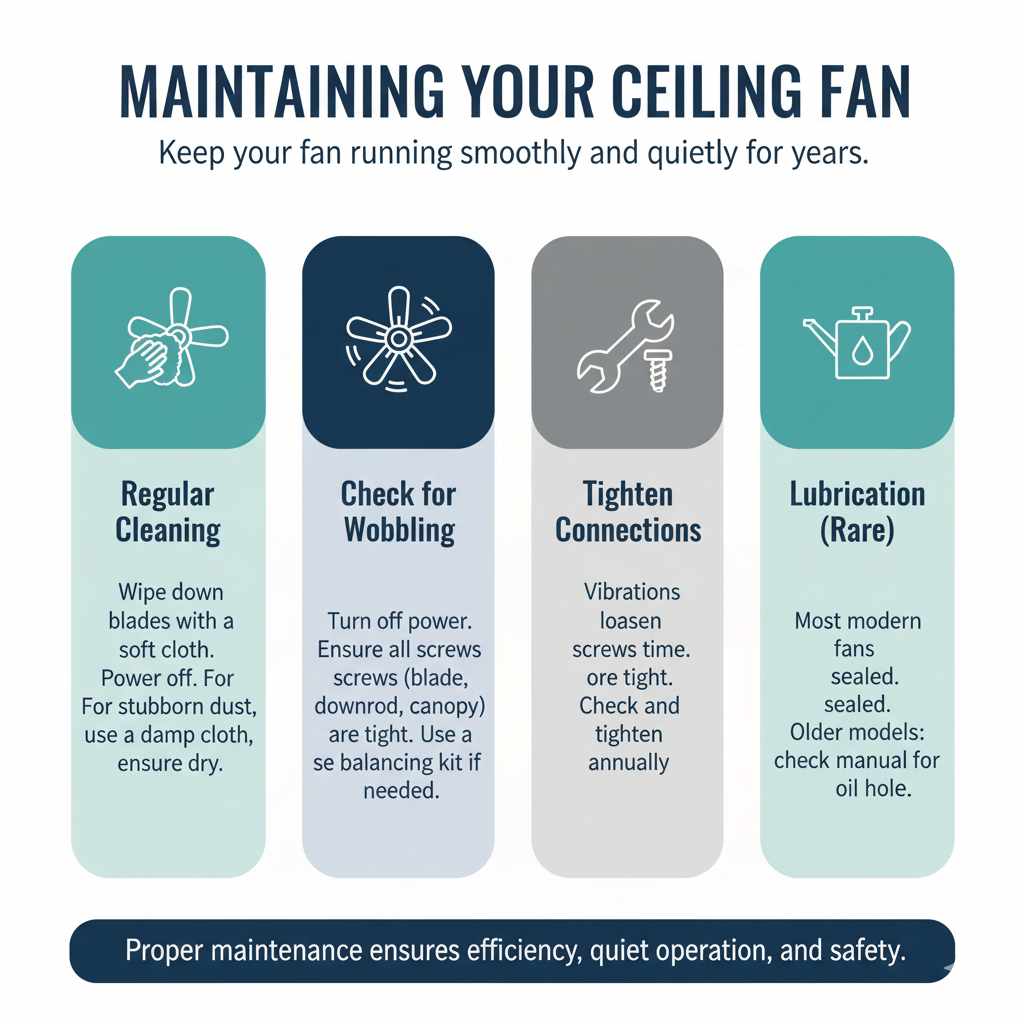
Once you’ve installed your beautiful new fan with its long downrod, a little maintenance will keep it running smoothly and quietly for years to come.
- Regular Cleaning: Dust can accumulate on the blades, making the fan less efficient and potentially causing wobbling. Wipe down the blades regularly with a soft cloth or a microfiber duster. For stubborn dust, a slightly damp cloth can be used, but ensure the power is off and the blades are completely dry before turning it back on.
- Check for Wobbling: Periodically check if the fan is wobbling excessively. If it is, turn off the power and ensure all screws (blade screws, downrod screws, canopy screws) are tight. Most fans come with a balancing kit; follow the instructions in your manual to use it if needed.
- Tighten Connections: Over time, vibrations can loosen screws. It’s a good idea to check and tighten all visible screws, especially those holding the blades and the downrod, at least once a year.
- Lubrication (Rarely Needed): Most modern ceiling fans have sealed motors that do not require lubrication. Older models might have an oil hole; consult your manual.
Proper maintenance ensures your fan operates efficiently, quietly, and safely, especially important for fans installed high up with long downrods.
Frequently Asked Questions (FAQ)
Q1: How do I know if my ceiling box can support a fan with a long downrod?
A: Standard light fixture boxes are not strong enough for ceiling fans. You need a “fan-rated” electrical box. These are typically metal and are either directly mounted to a ceiling joist or use a brace that spans between joists. Look for markings like “Acceptable for Fan Support” on the box. If you’re unsure, it’s best to have an electrician check or install a fan-rated box.
Q2: Can I use a downrod from a different brand than my fan?
A: It’s generally recommended to use a downrod from the same manufacturer as your fan to ensure compatibility. While some universal downrods might exist, the threading and connection points can vary, potentially leading to an unsafe installation. Always check your fan’s manual for recommended accessories.
Q3: My room has a sloped ceiling. What kind of downrod do I need?
A: For sloped ceilings, you’ll typically need a longer downrod than for a flat ceiling of the same height. This is to ensure the fan blades don’t hit the ceiling. Many fans are designed to be installed on sloped ceilings up to a certain angle (often 30 degrees). Some fans come with a canopy kit specifically for sloped ceilings, or you might need to purchase one separately. Always check the maximum slope angle your fan and its mounting hardware can accommodate.
Q4: How do I clean a ceiling fan with a long downrod that’s hard to reach?
A: A long-handled microfiber duster or a duster attachment for your vacuum cleaner can be very helpful. For a deeper clean, you can use a stepladder and a damp cloth, but always ensure the power is off. Some people also use extendable electrostatic dusters that can reach higher. Regular dusting will prevent heavy buildup.
Q5: What’s the difference between AC and DC motors in ceiling fans?
A: AC (Alternating Current) motors are the traditional type found in most ceiling fans. They are reliable but can be noisier and less energy-efficient. DC (Direct Current) motors are newer, much more energy-efficient, significantly quieter, and often offer more speed settings and reverse functions controlled by a remote. They are usually found in higher-end or modern fan designs.
Q6: My fan seems to wobble. What should I do?
A: Wobbling is usually caused by uneven blade weight or loose connections. First, ensure the power is off and re-tighten all screws holding the blades to the blade irons and the blade irons to the motor. Also, check that the downrod is securely attached. If wobbling persists, use the balancing kit that came with your fan. Follow the kit’s instructions carefully; it involves placing small weights on the blades to counteract the imbalance.
Conclusion
Choosing the best ceiling fan with long downrod is all about understanding your room’s needs and matching them with the right fan and installation. By considering your ceiling height, room size, desired style, and essential features like airflow and motor quality, you can make a confident decision. Installing a fan, especially with a longer downrod, is a rewarding DIY project that can significantly improve your home’s comfort and ambiance. Remember to prioritize safety by always turning off the power and following the manufacturer’s instructions. With the right fan and downrod, you’ll enjoy perfect air circulation and a stylish addition to your home for years to come. Happy installing!