Bifold, Closet and Sliding Doors: Install, Adjust, Lock and Repair — Complete Guide
For bifold and sliding closet doors, a common rule of thumb is to fix the track and alignment first: keep jambs within about 1/8 inch of plumb, keep top tracks level, and adjust pivots or rollers before replacing panels, locks, or guides. Bad setup causes rubbing, gaps, derailments, cracked hardware, and doors that will not stay closed or lock. This guide maps symptoms to installation, adjustment, locking, and repair steps for bifold, sliding, and standard closet doors.
Start here: pick the right closet door path


Bifold doors work best where you need access across almost the full opening and do not have room for a hinged door to swing into a hall, bed, or dresser. Sliding closet doors are often the better fit when the floor must stay clear of a pivot point and when the wall opening is wide enough for bypass panels, but they allow access to only half the closet at one time.
Bifold vs. sliding: access, clearance, hardware complexity, and repair patterns
Bifold closet doors use two or more symmetrical panels joined by center pivot hinges. They fold and stack in and out of a space, and most bifold doors come in pairs, though larger openings may need more panels. Because they do not swing, they work well in tight spaces like hallways.
Sliding closet doors use bypass-style travel on tracks and roller hardware. They expose only part of the opening at once, so long shelves and storage bins can be harder to reach.
Bifold systems usually fail at the spring-loaded top pivot, the adjustable bottom pivot, the top guide, or the bracket screws. Sliding systems usually fail at the rollers, track alignment, panel overlap, or bottom guide.
When an existing opening favors bifold doors
Choose bifold when you want near-full access to the opening, when the header is sound enough to carry a top track, and when the floor can accept a bottom pivot bracket. A common interior opening with light trim often takes a bifold kit with less wall-side modification than a bypass system.
Common bifold styles include flat-panel slabs for plain painted openings, six-panel doors that match traditional interior trim, louvered panels for airflow, mirrored panels for dressing areas, and doors with glass inserts for a lighter look. A 6-panel hollow-core bifold door is common in new builds. Louvered bifold doors can improve airflow and reduce a musty closet smell.
When a bypass sliding system is the better fit
Choose sliding when the opening is wide, the floor should stay free of a pivot bracket, or the door leaf width would make folding panels awkward near furniture. Sliding also helps when panel thickness or trim details would interfere with folding action on bifold hardware.
Repair first or replace now: the fast decision filter
Repair first when the panels are sound and the failure is clearly in the hardware: loose pivots, worn rollers, stripped guide screws, minor track damage, or poor adjustment. Replace the door or full kit when particleboard has swollen, a stile has split, the track is badly deformed, the hardware is obsolete, or repeated misalignment traces back to a crooked opening that trim alone cannot hide.
Suppose a 60-inch closet opening has bifold panels that sag at the center but the panels are flat and dry. That points to pivot wear or bracket movement, not door failure, so hardware replacement is usually the cheaper path.
What you’ll need
- Measuring tools: metal tape measure, level, laser level, framing square
- Cutting and install tools: oscillating tool, miter saw, hammer, finish nail gun, screwdrivers
- Fasteners and setup: shims, screws matched to framing, pencil, drill/driver, bits
- Bifold hardware: top track, spring-loaded top pivot, adjustable bottom pivot, top guide, floor and jamb brackets, aligners, replacement pivot pins
- Sliding hardware: bypass top track, rollers, bottom guide or guide channel, anti-jump retainers if the system uses them
- Finish materials: trim, filler, caulk, touch-up paint or stain
- New-opening parts if needed: door jamb kit, shims, casing
- Handles and knobs: closet door handles or knobs sized and placed to avoid folding or overlap interference
What size bifold or sliding doors do you need?
Measure the finished opening, not the rough framing: take width at the top, midpoint, and floor line, take height at the left jamb, center, and right jamb, then size the door to the smallest reading. Check plumb, level, and square before ordering because an out-of-plumb jamb or crowned floor can defeat even a correctly sized door kit.
Measure width and height the right way
- Measure width at the top, middle, and bottom of the finished opening.
- Measure height at the left, center, and right.
- Use the smallest width and the smallest height for sizing.
- Check the header with a level and each jamb with a level.
- Check the corners with a framing square for obvious out-of-square conditions.
A laser level can speed layout. This Old House used a 360-degree laser to project layout lines, which is especially helpful when a new jamb kit and trim must line up across both sides of the opening.
Account for tracks, floor clearance, overlap, and trim
Bifold systems need room for the top track, the spring-loaded top pivot, the adjustable bottom pivot, and the fold path. Sliding systems need enough width for bypass overlap and enough height for roller hangers and top track depth.
Buy from the finished opening dimension, then confirm the manufacturer’s opening range. If new jambs are being added, include that build-out before ordering. In one installation, the opening needed to be 62 inches to account for the jamb kit and shims. (Thisoldhouse)
When shimming a jamb kit is enough and when framing repair is needed
Use a door jamb kit when framing a new opening or when the old jamb is too damaged to hold brackets well. Shim the jamb plumb, then fasten it and trim it out.
If the header bows, the subfloor rises sharply at one side, or the opening is out of square enough that shims would leave a visibly tapered casing, fix the framing first. Hardware adjustment cannot correct a badly twisted opening.
How do you install bifold closet doors in an existing opening?
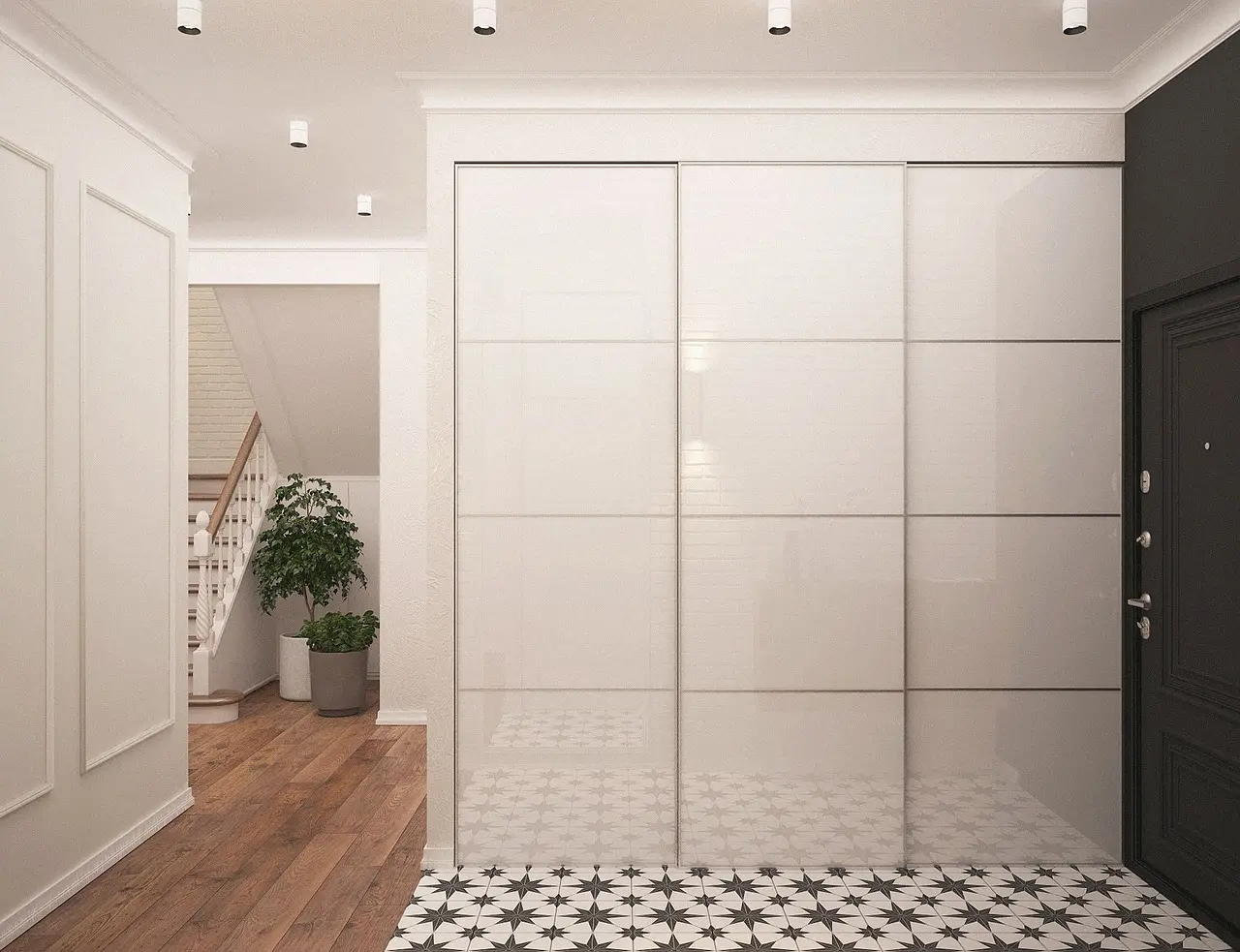
Install bifold doors by correcting the opening first, then mounting the top track level, setting the pivot-side brackets square, fitting the pivots and guide hardware, and making final gap adjustments with the bottom pivot. Most failures blamed on the doors start with a crooked track or misplaced bottom bracket.
Bifold door anatomy that matters during installation
Bifold closet doors have paired panels, a center pivot hinge line, a spring-loaded top pivot, an adjustable bottom pivot, a top track, a track guide, aligners, and knobs or pulls. Bifold door kits often include door panels, installation tracks, hardware, and pulls or knobs. Replacement pivots, brackets, guides, and track sections are commonly sold separately.
Install steps
- Remove old hardware and patch stripped holes before layout.
- Mark the opening centerline and the pivot side on the header and floor.
- Shim the jamb if it is out of plumb by more than about 1/8 inch.
- Cut the top track to length with a miter saw or as the kit allows.
- Mount the top track level to solid wood or framing.
- Install the floor bracket at the pivot side in the correct orientation.
- Install the upper jamb bracket if the kit uses one.
- Fit the adjustable pivot in the floor first.
- Insert the spring-loaded top pivot into the lead panel.
- Install the top guide in the following panel.
- Seat the top pivot into the track bracket.
- Seat the bottom pivot into the floor bracket.
- Engage the top guide in the track.
- A common rule of thumb is to adjust the bottom pivot left or right in about 1/8-inch increments, then recheck the reveal.
- Adjust door height at the bottom pivot one turn at a time, then recheck rubbing.
- Set the track guide so the panels fold cleanly without jumping.
- Install the knob centered on the center panel and middle rail.
- Open and close the door through full travel and fine-tune bracket position if needed.
That knob location matters. If the knob sits too close to the fold line or too near the stile edge, it can hit the adjacent panel and stop a full fold.
If that did not work
- Loosen the bottom bracket screws and shift the bracket slightly toward or away from the jamb.
- Reset the top track if the reveal changes from top to bottom.
- Replace the pivot pins if the door will adjust briefly, then drop again.
Picture a hallway closet where the left jamb leans inward. The panels may look too wide at the top and too narrow at the bottom. Moving only the top guide will not fix that, the jamb or bottom pivot position has to be corrected first.
How do you install sliding closet doors and tracks?
Install sliding closet doors from the finished opening lines, not rough framing marks, so panel overlap stays even at the jambs. Mount the top track straight, align the bottom guide directly below it, hang the rear panel first, then tune rollers until both panels hang plumb and travel cleanly.
Sliding door anatomy that affects fit
Sliding closet doors use a bypass top track, roller assemblies mounted to the door tops, and a bottom guide or guide channel that keeps the panels from swinging. Some systems also use anti-jump retainers. Overlap matters because poor overlap leaves a center gap or makes the front panel scrape the rear panel.
Install steps: measure the finished opening width
- Measure the finished opening width and mark track layout from that line.
- Confirm that the header can hold the top track screws.
- Cut the top track to length if required.
- Mount the top track straight and fully supported.
- Mark the bottom guide position directly below the track.
- Install the bottom guide or guide channel in line with the top track.
- Attach roller hardware to both door panels.
- Hang the rear panel first.
- Hang the front panel second.
- A common rule of thumb is to adjust the rollers in about 1/8-inch height changes or one adjuster turn at a time, then recheck plumb.
- Set overlap so the center gap and jamb gaps stay controlled.
- Check anti-jump retention or guide engagement if the system uses it.
If that did not work: shift the bottom guide until
- Shift the bottom guide until it sits exactly below the track path.
- Replace any roller that binds, flats, or wobbles under load.
- Replace the track if a straightedge shows a kink that keeps returning the panel to one spot.
Closet door troubleshooting matrix
| Symptom | Likely cause | Fastest fix | Replace-if threshold |
|---|---|---|---|
| Bifold sags at center | Bottom pivot slipped or worn | Raise and shift the adjustable bottom pivot; retighten bracket screws | Replace pivot set if adjustment will not hold for a full open-close cycle |
| Bifold gap is wide at top, tight at bottom | Jamb out of plumb or top track mounted crooked | Shim jamb or remount track level | Repair framing if shims leave a visibly twisted opening |
| Panels rub at floor | Door hanging low, floor rise, or swollen bottom rail | Raise bottom pivot or roller setting | Replace panel if particleboard is swollen or edge is crumbling |
| Bifold comes off track | Missing top guide, bent track, or loose bracket | Reseat guide and tighten brackets | Replace track if bent sections keep ejecting the guide |
| Loose pivot pin | Worn pivot hardware or enlarged mounting hole | Install new pivot pin or bracket | Replace panel if the stile is split around the pivot socket |
| Doors drift open | Track not level or pivots mispositioned | Level the track and reset pivot point | Replace warped panel if drift continues with a level track |
| Sliding door sticks mid-span | Dirty track or seized roller | Clean track and replace the bad roller | Replace both rollers if one failure has worn the mate flat |
| Sliding door scrapes rear panel | Poor overlap or roller heights out of match | Adjust roller height and reset panel order or spacing | Replace bent hanger bracket if one side cannot be leveled |
| Bottom of sliding panel swings out | Missing or misaligned bottom guide | Realign or replace the guide | Replace guide channel if worn wide enough to let the panel walk |
| Top track noise and binding | Track screws overtightened or track kinked | Back off distorted screws and straighten minor bends | Replace track if the roller catches at the same spot every pass |
| Failed latch or magnetic catch on bifold | Strike misaligned or weak catch | Reset strike position and tighten screws | Replace latch set if magnet or spring has failed |
| Lock will not engage on sliding door | Poor overlap, bad strike placement, or panel drift | Adjust overlap and move strike plate | Replace lock body if alignment is correct but the hook or loop will not catch |
How do you adjust and repair doors that sag, rub, stick, or jump the track?

Start at the symptom location before touching any adjuster: top, bottom, latch side, or pivot side. On bifold doors, the bottom pivot usually controls height and side gap, while the top guide keeps alignment. On sliding doors, rollers and guides do most of the work, and damaged tracks quickly undo any adjustment.
Bifold adjustment and repair workflow
- Check the top track for level and the pivot-side jamb for plumb.
- Inspect the spring-loaded top pivot for free travel and full seating.
- Inspect the adjustable bottom pivot for wear or a loose locknut.
- Raise or lower the bottom pivot one turn at a time to correct floor rub.
- Shift the bottom pivot bracket in 1/8-inch increments to correct side gap.
- Reset the top guide only after the bottom pivot is correct.
- Tighten loose brackets and fill stripped screw holes before reinstalling screws.
- Replace the pivot pin, guide, aligner, or bracket if adjustment no longer holds.
Sliding repair workflow
- Vacuum the track and remove paint, grit, or burrs.
- Roll each panel slowly and note one repeat bind point.
- Adjust roller height one side at a time until the panel hangs plumb.
- Realign the bottom guide to stop panel swing and scraping.
- Replace seized or flat-spotted rollers.
- Replace the track if a bend or crush point keeps returning the bind.
How to replace bifold hardware and pivots
- Remove the panel from the track and floor bracket.
- Match the old pivot pin diameter and bracket shape before buying parts.
- Replace only the failed piece when the remaining hardware is sound.
- Replace the full hardware kit when several parts are worn or mixed from older systems.
- Rehang the panel and readjust bottom pivot height and side gap.
Repair is usually enough when one pivot pin cracks, one guide wears down, or one bracket pulls loose. Full replacement makes more sense when old track dimensions no longer match available guides or when repeated patching has enlarged the stile sockets.
If that did not work: check for a bowed header
- Check for a bowed header or floor rise with a long level.
- Trim or replace swollen panels only after confirming the opening is true.
- Replace the whole door or kit when the panel is split, warped, or water-damaged.
How do you lock bifold or sliding closet doors?
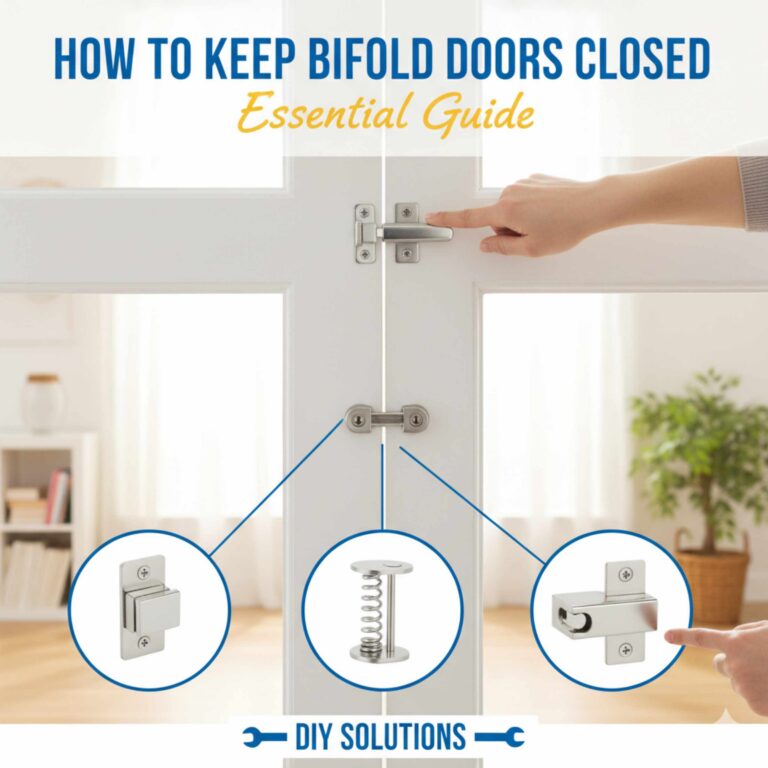
Closet door locks are best treated as privacy or child-deterrent hardware, not true security. Bifold doors usually accept surface slide bolts or catches placed away from the fold path, while sliding doors use loop locks, cabinet-style bypass locks, or jamb-side latches that clear panel overlap.
Lock choices for bifold doors
Surface slide bolts work on the lead panel when mounted near the top or at a comfortable reach point that does not interfere with folding. Magnetic catches can help keep panels closed, and some kits add a privacy turn piece, but that is still light-duty hardware.
Keep hardware off the hinge line and away from the center fold. The usual knob location is centered on the center panel and middle rail, so lock placement has to avoid that grasp point.
Lock choices for sliding doors
Loop locks, cabinet-style bypass locks, and jamb-side hook latches can hold a sliding panel in place. Place the strike so the lock engages when overlap is correct and the panel sits fully in the guide. A drifting panel often points to roller or track issues, not lock failure.
What these locks can and cannot do
They can provide bedroom privacy, child deterrence, and a way to keep doors from drifting open. They do not provide exterior-grade security, and thin hollow-core closet panels should not be treated as a secure barrier.
Common mistakes
What goes wrong and how to avoid it
- Buying to the nominal opening size without using the smallest measured dimension from top, middle, bottom, left, center, and right
- Mounting the track to a crooked header instead of shimming the jamb or correcting the opening first
- Trying to solve every reveal problem with the top guide instead of starting at the bottom pivot on bifold doors
- Overtightening track screws until the track distorts and the guide or roller binds
- Skipping shims behind a new door jamb kit, which leaves brackets loose and reveals uneven
- Placing knobs where they hit the adjacent panel or interrupt the fold
- Ignoring overlap on sliding doors, which leads to center gaps and locks that will not engage
Prevention
Retighten accessible bracket and guide screws once after the first week of regular use. New installs can settle slightly, and catching that movement early prevents elongated screw holes and repeat derailment.
Frequently asked questions
How do I adjust bifold doors so they close evenly?
Start with the bottom pivot, not the top guide. Raise or lower the bottom pivot one turn at a time for height, then shift the bracket in 1/8-inch increments for side gap. Recheck the reveal from top to bottom, then fine-tune the top guide only if the panels still wander.
How do I fix bifold doors that come off the track?
Inspect the top guide first, then the track, top pivot, and bracket screws. Reseat the guide, tighten loose brackets, and replace worn pivot pins or guides. If the track is bent or crushed and the guide jumps out at the same spot every time, replace the track section or the kit.
Why do my closet doors keep sticking or rubbing?
Sticking usually comes from one of five places: a crooked top track, a low bifold bottom pivot, seized sliding rollers, a misaligned bottom guide, or a swollen panel edge. Check where the contact happens, correct the hardware at that point, and replace the panel only if the material itself has failed.
Can I use bifold doors instead of sliding closet doors?
Yes, if the opening can accept a pivot bracket and the fold path will clear flooring, trim, and nearby furniture. Bifold gives wider access across the opening, while sliding keeps panels in a bypass path and limits access to half the closet at one time.
When should I repair vs replace closet doors?
Repair when the panels are straight and dry and the problem is isolated to pivots, guides, rollers, brackets, or track alignment. Replace when particleboard has swollen, stiles are split, tracks are badly deformed, hardware is obsolete, or a bad opening keeps forcing the doors out of alignment after repeated adjustments.
Sponsored / affiliate links. As an Amazon Associate I earn from qualifying purchases. I may earn additional commission from eligible campaigns.