Do Air Mattresses Cause Back Pain? Truth and Fixes
Yes, air mattresses can cause back pain when they sag, leak air overnight, or push the spine into a curled shape. If pain starts after one or two nights and fades after sleeping elsewhere, the bed is the likely cause. Left alone, that sore spot can turn into a stubborn flare-up. This guide shows how to sort support failure, air loss, and poor sleeping posture, then fix the right one first.
Do air mattresses cause back pain?




Yes. An air mattress can cause back pain when it cannot keep the spine in neutral alignment, especially if it softens during the night or is set at the wrong firmness for the sleeper’s body weight and position. The mattress is not always the only cause, though, so the pattern matters.
When the mattress is the likely cause
If back pain starts after sleeping on an air mattress and eases on a firmer surface, the mattress is a strong suspect. Morning stiffness, a sore low back, and a feeling of sinking through the middle point to lost support rather than a random flare-up.
Guest use is one thing. Nightly use is another. A one-night setup that holds air fairly well may be fine for visitors, while repeated sleep exposes slow leaks, pump inconsistency, and pressure shifts that keep the spine from resting in neutral alignment.
When the pain may be coming from somewhere else
Not every ache comes from the mattress. A recent strain, poor lifting mechanics, long sitting, an old disc issue, or a bad pillow can all leave someone sore in bed and point blame at the air mattress too quickly. If pain keeps showing up off the mattress, look beyond the bed.
Why nightly use is different from guest use
Temporary use usually fails less often because there is less time for air loss and body position drift to add up. Nightly use magnifies small problems. A setup that feels fine at bedtime can be too soft by 3 a.m., and that shift is enough to twist the lower back.
According to — CNET’s top air mattress has a 19-inch-tall profile.
What air mattress problems usually trigger morning pain?
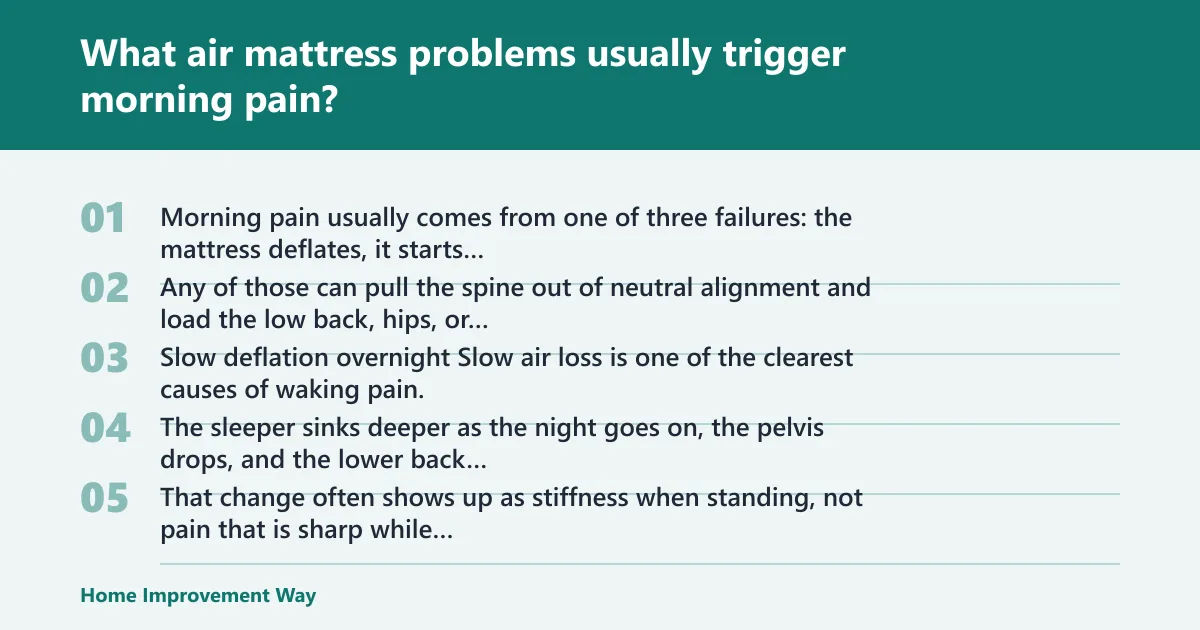
Morning pain usually comes from one of three failures: the mattress deflates, it starts at the wrong firmness, or it inflates unevenly and throws the body off center. Any of those can pull the spine out of neutral alignment and load the low back, hips, or shoulders unevenly.
Slow deflation overnight
Slow air loss is one of the clearest causes of waking pain. The sleeper sinks deeper as the night goes on, the pelvis drops, and the lower back rounds. That change often shows up as stiffness when standing, not pain that is sharp while lying still.
Underinflation, overinflation, and uneven inflation
Underinflation lets the hips sink too far. Overinflation creates a hard surface that can press into the ribs, hips, and shoulders without giving those joints any relief. Uneven inflation is worse than either one because it tilts the body and makes the spine work against a sloped surface.
Poor spinal alignment from the sleep surface
The goal is neutral alignment, where the natural curve of the spine stays close to its normal shape. Too-soft air mattresses let the middle sag. Too-firm ones can push the lumbar area into extension. Either way, the back muscles often do extra work all night.
| Symptom pattern | Likely air-mattress cause | What to try first |
|---|---|---|
| Fine at bedtime, sore on waking | Slow deflation overnight | Check seams and valve, add a top-off before sleep, test the pump cycle |
| Hips sink, low back feels rounded | Underinflation | Add air in small steps until the pelvis stops dropping |
| Pressure at hips, shoulders, or ribs | Overinflation | Release a little air and retest side or back comfort |
| One side feels higher or lower | Uneven inflation | Reinflate on a level floor, smooth the surface, check internal baffles |
| Pain shifts after turning side to side | Side-sleeping pressure points | Add a thin foam topper, change pillow height, reduce firmness slightly |
| Feels okay at first, then gets firmer or softer during the night | Overnight firmness changes | Test pump behavior, close valves fully, look for temperature-related pressure loss |

How sleeping posture changes the pressure on your back
Sleeping posture changes where load lands. Back sleeping usually asks for even support. Side sleeping needs more pressure relief at the shoulder and hip. Stomach sleeping often arches the low back. Combo sleepers add another problem: repeated repositioning exposes every weak spot in the mattress.
Back sleepers and neutral alignment
Back sleepers usually do best when the pelvis does not sink and the chest does not feel propped upward. If the mattress is too soft, the low back rounds. If it is too hard, the small of the back may lose contact and feel strained by morning.
Side sleepers and shoulder and hip pressure points
Side sleepers often need more give at the shoulder and hip, but not so much that the waist collapses. On an air mattress, that balance is hard to get if the surface is stiff and thin. Pressure points often show up as hip pain, shoulder numbness, or a sore waistline.
Stomach sleepers and lumbar strain
Stomach sleeping can pull the lumbar spine into extension, especially on a firm or overinflated air mattress. That position may feel fine for a short stretch, then produce an ache across the low back by morning. A flatter pillow setup can help, but the posture itself is still demanding.
Combo sleepers and repeated repositioning
Combo sleepers need a surface that lets them turn without fighting the bed. If the mattress shifts air unevenly or feels unstable at the edges, every movement can wake the back muscles. That is one reason a steady air chamber layout matters so much.
What firmness is best for back pain on an air mattress?
The best firmness is the one that keeps the spine neutral for that sleeper’s body type and position. For some people that means firmer support. For others, especially side sleepers, it means a little more give at the shoulder and hip without letting the midsection sink.
How to judge the right firmness by sleeper type
Back sleepers often do well with medium-firm support on an air mattress. Side sleepers often do better with a slightly softer surface than back sleepers. Stomach sleepers usually need the firmest setup they can tolerate without creating pressure spikes. Combo sleepers often do best with easy fine-tuning.
Why heavier sleepers often need more support
Heavier sleepers compress the air chamber more, so a mattress that seems firm to a lighter person may sag under a larger body. That is why a model with better chamber construction, stronger seams, or a dual-chamber layout often performs better than a basic single-baffle design.
Why side sleepers often need more pressure relief
Side sleepers need the mattress to cushion the shoulder and hip while still supporting the waist. Too much firmness creates sharp pressure points. Too little firmness lets the spine bend sideways. A thin foam layer on top can help when the air surface feels too hard.
Diagnostic checklist: match your symptoms to the likely cause
This is the fastest way to sort mattress trouble from something else. Start with the pain pattern, then match it to the failure mode. Fix the easiest item first. If the pain keeps showing up after those checks, the mattress may be the wrong fit for regular sleep.
- Wake up and notice where the pain sits: low back, mid back, hips, or shoulders.
- Check whether the bed felt different at bedtime than it did at dawn.
- Press along the surface for soft spots, slope, or a low center section.
- Compare pain after back sleeping versus side sleeping.
- Add or remove a small amount of air, then retest for one night.
- If the mattress still shifts firmness overnight, inspect the valve, seams, and pump.
- Stop using it if symptoms worsen night after night despite adjustments.
Fixes you can try before replacing the bed
Top off the mattress right before sleep. Put it on a flat floor, not a sagging frame. Use a small pillow under the knees for back sleeping or between the knees for side sleeping. If the surface is too hard, add a thin foam topper. If it is too soft, add air in short bursts and retest.
What mattress features matter most for support?
Support depends on structure, not only on firmness. Air chamber construction, pump behavior, and surface materials all shape how well the mattress holds the spine. A well-built inflatable can feel far more stable than a cheap one set to the same pressure.
Air chamber construction and why it matters
Internal air coils, horizontal air chambers, and dual-chamber designs help the mattress hold shape and resist sagging. CNET says the best air mattress can include 40 internal air coils, and that kind of construction can improve support compared with a flat, empty bladder feel.
A few useful reference points: CNET’s top air mattress has a 19-inch-tall profile, the best sturdy air mattress is 22 inches tall, one model offers three firmness levels, and one includes a 2-year warranty. CNET also notes one air mattress is made to be easy to fold up and store, which matters for temporary use.
Built-in pumps and dual pump systems
A built-in pump helps maintain inflation and makes top-offs easier. Dual pump systems can separate inflation from fine adjustment, which may improve firmness consistency. Some models run all night, which can help offset slow leaks, but the real value is steadier support from bedtime to morning.
Memory foam layers, hybrids, and coil support
Supportive mattress materials can soften pressure without turning the surface mushy. Memory foam layers help with pressure relief. Hybrid construction adds responsiveness. Coils can improve edge support and reduce that hammock feeling. CNET’s best affordable hybrid mattress is $284, its best memory foam mattress for back pain is $799, and its best firm mattress for back pain is $1,799.
How can you stop back pain on an air mattress?
Stop the pain by matching the fix to the failure. If the mattress is soft, add air. If it is hard and painful, bleed some out. If posture is the issue, change pillows and sleeping position. If the mattress keeps changing shape overnight, the pump or chamber design may be the problem.
Adjust inflation correctly
Make changes in small steps. Add a little air, lie down, and check whether the hips still drop below the shoulders. If the surface feels rigid and pressure points appear, let a little out. The goal is support with just enough give to keep the spine level.
Add pressure relief on top if needed
A thin foam topper can help side sleepers and lighter sleepers who feel every seam and ridge. It should soften pressure, not erase support. Thick, plush toppers can make an already soft air mattress worse by allowing the pelvis to sink farther.
Improve pillow setup and sleep posture
Use pillows to keep the neck and pelvis from twisting. Side sleepers often benefit from a pillow between the knees. Back sleepers may do better with a pillow under the knees to reduce lumbar tension. Stomach sleeping is the hardest posture to make comfortable on an air mattress.
Know when to stop using the air mattress
Stop using it if pain seems to be getting worse, if symptoms spread into the legs, if numbness or weakness appears, or if the mattress still will not hold a consistent shape after adjustments. If back pain is severe, follows an injury, or does not improve away from the mattress, get medical evaluation.
Frequently asked questions
Do air mattresses cause back pain?
They can. The problem usually comes from support failure, air loss, or the wrong firmness for the sleeper’s body type and position. A temporary ache that starts with air-mattress use and improves on another bed is a strong sign the sleep surface is part of the cause.
Why do air mattresses hurt my back?
They hurt the back when they let the spine leave neutral alignment or create pressure spikes at the hips and shoulders. Slow deflation, uneven inflation, and a poor match for side sleeping are common reasons. A mattress that feels fine at bedtime can still fail by morning.
How can I stop back pain on an air mattress?
First, check inflation. Then adjust posture and pillows. Add a thin topper if the surface is too hard, or remove air if it is too soft. If the mattress keeps losing firmness overnight, inspect the valves, seams, and pump before assuming the whole bed is unusable.
Are air mattresses bad for your back?
Not automatically. A well-built air mattress can work for short stays or guests if it holds air and keeps the spine in neutral alignment. Problems can start when the bed sags, shifts, or stays too firm or too soft for the sleeper. Support quality matters more than the label.
Can an air mattress worsen existing back pain?
Yes. A back already irritated by strain, disc issues, or stiffness can react badly to poor support, especially if the mattress softens overnight. If a setup consistently increases pain, limit use and switch to a more supportive sleep surface while the back settles down.
Which air mattress is best for side sleepers with back pain?
Side sleepers with back pain usually do best on an air mattress with adjustable firmness, stable chamber construction, and enough surface give to reduce shoulder and hip pressure. A thin foam layer can help. The key is to support the waist while avoiding a hard, point-loaded feel.
Sponsored / affiliate links. As an Amazon Associate I earn from qualifying purchases. I may earn additional commission from eligible campaigns.
 YUCHENGTECH Ionizing Air Blower Static Eliminator Fan Desktop Ionizer Air Blower with Detachable Cord ESD Ionizer Electrostatic Discharge Fan 110V
 Prolux New Comfort CA3500 6-Stage Air Purifier & Ozone Generator with True HEPA & UV-C Light, Covers Up to 3,000 Sq Ft, Portable for Home or Commercial Use