How High Are Door Knobs? Standard Height Guide
Ever wondered why door knobs seem to be at just the right spot? It’s not by accident! Many people find the exact measurements for door knobs a bit puzzling, especially when planning home projects or just out of curiosity. This common question can seem tricky at first. But don’t worry, figuring out the standard height is simpler than you might think. We’ll walk through it step-by-step so you can easily find the answer.
Understanding Door Knob Height Standards
Knowing the typical height for door knobs is super helpful for many reasons. Whether you’re building a new home, renovating, or even just curious about accessibility, these standards make sure doors are easy for most people to use. This guide aims to make that clear.
Why Standard Heights Matter
Door knob height isn’t just random; it’s set for ease of use and safety. These standards help ensure that people of different heights, including children and adults, can comfortably reach and operate doors. Consistency also makes it easier for builders and manufacturers.
Everyone knows what to expect.
When you think about how often we use doors, having them at a convenient height makes a big difference in our daily lives. It’s a small detail that contributes a lot to a home’s functionality. We’ll explore the reasons behind these measurements next.
Accessibility Considerations
Accessibility is a key reason for standard door knob heights. Building codes often require door knobs to be placed at a height that is reachable by people using wheelchairs. This is part of making spaces inclusive for everyone.
A universally reachable door knob ensures independence and ease of access.
This focus on accessibility benefits more than just wheelchair users. It helps people with limited reach due to age or disability. It also makes doors easier for children to open.
The goal is to create environments that are welcoming and functional for all users, promoting equal access.
- Inclusivity for All Ages
Door knob heights are often set with children in mind. A standard height means that older children can likely reach and open doors independently. This fosters a sense of autonomy for younger family members.
It also means parents don’t have to constantly help with simple tasks.
- Ease of Operation for Adults
For adults, the standard height makes opening doors effortless. There’s no need to strain or bend awkwardly. This convenience contributes to the overall comfort and usability of a living space.
It’s a design choice that prioritizes user experience.
- Compliance with Building Codes
Many regions have building codes that specify the acceptable range for door knob installation. These codes are in place to ensure safety and accessibility standards are met. Following these guidelines is important for new constructions and renovations.
The Standard Door Knob Height Explained
So, you’re wondering about the magic numbers for door knobs? Let’s break down the standard height. This information is key for anyone looking to install or simply understand door hardware.
The Common Measurement
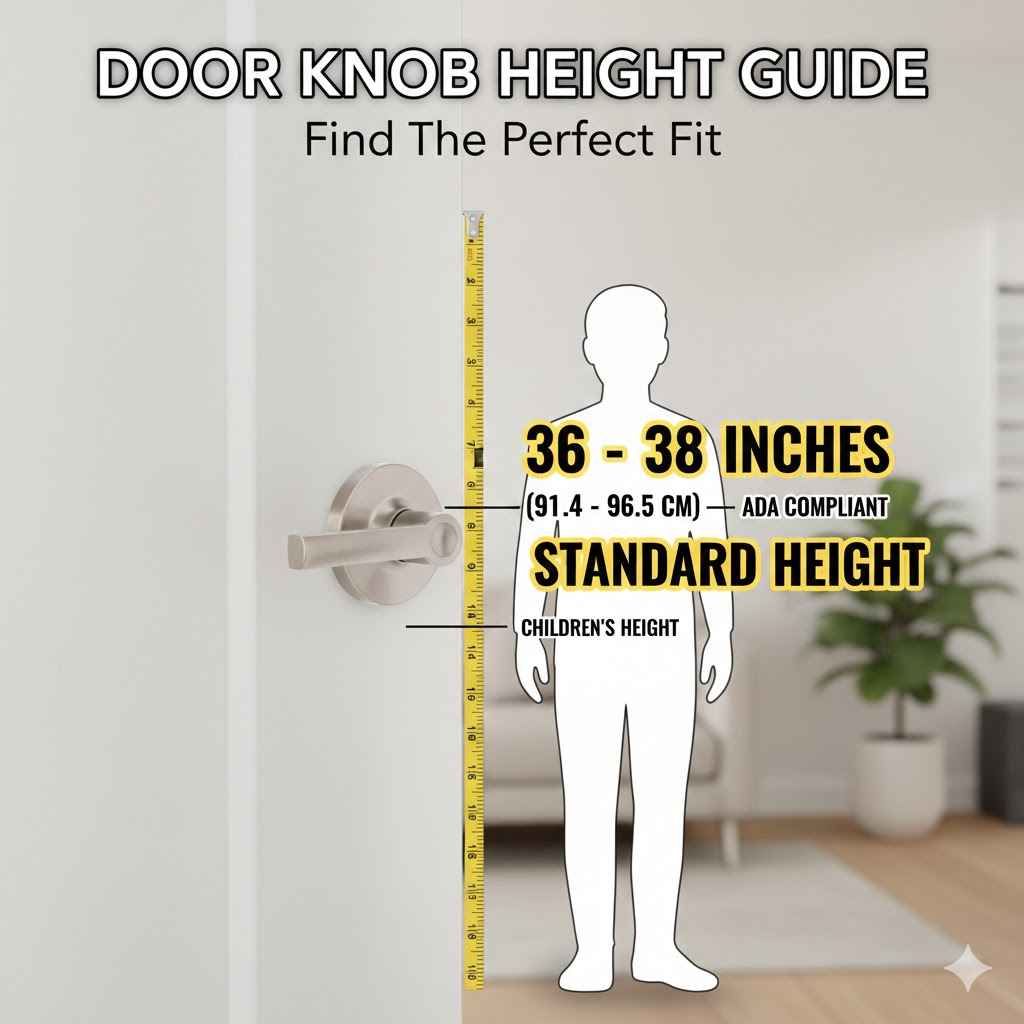
Most commonly, door knobs are installed at a height of 34 to 38 inches from the finished floor to the center of the doorknob. This range is widely accepted in residential and commercial settings. It hits a sweet spot for accessibility and ease of use.
This 34-38 inch range is not an accident. It’s been determined through practice and testing to be practical for the majority of people. It allows for comfortable operation without being too high or too low.
- Center of the Knob is Key
It is important to note that this measurement refers to the center of the knob itself. This is the point around which the knob rotates. Measuring to the top or bottom of the knob would yield different results and is not the standard practice.
Understanding this detail ensures accurate installation. When you’re looking at your door, visualize the knob and find its middle point for measurement. This precision is what makes the standard effective.
- Variations and Customizations
While 34 to 38 inches is the standard, there can be variations. Some doors might have slightly different heights based on specific needs or design choices. However, this range is the most common starting point.
For specialized applications, like ensuring ADA compliance, specific heights might be mandated. These often fall within or are very close to the standard range. Customization is possible but often respects the established norms.
Measuring the Existing Height
Want to check your own doors? Measuring is straightforward. You’ll need a tape measure.
Start from the floor and measure straight up to the middle point of the existing door knob.
Make sure you are measuring from the finished floor. This means if you have carpet, measure from the top of the carpet. If it’s hardwood or tile, measure from the surface of that material.
- Tools Needed
A simple tape measure is all you really need for this task. A level can also be helpful to ensure your measurements are straight up and down. But for just finding the height, a tape measure is sufficient.
- Where to Place the Tape Measure
Hold the end of the tape measure at the base of the door frame, right on the floor. Extend the tape vertically up the door until you reach the center of the door knob. Read the measurement at that point.
It’s a good idea to take a couple of measurements to ensure accuracy. Sometimes doors can have slight variations even on the same level. Double-checking your work helps avoid any installation mistakes later.
- Example Scenario
Let’s say you measure your front door knob. You place the tape measure at the bottom of the door frame and pull it up. You find the center of the knob is exactly 36 inches from the floor.
This falls perfectly within the standard range.
Now, consider a different door in your house, perhaps a closet door. Measuring this one, you find the center of the knob is at 35.5 inches. This is also well within the typical range and considered standard.
How High Are Door Knobs? A Practical Guide
We’ve established the general range for door knobs. But how does this play out in real-world scenarios? Let’s look at some practical applications of these measurements and why they are important.
Residential vs. Commercial Doors
While the standard for residential doors is generally 34 to 38 inches, commercial buildings sometimes have slightly different guidelines, often focusing more strictly on ADA compliance. However, the core principle of accessibility remains the same.
Commercial spaces often need to accommodate a wider range of users and must meet stricter legal requirements for accessibility. This means their door knob heights are often precisely calibrated.
- Residential Standards
In homes, the 34-38 inch range provides comfort for family members of various ages and sizes. It balances ease of use with aesthetic considerations. Homeowners might also choose slightly different heights for specific rooms or aesthetic preferences, though deviations are usually minor.
The goal in residential settings is to create a welcoming and functional space. Standard heights contribute to this by making doors easy to operate for everyone who lives there. It’s a subtle but important aspect of home design.
- Commercial and Public Spaces
Commercial and public buildings must adhere to specific accessibility standards, often mandated by the Americans with Disabilities Act (ADA) in the United States. These standards typically require door hardware to be installed at a height between 34 and 48 inches from the floor. This broader range ensures access for a wider variety of users, including those in wheelchairs.
The precise height in commercial settings is often 38 inches to the center of the lever handle for accessibility. Lever handles are also preferred over knobs in commercial settings for ease of use, especially for individuals with limited hand strength or dexterity.
- ADA Compliance Details
The Americans with Disabilities Act (ADA) specifies that accessible doors must have hardware operable with one hand, without tight grasping, pinching, or twisting of the wrist. For lever handles, the operable part must be no lower than 34 inches and no higher than 48 inches above the finished floor. This range ensures that people using wheelchairs can reach and operate the door easily.
Knobs are generally discouraged in accessible design due to the difficulty some individuals have in turning them. However, if a knob is used, it must also fall within the specified height range. The emphasis is on the ease of operation.
- Example Case Study: A Public Library Renovation
When a local public library underwent a renovation, a key focus was improving accessibility. Previously, some of the older doors had knobs installed at varying heights, making them difficult for some patrons to use. During the renovation, all new door hardware was installed following ADA guidelines.
The project manager ensured that all new lever handles on the main entrance and internal doors were set at 38 inches from the floor. This change, along with wider doorways, significantly improved the library’s usability for everyone. Feedback from patrons indicated a much more welcoming and user-friendly environment.
Factors Affecting Door Knob Height
Several factors can influence the exact placement of a door knob. While there’s a standard, practical considerations can lead to slight adjustments. These are usually minor and aim to optimize usability.
- Door Type and Size
The type and size of the door can sometimes play a role. For instance, a very tall door might have its knob placed slightly higher to maintain visual balance and ease of reach. Smaller doors, like those on cabinets, will naturally have much lower hardware.
- Architectural Design and Aesthetics
Sometimes, architectural design or aesthetic preferences might influence the placement. A designer might opt for a slightly different height to complement the overall look of the room or the door itself. However, these decisions usually still fall within a comfortable range.
- User Needs and Preferences
As mentioned, specific user needs are a major factor. For homes with very young children or individuals with particular mobility requirements, adjustments might be made. This ensures that everyone in the household can easily access and use the doors.
A family with toddlers might choose to install a secondary, lower-placed knob or a child-safe lock. Conversely, for a very tall individual, a slightly higher placement might feel more natural, although this is less common in standardized construction.
Installing Door Knobs at the Correct Height
If you’re installing a new door or replacing hardware, getting the height right is important. Following the standard guidelines ensures your doors are functional and accessible.
Preparation and Measurement
Before you start, gather your tools. You’ll need a tape measure, a pencil, and potentially a drill. Measure from the finished floor to the desired height, marking the center point for the knob.
Double-checking your measurements is crucial. Measure twice, drill once, as the saying goes. This saves time and prevents mistakes that could affect the door or the knob’s function.
- Marking the Center Point
Once you’ve determined the correct height (usually 34-38 inches for residential settings), use your tape measure to mark the exact center point where the knob will be installed. This spot is where the spindle will pass through the door.
- Using a Level for Accuracy
A spirit level is your best friend here. After marking the height, hold the level vertically against the door at your mark. This ensures your measurement is perfectly straight up from the floor, avoiding any angled installations that can look odd and feel awkward.
- Example Scenario: New Door Installation
Imagine you’re hanging a brand-new interior door. After fitting the door into its frame, you decide on a standard knob height of 36 inches. You use your tape measure to mark this height at the usual latch side of the door.
Then, using a level, you confirm the mark is perfectly vertical.
You then use this mark as a guide for drilling the holes for the knob’s spindle and the strike plate on the door frame. Precision at this stage ensures the knob will operate smoothly and the door will latch correctly.
Drilling and Fitting
Follow the manufacturer’s instructions for your specific door knob. Most come with a template to help you mark drilling locations accurately. Drill pilot holes if necessary to prevent wood from splitting.
Ensure the hardware is fitted snugly. A loose knob can be frustrating and may not operate correctly. Take your time during this process.
- Following Manufacturer Guidelines
Every door knob set is a little different. The instructions that come with your hardware are designed to make installation as smooth as possible. They often include diagrams showing where to drill and how to assemble the parts.
- Ensuring Smooth Operation
After installation, test the knob to make sure it turns freely and the latch retracts and extends smoothly. If it feels stiff or sticky, check for any misalignment or obstructions. Sometimes, a slight adjustment is all that’s needed.
Frequently Asked Questions
Question: What is the most common door knob height for homes?
Answer: The most common height for door knobs in residential settings is between 34 and 38 inches from the finished floor to the center of the knob.
Question: Do building codes specify door knob height?
Answer: Yes, building codes, especially those related to accessibility like ADA standards, specify ranges for door knob and lever handle heights to ensure ease of use for all individuals.
Question: Can I install a door knob at any height I want?
Answer: While you can technically install a door knob at any height, adhering to standard ranges ensures usability and accessibility. For ADA compliance, specific height requirements must be met.
Question: Are there differences between knob and lever handle heights?
Answer: Yes, lever handles are often required to be within a slightly wider range (34-48 inches for ADA compliance) due to their easier operation compared to knobs.
Question: What if my door knob is too high or too low?
Answer: If a door knob is too high or too low for comfortable use, it may be possible to adjust its position or replace the hardware. For new installations, using the standard height is recommended.
Conclusion
Understanding how high door knobs should be is simple once you know the standard range. The 34 to 38 inch measurement for the knob’s center is key for homes. This height ensures doors are easy for most people to use.
Following these guidelines makes your doors functional and accessible.