How Long Does It Take For Wood To Become Petrified: Truth
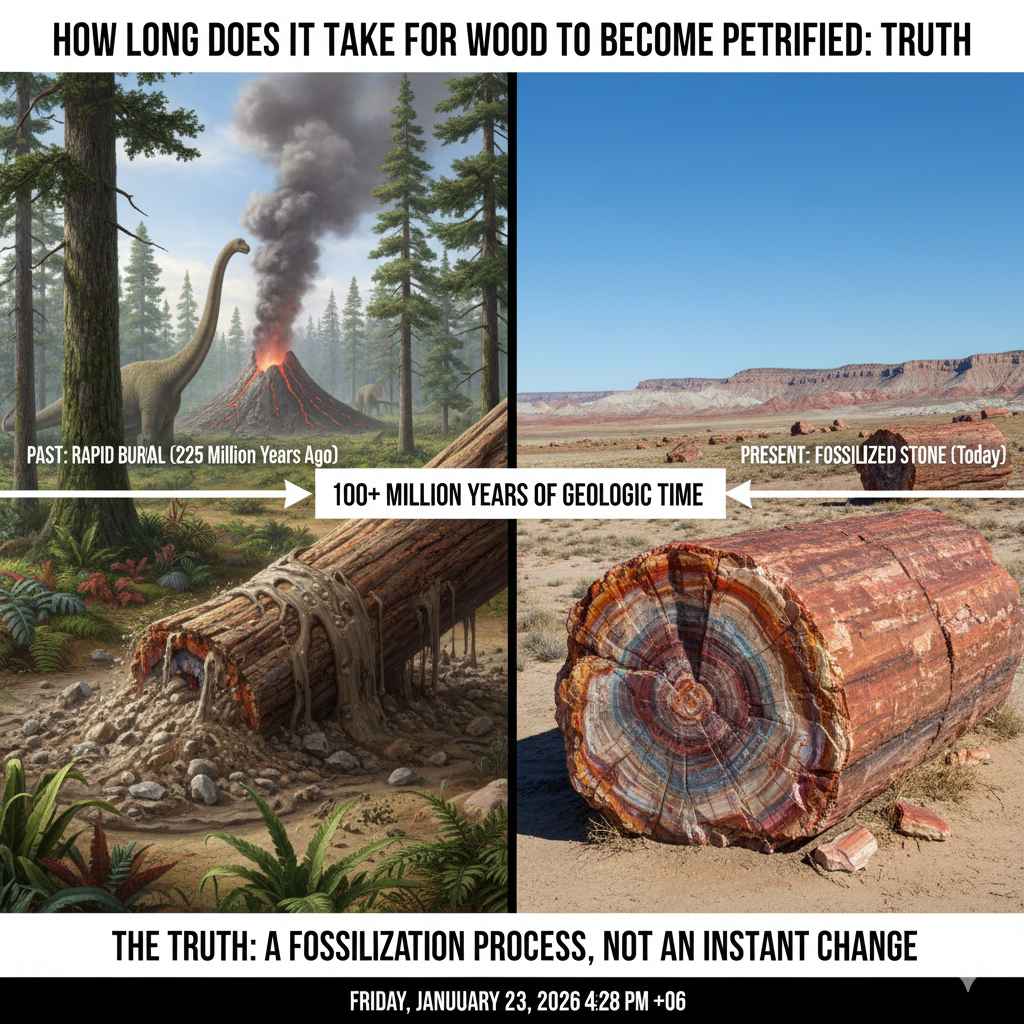
The truth is, natural petrification is an incredibly slow process, usually taking millions of years. For wood to turn completely to stone, it needs perfect conditions: burial in sediment rich with minerals, flowing water, and a complete lack of oxygen. There is no quick, natural way for this to happen.
Hello there! I’m Md Meraj, and I love exploring the stories behind natural materials, whether it’s a beautiful piece of oak for a new table or a fascinating rock that looks just like wood. Have you ever held a piece of petrified wood? It’s heavy like a stone but has the clear grain and rings of a tree. It’s truly amazing! A common question I hear is, “How long does it take for wood to become petrified?” The answer isn’t a simple number, but it’s a fascinating story. Don’t worry, I’m here to walk you through it in a simple, easy-to-understand way. Let’s uncover the truth behind this incredible natural process together.
When we talk about petrified wood, we are talking about a process that happens on a geological timescale. It’s not something that happens in a few years, a few hundred years, or even a few thousand years. The real answer is that it takes millions of years for wood to become truly petrified. Most of the petrified wood we find today, like the stunning logs in Arizona’s Petrified Forest National Park, is from the Late Triassic period. That means it’s over 200 million years old! While some younger examples exist, the process is always incredibly long.
Why so long? Because it involves a slow, cell-by-cell replacement of the wood’s organic material with minerals. It’s a delicate and rare sequence of events. If any step is missed or rushed, the wood simply rots away and disappears forever. So, when you hold a piece of petrified wood, you are holding a fossil that has survived an extraordinary journey through time.
What Is Petrified Wood, Exactly?
Before we dive deeper into the timing, let’s get clear on what petrified wood is. It’s a specific type of fossil. The name “petrified” comes from the Greek root “petro,” which means “rock” or “stone.” Essentially, petrified wood is wood that has turned into stone.
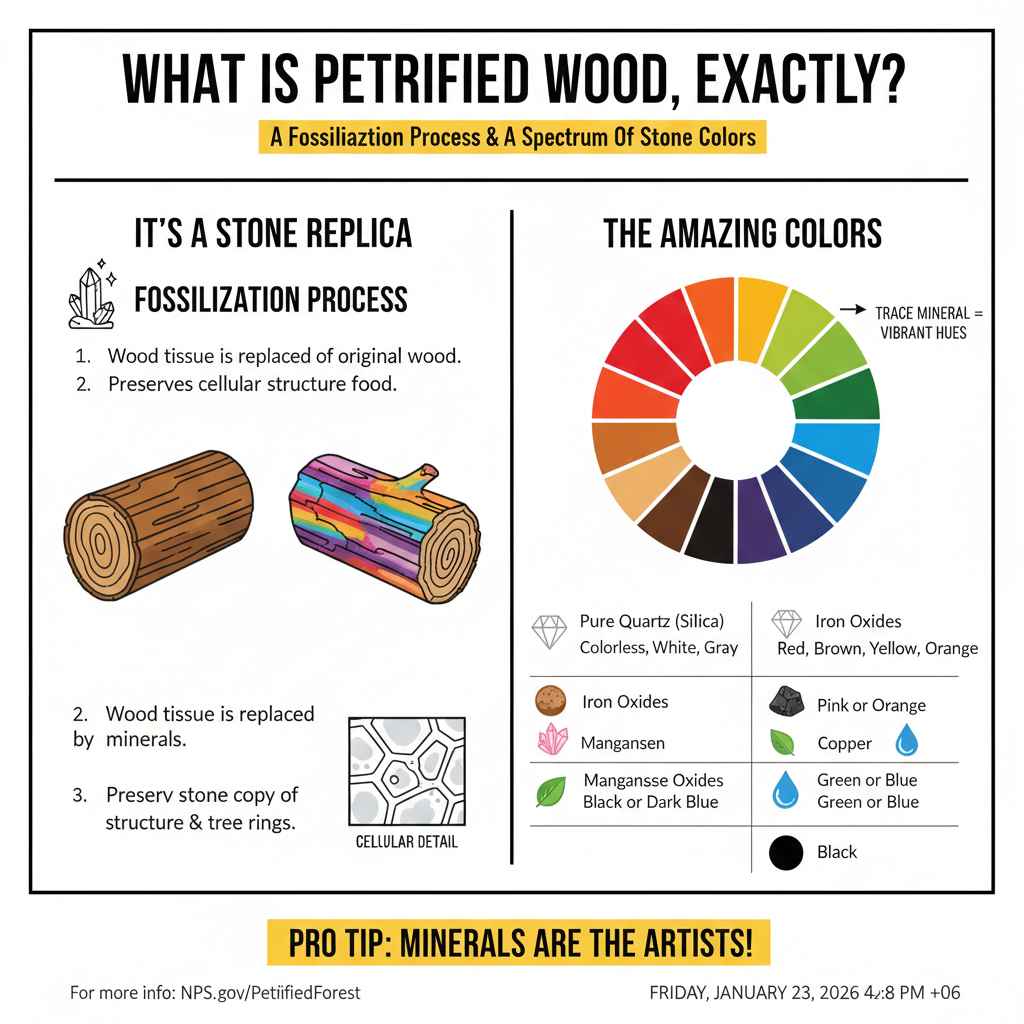
But it’s not like a magical transformation. Instead, it’s a replacement process. The original wood tissue does not become rock. Instead, every tiny part of the wood—the cell walls, the fibers, the growth rings—is replaced by minerals. This creates a perfect stone replica of the original piece of wood. It’s so precise that scientists can often identify the exact species of the ancient tree just by looking at the stone version of its cellular structure.
The Amazing Colors of Petrified Wood
One of the most beautiful things about petrified wood is its vibrant colors. These colors are not from the original tree. They come from the trace minerals that were in the water that seeped through the wood during the petrification process. Different minerals create different colors.
| Mineral | Resulting Color |
|---|---|
| Pure Quartz (Silica) | Colorless, white, or gray |
| Iron Oxides | Red, brown, yellow, and orange |
| Manganese | Pink or orange |
| Manganese Oxides | Black or dark blue |
| Copper | Green or blue |
| Cobalt | Green or blue |
| Carbon | Black |
The Step-by-Step Process of Petrification
For wood to petrify, a series of lucky events must happen in the right order. It’s a bit like baking a very, very slow cake. If you miss an ingredient or get the temperature wrong, it won’t work. This is why petrified wood is relatively rare.
The scientific name for this process is permineralization. Here’s how it works, step by step:
- A Tree Must Be Buried Quickly: A tree falls or is knocked down by a natural event like a flood or volcanic eruption. To become petrified, it must be buried very quickly under layers of sediment, like mud, silt, sand, or volcanic ash.
- Oxygen Must Be Cut Off: This rapid burial is the most important step. It seals the wood off from oxygen. Without oxygen, the bacteria and fungi that cause wood to rot and decay cannot survive. The wood is preserved instead of decomposing.
- Mineral-Rich Water Must Flow Through: Over a very long time, groundwater begins to seep through the layers of sediment and into the buried wood. This water must be rich in dissolved minerals. The most common mineral involved is silica, which is dissolved from volcanic ash.
- The Slow Replacement Begins: As the water flows through the wood, it slowly dissolves the original organic material of the wood (the cellulose and lignin). As each tiny molecule of wood dissolves, a molecule of a mineral is left in its place.
- A Perfect Copy is Made: This molecule-by-molecule exchange happens so slowly and precisely that it preserves the wood’s original structure. The growth rings, the cell walls, and even the damage from ancient insects can be perfectly copied in stone.
- Time, Time, and More Time: This process continues for millions of years until all the organic material is gone and replaced by minerals, usually a type of quartz called chalcedony. The wood is now a fossil—a piece of petrified wood.
The Four Key Ingredients for Petrification
Think of petrification as a recipe with four essential ingredients. You need all of them for the process to succeed. If even one is missing, the wood will simply turn back into soil.
- Wood: This is the starting point. You need a fallen tree or piece of wood to serve as the template for the fossil.
- Water: This is the delivery service. Water carries the dissolved minerals into the wood and carries away the decaying organic material.
- The Right Sediments (and a Lack of Oxygen): The wood must be buried in something that protects it from oxygen. Volcanic ash is ideal because it’s fine-grained and very rich in silica, the primary mineral needed for petrification. Mudflows and swampy deltas also work well.
- An Immense Amount of Time: There are no shortcuts in nature. The slow, gradual replacement process is what allows for the incredible detail seen in petrified wood. This is a process that unfolds over millions of years, not thousands.
Can We Make Petrified Wood in a Lab?
This is a great question! With our modern technology, can we speed up this millions-of-years process? The answer is yes, but it’s not quite the same as what nature produces.
Scientists at the Pacific Northwest National Laboratory (PNNL) have developed a process to create a ceramic material that mimics petrified wood in a matter of days. The process involves soaking small pieces of wood in an acid solution, then a silica solution, and then baking it in a high-temperature argon-filled furnace. The result is a silicon carbide ceramic that has replicated the wood’s microscopic structure.
However, this lab-created material is not the same as natural petrified wood. Natural petrified wood is made of silica dioxide (quartz), while this lab-made version is silicon carbide, a very different and man-made material. So while we can create a fast copy, we can’t yet replicate nature’s beautiful, slow, and colorful artistry.
Where Can You Find Petrified Wood?
Petrified wood can be found all over the world, but there are a few places that are famous for their vast and colorful deposits. These locations had the perfect conditions for petrification millions of years ago—usually a combination of lush forests and active volcanoes.
Famous Petrified Wood Hotspots
| Location | Country | Notable Features |
|---|---|---|
| Petrified Forest National Park | USA (Arizona) | Home to one of the largest concentrations of colorful petrified wood in the world. As an official U.S. National Park, strict rules apply. According to the National Park Service, collecting any petrified wood from inside the park is illegal and strictly enforced. |
| Ginkgo Petrified Forest State Park | USA (Washington) | Known for its rare specimens of petrified ginkgo trees, which were buried in ancient lava flows. |
| Lesvos Petrified Forest | Greece | A UNESCO World Heritage site where entire petrified tree trunks are found still standing upright, buried by volcanic ash 20 million years ago. |
| Jaramillo Petrified Forest | Argentina | Features massive petrified conifer trees, some reaching over 30 meters (100 feet) in length. |
| Yellowstone National Park | USA (Wyoming) | Contains dozens of layers of petrified forests on Specimen Ridge, buried by successive volcanic eruptions. |
How to Tell if You’ve Found Petrified Wood
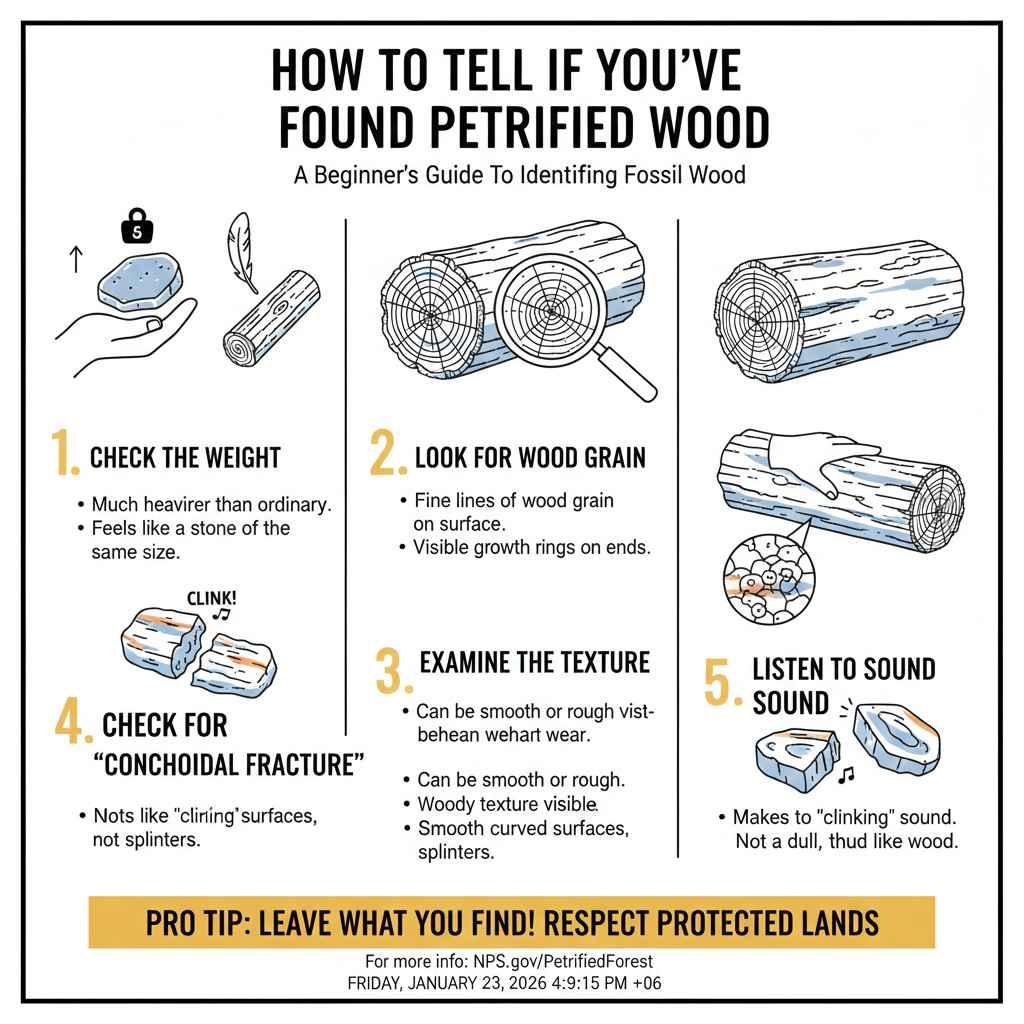
Imagine you’re out on a hike and you find a rock that looks suspiciously like a piece of wood. How can you tell if it’s the real deal? Here are a few simple tips for beginners:
- Check the Weight: Petrified wood is a rock, so it will be much heavier than a piece of ordinary wood of the same size. If it feels as heavy as a stone, that’s a good first clue.
- Look for Wood Grain: This is the biggest giveaway. Look closely at the surface. Can you see the fine lines of wood grain? Can you see growth rings on the end, just like a tree stump? This level of detail is a hallmark of petrified wood.
- Examine the Texture: The surface might be smooth and polished if it’s been in a river, or it could be rough. But you should still be able to see the woody texture underneath any surface wear.
- Check for a “Conchoidal Fracture”: This is a fancy term for how a stone-like material breaks. If the piece is broken, look for smooth, curved surfaces, similar to how thick glass or flint breaks. Wood splinters when it breaks; petrified wood fractures like a rock.
- Listen to the Sound: Gently tap it with another rock (if you can do so without damaging it). It should make a “clinking” sound, like two stones hitting each other, not the dull “thud” of wood.
Remember, always be respectful of the land where you are searching. Public lands like National Parks and Monuments forbid the collection of any natural materials. On other public lands (like Bureau of Land Management land), there may be rules about how much you can collect. Always check local regulations before removing anything.
Frequently Asked Questions (FAQ)
1. Is petrified wood still actually wood?
No, it is not. Although it looks exactly like wood, all of the original organic material has been replaced by minerals. It is a stone fossil that is a perfect replica of the original wood, right down to the microscopic cell structure.
2. Can any type of tree become petrified?
Yes, any type of woody plant can become petrified if the conditions are absolutely perfect. Scientists have found petrified examples of everything from massive conifers and hardwoods to smaller ferns and palms.
3. Is petrified wood valuable?
The value of petrified wood depends on several factors, including its size, color, completeness, and the detail of its preservation. A small, gray piece might be very common, while a large log with vibrant rainbow colors and perfectly preserved bark can be extremely rare and valuable.
4. Why can’t I collect petrified wood from a National Park?
National Parks are protected areas created to preserve natural and cultural resources for everyone to enjoy. If every visitor took a piece of petrified wood, there would be none left for future generations to see. The rules are in place to protect these amazing outdoor museums.
5. How hard is petrified wood?
Petrified wood is very hard. Since it is mostly composed of quartz, it has a hardness of about 7 on the Mohs hardness scale. For comparison, steel is about a 4.5, and a diamond is a 10. This hardness is why it can be polished to a beautiful, glass-like shine.
6. Can I petrify wood in my backyard?
Unfortunately, no. The conditions required—no oxygen, high pressure from burial, and a constant flow of mineral-rich water over millions of years—are impossible to recreate at home. The wood would simply rot away in a matter of months or years.
7. What is the difference between petrified wood and fossilized wood?
This is a great question! “Fossilized wood” is a broad term for any ancient wood that has been preserved. Petrification is one specific, and very common, type of fossilization. Other types include wood preserved in amber (tree sap) or wood that has left an impression (a mold or cast) in sediment after rotting away.
Conclusion: A Story Written in Stone
So, how long does it take for wood to become petrified? The truth is, it takes an astonishing amount of time—millions of years—and a perfect storm of geological conditions. It’s a testament to the slow, powerful, and artistic forces of our planet. It’s not a process of change but a process of complete replacement, where rock takes the form of wood so perfectly that it tells the story of a tree that lived millions of years ago.
The next time you see or hold a piece of petrified wood, take a moment to appreciate its incredible journey. You’re not just holding a beautiful rock; you are holding a piece of ancient history, a snapshot of a long-lost forest, and a true natural wonder. Keep exploring, stay curious, and enjoy the amazing world around you!