How Many Self-Closing Hinges Per Door Do You Need
Figuring out how many self-closing hinges you need for a door can seem tricky when you’re just starting out. You want to make sure your door closes smoothly and safely, but the exact number might not be obvious. Don’t worry, it’s simpler than it sounds.
We’ll walk you through it step-by-step so you know exactly what to do. Let’s get your doors working perfectly.
Determining the Right Number Of Self-Closing Hinges
Deciding how many self-closing hinges are needed for a door involves understanding the door’s weight, size, and how reliably you want it to close. Self-closing hinges, often called automatic door closers or spring hinges, are designed to return a door to its closed position automatically. This is useful for fire safety, privacy, and convenience.
The primary factor is always the door’s weight. A heavier door requires more robust or more numerous hinges to ensure it closes properly without slamming or failing to latch. Understanding this basic principle is the first step in correctly outfitting your doors.
Door Weight And Its Impact
The weight of a door is the most critical factor in determining the number and type of self-closing hinges required. Doors come in various materials, such as solid wood, hollow core, glass, or metal, each with a different weight. A standard interior hollow core door is much lighter than a solid oak door.
Exceeding the hinge’s weight rating can lead to improper door closure, excessive wear and tear on the hinges and frame, and even hinge failure. It’s essential to consult the manufacturer’s specifications for the hinges to match them with the door’s weight capacity. This ensures safety and longevity for the entire door system.
- Understanding Door Materials
- Estimating Door Weight
- Manufacturer Specifications
Different materials affect a door’s weight significantly. Solid wood doors, especially hardwoods like oak or maple, are considerably heavier than hollow core doors, which have a lighter, often cardboard-like, internal structure. Metal doors, often used in commercial settings or for exterior entry, can also be quite heavy.
Knowing the material helps estimate the weight.
For a rough estimate, a standard interior hollow core door might weigh between 15-30 pounds. A solid interior wood door can range from 30-60 pounds or more. Exterior doors, particularly solid wood or metal ones, can weigh 50-100 pounds or even higher, especially with features like glass panels.
Always check the product packaging or the manufacturer’s website for the maximum weight capacity of the self-closing hinges. This information is vital for selecting the correct hinges. For example, a hinge rated for 50 pounds may not be sufficient for a heavy solid wood door.
Types Of Self-Closing Hinges
There are several types of self-closing hinges, each with its own mechanism and application. The most common are spring hinges and door closers. Spring hinges are simple and often used for interior doors, providing a moderate closing force.
Door closers, which are usually mounted on the surface of the door or frame, offer more control over the closing speed and force, making them suitable for heavier doors or where fire safety regulations apply. Understanding these differences helps in choosing the right solution for your needs.
Spring Hinges
Spring hinges are a popular choice for interior doors where a gentle closing action is desired. They contain a coil spring that, when the door is opened, is compressed. As the door swings shut, the spring expands, pulling the door closed.
These hinges are often used in pairs and are generally easy to install, resembling standard door hinges but with an added spring mechanism. They are best suited for lighter doors and do not offer adjustable closing speeds.
Surface-Mounted Door Closers
Surface-mounted door closers are more heavy-duty devices that attach to the surface of the door and frame. They typically consist of a hydraulic or pneumatic cylinder with a spring mechanism. These closers provide significant control over the closing speed, allowing you to adjust how quickly or slowly the door closes.
They are often required for fire doors to ensure they close properly in case of a fire, preventing smoke and flames from spreading. Their robustness makes them suitable for heavier doors and high-traffic areas.
Concealed Door Closers
Concealed door closers are designed to be hidden within the door or the frame, offering a more aesthetically pleasing solution. While they provide similar functionality to surface-mounted closers, their installation is more complex. They are often used in commercial buildings and high-end residential properties where appearance is a priority.
Like surface-mounted closers, they offer adjustable closing speeds and forces.
How Many Hinges Are Standard?
For most standard interior and exterior doors, three hinges are the typical installation. This provides ample support for the door’s weight and ensures it hangs straight. However, when you introduce self-closing functionality, especially with heavier doors, you might need to consider more than just the standard three.
The goal is to maintain stability and proper function over time.
Standard Door Hinge Count
A typical door installation usually involves three hinges. This number is based on distributing the door’s weight evenly across the frame. For standard interior doors that are not exceptionally heavy, three hinges are often sufficient to keep the door aligned and prevent sagging over time.
This has been a long-standing practice in door installation for a good reason: it works well for most common scenarios.
When More Hinges Are Needed
If a door is particularly heavy, such as a solid wood door or a door with glass panels, four or even five hinges might be necessary to provide adequate support. This is especially true if the door is taller than average or subject to frequent use. Adding an extra hinge helps to spread the load more effectively, preventing the door from warping or the frame from being stressed excessively.
Calculating The Required Number Of Self-Closing Hinges
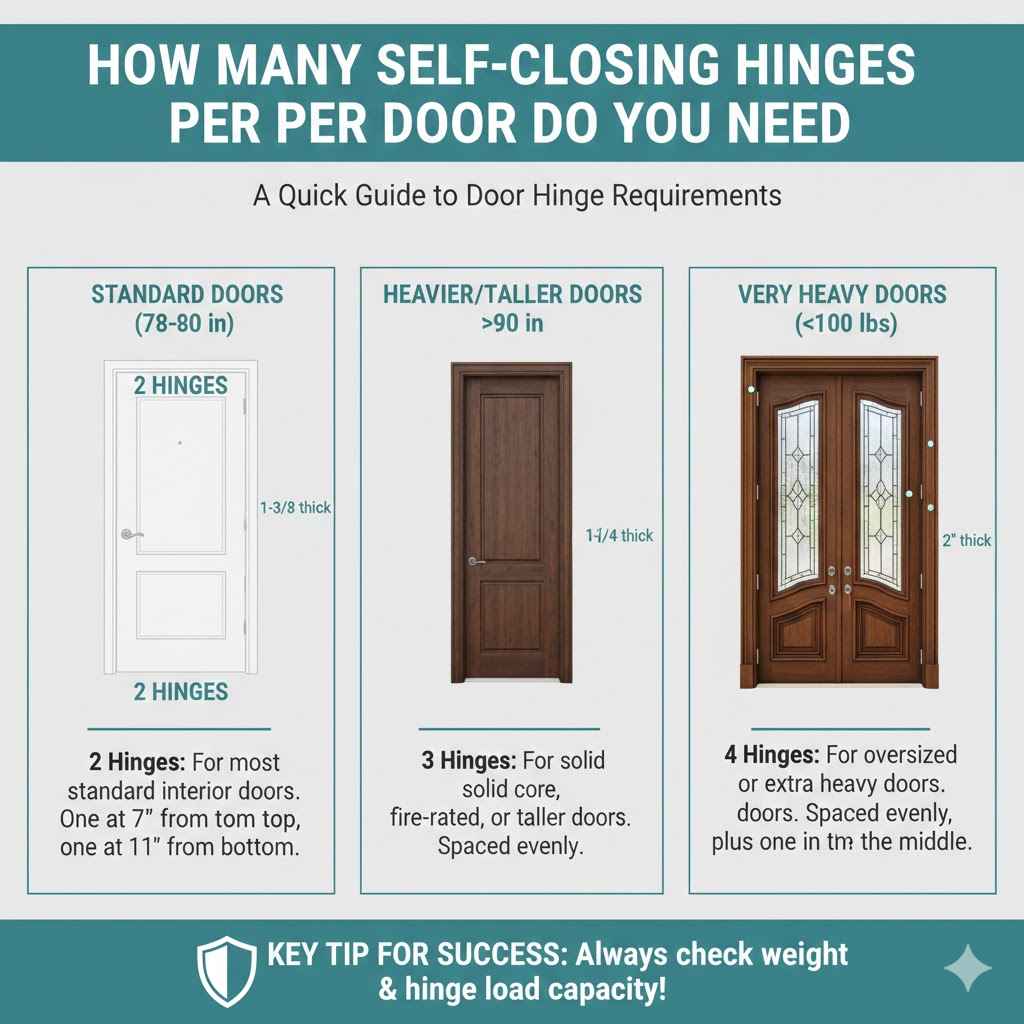
Now, let’s get to the core question: How Many Self-Closing Hinges Per Door Do You Need? The answer is not a simple one-size-fits-all. It depends on the factors we’ve discussed. For lighter interior doors, you might get away with two or three self-closing hinges, similar to standard hinges.
However, for heavier doors or those requiring stricter closure, you’ll need to pay close attention to the weight ratings and potentially use more hinges or a stronger door closer mechanism.
Lightweight Interior Doors
For lightweight interior doors, such as hollow core doors used in bedrooms or closets, two or three self-closing spring hinges might suffice. These hinges are designed to provide a gentle closing action without being overly forceful. The key here is that the hinges must be rated to handle the door’s weight.
A common scenario is using two self-closing hinges on a lighter door where one hinge is a standard, non-closing hinge for added stability, and two are self-closing for the desired function.
Medium Weight Doors
For medium-weight doors, like solid core interior doors or lighter exterior doors, three self-closing hinges are often recommended. This provides sufficient strength and closing power. If using spring hinges, ensure they are rated for the door’s weight.
For a more controlled close, a light-duty door closer might be integrated with standard hinges, or all three could be self-closing spring hinges.
Heavy Duty Doors
Heavy doors, such as solid wood exterior doors, metal doors, or large double doors, often require a dedicated door closer mechanism in addition to hinges. While you will still use hinges (typically three or four heavy-duty standard hinges), the self-closing function is primarily managed by the closer. Some heavy-duty self-closing hinges exist, but they are less common than the combined hinge and closer system for significant weight.
Installation Considerations
Proper installation is as crucial as choosing the right number of hinges. Incorrect placement or adjustment can lead to doors that don’t close properly, slam shut, or wear out prematurely. Always follow the manufacturer’s instructions for your specific hinges or door closer.
Placement Of Self-Closing Hinges
Typically, self-closing hinges are installed in the same positions as standard hinges: one at the top, one in the middle, and one at the bottom of the door. For heavier doors or when using fewer self-closing hinges, you might place the self-closing hinges at the top and middle, with a regular hinge at the bottom for extra support. The exact placement can sometimes be adjusted based on the door and frame type to achieve the best closing action.
Adjusting Closing Speed And Force
Many self-closing hinges and door closers come with adjustment screws. These allow you to fine-tune the closing speed and the force with which the door closes. For spring hinges, the adjustment is usually made by changing the tension on the spring.
For hydraulic or pneumatic closers, specific screws control the speed of latching and closing. Proper adjustment prevents doors from slamming shut or closing too slowly, which can be a safety hazard or an inconvenience.
Maintaining Your Self-Closing Hinges
Regular maintenance can extend the life of your self-closing hinges. This can include occasional cleaning, lubrication of moving parts, and checking that all screws remain tight. For hydraulic closers, you’ll want to check for any oil leaks, which would indicate a need for repair or replacement.
Keeping the hinges clean and free of debris ensures smooth operation.
Real-Life Examples And Scenarios
Let’s look at some practical situations to solidify your understanding of how many self-closing hinges are needed.
Example 1 A Lightweight Interior Door
Consider a standard hollow core interior door leading to a guest bathroom. This door weighs about 20 pounds. You want it to close gently behind guests but not slam.
In this case, two self-closing spring hinges would be a good choice. You could place one at the top and one in the middle. A regular hinge at the bottom would provide extra stability without adding unnecessary closing force.
Example 2 A Medium-Weight Exterior Door
Imagine a solid wood exterior door for your shed. This door might weigh around 40 pounds. For this, three heavy-duty self-closing spring hinges are recommended.
These hinges are designed to handle more weight and provide a more robust closing action, ensuring the shed is securely shut against weather and pests. Ensure the hinges have a weight rating well above 40 pounds for longevity.
Example 3 A Heavy Commercial Door
For a heavy metal fire door in an office building, you’ll typically use three heavy-duty standard hinges along with a high-quality, adjustable surface-mounted door closer. While the hinges provide support, the door closer is responsible for the controlled closing function, often mandated by building codes for fire safety. The closer will have a high weight capacity and adjustable speed settings.
Common Mistakes To Avoid
When installing or selecting self-closing hinges, certain mistakes are common, especially for DIY enthusiasts. Being aware of these can save you time, frustration, and potential extra costs.
- Overlooking Door Weight
- Using Too Few Hinges
- Incorrect Adjustment
The most frequent error is not accounting for the door’s actual weight. People often assume all interior doors are the same or underestimate the heaviness of solid wood doors. This leads to installing hinges that are too weak, resulting in poor performance or early failure.
While the question is about self-closing hinges, the number of hinges in total is still critical. Using only two self-closing hinges on a door that ideally needs three can cause the door to sag, put undue stress on the frame, and compromise the effectiveness of the self-closing mechanism.
Not properly adjusting the closing speed and force is another common oversight. A door that closes too quickly can be a hazard, especially for children or the elderly. Conversely, a door that closes too slowly might not latch properly, defeating the purpose.
Frequently Asked Questions
Question: Can I use standard hinges with a separate door closer?
Answer: Yes, absolutely. For many doors, especially heavier ones or those requiring precise control, using standard, sturdy hinges in conjunction with a separate surface-mounted or concealed door closer is the most effective solution. The hinges provide structural support, while the closer manages the closing action.
Question: How do I know if my door is too heavy for self-closing spring hinges?
Answer: If your door is significantly heavy (over 50-60 pounds), made of solid hardwood, or is a large exterior door, it’s likely too heavy for most standard self-closing spring hinges. Check the weight rating on the hinge packaging. If the door feels difficult to lift or is already sagging, it’s definitely too heavy for lighter-duty self-closing options.
Question: Do I need self-closing hinges on every door?
Answer: Not necessarily. Self-closing hinges are often used for specific purposes like fire doors, doors where privacy is important (like bathrooms), or doors that you want to ensure stay closed automatically for safety or convenience. For closets or rooms where manual closing is fine, standard hinges are perfectly adequate.
Question: Can I install self-closing hinges myself?
Answer: Yes, installing self-closing spring hinges is generally a DIY-friendly task, similar to installing regular hinges. However, installing separate door closer mechanisms can be more complex and may require specific tools and a bit more mechanical know-how. Always follow the manufacturer’s instructions carefully.
Question: What happens if I use too many self-closing hinges?
Answer: Using too many self-closing hinges, especially if they are all high-tension spring hinges on a lighter door, can make the door difficult to open and could cause excessive wear on the hinges and the frame. It can also lead to the door closing too forcefully. It’s best to stick to the recommended number based on door weight and desired function.
Summary
When deciding how many self-closing hinges per door you need, focus on the door’s weight and the desired closing action. For light interior doors, two or three self-closing spring hinges may work. Heavier doors often benefit from three heavy-duty hinges plus a dedicated door closer.
Always check hinge weight ratings and follow installation guidelines for a secure, functional door.