How to Calculate Annual Light Fixture Price: Proven Savings
Quick Summary:
Calculating your annual light fixture cost is simple! It involves tracking initial purchase price, expected lifespan, and energy consumption. By understanding these factors, you can make informed choices to significantly reduce your lighting expenses year after year.
Hey there, DIY renovators and home improvement enthusiasts! Md Meraj here, your friendly guide to making your home projects both successful and budget-friendly. Ever looked up at your light fixtures and wondered about the real cost beyond the sticker price? It’s a common question, especially when you’re looking to trim down those monthly bills. The good news is, figuring out the annual price of your light fixtures isn’t complicated. We’ll break it down together, step-by-step, so you can see exactly where your money goes and, more importantly, how to save it. Get ready to shine a light on smart savings!
Understanding the True Cost of Light Fixtures
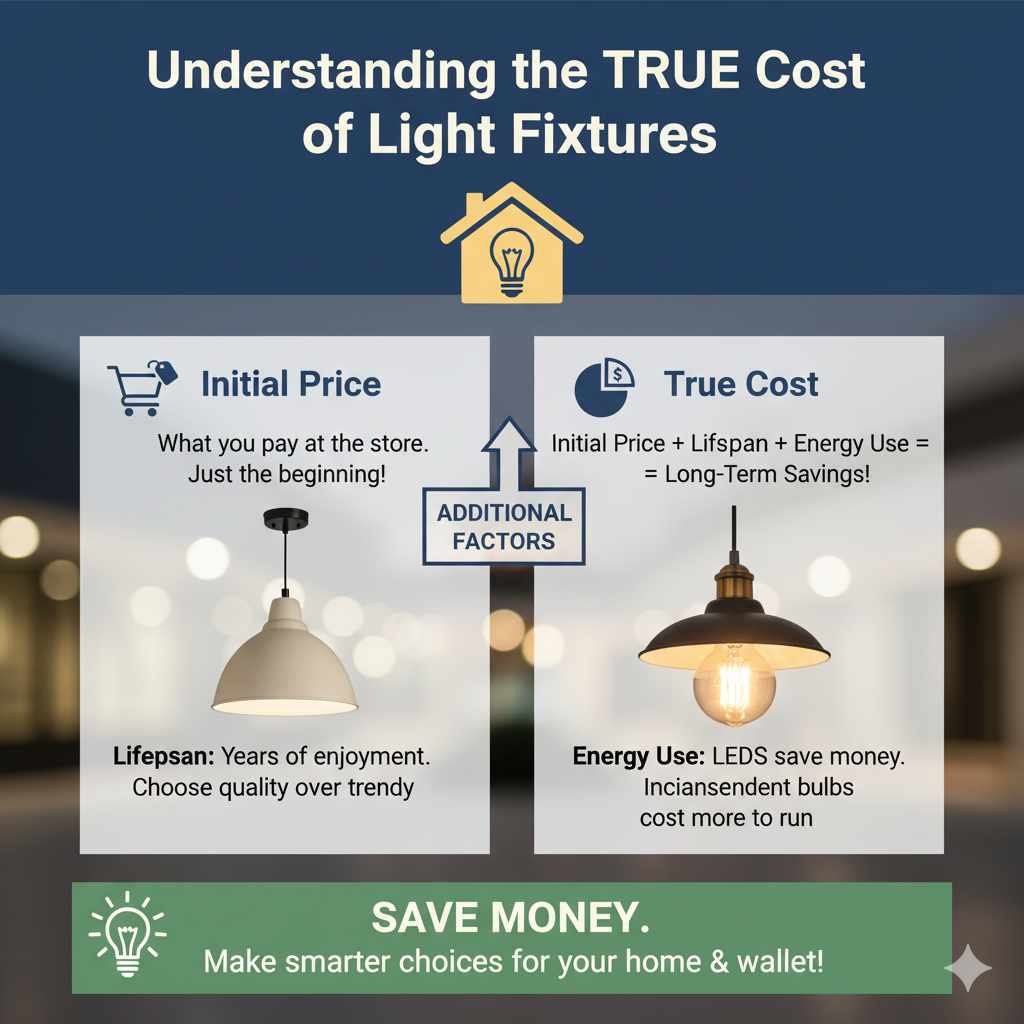
When we think about the cost of a light fixture, most of us immediately picture the price tag at the store. But as homeowners who love to get hands-on, we know there’s more to it. The initial purchase price is just the beginning. We also need to consider how long that fixture will last and how much energy it uses to keep our homes bright. Thinking about these elements together gives us the “true cost,” and understanding this is the first big step towards saving money.
Let’s imagine you’re picking out a new pendant light for your kitchen. You might fall in love with its design, and that’s great! But before you buy, let’s think about its lifespan. Will it be a fixture you love for years, or is it a trendy piece that might need replacing in a couple of seasons? And what about the light bulbs it uses? Are they energy-efficient LEDs, or older, power-hungry incandescent bulbs? These details might seem small, but they add up significantly over the course of a year.
This guide will walk you through how to calculate this annual price. We’ll cover everything from initial investment to running costs, helping you make smarter choices for your home and your wallet. By the end, you’ll feel confident in assessing the long-term value of your lighting and identifying opportunities for proven savings.
The Components of Annual Light Fixture Price
To accurately calculate the annual price of a light fixture, we need to look at three main components:
- Initial Purchase Price: This is what you pay upfront for the fixture itself.
- Lifespan (Depreciation): How long the fixture is expected to last. We’ll factor in its “wear and tear” over time.
- Energy Consumption: The cost of the electricity used by the bulbs in the fixture.
Let’s dive into each of these so you can see how they contribute to your overall lighting expenses.
1. Initial Purchase Price
This is the most straightforward part. It’s simply the price you paid for the light fixture. When you’re shopping, it’s easy to get caught up in the aesthetics, but always keep an eye on the price. Sometimes, a slightly more expensive fixture might offer better quality or energy efficiency, which can save you money in the long run. Don’t shy away from looking at sales or considering fixtures from reputable brands that are known for durability.
2. Lifespan and Depreciation
Light fixtures, especially those made from quality materials, are designed to last for many years. However, nothing lasts forever. We can think of the initial purchase price as an investment that gets “used up” over its lifespan. This is often referred to as depreciation. By dividing the initial cost by the estimated number of years the fixture will last, we can determine its annual cost due to wear and tear.
How to Estimate Lifespan:
- Quality of Materials: Fixtures made from solid metal, high-quality glass, or durable plastics tend to last longer than cheaper, flimsier options.
- Manufacturer’s Warranty: A longer warranty often indicates the manufacturer’s confidence in the product’s durability.
- General Estimates: For most indoor residential fixtures, a lifespan of 15-25 years is a reasonable estimate if well-maintained. Outdoor fixtures might have a shorter lifespan due to exposure to elements.
- Check Reviews: Online reviews can sometimes provide insights into how long a fixture has lasted for other users.
For example, if you buy a beautiful chandelier for $300 and expect it to last for 20 years, its annual cost from depreciation is $300 / 20 years = $15 per year.
3. Energy Consumption (Bulb Costs)
This is where you can often see the most significant savings. The type of light bulbs you use has a huge impact on your electricity bill. Here’s how to break it down:
- Bulb Wattage: This tells you how much power the bulb uses.
- Hours of Use: How many hours per day the light is typically on.
- Electricity Cost: The price you pay per kilowatt-hour (kWh) from your utility company.
Calculating Annual Bulb Cost:
- Find the Wattage: Look at the bulb itself or its packaging.
- Convert to Kilowatts: Divide the wattage by 1000 (e.g., a 60-watt bulb is 0.06 kW).
- Calculate Daily Energy Use: Multiply the kilowatts by the average hours the light is on per day.
- Calculate Annual Energy Use: Multiply the daily energy use by 365 days.
- Calculate Annual Cost: Multiply the annual energy use by your electricity rate (cost per kWh).
Let’s use an example: Suppose you have a fixture with three 60-watt incandescent bulbs that are on for 4 hours a day, and your electricity costs $0.15 per kWh.
- Total Wattage: 3 bulbs 60 watts/bulb = 180 watts
- Kilowatts: 180 watts / 1000 = 0.18 kW
- Daily Energy Use: 0.18 kW 4 hours/day = 0.72 kWh/day
- Annual Energy Use: 0.72 kWh/day 365 days/year = 262.8 kWh/year
- Annual Bulb Cost: 262.8 kWh/year $0.15/kWh = $39.42 per year
Now, imagine you switched those to three 10-watt LED bulbs. The calculation would be:
- Total Wattage: 3 bulbs 10 watts/bulb = 30 watts
- Kilowatts: 30 watts / 1000 = 0.03 kW
- Daily Energy Use: 0.03 kW 4 hours/day = 0.12 kWh/day
- Annual Energy Use: 0.12 kWh/day 365 days/year = 43.8 kWh/year
- Annual Bulb Cost: 43.8 kWh/year $0.15/kWh = $6.57 per year
That’s a huge saving of over $30 per year, just by switching bulbs in one fixture! Over many fixtures and years, this adds up dramatically.
Putting It All Together: The Annual Price Formula
Now that we understand the components, we can create a simple formula to calculate the total annual price of a light fixture.
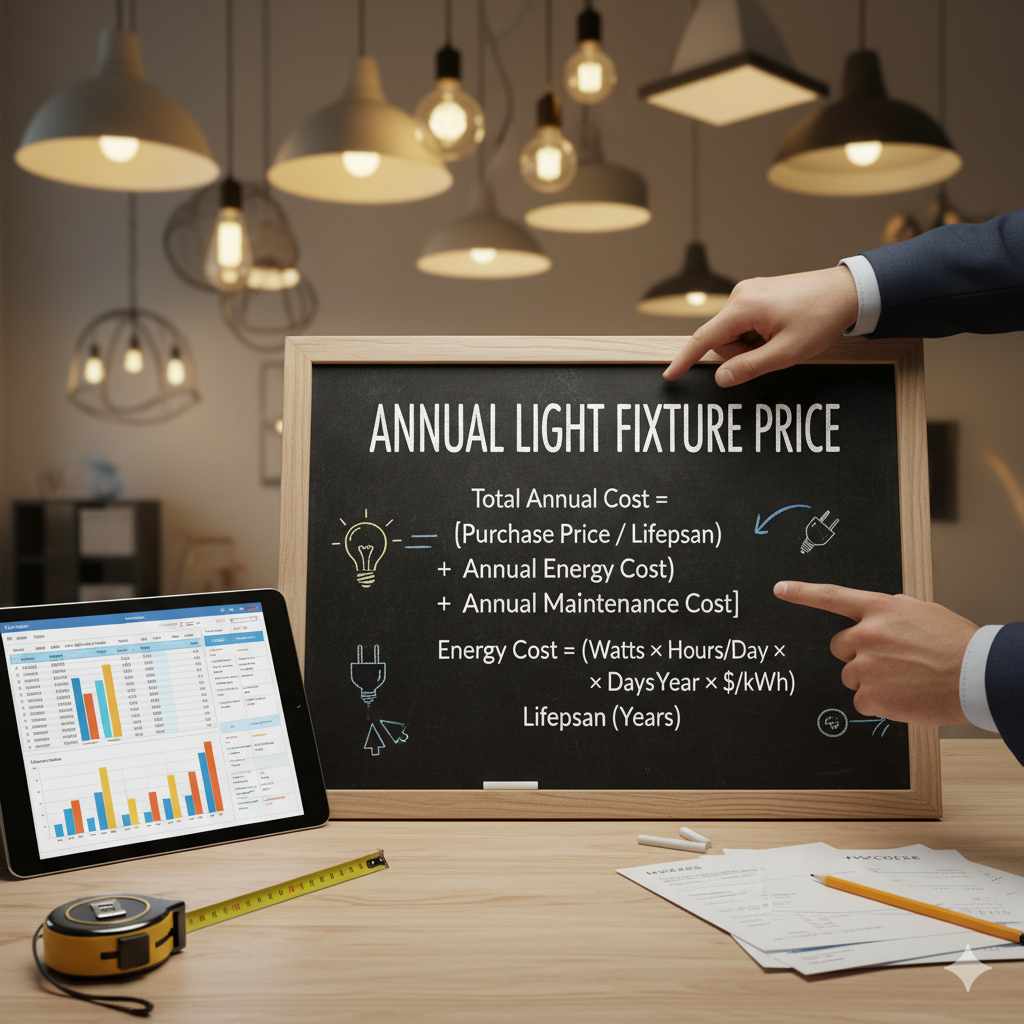
Annual Light Fixture Price = (Initial Purchase Price / Estimated Lifespan in Years) + (Annual Bulb Cost)
Let’s revisit our chandelier example. Assume the chandelier cost $300, is expected to last 20 years, and uses LED bulbs that cost $10 per year to run (as calculated above).
- Depreciation Cost per Year: $300 / 20 years = $15
- Annual Bulb Cost: $10
- Total Annual Light Fixture Price: $15 + $10 = $25 per year
This $25 represents the total cost of having that chandelier in your home for one year, considering its initial investment and its running cost. It’s a much more realistic view than just the $300 purchase price.
Calculating Annual Light Fixture Price: Step-by-Step Guide
Ready to crunch some numbers for your own home? Follow these steps to calculate the annual price for your light fixtures.
Step 1: Gather Information for Each Fixture
For every light fixture you want to analyze, you’ll need to collect the following:
- Fixture Name/Location: (e.g., “Living Room Chandelier,” “Kitchen Pendant Light”)
- Initial Purchase Price: The amount you paid for the fixture. If it was a gift or came with the house, you might need to estimate a fair market value or skip this part and focus on running costs.
- Estimated Lifespan (Years): Your best guess for how long the fixture will last.
- Number of Bulbs: How many bulbs the fixture holds.
- Wattage Per Bulb: The power consumption of each bulb.
- Average Daily Usage (Hours): How many hours per day the light is typically on.
- Your Electricity Rate ($/kWh): Check your latest utility bill or your provider’s website.
Step 2: Calculate Annual Depreciation Cost
If you have the initial purchase price and estimated lifespan, calculate this:
Annual Depreciation Cost = Initial Purchase Price / Estimated Lifespan (Years)
Step 3: Calculate Annual Bulb Cost
This involves a few sub-steps:
- Total Wattage: Number of Bulbs × Wattage Per Bulb
- Kilowatts (kW): Total Wattage / 1000
- Daily Energy Use (kWh): Kilowatts × Average Daily Usage (Hours)
- Annual Energy Use (kWh): Daily Energy Use × 365
- Annual Bulb Cost: Annual Energy Use × Your Electricity Rate ($/kWh)
Step 4: Calculate Total Annual Light Fixture Price
Add the results from Step 2 and Step 3:
Total Annual Light Fixture Price = Annual Depreciation Cost + Annual Bulb Cost
Step 5: Repeat for All Fixtures and Analyze
Go through this process for all the light fixtures in your home, or for a specific area you want to focus on. Once you have the annual price for each, you can start to see where your biggest costs are.
Example Calculation Table
To make this even clearer, let’s look at a comparison of two different fixtures in a hypothetical home. Assume the electricity rate is $0.12 per kWh.
| Fixture Description | Initial Purchase Price | Estimated Lifespan (Years) | Annual Depreciation Cost | Number of Bulbs | Wattage Per Bulb | Total Wattage (W) | Kilowatts (kW) | Daily Usage (Hours) | Annual Energy Use (kWh) | Annual Bulb Cost | Total Annual Price |
|---|---|---|---|---|---|---|---|---|---|---|---|
| Living Room Chandelier (LED) | $200 | 15 | $13.33 | 5 | 10W | 50W | 0.05 kW | 3 | 54.75 kWh | $6.57 | $19.90 |
| Kitchen Incandescent Pendant | $150 | 10 | $15.00 | 3 | 75W | 225W | 0.225 kW | 5 | 410.63 kWh | $49.28 | $64.28 |
As you can see from this table, even though the kitchen pendant was cheaper initially, its higher energy consumption makes its total annual cost significantly higher than the living room chandelier. This kind of comparison is incredibly powerful for making smart upgrades.
Proven Savings Strategies: Beyond the Calculation
Now that you know how to calculate the annual price, let’s talk about how to actively reduce it. These strategies leverage your understanding of the components we’ve discussed.
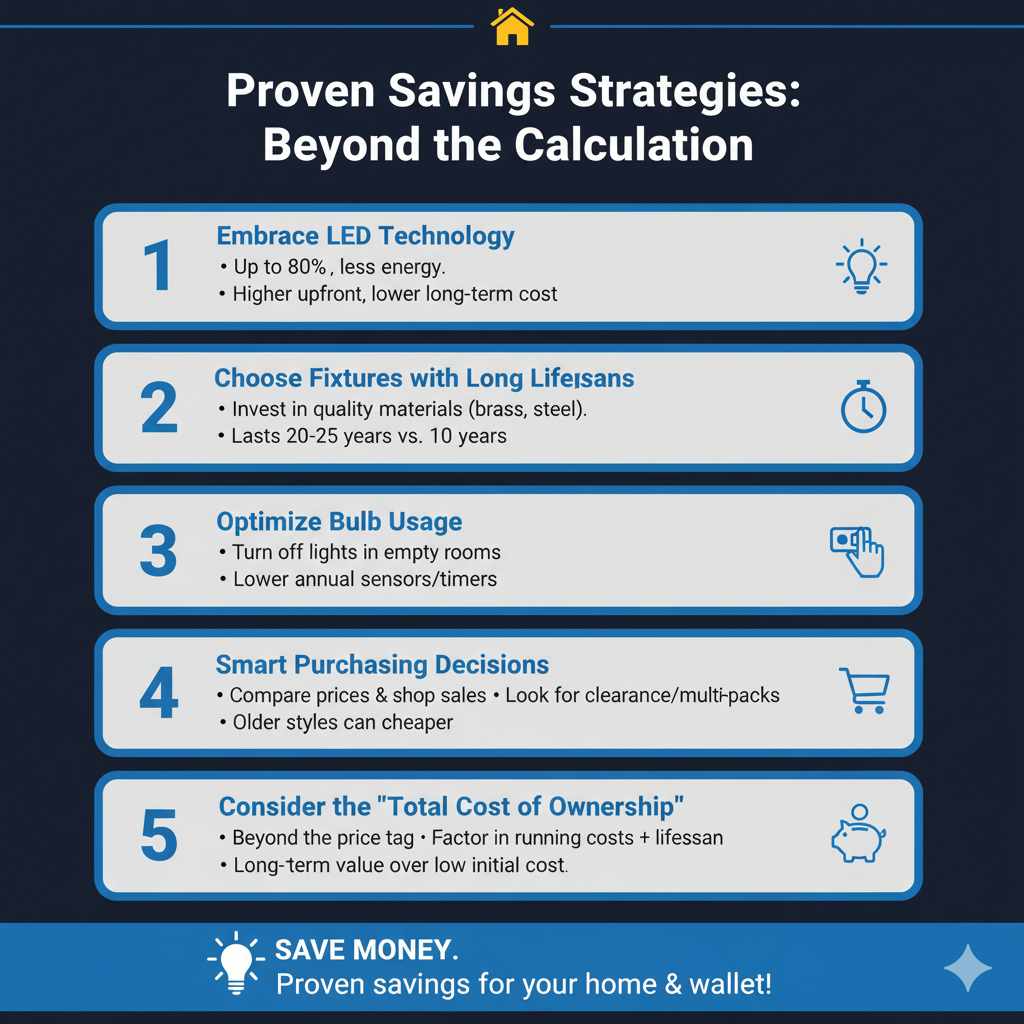
1. Embrace LED Technology
This is the single most impactful way to save money on lighting. LEDs (Light Emitting Diodes) use up to 80% less energy than traditional incandescent bulbs and last much longer. While the upfront cost of an LED bulb might be slightly higher, its drastically lower energy consumption and extended lifespan mean you’ll save a bundle over time. For instance, a typical LED bulb can last 15,000 to 25,000 hours, compared to about 1,000 hours for an incandescent bulb. Check out resources like the U.S. Department of Energy’s Energy Saver website for more on efficient lighting choices.
2. Choose Fixtures with Long Lifespans
When buying new fixtures, invest in quality. A well-made fixture from a reputable brand might cost more upfront, but if it lasts 20-25 years instead of 10, its annual depreciation cost will be lower. Look for fixtures made from durable materials like solid brass, steel, or aluminum, and check for good craftsmanship. This is where your woodworking skills might even come in handy if you’re considering custom or refurbished pieces!
3. Optimize Bulb Usage
Simply turning off lights when you leave a room makes a difference. For fixtures that are on for extended periods, consider installing dimmer switches. Dimmers not only allow you to adjust the ambiance but also reduce energy consumption when lights are not at full brightness. For outdoor security lights or areas where lights are often left on out of habit, consider motion sensors or timers.
4. Smart Purchasing Decisions
Don’t be afraid to shop around. Compare prices for similar fixtures and bulbs from different retailers. Look for sales, clearance items, or consider buying multi-packs of LED bulbs, which often offer a lower per-unit cost. Sometimes, slightly older but still functional fixture styles can be found at a deep discount.
5. Consider the “Total Cost of Ownership”
When you’re making a purchasing decision, think beyond the immediate price tag. A fixture that costs $100 and lasts 5 years with high energy usage might end up costing you more annually than a $200 fixture that lasts 20 years and uses efficient LED bulbs. Always factor in the running costs and lifespan.
Frequently Asked Questions (FAQ)
Q1: Do I really need to calculate this for every single light fixture?
A: Not necessarily! For the biggest impact, focus on the fixtures that are used most often (like living room, kitchen, or porch lights) or those with older, less efficient bulbs. If a fixture is rarely used or has a very low wattage bulb, its annual cost will be minimal, and you might not need to calculate it.
Q2: What if I don’t know the exact lifespan of my fixture?
A: It’s okay to estimate! For most indoor fixtures made of metal and glass, 15-25 years is a good general range. For plastic fixtures or those in harsh environments (like bathrooms with high humidity or outdoor areas), you might estimate 10-15 years. The goal is to get a reasonable approximation.
Q3: How do I find my electricity rate ($/kWh)?
A: Your electricity rate is usually listed on your monthly utility bill. Look for a section that details your energy usage and the cost per kilowatt-hour. If you can’t find it on your bill, you can typically find it on your utility provider’s website or by calling their customer service.
Q4: Are smart bulbs worth the extra cost?
A: Smart bulbs offer convenience (like controlling lights with your phone or voice) and can often be programmed for energy-saving routines. While they might have a higher initial cost, their LED technology is very energy-efficient, and the added features can lead to further savings by ensuring lights aren’t left on unnecessarily. For many, the convenience and potential savings make them a worthwhile investment.
Q5: How often should I replace my light bulbs?
A: With LED bulbs, you’ll rarely need to replace them. They can last for 15-25 years with typical household use. Incandescent bulbs need replacing much more frequently, often every year or two. The key is to switch to LEDs to minimize replacement frequency and cost.
Q6: Does the material of the light fixture affect its annual price?
A: Yes, indirectly! While the material itself doesn’t consume energy, it significantly impacts the fixture’s lifespan. Higher-quality materials like solid brass, stainless steel, or thick glass will generally lead to a longer lifespan, reducing the annual depreciation cost compared to cheaper, less durable materials that might need replacing sooner.
Q7: Can I use this calculation for outdoor lighting?
A: Absolutely! The calculation method remains the same. However, you might need to adjust the estimated lifespan downwards for outdoor fixtures, as they are exposed to weather, insects, and other elements that can reduce their durability compared to indoor fixtures. Also, consider energy efficiency for outdoor lights that run all night, like security lights.
Conclusion: Illuminating Your Savings Potential
By taking the time to calculate the annual price of your light fixtures, you’re not just crunching numbers; you’re gaining valuable insight into your home’s energy usage and overall expenses. You’ve learned that the true cost extends far beyond the initial purchase price, encompassing the lifespan of the fixture and, most importantly, the ongoing cost of powering the bulbs.
We’ve seen how simple changes, like switching to energy-efficient LED bulbs, can lead to substantial savings year after year. By applying the formula—Annual Light Fixture Price = (Initial Purchase Price / Estimated Lifespan) + Annual Bulb Cost—you can identify which fixtures are costing you the most and where your upgrade efforts will yield the best return. This knowledge empowers you to make smarter, more economical choices for your home, ensuring that your lighting not only brightens your space but also eases your budget.
Remember, every little bit of information you gather and every smart decision you make contributes to a more efficient and cost-effective home. So, go ahead, grab your utility bill, and start calculating. You might be surprised at how much you can save. Happy renovating and happy saving!