How to Remove a Door Knob From the Outside
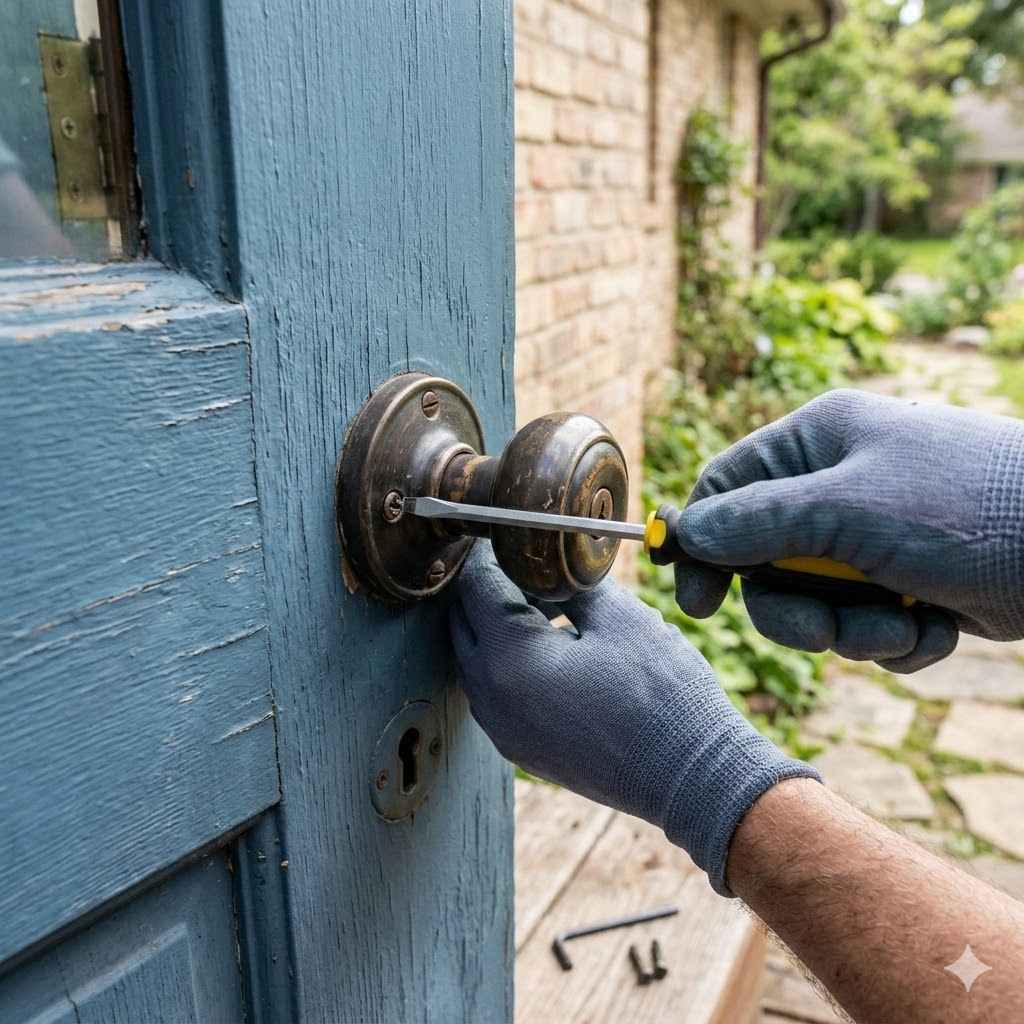
Sometimes, you might need to figure out How to Remove a Door Knob From the Outside. This can happen if a lock gets stuck, if you’re changing out old hardware, or even if you’ve misplaced the key. For folks new to DIY tasks, it might seem a little tricky at first, especially since you can’t just reach the screws from the outside.
But don’t worry! We’re going to walk through this process together with simple steps. You’ll see it’s easier than you think.
Let’s get started on how to tackle this common household fix.
Getting Started How to Remove a Door Knob From the Outside
Understanding the basic structure of a doorknob is the first step to successfully removing one from the outside. Most doorknobs are designed with a hidden mechanism that allows for a clean installation and removal. The challenge when working from the outside is accessing these internal components without the usual point of entry (the inside where screws are typically visible).
This section will cover the essential tools you’ll need and the general principles behind doorknob removal, setting the stage for the specific techniques that follow. We’ll also touch upon common doorknob types you might encounter.
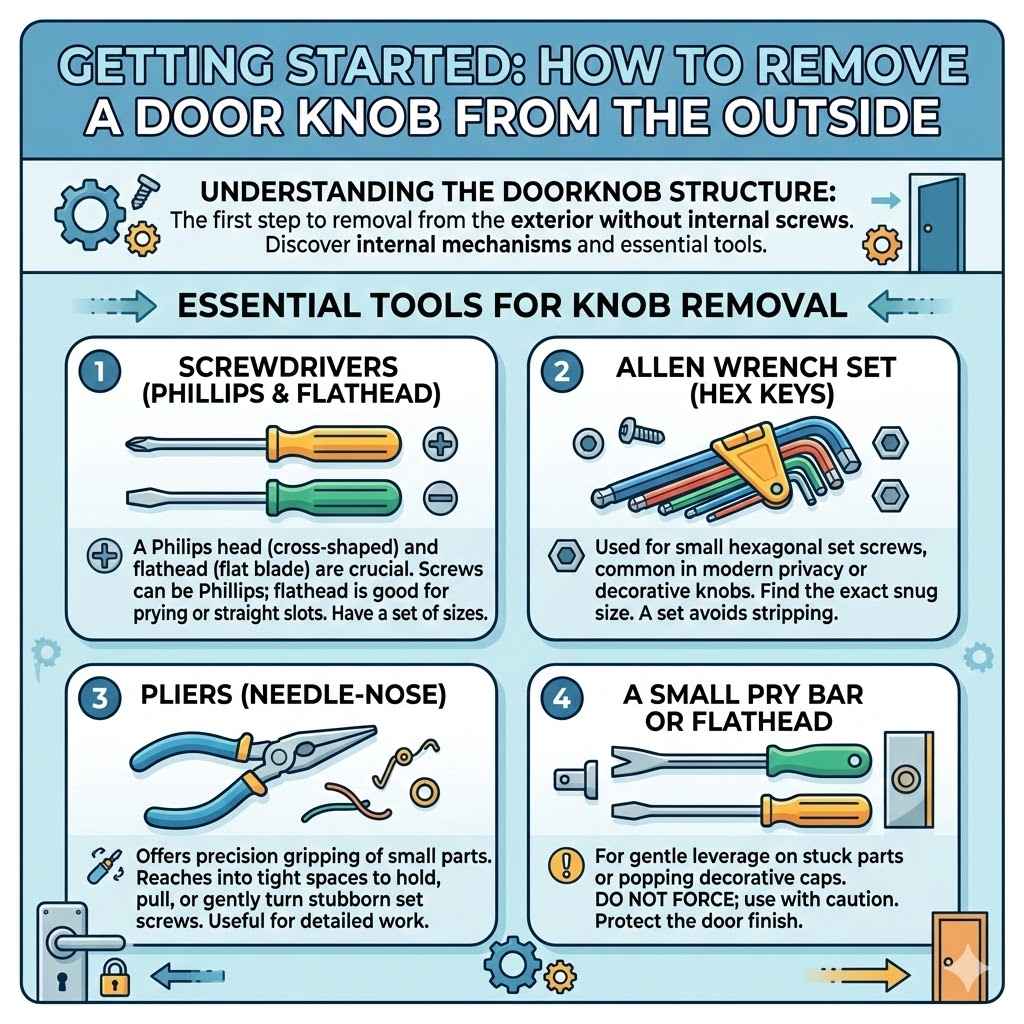
Essential Tools for Knob Removal
To effectively remove a doorknob from the outside, having the right tools makes all the difference. You don’t need a professional toolkit, just a few common household items that can help you access and release the knob. Gathering these items beforehand will streamline the process and prevent frustration.
Think of these as your essential helpers for the task at hand.
ScrewdriversYou will likely need both a Phillips head and a flathead screwdriver. The Phillips head screwdriver has a cross-shaped tip, perfect for screws with a matching indent. A flathead screwdriver, with its single, flat blade, is useful for prying or turning screws with a straight slot.
Sometimes, the screws holding a doorknob together are Phillips, while other components might require a flathead for leverage or for accessing hidden release points. Having a set with various sizes ensures you have the right fit for any screw you encounter, preventing damage to the screw head.
Allen Wrench SetMany modern doorknobs, especially those with privacy locks or decorative designs, use small, hexagonal screws or set screws. These require an Allen wrench, also known as a hex key. Allen wrenches come in a set of various sizes, usually measured in millimeters or inches.
You’ll need to find the specific size that fits snugly into the hexagonal hole on the doorknob’s spindle or base. A loose fit can strip the screw, making removal much harder. It’s wise to have a set handy, as different doorknobs use different sizes.
PliersA pair of needle-nose pliers can be invaluable. They offer precision for grasping small parts or wires, and their long, tapered jaws can reach into tight spaces. Sometimes, you might need to gently pull on a component or hold a small piece in place while working on another part of the knob assembly.
They can also be useful for gripping and turning a stubborn set screw if an Allen wrench isn’t quite doing the job, or if you need to gently pry something loose.
A Small Pry Bar or Flathead ScrewdriverFor situations where parts are slightly stuck or need a little persuasion, a small pry bar or the flathead screwdriver can be used very carefully. The goal is to apply gentle leverage, not force, to separate components or pop off decorative caps. Using too much force can damage the doorknob or the door itself.
Always use these tools with caution, and consider placing a thin cloth or piece of cardboard underneath to protect the door’s finish.
Understanding Doorknob Mechanisms
Doorknobs operate on relatively simple mechanical principles, but their design can vary significantly. For external removal, we’re most concerned with how the knob is secured to the spindle and how the spindle is attached to the latch mechanism. Most knobs are held in place by screws or a set screw.
Some might have a decorative cover plate that needs to be removed first to reveal these securing points.
The spindle is the rod that passes through the door and connects the two knobs (or the knob and the exterior plate). It also operates the latch mechanism. When you turn the knob, the spindle rotates, retracting the latch.
The challenge of removing a knob from the outside often comes down to finding and releasing the component that holds the spindle or the knob itself to this rod.
Here’s a basic breakdown of common securing methods you’ll encounter:
Visible ScrewsThe most straightforward type. These screws are on the interior side of the doorknob. If you had access to the inside, this would be the easiest method.
Since we’re working from the outside, this is usually not an option for removal, but it helps to know how they would be removed.
Hidden Set ScrewsThese are small screws, often hexagonal (requiring an Allen wrench), located on the underside or side of the knob base. They often go into a threaded hole on the spindle, securing the knob to it. Finding and loosening these is a common way to remove a knob without visible screws.
Spring-Loaded Latches or ClipsSome doorknobs have a small slot or hole on the neck of the knob. Inserting a small tool, like a paperclip or a thin screwdriver, into this slot can release a spring-loaded mechanism that holds the knob onto the spindle. This is very common for interior privacy knobs.
Decorative Rosette or Thumbturn CoversMany doorknobs have a circular metal plate called a rosette, or a thumbturn for privacy locks. These can sometimes be screwed on, snapped on, or have hidden screws underneath. Removing these covers often exposes the set screws or other fasteners you need to access.
Common Types of Doorknobs and Removal Techniques
The method for removing a doorknob from the outside depends heavily on the type of doorknob you have. Understanding these variations will help you identify the best approach. We’ll explore the most common types, from simple passage knobs to more complex keyed entry knobs, and detail the specific steps needed to get them off without access to the interior side.
Each type has a characteristic way it’s secured, and knowing that is key to a successful removal.
Passage Doorknobs
Passage doorknobs are typically found on interior doors like closets or hallways, where a lock isn’t needed. They are designed for simple passage and are generally the easiest to remove, even from the outside, if you know where to look.
The main challenge with passage knobs when working from the outside is that the screws are usually on the interior side. However, many passage knobs are designed with a small hole or slot on the exterior knob itself. This hole is where you’ll insert a tool to release the knob from its spindle.
Locate the Release HoleCarefully examine the exterior knob. Look for a small hole, usually near the neck where the knob meets the door or the decorative plate (rosette). This hole is designed to accept a thin, pointed tool.
Insert and Depress ToolTake a paperclip straightened out, a small nail, or a thin screwdriver. Insert the tool into the release hole. You should feel it engage with a small spring-loaded mechanism inside.
You may need to wiggle the tool slightly to find the right spot. Apply gentle pressure.
Pull Off the KnobWhile keeping the tool pressed down, gently pull the doorknob straight off the spindle. It should slide off. If it doesn’t come easily, try turning the knob slightly as you pull, or try a different tool that fits more snugly.
Remove the Rosette and Latch AssemblyOnce the knob is off, you’ll usually see the rosette (the decorative plate). This may be held on by small screws, or it might snap on. If it snaps on, look for a small gap where you can carefully insert a flathead screwdriver or putty knife to gently pry it off.
After the rosette is removed, you will see the screws holding the latch mechanism to the door. Unscrew these to remove the latch assembly.
Privacy Doorknobs
Privacy doorknobs are common for bedrooms and bathrooms. They have a locking mechanism, usually operated by a small button or a turn-piece on the interior knob. Removing these from the outside requires accessing the locking mechanism or the set screw.
The exterior side of a privacy knob often looks like a smooth knob without visible screws. The key is usually a small hole or slot, similar to passage knobs, designed for emergency release. If it’s a push-button lock, the exterior knob itself might be removable to reveal the spindle.
Identify the Exterior Lock ReleaseLook closely at the exterior knob. You will likely find a small hole or slot. This is the emergency release.
It’s designed so someone on the outside can unlock the door in an emergency if they don’t have the key.
Use the Release ToolInsert a thin, sturdy object like a straightened paperclip, a small nail, or a very thin flathead screwdriver into the release hole. Push firmly. You should feel a click or a release.
This disengages the lock mechanism.
Remove the KnobOnce the lock is disengaged, you can usually pull the exterior knob straight off the spindle. Some models might require you to turn the knob slightly as you pull. If it doesn’t come off, double-check that the release mechanism is fully depressed and try again.
You might also need to remove the interior knob first if the exterior one is difficult to access.
Dealing with Set Screws on Privacy KnobsSome privacy knobs, especially higher-end models, might use a small set screw on the neck of the knob. If you can’t find a release hole, look for a tiny screw on the underside of the knob. This will require an appropriately sized Allen wrench to loosen.
Turn it counter-clockwise until the knob is loose and can be pulled off.
Keyed Entry Doorknobs
Keyed entry doorknobs, often called deadbolts or entry locks, are the most secure type and are found on exterior doors. Removing these from the outside is usually more involved because they are designed for security and have more internal components. The screws that hold the entire assembly together are typically hidden on the interior side.
For keyed entry knobs, the external knob or cylinder is often held in place by a mounting plate with screws that are accessible from the inside. If you can’t get to the inside, you’ll need to find a way to detach the exterior cylinder. Some models have a small access hole on the side of the lever or knob that allows you to release it.
Others require removing a retaining clip or screw from the interior assembly.
Locate Visible Screws (if any)On some older or simpler keyed knobs, there might be visible screws on the exterior faceplate. However, this is rare for modern, secure locks. If you see them, simply unscrew them to detach the faceplate and then proceed to the next steps.
Look for a Small Release Slot on the ExteriorMany exterior key cylinders have a small slot or hole on the side of the neck, often near where the cylinder meets the door. This slot might house a retaining pin or screw. You might need a very small screwdriver or a pick to access and release this.
Some designs might even have a visible screw head that requires a specialized tool, but usually, it’s a clip or pin.
Removing the Cylinder and Escutcheon PlateIf you can release the exterior cylinder, you may then need to remove the larger decorative plate (escutcheon) surrounding it. This plate is usually held by two long screws that go all the way through the door to the interior side. If you can’t access these from the interior, you might have to resort to more forceful methods or find a way to bypass the internal mechanism.
The “Drilling” Method (Last Resort)For truly stubborn or locked keyed entry knobs where no other method works, drilling out the cylinder is a common locksmith technique. This is a destructive method and should only be considered if you’re prepared to
Differentiating Knob Types
Being able to tell the difference between these knob types is crucial for choosing the right removal strategy. Here’s a quick guide:
| Doorknob Type | Common Location | Locking Mechanism | Exterior Removal Clue |
|---|---|---|---|
| Passage | Closets, Hallways | None | Small hole/slot on knob neck |
| Privacy | Bathrooms, Bedrooms | Push-button or turn-piece inside | Small hole/slot for emergency release |
| Keyed Entry | Exterior doors | Key cylinder | Visible keyhole, sometimes a side slot |
This table highlights the key differences. Passage knobs are the simplest, with no security features. Privacy knobs offer basic privacy with a simple lock.
Keyed entry knobs provide higher security with a key lock and are designed to be harder to bypass from the outside.
Step-by-Step Guide: How to Remove a Doorknob From the Outside
Now that you understand the different types of doorknobs and the tools involved, let’s break down the actual process of removing a doorknob from the outside. We will focus on methods that are non-destructive where possible. Remember, patience and the right technique are more important than force.
Method 1: Using the Emergency Release Slot
This is the most common and easiest method for privacy and many passage doorknobs. It involves using the built-in emergency release feature. This method is non-destructive and can usually be completed in minutes.
Inspect the Exterior Knob: Look carefully for a small hole, pinhole, or slot on the neck of the exterior doorknob. This is typically located on the side of the knob shaft where it meets the door or the decorative plate (rosette).
Select Your Tool: Find a thin, rigid item that can fit into this hole. A straightened paperclip, a small nail, a safety pin, or the tip of a very small flathead screwdriver works well.
Insert and Press: Push the tool firmly into the release slot. You might feel a slight resistance, and then a click as it engages a spring mechanism inside the knob assembly.
Pull the Knob Off: While keeping the tool pressed in, grip the exterior doorknob and pull it straight away from the door. It should slide off the spindle. Sometimes, you may need to gently turn the knob as you pull to help it release.
Remove the Rosette: With the knob removed, you’ll see the rosette. Many rosettes are held on by small screws hidden underneath. If you don’t see screws, the rosette might be a snap-on type. Look for a small gap or notch around the edge where you can gently pry it off using a thin flathead screwdriver or a putty knife. Be careful not to damage the door finish.
Access Remaining Screws: Once the rosette is off, you should see the mounting screws that hold the interior and exterior parts of the doorknob assembly together. Unscrew these to remove the entire latch mechanism from the door.
This method is effective for about 70% of interior doorknobs. It’s the go-to approach because it requires minimal tools and is designed for user accessibility.
Method 2: Removing a Knob Secured by a Set Screw
Some doorknobs, particularly those with a sleeker design or a more robust feel, use a small set screw to hold the knob onto the spindle. These screws are often hidden and require an Allen wrench.
Locate the Set Screw: Examine the neck of the doorknob, usually on the underside or along the side. Look for a very small hole. If you find one, it likely contains a set screw.
Choose the Correct Allen Wrench: Set screws are typically hexagonal. You’ll need an Allen wrench (hex key) that fits snugly into the hole. If the set screw is very small, you might need a precision set of Allen wrenches.
Loosen the Set Screw: Insert the Allen wrench into the set screw and turn it counter-clockwise. You don’t need to remove the screw completely; just loosen it enough so that the knob can slide off the spindle. Often, a few turns are sufficient.
Pull Off the Knob: Once the set screw is loosened, grip the doorknob and pull it straight away from the door. It should now detach from the spindle.
Remove the Rosette and Latch: After the knob is off, you will likely need to remove the rosette. This may involve unscrewing it directly or prying off a decorative cap to reveal mounting screws. Then, unscrew the screws holding the latch mechanism to the door.
This method is common for higher-quality interior knobs and some exterior lever handles. The set screw provides a secure hold and prevents the knob from being easily pulled off.
Method 3: Removing a Keyed Entry Knob (Exterior Access)
Keyed entry knobs are designed for security and are trickier to remove from the outside if locked or if you don’t have the key. The screws are almost always on the interior. If you cannot access the interior, you’ll need to work on the exterior cylinder.
Identify the Cylinder Type: Note if it’s a knob or a lever handle. Look for any visible screws on the faceplate or neck of the exterior part. Most modern locks have these concealed.
Look for a Retention Mechanism: Many exterior cylinders are held in place by a retaining clip or screw accessed from the interior side. However, some may have a small slot on the exterior, near the base of the cylinder, where a retaining pin can be released. You might need a pick or a very small, thin tool to find and dislodge this pin.
Remove the Exterior Cylinder: If you can dislodge the retaining pin or screw, the exterior cylinder might then be able to be pulled out or rotated slightly to be removed.
Access Interior Mounting Screws: Once the exterior cylinder is out, you’ll often see the interior mounting plate, which has screws going through the door. If these are accessible, you can then remove them to take off the entire lock assembly.
Specialized Tools for Keyed Locks: For some high-security locks, specialized tools might be needed, or a locksmith might need to pick the lock or use a more advanced bypass technique. If the lock is functional and you don’t have access to the interior, consider calling a professional to avoid damaging the door.
It’s important to note that attempting to force a keyed entry lock can cause significant damage to the door. If you’re unsure, professional help is recommended.
Scenario Example 1: Stuck Bathroom Privacy Knob
Imagine you’re trying to open a bathroom door, but the privacy knob is stuck, and the button won’t engage properly. You’re on the outside and need to get in. You don’t have a key, but you suspect it’s a standard privacy knob.
- Identify the Knob: You see a typical round doorknob on the bathroom door.
- Look for the Release: You inspect the exterior knob and find a small, round hole on the neck of the knob.
- Grab a Tool: You find a straightened paperclip.
- Insert and Press: You insert the paperclip into the hole and push firmly. You hear a faint click.
- Pull Knob Off: You then pull the doorknob straight off the door. It slides off easily.
- Remove Rosette and Latch: You see the decorative plate (rosette) and a couple of screws holding it. You unscrew them, and the entire latch mechanism comes free.
In this scenario, the emergency release method worked perfectly, allowing quick access without damage.
Scenario Example 2: Old Closet Door Knob Won’t Turn
You have an old closet door where the doorknob is loose and won’t turn the latch. You need to remove it to fix or replace it. The knob feels like it might be screwed on.
- Examine the Knob: You look at the exterior knob. It seems to have a small, almost invisible screw hole on the underside of the knob’s neck.
- Find the Right Tool: You locate a small Allen wrench from a multi-tool set that fits the hole.
- Loosen the Screw: You insert the Allen wrench and turn it counter-clockwise a few times. The knob feels looser.
- Remove Knob: You grip the knob and pull it straight away from the door. It slides off the spindle.
- Proceed with Latch Removal: You then remove the rosette and unscrew the latch mechanism from the door edge.
This case demonstrates how a set screw secures a doorknob, requiring an Allen wrench for removal.
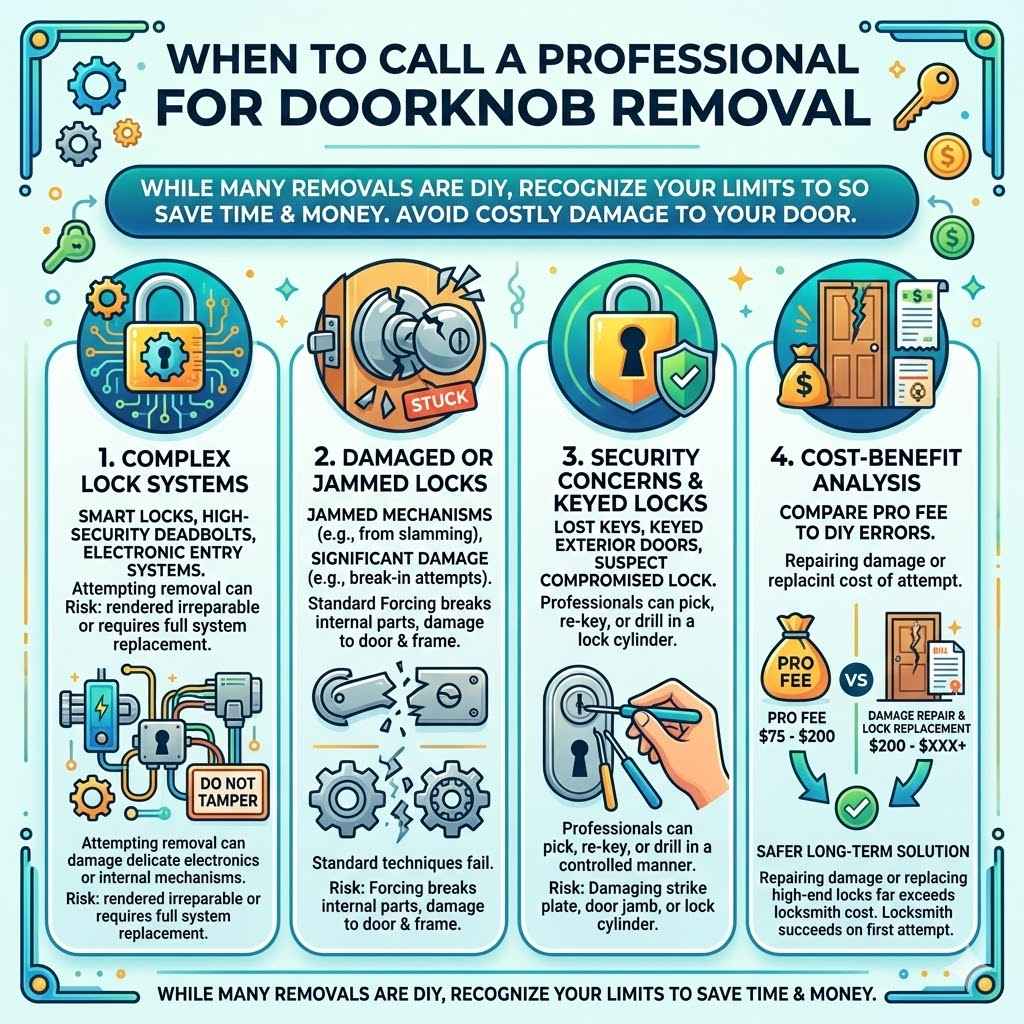
When To Call A Professional
While many doorknob removals are straightforward DIY tasks, there are specific situations where it’s best to call a professional locksmith or handyman. Attempting to force a lock that you don’t understand can lead to costly damage to your door or the lock hardware itself. Knowing your limits and recognizing when to seek expert help can save you time, money, and a lot of frustration.
Professionals have specialized tools and extensive experience with a wide variety of lock mechanisms.
Complex Lock Systems
Some doorknobs are part of more complex security systems, such as smart locks, high-security deadbolts, or integrated electronic entry systems. These are not typically designed for simple manual removal from the outside, especially if they are malfunctioning or locked. Trying to dismantle these without the proper knowledge can damage the electronic components or the internal locking mechanism, rendering the lock irreparable or requiring a complete system replacement.
For instance, a high-security deadbolt might employ multiple locking points and tamper-resistant features that prevent easy bypass. Similarly, smart locks often have intricate wiring and electronic boards that can be easily damaged if mishandled. In these cases, a locksmith has the expertise and specialized tools to diagnose the problem and either repair or replace the lock safely.
Damaged or Jammed Locks
If a doorknob is jammed and won’t turn at all, or if it has been significantly damaged (e.g., by attempted break-ins), the internal mechanisms might be broken or misaligned. Standard removal techniques may not work in these situations. Forcing a jammed lock can break off parts of the mechanism, making it even harder to remove and potentially damaging the door frame or the door itself.
A locksmith can assess the damage and determine the most effective method for removal, which might involve picking the lock, drilling it out, or using specialized bypass tools.
Consider a scenario where a door has been slammed shut with excessive force, causing the latch to jam. The doorknob might feel loose, but the latch remains extended. If the standard removal process doesn’t free the latch, it’s a sign that internal damage has occurred.
A professional can often resolve such issues without causing further harm to the door.
Security Concerns and Keyed Locks
When dealing with keyed entry doorknobs, especially those on exterior doors, security is a primary concern. If you’ve lost the key and need to regain access, or if you suspect the lock is compromised, it’s often safer and more efficient to call a professional. Locksmiths can not only remove the lock but also re-key it or install a new one, ensuring the security of your home or property is maintained.
Attempting to force or drill a keyed lock without expertise can damage the strike plate or the door jamb, leading to more extensive repairs.
For example, if you’re locked out of your house and the keyed doorknob is stuck, a locksmith can typically pick the lock to open it. If picking is not possible, they can then resort to drilling the cylinder in a controlled manner. This ensures that the door itself remains functional.
They can then advise on replacing the lock with a new, secure option.
Cost-Benefit Analysis
While calling a professional might seem more expensive upfront than a DIY approach, it’s important to consider the potential costs of errors. If you damage the door or the lock during a DIY removal attempt, the repair costs could far exceed the fee of a professional locksmith. For example, if you accidentally drill into the wrong part of a high-security lock, you might end up needing to replace the entire lock and potentially repair damage to the door.
A locksmith’s expertise means they are more likely to succeed on the first attempt, saving you from these additional expenses and the time involved in fixing mistakes.
A typical locksmith service call for doorknob removal might cost between $75 and $200, depending on the complexity of the lock and your location. In contrast, repairing a damaged door jamb or replacing a high-end lock could cost several hundred dollars. Therefore, for anything beyond the most basic doorknob types or if you encounter resistance, a professional is often the most cost-effective solution in the long run.
Frequently Asked Questions
Question: Can I remove a doorknob from the outside if it’s locked?
Answer: Yes, for privacy and some passage doorknobs, you can typically remove them from the outside even when locked by using the emergency release slot with a small tool. For keyed entry knobs, you will need the key or professional assistance.
Question: What if I can’t find a hole to release the knob?
Answer: If there’s no visible release hole, look carefully for a small set screw on the underside of the knob neck, which requires an Allen wrench. If neither is present, you may have a different type of knob, or it might be a keyed entry knob requiring specific tools or professional help.
Question: Will removing the doorknob damage my door?
Answer: If done correctly, removing a doorknob should not damage your door. Using the proper tools and techniques, especially the emergency release or set screw methods, is crucial to avoid scratches or dents.
Question: How do I remove a doorknob if the screws are on the inside?
Answer: For knobs where screws are only on the inside, you’ll need to find an alternative method. This usually involves looking for a release slot or a set screw on the exterior knob itself. If those aren’t present, it might be a keyed lock that requires a different approach or professional help.
Question: What’s the difference between a passage knob and a privacy knob removal?
Answer: Passage knobs usually have a simple release mechanism (a hole to push a tool into). Privacy knobs also have a release mechanism for emergencies, allowing external removal, but they also have a locking feature controlled from the inside.
Summary
Successfully removing a doorknob from the outside often comes down to identifying the knob type and finding its specific release mechanism. Whether it’s a hidden set screw or an emergency slot, most interior knobs can be removed with common household tools. For keyed entry locks or stubborn mechanisms, consider professional help to avoid damage.
With the right approach, you can tackle this task confidently.