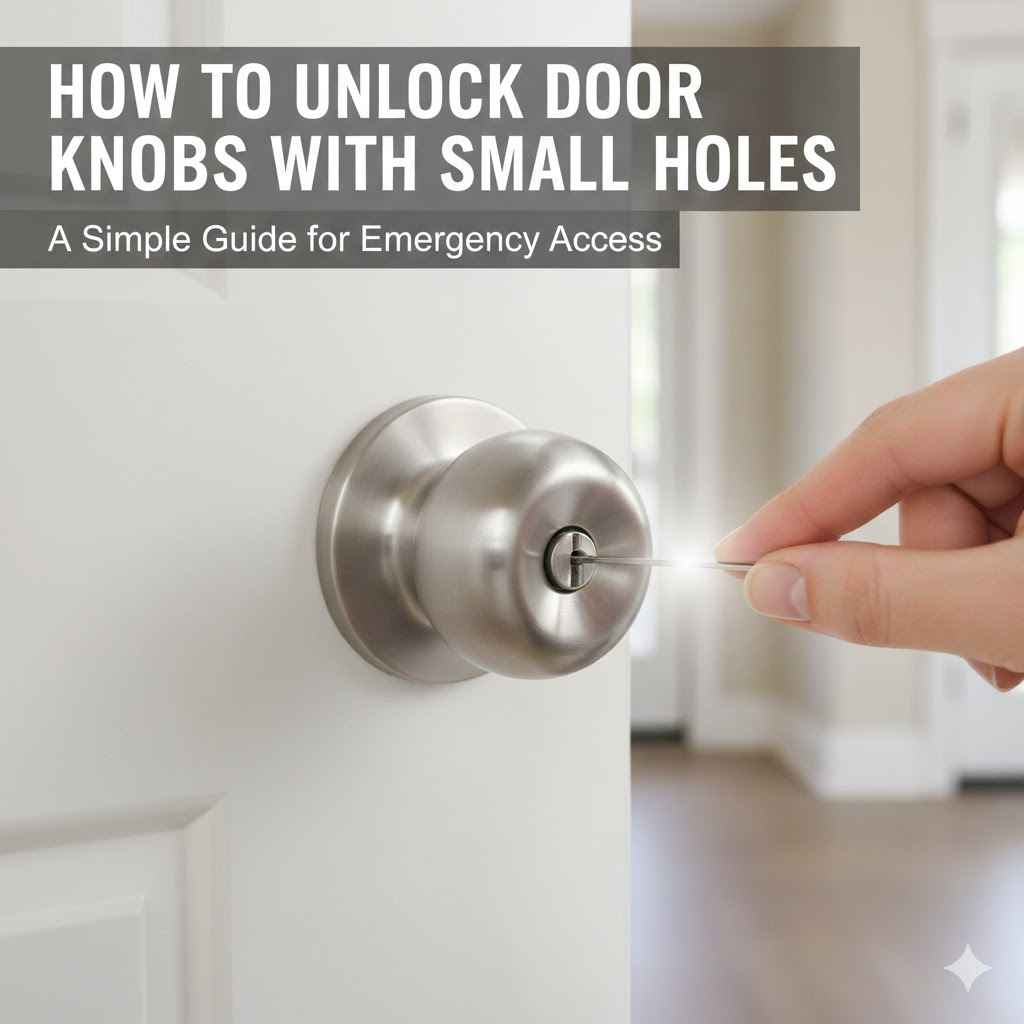
How to Unlock Door Knobs With Small Holes
Sometimes doors can be tricky. You might find yourself needing to open a door knob that has a small hole. This can seem confusing at first, especially if you’re not sure what to do.
Don’t worry though, it’s often simpler than you think. This guide will show you exactly what steps to take to solve this common puzzle. We’ll go through it all step by step so you can easily open that door.
Understanding Door Knobs With Small Holes
Many door knobs have a small hole for a specific reason. This hole is usually a way to reset or manually operate the lock. It’s designed for situations where you might lose a key or need to override the normal locking mechanism.
For beginners, figuring out the purpose of this tiny hole can be a bit of a mystery. They might wonder if it’s for a special tool or if it means the lock is broken. This section will demystify these common door knobs.
We’ll explain what the hole is for and why it’s a helpful feature.
The Purpose of the Small Hole
The small hole you see on many door knobs serves a very practical purpose. It’s not just a decorative element. This tiny opening is typically a part of the locking mechanism.
It allows you to interact with the internal workings of the lock. For example, it can be used to push a small button or insert a slim tool to disengage the lock.
This feature is especially useful for privacy locks, often found on interior doors like bathrooms and bedrooms. These locks usually have a way to be opened from the outside in case of an emergency or if a child locks themselves in. The small hole is the key to that external access.
Think of it as a secret passage for the lock. Without it, you might be stuck if the knob jams or you can’t find the key. It adds an extra layer of utility and safety to your doors.
Common Types of Locks With Small Holes
You’ll most often find this small hole on interior door knobs. These are usually privacy locks. They are designed to keep a room private but also allow for easy access in an emergency.
Examples include knobs on bedroom doors, bathroom doors, and closet doors. These knobs usually have a button or a lever on the inside that you push to lock. On the outside, you’ll see that small hole.
It’s usually round.
Sometimes, you might see a small slot instead of a round hole. This slot can also be used with a flat tool. The general idea is the same: provide a way to open the lock from the outside without a key.
Tools and Techniques for Unlocking
Knowing how to unlock door knobs with small holes is a skill many people need at some point. The good news is you probably already have the tools you need at home. You don’t need special locksmith equipment for most of these locks.
The key is using the right tool in the right way.
We’ll go over common household items that work perfectly for this task. You’ll learn about simple pushing and turning methods. We’ll also discuss what to do if the first attempt doesn’t work.
By the end of this section, you’ll feel confident tackling these locks.
Simple Household Tools for the Job
For most door knobs with small holes, a few common household items will do the trick. You don’t need a toolbox full of gadgets. Simplicity is often the best approach.
- Paperclip: This is a classic. Unbend a sturdy paperclip so you have a straight piece with a small hook at the end. This hook can be used to push a button inside the hole.
- Small Screwdriver: A very small, thin flathead screwdriver is often perfect. Its tip can fit into the hole and either push a button or be used to turn a locking mechanism. Make sure it’s small enough not to damage the knob.
- Bobby Pin: Similar to a paperclip, a bobby pin can be bent and used to access the inner workings. You might need to straighten it out somewhat.
- Push Pin or Sewing Needle: For very small holes, a sturdy push pin or a strong sewing needle can work to press a tiny button inside.
The main idea is to find something thin and strong enough to fit into the hole and interact with what’s inside. Always be gentle to avoid damaging the lock mechanism.
The Paperclip Method
The paperclip method is very popular because most people have paperclips readily available. It’s a straightforward process that works on many privacy locks.
First, take a standard metal paperclip. Straighten out one end of it. You want to create a stiff rod.
Now, look at the small hole on the outside of the door knob. Gently insert the straightened end of the paperclip into the hole. You should feel some resistance.
Once the paperclip is inside, try to feel for a button or a small catch. Push firmly but not forcefully. If you feel a click or the knob loosens, you’ve likely disengaged the lock.
If pushing doesn’t work, try wiggling the paperclip slightly while pushing. Sometimes, you need to align the paperclip just right to press the internal mechanism.
Using a Small Screwdriver
A small flathead screwdriver is often more effective than a paperclip because it’s sturdier and its tip can sometimes fit more precisely into the locking mechanism.
Select a screwdriver with a thin, narrow blade. It needs to fit comfortably within the small hole without forcing it.
Insert the tip of the screwdriver into the hole. You’re looking to engage with whatever is inside that allows the lock to be operated from the outside.
For many privacy knobs, there’s a small button located deep within the hole. You’ll need to push the screwdriver tip firmly against this button. You might hear or feel a click when the lock disengages.
In some cases, the hole might be a slot where you can insert the screwdriver and then turn it. This would be similar to turning a key. Try a slight turning motion if a simple push doesn’t work.
The Push and Turn Technique
Sometimes, unlocking the knob involves more than just a simple push. Many privacy locks require a combination of pushing and turning.
Once you’ve inserted your tool (like a paperclip or small screwdriver) into the hole, push in firmly. While keeping the pressure applied, try to turn the door knob as you normally would to open it.
The idea is that the pressure from the tool disengages the lock, and the turning motion then opens the door. It’s like a two-step process.
You might need to experiment with the amount of pressure and the direction of the turn. If one way doesn’t work, try the other. Be patient.
Troubleshooting Common Issues
Even with the right tools and techniques, sometimes a door knob with a small hole can be stubborn. You might push and push, but the lock won’t budge. This is where a little troubleshooting comes in handy.
We’ll cover common problems people face and provide simple solutions. Understanding why a lock might not be opening easily can save you frustration and help you find the right fix. This will ensure you’re prepared for any situation.
When the Hole Seems Too Small
Occasionally, the small hole might seem too tiny for even a straightened paperclip or a thin screwdriver. This is common with some modern or very compact lock designs.
If your tool isn’t fitting, try a different household item. A strong sewing needle or a fine-tipped tweezers might work. You can also try to carefully bend a paperclip into a very fine point.
The goal is to find something that can reach the internal mechanism without being too thick. If the hole is exceptionally small, it likely contains a very small button or pin that needs to be pressed.
Another tip is to use a tool that has a bit of length. This allows you to reach further into the hole, potentially past any initial obstructions, to get to the actual locking component.
If the Lock Doesn’t Budge
If you’re applying pressure with your tool and the lock simply won’t release, there could be a few reasons. The mechanism might be stuck, or you might not be pushing in the right spot.
First, try applying more consistent and firm pressure. Sometimes, it just takes a little more effort.
If that doesn’t work, try wiggling your tool gently while applying pressure. This can help dislodge a sticky mechanism.
Also, ensure you are pushing straight into the hole. Angled pressure can prevent you from hitting the internal button or lever correctly.
In some rare cases, the lock mechanism itself might be broken or jammed internally. If you’ve tried everything and it still won’t open, it might be time to consider calling a locksmith or looking into more advanced options.
What If I Can’t Find the Button?
Not all small holes on door knobs work the same way. Some have a distinct button to push, while others have a small spindle or slot to turn.
If you insert your tool and don’t feel a button, try gently rotating the tool itself. You might be trying to turn a small spindle that engages the lock.
Another possibility is that the hole is simply a guide. In these cases, you might need to insert a thin, flat object (like a shim or a stiff piece of plastic) between the door and the frame near the latch to force it open. However, this is less common for standard privacy locks with a small hole.
For privacy locks, the most common method involves pushing something into that hole. If you can’t find a button, try rotating your tool in a circular motion or a slight back-and-forth motion while applying gentle pressure.
When to Call a Professional
While most issues with door knobs and their small holes can be resolved with simple household tools and techniques, there are times when professional help is needed. Knowing when to stop trying yourself and call in an expert can save you time, prevent damage, and ensure the problem is solved efficiently.
This section will guide you on recognizing situations where calling a locksmith is the best course of action. It’s about understanding the limits of DIY and when professional expertise is truly valuable.
Signs You Need a Locksmith
There are several indicators that suggest it’s time to bring in a professional locksmith. These usually involve situations where DIY attempts have failed or when there’s a risk of causing further damage.
- The knob is completely jammed: If the knob won’t turn at all, even with normal operation, and your attempts to use the small hole are unsuccessful, the internal mechanism might be severely damaged.
- You’ve tried multiple tools and methods without success: If you’ve exhausted the simple solutions and the door still won’t open, a locksmith has specialized tools and knowledge to handle difficult situations.
- The door knob is damaged: If the knob itself is broken, cracked, or feels loose and unstable, forcing it further could cause more significant damage, leading to more expensive repairs.
- Security is a concern: If you’re dealing with a door that has a higher security requirement or if you believe the lock might have been tampered with, a locksmith can assess the situation and recommend appropriate solutions.
- You’re in an urgent situation: If you need to get through the door immediately due to an emergency (e.g., a child locked in, a safety issue), a locksmith can often provide a rapid response.
Preventing Future Issues
Once you’ve successfully opened a door knob with a small hole, or if you’ve had to call a professional, it’s wise to think about preventing future problems. Regular maintenance and understanding your locks can go a long way.
For interior privacy locks, always ensure you’re not forcing the locking mechanism. When locking, a gentle turn is usually sufficient. Avoid slamming doors, as this can jar the internal components.
If you notice any sticking or difficulty in operation, don’t ignore it. Sometimes, a small amount of lubricant (like graphite powder, not oil-based lubricants which can attract dust) can help. Apply it sparingly into the keyhole or mechanism if applicable.
For exterior doors, ensure your locks are appropriate for the environment and regularly checked. If you live in an area with extreme weather, this is particularly important as moisture and temperature changes can affect metal components.
When DIY Could Cause Damage
It’s crucial to know the line between trying a simple fix and potentially causing more harm. Forcing tools into the small hole can strip the internal components or break off pieces inside.
If the small hole is unusually shaped or you’re not sure what you’re pushing against, aggressive manipulation can damage the delicate parts of the lock cylinder. This can turn a simple unlock situation into a need for a full lock replacement.
Another common mistake is using a tool that is too large. This can expand the hole or damage the surrounding metal, affecting the knob’s appearance and function.
If you feel you are using excessive force, it’s a clear sign that your current approach might be wrong or the lock is genuinely stuck. At this point, stepping back and considering professional help is the wisest decision.
Understanding Lock Mechanisms
To truly master how to unlock door knobs with small holes, it helps to have a basic grasp of how these locks work. This isn’t about becoming a locksmith, but rather about understanding the engineering behind that small hole. Knowing the function of different parts can demystify the process and make troubleshooting easier.
We will explore the common types of mechanisms found in door knobs with small holes. This knowledge will empower you to use the right tools and apply the correct techniques with greater confidence.
Privacy Lock Mechanisms
The most frequent type of lock featuring a small hole is the interior privacy lock. These are designed for convenience and immediate privacy rather than high security.
Inside the knob, there is usually a simple spring latch. On the inside, you have a thumb turn or button to engage and disengage the lock. On the outside, the small hole is the access point.
When you look into the small hole, you are typically trying to push a small plunger or lever. This action releases the internal locking mechanism. It’s like pushing a button on a remote control to send a signal.
These locks are designed to be easily bypassed from the outside for emergencies. They are not meant to keep intruders out, but rather to provide privacy from within the room.
Push-Button vs. Twist-Lock Mechanisms
Door knobs with small holes usually employ one of two primary locking mechanisms: push-button or twist-lock. Understanding the difference helps in knowing how to tackle them.
The push-button mechanism is common on many bathroom and bedroom knobs. You press a button on the inside to lock. From the outside, the small hole contains a button that you push with a paperclip or similar tool to retract the lock.
The twist-lock mechanism is also seen, sometimes with a small slot instead of a round hole. In this design, a small spindle or post is located within the hole. You insert a tool and turn it, much like you would turn a key, to disengage the lock.
Some knobs might even have a combination, where pushing a button first allows for a subsequent turn. The key is to identify whether you’re trying to push something down or turn something within the hole.
The Role of Springs and Pins
At the heart of how these locks operate are small springs and pins. These tiny components are what make the lock mechanism function.
When you push the button on the inside of a privacy lock, you are compressing a spring. This action engages a pin or bolt that secures the latch.
The small hole on the outside provides a way to manually override this. When you insert a tool and push, you are directly manipulating a part of this spring-loaded system. You might be pushing a small stem that is connected to the locking pin, or you might be pushing a lever that retracts the bolt.
These internal parts are often made of metal and designed for repeated use. However, they can become worn, dirty, or misaligned, which is when problems can arise.
Real-Life Scenarios and Solutions
Seeing how these techniques apply in real-life situations can make learning how to unlock door knobs with small holes much easier. These examples illustrate common challenges and provide practical steps to overcome them.
Let’s look at a few scenarios where this knowledge comes in handy. These stories show that these situations are common and manageable with the right approach.
Scenario 1 The Toddler and the Bathroom Door
Little Timmy, a curious toddler, decided to “play lock” on the bathroom door. He somehow managed to turn the interior knob to the locked position. His mom, Sarah, was on the other side, and Timmy was happily playing with bath toys, completely unaware of his mom’s predicament.
Sarah couldn’t reach him and started to worry.
Sarah remembered the small hole on the outside of the bathroom door knob. She quickly grabbed a paperclip from her desk, straightened it out, and inserted it into the hole. She felt a small click as she pushed.
The knob then turned freely, and she was able to open the door to a giggling Timmy. The paperclip saved the day, preventing any unnecessary panic.
Scenario 2 The Misplaced Key
David was getting ready to leave for work and couldn’t find his house key. He knew he had locked the front door from the inside, and now he was stuck. The front door knob had a small hole, which he had never paid much attention to before.
He was running late and needed a quick solution.
David found a small flathead screwdriver in his tool bag. He carefully inserted the tip into the hole on the exterior knob. He felt it make contact with something solid and pushed firmly.
He heard a distinct “pop” sound, indicating the lock had disengaged. He then turned the knob, and the door opened. He was able to get to work on time, thanks to knowing about that small hole.
Scenario 3 The Jammed Bedroom Door
A couple, Mark and Lisa, found their bedroom door jammed shut. The knob wouldn’t turn properly, and the lock seemed stuck. They tried jiggling the knob, but it wouldn’t budge.
They looked at the outside knob and saw the familiar small hole.
Mark used a straightened paperclip. He inserted it and pushed. Nothing happened.
He then tried wiggling the paperclip while pushing. Still no luck. He then switched to a small screwdriver.
This time, when he inserted it and applied firm pressure while gently trying to turn the knob, he felt the lock release. They realized the mechanism was just a bit stiff and needed a bit more pressure from the right tool.
Frequently Asked Questions
Question: Can I use any tool to unlock the door knob hole?
Answer: It’s best to use tools that are thin, strong, and not too large. Things like paperclips, bobby pins, or small flathead screwdrivers are ideal. Avoid using anything too thick or sharp that could damage the lock.
Question: What if the small hole on the door knob is a slot?
Answer: If the hole is a slot, you’ll likely need a thin, flat tool like a small flathead screwdriver or a stiff piece of metal. You’ll need to insert it and turn it, similar to using a key, to disengage the lock.
Question: How do I know if I’m pushing the right thing in the hole?
Answer: You’re usually trying to push a small button or lever inside the lock mechanism. You might feel a slight click or resistance. Gentle wiggling or varying the pressure can help you find the right spot.
Question: Will this method work on exterior door locks?
Answer: The small hole method is primarily designed for interior privacy locks. Exterior locks usually require a key or a more complex bypass. This technique is generally not effective for deadbolts or high-security exterior locks.
Question: What if I break my tool inside the lock?
Answer: If your tool breaks inside the lock, try to carefully remove the broken piece if possible. If not, you may need to call a locksmith, as they have special tools to extract broken items from locks.
Wrap Up
You’ve learned how to unlock door knobs with small holes using simple tools and techniques. Whether it’s a misplaced key or a curious child, you now have the knowledge to handle these situations. Remember to be gentle and patient.
You can successfully open most of these locks yourself with a little practice.