LVP Flooring Cost Calculator: Real Budget Ranges and Checks
A reasonable LVP flooring budget often falls in a moderate per-square-foot installed range; if one quote is noticeably below the others, I check for missing prep, trim, or waste. Missed line items can turn a cheap bid into a costly change order after the old floor comes up. This guide gives you an LVP flooring cost calculator built from contractor line items, plus checks to spot padded or incomplete quotes.
How is this calculated?
Press Calculate to see the math with your numbers.
How much does LVP flooring cost per square foot?
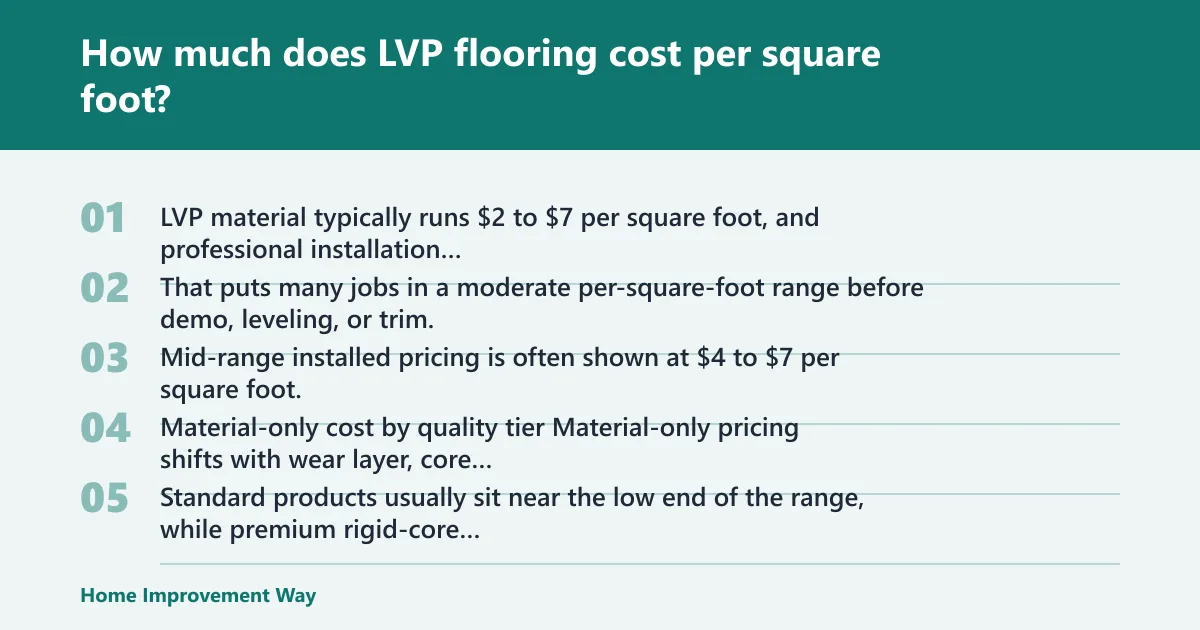
LVP material typically runs $2 to $7 per square foot, and professional installation usually adds $1.50 to $4 per square foot. That puts many jobs in a moderate per-square-foot range before demo, leveling, or trim. Mid-range installed pricing is often shown at $4 to $7 per square foot.
Material-only cost by quality tier
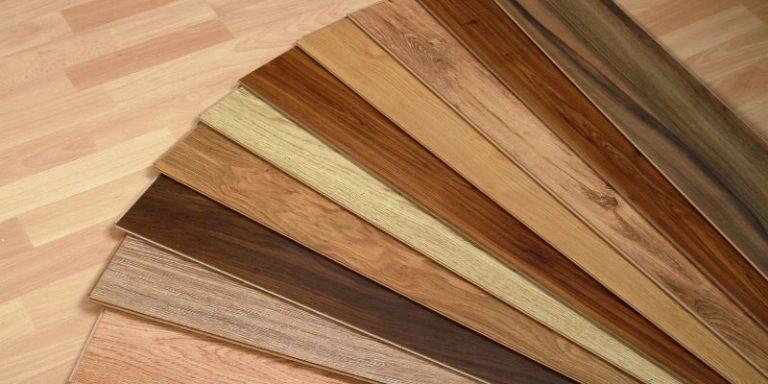
Material-only pricing shifts with wear layer, core type, and plank thickness. Standard products usually sit near the low end of the range, while premium rigid-core products reach higher material prices because they are built for heavier traffic, better dent resistance, and a more stable feel underfoot.
Water resistance does not mean every plank is equal. The face and core still matter, and the wear layer is a major price driver. Standard LVP uses a 12 mil wear layer in one common tiering system, while premium LVP is shown with a 20 mil wear layer.
Installed cost range and what usually moves it
Installed cost includes material plus labor, but not always demo, underlayment, or subfloor correction. A simple click-lock room with a flat slab can stay near the lower part of the range. Glue-down work, lots of doorways, and uneven floors push the number up fast.
Where waterproof and wear-layer claims affect price
LVP is sold as water-resistant or waterproof, and that is useful in kitchens, baths, and basements. Still, the floor is only as forgiving as the subfloor and edge details. Higher wear layers usually cost more, but they also help the floor hold up longer in busy rooms.
According to LVP Flooring Cost Calculator — The example 400 sq ft LVP project totals $2,540.
Enter your room size and calculate square footage
Room size is the first number in any lvp flooring cost calculator. Measure each room’s length and width, calculate the square footage separately, then add the rooms together. Use square footage for both material and labor calculations, but keep waste separate because it applies to material orders, not installation time.
Length × width for one room
For a single rectangle, multiply length by width. A 10-foot by 12-foot room equals 120 square feet. Keep the measure in the same unit before multiplying, and round only after you calculate the area. That prevents small errors from snowballing when material is ordered.
How to total multiple rooms
Add each room area separately, then combine the totals. If a hallway connects two rooms, include it only once. For kitchens, closets, and alcoves, count each section that will receive LVP. This keeps the estimate closer to how installers price real work.
Where to round and where not to
Round the final purchase quantity after waste is added, not before. Labor can usually follow the exact measured area. Material orders need a buffer for cuts, but labor is billed on the area installed, plus any extra work that the job needs.
- Measure each room length and width.
- Multiply length by width for area.
- Add all room areas together.
- Add waste to the material order only.
- Apply labor to the installed square footage.
How much extra LVP should I order for waste and cuts?
For many simple rooms, a waste allowance around 10% is often enough; layouts with more corners or direction changes may need closer to 15%, and irregular rooms or plans with lots of cuts may need around 20%. Waste applies to the material order, not to labor. If a quote adds waste to both material and labor, that is a red flag.
10% for standard rooms
Use 10% for simple rectangles with few door cuts and a predictable plank direction. This covers trim waste, end cuts, and the occasional damaged plank. It is the baseline most calculators use when the room shape is straightforward.
15% for layouts with more corners or direction changes
Once a room has extra corners, several closets, or plank direction changes, 15% is safer. More cuts mean more offcuts. That does not raise labor by itself, but it does raise the amount of flooring you need to buy.
20% for irregular rooms, mixed patterns, or many cuts
Use 20% when a room is irregular, when multiple small spaces are tied together, or when the layout creates heavy cutting around islands, vents, and doorways. This is common in older homes and in spaces that are far from simple rectangles.
What does LVP installation labor add?
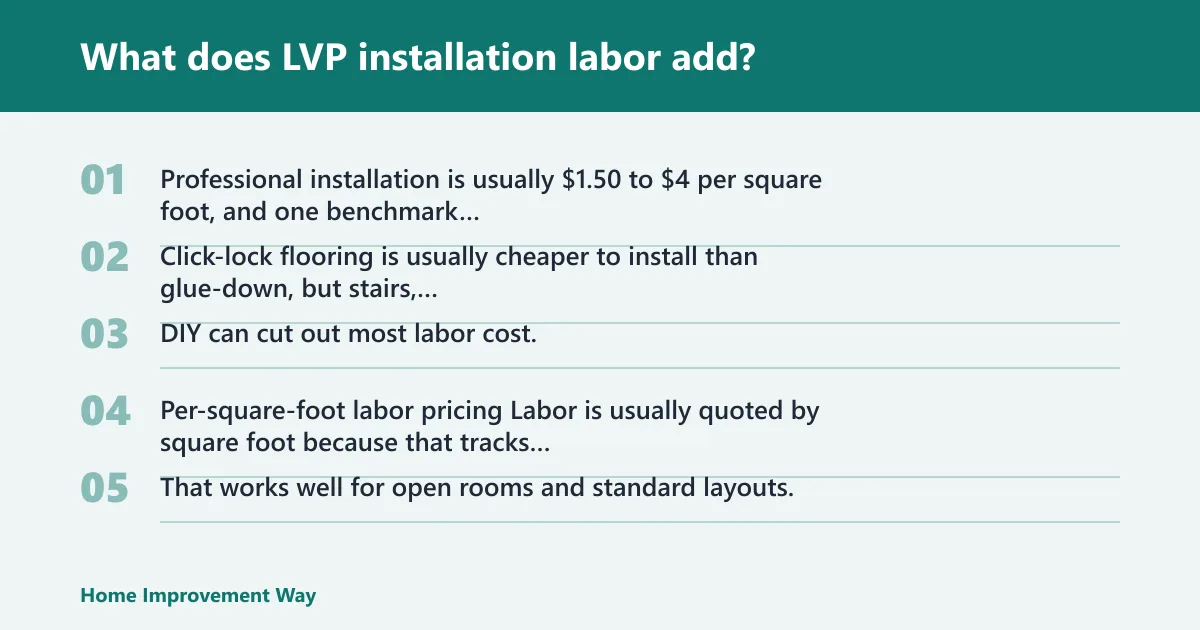
Professional installation is usually $1.50 to $4 per square foot, and one benchmark lists LVP labor at $1.00 to $5.00 per square foot. Click-lock flooring is usually cheaper to install than glue-down, but stairs, transitions, and prep work can move labor higher. DIY can cut out most labor cost.
Per-square-foot labor pricing
Labor is usually quoted by square foot because that tracks the area actually installed. That works well for open rooms and standard layouts. It becomes less useful when the project has many details, so contractors may add separate charges for trim, stairs, or floor prep.
Why click-lock is usually cheaper than glue-down
Click-lock LVP is a common DIY-friendly format, and it usually goes in faster than glue-down. Glue-down takes more surface prep, more planning, and more handling time. That extra effort usually shows up in the labor line, even if the material itself is similar.
Where stairs, transitions, and prep raise labor
Stairs take more time than flat runs. Transitions between rooms add cuts and finishing steps. Prep work, especially on uneven floors, is another labor driver. When a quote looks low, check whether those items are counted or left out for later.
Do you need underlayment for LVP?
Underlayment is sometimes optional, especially when the plank has an attached pad. When it is used, foam, cork, or rubber can add sound control, moisture protection, and a smoother feel underfoot. It is a separate line item, usually priced per square foot.
Attached pad versus separate underlayment
Some LVP products already include a pad. In that case, the installer may not need a separate layer unless the manufacturer allows it. When there is no attached pad, underlayment can help with sound and minor surface irregularities, but it should match the flooring system.
Foam, cork, and rubber options
Foam is common for basic sound reduction and ease of installation. Cork can help with acoustics and comfort. Rubber is often chosen where moisture and sound matter more. The right choice depends on the subfloor, room use, and the flooring product itself.
Sound and moisture reasons to add it
Underlayment can quiet footfall and add a moisture buffer, but it is not a cure for a wet or damaged subfloor. If the substrate has a leak or surface damage, that issue needs correction first. Underlayment sits in the estimate as a separate material cost.
What adds cost before the new floor goes in?
Subfloor condition, old flooring removal, and finishing details often explain why two quotes differ. A floor that is not flat may need leveling. Old carpet, tile, or glued vinyl may need removal. Trims and transitions may also need replacement or finishing.
Subfloor flatness and leveling
Subfloor leveling can add $1.00 to $3.00 per square foot. That cost usually comes from dips, humps, and damaged areas that must be corrected before new LVP goes down. The flatter the floor, the less the installer needs to correct on site.
Old flooring removal by material type
Old flooring removal can add $0.50 to $2.00 per square foot. Carpet is usually easier than tile or glued vinyl, but the actual cost depends on how the old material is attached and what lies underneath. Demo is often left out of base quotes.
Damage repairs, transitions, and trim
Water damage, loose seams, soft spots, and broken transitions all add time and material. Baseboards, doorway finishes, T-moldings, and reducers are often priced per linear foot. If a quote bundles these into a vague allowance, ask for a line-by-line breakout.
How to read a contractor quote line by line

A good quote should separate material, waste, labor, underlayment, demo, leveling, transitions, and trim. That is how contractors actually build jobs. A single all-in number can hide missing prep or later change orders, while a line-item quote is easier to sanity-check against your room size and floor condition.
| Line item | Typical pricing unit | Red-flag range for hidden-bid risk |
|---|---|---|
| Material | per square foot | Shown far below $2 to $7 without a clear product tier |
| Waste | percent of material order | 0% on anything but the simplest room, or added to labor too |
| Labor | per square foot | No labor line, or a number that ignores stairs and prep |
| Underlayment | per square foot | Included without stating the pad type or manufacturer rule |
| Demo | per square foot | Missing when old carpet, tile, or glued vinyl is present |
| Leveling | per square foot | Absent on uneven floors or damaged subfloors |
| Transitions | per linear foot | Doorways and room changes included as “minor extras” only |
| Trim | per linear foot | Baseboards, reducers, or doorway finishes missing from scope |
A quote-audit table like this helps compare bids that look similar at first glance. If one contractor is far cheaper, check whether the floor is being quoted without waste, demo, leveling, or trim. That is where many low bids fall apart.
Example project check
One example 400 sq ft LVP project totals $2,540. That kind of example is useful because it shows how material, labor, and add-ons can stack up on a real job. The total matters less than the parts that create it.
How much does LVP cost in different quality tiers?
Different tiers are not just about looks. They change wear layer thickness, core construction, and installed price. Mid-range LVP installed pricing is shown at $4 to $7 per square foot, while premium rigid-core LVP can reach $7 to $12 per square foot installed. Standard and premium products are not interchangeable on busy floors.
Budget tier
Budget LVP usually sits near the low end of the material range. It can work well in lighter-use rooms and smaller projects, but cheaper material often has less forgiving wear and fewer finish options. It is worth checking whether the quote includes the same prep as higher-end bids.
Mid-range tier
Mid-range products are where many homeowners land. They balance material cost, appearance, and durability better than the cheapest options. This tier often gives the best apples-to-apples comparison because the installed price is easier to compare across contractors.
Premium tier
Premium rigid-core LVP can cost more up front, but it is often chosen for better stability and a heavier wear layer. Standard LVP uses a 12 mil wear layer in one benchmark, while premium LVP is shown with a 20 mil wear layer. That difference can matter in entryways, kitchens, and rentals.
Frequently asked questions
how much does lvp cost per square foot
LVP material typically ranges from $2 to $7 per square foot, and professional installation is usually $1.50 to $4 per square foot. That puts many projects in the $4.50–$11 range before demo, leveling, or trim. The exact number depends on product tier and site conditions.
how much per square foot for vinyl plank flooring
For vinyl plank flooring, a practical planning range is the material cost plus installation cost. Mid-range installed pricing is shown at $4 to $7 per square foot. Lower bids may leave out prep, while higher bids often include more correction, finishes, or tougher layout work.
how much does it cost for luxury vinyl plank flooring
Luxury vinyl plank flooring can be priced at several levels. Premium rigid-core LVP can reach $7 to $12 per square foot installed. If a quote is below that, check what is excluded. If it is above that, ask whether leveling, demo, or trim is already built in.
what is the cost of luxury vinyl plank flooring
The cost of luxury vinyl plank flooring depends on whether you are buying material only or paying for a full install. Material commonly runs $2 to $7 per square foot, while installed work usually adds $1.50 to $4 per square foot. Extra prep can move the total higher.
How do I estimate LVP flooring cost for my room size?
Measure each room length and width, multiply to get area, then add all spaces together. Apply a 10% waste allowance to the material order, or 15% to 20% for harder layouts. Then add labor, underlayment, demo, leveling, and trim if those are part of the job.
What does LVP installation labor typically add per square foot?
Professional installation is usually $1.50 to $4 per square foot, and one benchmark lists LVP labor at $1.00 to $5.00 per square foot. Click-lock layouts are generally cheaper than glue-down, but stairs, transitions, and prep can push labor higher than a simple quote suggests.
What costs are not included in an LVP flooring calculator?
Many calculators leave out demo, leveling, trim, transitions, and sometimes underlayment. Old flooring removal can add $0.50 to $2.00 per square foot, and subfloor leveling can add $1.00 to $3.00 per square foot. Those omissions are the main reason bids do not match online estimates.
Sponsored / affiliate links. As an Amazon Associate I earn from qualifying purchases. I may earn additional commission from eligible campaigns.