Plywood Cost Calculator: Sheets, Waste, and Total Price
A plywood cost calculator should begin with sheet area, add 10–15% waste, then multiply by local sheet price and add delivery, fasteners, and trim. Leave out those extras, and a floor, wall, or ceiling budget can miss by hundreds, or leave you one sheet short on install day. This guide shows how to count sheets, price common sizes, and catch the hidden costs that change the total.
How is this calculated?
Press Calculate to see the math with your numbers.
How the plywood cost calculator works


The calculator turns the surface you want to cover into a sheet count and a material budget. Enter length, width, sheet size, waste factor, and price. The output should tell you how many sheets to buy and what the plywood will cost before add-ons.
What you enter: length, width, sheet size, waste, and price
The calculator lets users enter the length and width of the surface to cover. It also includes waste factor as an input. That is the part many simple sheets leave out. A 4 ft x 8 ft panel is common, but sheet dimensions can vary, which changes the area and the final count.
Plywood price can be entered as price per sheet or price per square foot. The better choice depends on how the store labels stock and how much the sheet size varies. Local retail price matters more than a generic online guess.
What the calculator returns: sheet count and total cost
The calculator outputs the number of plywood sheets needed. It also outputs plywood cost. That result should be treated as a material estimate, not the full job price, because delivery, fasteners, adhesive, underlayment, and trim waste can add up fast.
Why the answer changes when sheet size changes
Sheet area changes the math. A larger custom sheet can reduce seams and sheet count, while a smaller sheet can raise both. Grain direction, room shape, and cutout placement also change what can be reused from each panel, so two jobs with the same square footage can still buy different quantities.
How do you calculate plywood price?
Start with the area you need to cover, then divide by the sheet area, round up, and multiply by price. If the price is given per square foot, use that number directly after adding waste. If it is given per sheet, convert the project area into sheet count first.
Area first: length × width
Measure the surface in one unit and keep it consistent. If the room is in feet, keep the sheet dimensions in feet too. Surface area to cover is simply length × width for walls, floors, and ceilings. Mixed units lead to wrong totals and bad sheet counts.
Sheet area: 4 ft × 8 ft or your custom size
A common plywood panel size is 4 feet by 8 feet. That gives 32 square feet per sheet. Custom dimensions change that number, so a 4×8 sheet and a different-size sheet cannot be priced the same way unless the area matches.
Price per sheet versus price per square foot
Price per sheet is easier when buying standard stock. Price per square foot is better when comparing different grades, thicknesses, or custom sizes. Material grade and type affect price, so softwood plywood and flooring plywood may not match even when the area looks similar.
How many plywood sheets do you need?
Divide total project area by sheet area, then round up to the next whole sheet. That is the base quantity. After that, add allowance for waste, cutouts, and awkward edges. A cut list that looks tidy on paper often leaves scrap on the floor.
Convert the project area into sheet count
For standard stock, the calculation is usually total area ÷ about 32 square feet for 4×8 sheets. If the answer is about 8.2 sheets, the buy list becomes 9 sheets before waste. That rounding protects against shortfalls caused by offcuts and imperfect layout.
Round up to whole sheets
Sheet quantity calculation must always round up. Partial sheets usually are not available at checkout. Even if the arithmetic says 8.1 or 8.3, the purchase is still 9 sheets. That is the only safe way to avoid running short on a wall seam, floor edge, or ceiling line.
Adjust for door, window, and cutout waste
Openings do not always save a full sheet. Door and window cutouts can create narrow strips that are hard to reuse. Edge waste and grain direction can also make a piece unusable for a visible run, so the sheet count should reflect what can actually be installed.
Why waste changes the buy list

Waste factor is the extra percentage added for scraps, cuts, and layout losses. Ten percent is often used as a default, and the calculator should include it. Use more when the room is irregular, the layout has many openings, or the grain direction matters on finished faces.
Defaulting to 10% waste
A 10% waste factor is a practical starting point for many straight runs and simple rooms. It gives room for saw kerf, edge trimming, and a few bad cuts. The calculator should apply waste before rounding, because a low estimate can become a short buy list once cuts are made.
When to use more than 10%
Use more than 10% when the job has many cutouts, stair-step walls, angled corners, or a lot of directional matching. Flooring layouts with tongue-and-groove edges can also create less reusable scrap. More waste is often cheaper than a second store run.
How grain direction and offcuts affect usable area
Some sheets lose useful area because the face grain must run a certain way. Offcuts from one opening may not fit another. That matters most when covering visible walls or when a floor requires staggered joints. The purchase count should include those layout losses.
Use the proof worksheet: three real pricing scenarios
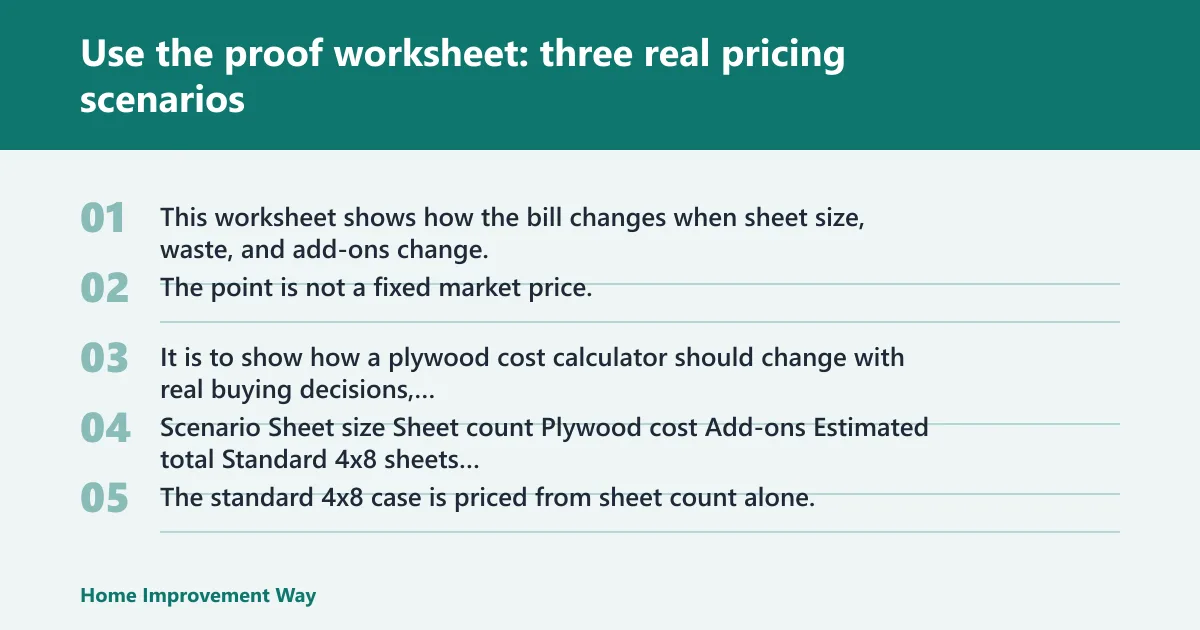
This worksheet shows how the bill changes when sheet size, waste, and add-ons change. The point is not a fixed market price. It is to show how a plywood cost calculator should change with real buying decisions, not just square footage.
| Scenario | Sheet size | Sheet count | Plywood cost | Add-ons | Estimated total |
|---|---|---|---|---|---|
| Standard 4×8 sheets | 4 ft x 8 ft | 9 | $396 | Delivery $45; fasteners $18 | $459 |
| Custom sheet dimensions | 4 ft x 10 ft | 7 | $371 | Delivery $45; adhesive $22; trim waste $15 | $453 |
| 10% waste case | 4 ft x 8 ft | 10 | $440 | Delivery $45; fasteners $18; underlayment $60 | $563 |
These examples use a simple retail assumption to show how the math moves. The standard 4×8 case is priced from sheet count alone. The custom sheet example cuts sheet count but adds a different mix of job costs. The 10% waste case shows how a modest allowance can push the budget higher before any finish work starts.
Standard 4×8 sheet scenario
For a straightforward project, 4×8 sheets keep the calculation simple. If the floor or wall area is close to the sheet math and the layout is rectangular, the buy list is easier to plan. That still does not mean the total is only sheet price; transport and fastening items matter.
Custom sheet dimension scenario
Custom sheet dimensions can reduce seams and may lower the sheet count. That can help on long runs or in spaces that do not match a 4×8 grid. The tradeoff is that custom sizes are not always stocked locally, so availability and delivery can change the final budget.
10% waste scenario with add-ons
A 10% waste case is where many budgets break. The material count looks close to the square footage, but delivery, fasteners, adhesive, and underlayment can push the job higher. If trim waste is likely, that should be built in before checkout, not after the first row is laid.
What changes plywood cost besides sheet count?
Sheet count is only one part of the bill. Grade, thickness, and plywood type all affect price. Softwood plywood is typically used for construction and industrial purposes. Flooring plywood often needs a different thickness or edge detail, and that changes the cost before labor ever starts.
Grade and thickness
Higher-grade sheets usually cost more because the face quality and core quality are better. Thickness also moves the price. Roofing can use 16-millimetre plywood. Subfloors are at least 19 millimetres thick. Those choices affect both material budget and how the floor performs.
Softwood plywood versus flooring plywood
Softwood plywood is common for construction use and often comes in 4 ft x 8 ft panels. Flooring plywood is different because it may need tongue-and-groove edges. Flooring applications often use tongue-and-groove plywood, and T&G plywood is usually found in the 13-to-25-millimetre range.
Delivery, fasteners, adhesive, and underlayment
Delivery is easy to miss when pricing sheets. Fasteners, adhesive, and underlayment also change the real budget. For subfloors and remodel work, these small line items can become a noticeable share of the total, especially when the order is small.
How to estimate plywood for walls, floors, and ceilings
The same math works for walls, floors, and ceilings, but the layout losses are different. Walls have openings. Floors may need directional joints or T&G edges. Ceilings are harder to handle, so breakage and awkward cuts can create more waste than the area alone suggests.
Wall coverage and openings
For walls, subtract only the openings you can truly recover from. Doors and windows often leave trim strips that are too narrow for another section. That is why a wall estimate should include waste, even when the raw opening area seems to reduce the sheet count on paper.
Flooring plywood and subfloor fit
For floors, sheet fit matters around joists and seams. Tongue-and-groove edges help alignment, but they do not remove the need for waste allowance. For a 15 × 17 ft floor, one example uses a 10% waste factor and says about 9 sheets are needed.
Ceiling coverage and handling breaks
Ceilings often need extra hands and more careful cuts. Damage during lifting can turn one sheet into scrap. When the layout is overhead, a conservative waste factor is safer than a tight estimate. That keeps the buy list from running short halfway through the room.
How do I calculate plywood price?
Calculate plywood price by finding the area to cover, converting that area into sheet count, rounding up, then multiplying by local sheet price. If the store prices by square foot, use area × price per square foot instead. Add waste before you multiply, not after.
How much does a 4×8 plywood cost?
The cost of a 4×8 sheet depends on grade, thickness, and type. A 4×8 panel is the common size, but that does not mean every sheet has the same price. Construction sheets, flooring sheets, and higher-grade panels can land at very different totals at the store.
How many plywood sheets do I need for a wall or floor?
Start with the wall or floor area, divide by the sheet area, and round up. Then add waste for cuts, seams, and openings. A wall with many windows or a floor with lots of cutouts will usually need more than the square footage alone suggests.
How do I factor in waste when buying plywood?
Add a waste factor before rounding up to whole sheets. Ten percent is a common default, but the number should rise when the room is irregular, the grain must run a certain way, or many offcuts cannot be reused. That is the safest way to protect the buy list.
What sheet size should I use for a plywood cost estimate?
Use the sheet size that matches the actual material you plan to buy. A 4 ft x 8 ft sheet is common, but custom lengths and widths can change both sheet count and cost. If the job uses mixed sizes, estimate each group separately and combine the totals.
How much plywood do I need for a 15 x 17 ft floor?
For a 15 × 17 ft floor, the area is about 255 square feet. With a 10% waste factor, the buy list should be about 9 sheets in the example used here. That is a useful starting point, but flooring layout, cuts, and product type can move the final count.
Is a plywood calculator accurate if I change sheet dimensions?
Yes, if the calculator is built around sheet area and not only around the default 4×8 size. Changing sheet dimensions changes the total area per sheet, which changes the count and cost. Accuracy drops only when the layout has irregular cuts, openings, or mixed sheet sizes.
How do I estimate plywood cost for flooring versus sheathing?
Estimate flooring and sheathing separately because the products can differ in thickness, edge detail, and grade. Flooring often uses tongue-and-groove panels and thicker stock. Sheathing may use construction-grade softwood plywood. Different panel types can produce a different sheet count and a different materials budget.
Frequently asked questions
how to calculate plywood price
Measure the surface, convert it to area, divide by sheet area, round up, then multiply by price per sheet or price per square foot. Add waste before rounding if the room has openings or awkward cuts. That gives a better material estimate than guessing from room size alone.
how much does a 4×8 plywood cost
A 4×8 sheet price depends on grade, thickness, and type, so there is no single number that fits every job. Construction panels and flooring panels are often priced differently. Use the local retail price for the exact sheet you plan to buy, not a generic average.
How many plywood sheets do I need for a wall or floor?
Divide the wall or floor area by the area of one sheet, then round up. After that, add waste for cutouts, seams, and scrap. A simple rectangle is easy. A room with openings, angles, or directional grain usually needs extra sheets.
How do I factor in waste when buying plywood?
Set a waste factor before you buy, with 10% as a common starting point. Increase it when the layout is irregular, the cuts are complex, or offcuts are unlikely to be reused. Waste should be part of the sheet count, not a guess added at the register.
What sheet size should I use for a plywood cost estimate?
Use the actual stock size you plan to purchase. The common plywood panel size is 4 feet by 8 feet, but custom dimensions are valid when the project calls for them. If you may mix sizes, price each size separately and add them together.
How do I estimate plywood cost for flooring versus sheathing?
For flooring, include thicker panels, tongue-and-groove edges, and a higher waste allowance if needed. For sheathing, compare the panel grade and thickness you need for the build. Then add delivery, fasteners, adhesive, and underlayment where the job requires them.
Sponsored / affiliate links. As an Amazon Associate I earn from qualifying purchases. I may earn additional commission from eligible campaigns.