Gutter bracket spacing calculator: how many hangers?
Use wider bracket spacing for most aluminum gutters, then tighten the spacing in snow, heavy-rain, or long-run conditions and near joints, corners, and outlets. Too few hangers lets gutters sag, pull loose, and overflow; I see that lead to rotten fascia and expensive fixes. This guide shows how to calculate hanger count for any roof edge and adjust spacing for gutter type, climate, and run length.
How is this calculated?
Press Calculate to see the math with your numbers.
What gutter brackets and hangers do
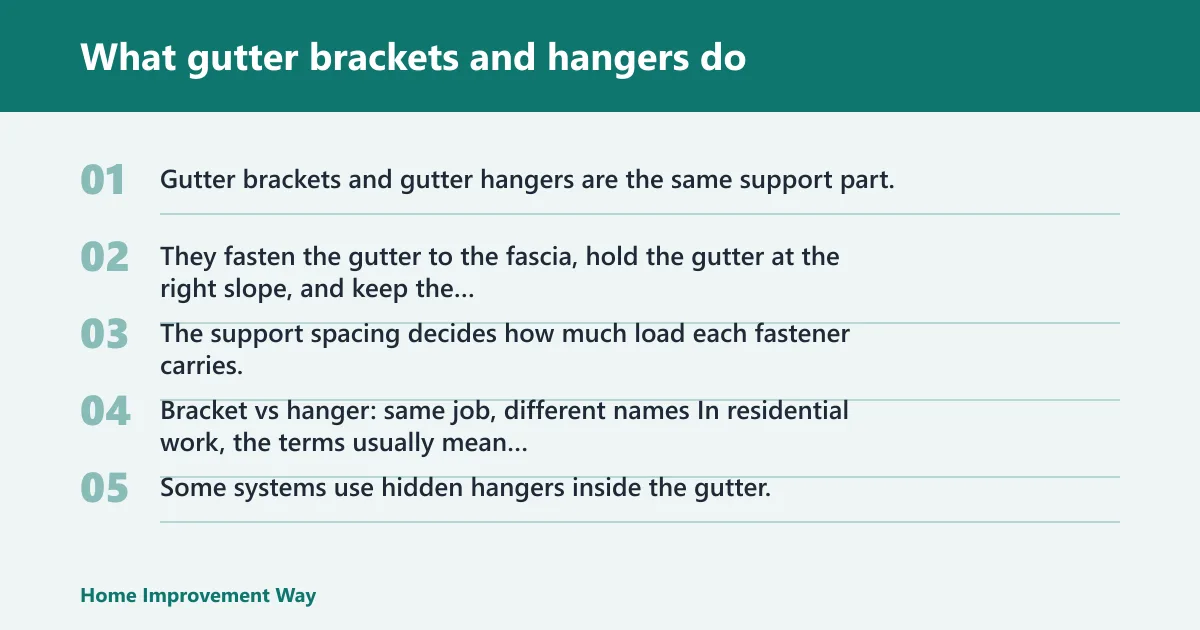

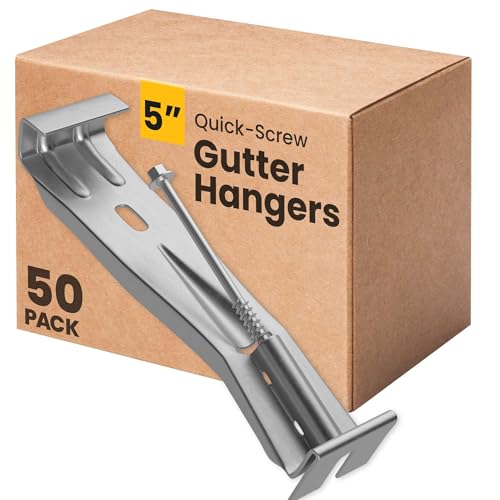

Gutter brackets and gutter hangers are the same support part. They fasten the gutter to the fascia, hold the gutter at the right slope, and keep the front edge from rolling when water, ice, or debris loads the run. The support spacing decides how much load each fastener carries.
Bracket vs hanger: same job, different names
In residential work, the terms usually mean the same thing. Some systems use hidden hangers inside the gutter. Others use external brackets. The label changes, but the job does not: support the gutter, hold alignment, and resist pull-out from the fascia.
How support load moves through the fascia and gutter
Load moves from the gutter wall into each hanger, then into the fascia board and fasteners. If spacing is too wide, each fastener carries more load and the gutter between supports can droop. That droop changes slope and can leave standing water at low spots.
Which gutter profiles need closer support
Heavier profiles and wider gutters generally need tighter support than light sectional runs. 5-inch K-style gutters, 6-inch K-style gutters, 5-inch half-round gutters, and 6-inch half-round gutters are all common options, but half-round profiles and full 6-inch systems usually need closer hanger spacing near joints and outlets.
According to Rain Gutter Calculator – Gutters, Downspouts & Materials — Bracket count can be estimated with floor(gutter length in inches / spacing) + 1.
How far apart should gutter brackets be?
Standard gutter bracket spacing is every 24-36 inches. For most homes, 30 inches is a practical middle choice, 36 inches fits mild conditions, and 24 inches is the safer setting for snow or ice areas. The maximum spacing for common residential work should stop at 36 inches.
Standard spacing range for most homes
Use the gutter bracket spacing that matches the load, not just the look of the run. A longer span between supports is more forgiving on a straight, short, lightly loaded run. Shorter spacing works better where water volume, ice, or roof length adds stress.
Maximum spacing before sag risk climbs
Once spacing opens past 36 inches, sag risk climbs fast. That is where fascia pull-out, seam separation, and visible belly in the gutter start to show up. If a run already has weak fascia or older fasteners, treat 36 inches as the upper limit, not the target.
When snow, ice, or long runs call for tighter spacing
Use 24-inch spacing in heavy snow or ice areas to prevent sagging. Tighten spacing on long runs, at corners, and near outlets because those points see more load and more movement. Heavy rain also pushes a run harder, especially when the roof edge feeds a lot of water into one section.
What is the spacing between gutter brackets?
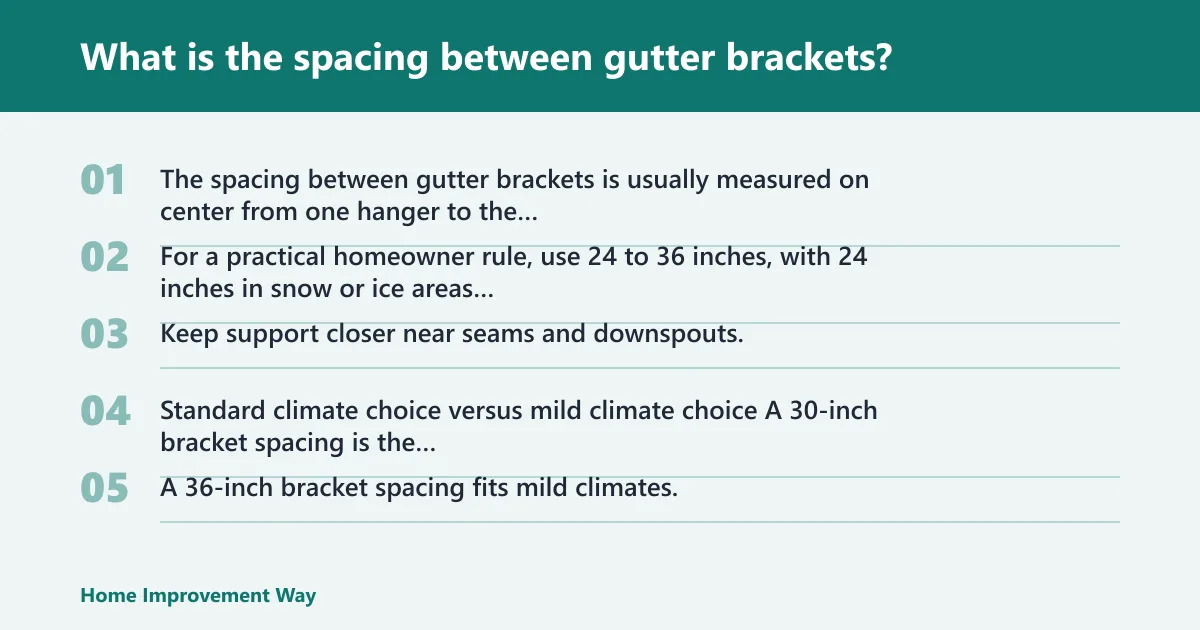
The spacing between gutter brackets is usually measured on center from one hanger to the next. For a practical homeowner rule, use 24 to 36 inches, with 24 inches in snow or ice areas and 30 inches as a good standard climate choice. Keep support closer near seams and downspouts.
Standard climate choice versus mild climate choice
A 30-inch bracket spacing is the standard climate choice. A 36-inch bracket spacing fits mild climates. A 24-inch bracket spacing fits snow or ice areas. That gives a simple way to match spacing to load without overbuilding every run.
Spacing near ends and seams
Do not treat the first and last hanger like the ones in the middle. Ends, corners, and splices need closer support because the gutter can twist there. A good rule is to tighten spacing to about 12 inches near joints, corners, and outlets, then return to the main interval.
What is the recommended spacing for gutter brackets?
The recommended spacing for gutter brackets is 24 to 36 inches on center, with the exact choice driven by climate, gutter profile, and run length. For a standard residential install, 30 inches is a workable target, but snow, long runs, and weak fascia should push the spacing tighter.
Compatibility with gutter type
Sectional aluminum gutters usually do well at 24 to 30 inches. Steel and half-round setups often need closer attention at the same spacing because the profile can flex differently and the load path changes at joints. The gutter material and bracket type should match the support interval.
Heavy rain and long-run adjustments
Heavy rain does not change the bracket math by itself, but it changes the load each hanger must carry. Long runs act the same way. The farther water has to travel before reaching a downspout, the more likely the gutter is to bow or hold a low spot if support is too wide.
How many brackets for guttering do I need?
Bracket count is based on roof edge length, not house width. Use floor(gutter length in inches / spacing) + 1 as the basic count, then add support at ends, corners, seams, and outlets when the run changes direction or meets a downspout. That keeps the support pattern practical.
Use roof edge length, not just house width
Measure the total roof edge length that will actually get gutter. That includes each eave, return, and separate run. Two walls that look similar from the ground can need different counts once corners and downspouts are included.
Use gutter section length for material takeoff
Gutter section length is a material-planning number, not a hanger-spacing number. Common section lengths can help count gutter pieces and seams, but hanger count still follows the actual run length. A 20-foot run might use two sections, but the hanger count still comes from the support interval.
Add downspouts, corners, and open ends
Downspouts should be placed every 20-30 feet of gutter run, and they usually belong at the ends of runs or at low points. End caps close off gutter ends, so they matter in the planning step even though they do not change spacing directly. Every open end needs an end cap.
How far to space gutter brackets on a run?
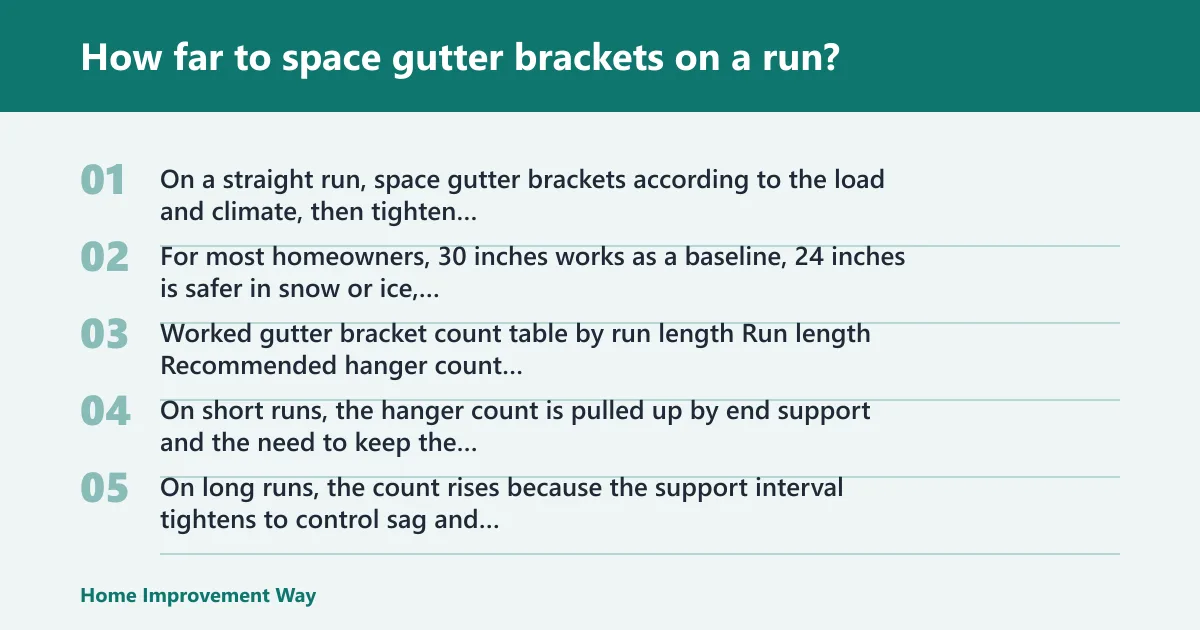
On a straight run, space gutter brackets according to the load and climate, then tighten the spacing near outlets, corners, and seams. For most homeowners, 30 inches works as a baseline, 24 inches is safer in snow or ice, and 36 inches is the upper edge for mild conditions.
Worked gutter bracket count table by run length
| Run length | Recommended hanger count | Exact on-center spacing | When to tighten spacing |
|---|---|---|---|
| 8 ft | 5 | 24 in | Keep 12 in near ends if the run ends at a corner or outlet |
| 10 ft | 5 | 30 in | Tighten to 24 in in snow or ice areas |
| 12 ft | 6 | 24 in | Use closer spacing where the fascia is soft or older |
| 16 ft | 8 | 24 in | Use 18 in if the run is long, exposed, or gets heavy runoff |
| 20 ft | 9 | 30 in | Move to 24 in if the run has one downspout or heavy snow |
| 24 ft | 13 | 24 in | Keep support closer at the outlet and any splice |
| 30 ft | 13 | 30 in | Use 24 in if the run feeds a lot of roof area |
| 40 ft | 21 | 24 in | Split the run with a downspout or tighten support through the middle |
How to read the table
The table uses a practical spacing pattern, not a bare minimum. On short runs, the hanger count is pulled up by end support and the need to keep the gutter from twisting. On long runs, the count rises because the support interval tightens to control sag and outlet stress.
When to round up for end hangers and seams
Round up whenever a run has an open end, a corner, a splice, or an outlet near the middle. Those points need their own support zone. If the formula gives a borderline count, add one hanger rather than stretch the interval and hope the run stays flat.
Do downspouts change gutter bracket spacing?
Yes. Downspouts change bracket spacing because the outlet area carries more movement and more water load than a plain straight run. Downspouts should be placed every 20-30 feet of gutter run, and support should be tightened near the outlet so the gutter does not dip or twist.
Why outlets need extra support nearby
The gutter opens at the outlet, and that opening weakens the section around it. Water rushes toward the outlet during storms, so the metal flexes there more than in the middle of the run. Extra hangers on both sides of the outlet help prevent distortion.
How downspout placement changes hanger count on each side of a run
If a run is divided by a downspout, count each side as its own support span. That usually lowers the risk of sagging and can reduce the effective spacing needed on each segment. Long continuous runs without enough outlets need tighter hanger spacing to compensate.
When standard spacing fails
Standard spacing fails when the support interval is too wide for the load or the fascia cannot hold the fasteners. The usual warning signs are visible belly in the gutter, dripping at the seam, loose screws, and water overshooting the trough instead of moving cleanly to the downspout.
Sagging from oversized spacing
Oversized spacing lets the gutter bow between supports. Once that happens, the slope changes and water starts to sit in the low spot. Even a small dip can trap debris and speed up corrosion or staining along the gutter line.
Fascia pull-out and loose fasteners
Fasteners can pull out when the hanger spacing is too wide or the fascia board is weak. Repeated freeze-thaw cycles make that worse. If screws are loose or stripped, moving to closer spacing and better fastener placement is safer than simply tightening the old holes.
Snow-load distortion and seam stress
Snow and ice add vertical load and sideways pressure. That can twist half-round gutters, open seams, and stress the gutter joints near splices. In those areas, the safe move is to shorten the interval and support the gutter close to the seam line.
How to use the calculator step by step
Start with the roof edge length, choose the gutter type, and decide whether the site behaves like a mild climate or a snow-load climate. Then set the hanger spacing, count the downspouts, and add support near every end, corner, splice, and outlet.
- Measure the total roof edge length that will receive gutter.
- Choose the gutter profile and material.
- Set spacing at 30 inches for standard conditions, 24 inches for snow or ice, or 36 inches only for mild conditions.
- Count downspouts at the ends of runs and on longer runs every 20-30 feet.
- Add extra hangers near corners, seams, and outlets.
- Use 10-foot gutter sections to plan material, then verify hanger count separately.
- Confirm end caps for every open end.
Frequently asked questions
How far apart should gutter brackets be?
For most homes, gutter brackets should be spaced every 24-36 inches on center. A 30-inch spacing works well as a general target, while 24 inches is the safer choice in snow or ice areas. Keep spacing tighter near corners, seams, and outlets.
How many brackets do I need for a 40 foot gutter run?
A 40-foot gutter run usually needs 21 brackets at 24-inch spacing. That count helps control sag over the long span and gives better support near the outlet area. If the run has a corner, seam, or weak fascia, add support rather than stretching the spacing.
Do downspouts change gutter bracket spacing?
Yes. Downspouts affect spacing because the outlet area takes more load and more water movement. They should be placed every 20-30 feet of gutter run, and the brackets near each outlet should be closer together. That helps keep the gutter flat and aligned.
What is the recommended spacing for gutter brackets?
The recommended spacing is 24 to 36 inches, depending on climate and gutter profile. Use 36 inches only in mild conditions, 30 inches as a standard choice, and 24 inches where snow, ice, heavy runoff, or longer runs make the gutter more likely to sag.
What is maximum spacing for gutter brackets?
For common residential work, 36 inches is the practical maximum. Going wider than that increases the risk of sagging, fascia pull-out, and seam stress. If the run is long or the fascia is weak, the right move is to tighten spacing, not push past the limit.
How many brackets for guttering do I need?
Use the roof edge length, not the house width, and apply floor(gutter length in inches / spacing) + 1 as the base count. Then add support for ends, corners, seams, and outlets. That gives a more realistic number than a simple length-only estimate.
Sponsored / affiliate links. As an Amazon Associate I earn from qualifying purchases. I may earn additional commission from eligible campaigns.
 Stainless Steel Stove Pipe Roof Bracket Support Heavy Duty Weatherproof Chimney Tube Clip Durable Fixing Holder for Residential Building Roof Wall Mount Boiler Flue
 Stainless Steel Wall Bracket for Chimney and Furnace Tubes, Support Kit for Wood Stove Pipes with Fittings, Fixed Ventilation Pipe Holder