Door jamb screw length calculator: pick the right length
For most prehung doors, I pick a screw that runs through the jamb and shim stack, then bites about 1 to 1 1/2 inches into the stud; a 2 1/2-inch screw is a common default. Too short leaves the frame loose. Too long can bow the jamb, split shims, or pull the reveal off. This guide shows the calculator rule, the measurements to take, and how to pick screws for different jamb and shim stacks.
How is this calculated?
Press Calculate to see the math with your numbers.
What screw length do you need for a door jamb?

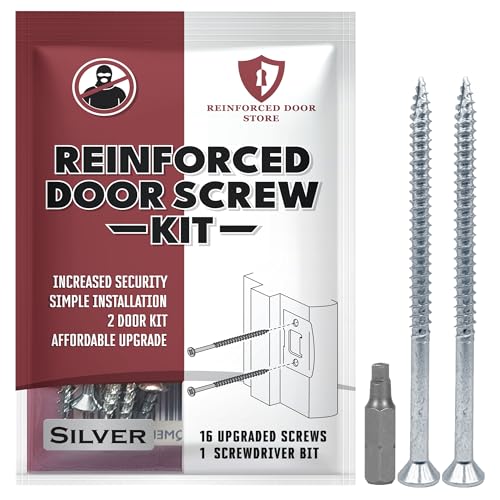

For a door jamb, the right screw length is the one that crosses the side jamb or head jamb, passes through any shims, and still enters the framing stud far enough to hold. For a prehung door frame, the screw should fasten the jamb to framing, not stop in air or only in the jamb.
When this applies to a prehung door frame
This choice matters most on prehung interior doors and exterior doors, where the jamb arrives with the slab already set in the frame. The side jambs usually get the fasteners, and the head jamb may need support where the frame is out of plane or the rough opening is uneven. Shims create the gap the screw must cross.
The parts that set the length
The door jamb screw length calculator is really a three-part question: jamb thickness, shim thickness, and target stud bite. The screw has to get through all of that without punching through the face of the jamb. If the screw head sits proud, or the tip stalls before the stud, the frame will move later.
How to calculate door jamb screw length
The working rule is simple: add the jamb thickness, add the shim stack, then add the stud bite you want. For door jamb work, the thickness part is the jamb plus shim stack, and the penetration part is the bite into the framing stud. The calculator uses the formula SL = MT + PD, and it supports inches and millimeters.
Use the correct reference point for head style
Head style changes where the length starts. A protruding-head length reference starts under the head, while a flat or countersunk head reference starts at the top surface. That matters because the same catalog length can sit differently in the jamb and can change whether the point reaches the stud or the head bottoms out early.
Measure from the same plane
Top material thickness must be measured from the same reference plane. If the screw head seats on the jamb face, measure from that face. If it is a countersunk or flat head, measure from the surface the head will sit flush with. Mixing reference points is how people end up with screws that are either short or too long.
Use inches and millimeters without mixing units
The calculator supports inches and millimeters, but one calculation should stay in one unit system. If the jamb and shim stack are measured in millimeters, keep the target bite in millimeters too. If the rough opening is being planned in inches, keep all inputs in inches and only convert at the end if needed.
- Measure the jamb thickness at the fastening point.
- Measure the shim stack at that same point.
- Choose the target stud penetration depth.
- Add the three values for total screw length.
- Compare the result to a catalog length and head style.
How deep should a screw bite into the stud?
For door jamb fastening, the screw should bite enough into the stud to hold alignment under daily use, but not so deep that it telegraphs through the jamb face or distorts the frame. A minimum bite can hold a light interior jamb, while a safer target bite gives better grip when the opening sees more movement.
Minimum bite versus practical target
The tradeoff is simple. Short penetration can leave the frame loose, especially if the shim stack compresses later. Excessive length can force the screw tip through thin jamb material or split a shim stack that was already tight. For that reason, the practical target bite is usually the better planning number than the bare minimum.
What fails when the bite is wrong
Too little stud bite means the jamb can rack, the latch strike can drift, and the reveal can go uneven. Too much length can punch through the jamb face or drag the jamb out of plane as the screw tightens. In a prehung door, either failure shows up fast at the latch or hinge side.
Door jamb screw length lookup table
This lookup table turns the formula into quick choices for common jamb thicknesses, shim stacks, and target stud penetration depths. It assumes a screw must pass through the jamb and shims, then enter the stud. Use the final column as a starting range, then match it to the head style and the actual jamb face.
| Jamb thickness | Shim stack | Target stud bite | Calculated length | Practical screw length range |
|---|---|---|---|---|
| 3/4 in. | 1/8 in. | 1 in. | 1 7/8 in. | 2 in. |
| 3/4 in. | 1/4 in. | 1 1/4 in. | 2 1/4 in. | 2 1/2 in. |
| 3/4 in. | 3/8 in. | 1 1/2 in. | 2 5/8 in. | 2 1/2 in. to 3 in. |
| 1 in. | 1/8 in. | 1 in. | 2 1/8 in. | 2 1/4 in. |
| 1 in. | 1/4 in. | 1 1/4 in. | 2 1/2 in. | 2 1/2 in. |
| 1 in. | 3/8 in. | 1 1/2 in. | 2 7/8 in. | 3 in. |
| 1 1/4 in. | 1/4 in. | 1 1/4 in. | 2 3/4 in. | 2 1/2 in. to 3 in. |
| 1 1/4 in. | 3/8 in. | 1 1/2 in. | 3 1/8 in. | 3 in. |
Recommended ranges for common door types
For many interior prehung doors with modest shim stacks, a 2 1/2-inch screw is often a practical default because it usually clears the jamb, crosses the shims, and still grabs the stud. For heavier exterior doors, longer screws are often a better starting point when the jamb is thicker or the shim stack is wider.
Pass/fail check for a safe length
A screw passes if it reaches the stud, gets the target bite, and still leaves the head seated correctly. It fails if it stops in the shim gap, barely enters the stud, or pokes through the jamb face. Use this check before driving the full set of fasteners.
- Pass: the point reaches the stud.
- Pass: the stud bite matches the target depth.
- Pass: the head seats without crushing the jamb.
- Fail: the screw ends in the shim stack.
- Fail: the tip breaks through the jamb face.
- Fail: the head pulls the frame out of alignment.
Should door jamb screws go into the stud or just the jamb?
Door jamb screws should go through the jamb and into the framing stud, not stop at the jamb alone. The jamb is the finished frame, but the stud is the structural backer that holds the opening square. In a prehung installation, the shimmed jamb needs that solid bite to stay put.
What changes when the gap is larger than expected
If the rough opening leaves a larger-than-expected gap, the shim stack gets thicker and the screw needs more length. That is where a door jamb screw length calculator matters most. The screw still has to land in the stud after crossing the added gap, and the head style still has to match the measurement method.
How do shims change the screw length you need?
Shims add thickness to the path the screw must travel, so they must be included in the calculation. A thicker shim stack means a longer screw, provided the jamb can accept that length without the tip breaking through the face. Thin shims can also compress, so a small allowance is wise when the opening is irregular.
When shim thickness varies along the jamb
It is common for the hinge side to need a different shim stack than the latch side or head jamb. That means one screw length may not be ideal for every location. The practical move is to size for the thickest stack at the fastening point, then confirm that shorter areas will not allow the screw to overrun the jamb.
Worked example
Take a typical jamb thickness, a modest shim stack, and a reasonable target stud bite. Using SL = MT + PD, the total comes to roughly 2 1/4 inches before head-style adjustment. In catalog terms, that points to a 2 1/2-inch screw as the safer purchase size.
What is the difference between protruding-head and countersunk screw length?
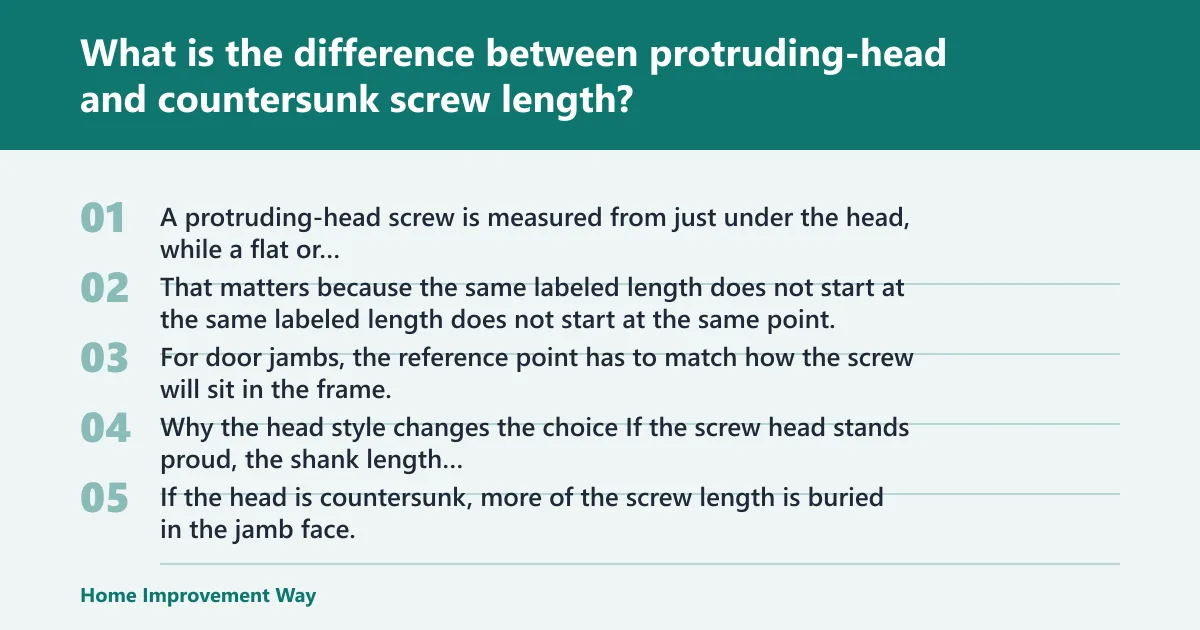
A protruding-head screw is measured from just under the head, while a flat or countersunk screw is measured from the top surface where the head sits flush. That matters because the same labeled length does not start at the same point. For door jambs, the reference point has to match how the screw will sit in the frame.
Why the head style changes the choice
If the screw head stands proud, the shank length available to cross the jamb can be less than the catalog number suggests. If the head is countersunk, more of the screw length is buried in the jamb face. That difference is small in isolation, but it matters when the jamb is thin or the shim gap is tight.
Frequently asked questions
What screw length do I need for a door jamb?
Choose a screw long enough to cross the jamb, pass through the shim stack, and bite into the stud with about 1 to 1 1/2 inches of engagement. For many prehung doors, 2 1/2-inch screws are the common starting point, but thicker jambs or wider gaps can call for longer fasteners.
How deep should a screw penetrate into framing for a door jamb?
It should penetrate deep enough to hold the jamb steady after the shims compress and the door gets used. A shallow bite may hold briefly, but a more generous bite gives the frame better resistance to movement. The right depth depends on jamb thickness, shim stack, and whether the door is interior or exterior.
Should door jamb screws go into the stud or just the jamb?
They should go into the stud. The jamb alone is not the structural anchor; it is the trim-and-frame member that must be tied back to the framing. In a prehung opening, screws that stop in the jamb will not hold the reveal and alignment the way a stud-anchored fastener will.
How do I calculate screw length for shims and gaps?
Add the jamb thickness, the shim thickness, and the target penetration depth. That gives the total length needed for the fastener path. Then compare that total with the catalog length and the head style so the measurement starts at the correct point and the screw does not overrun the jamb face.
What is the difference between protruding-head and countersunk screw length?
Protruding-head screws are measured from under the head, while countersunk screws are measured from the top surface. That affects the usable length in the jamb because the head sits differently. If the wrong reference is used, the chosen screw may be too short to reach the stud or too long for the jamb face.
Can I use the same calculator for inch and millimeter measurements?
Yes, as long as every input stays in the same unit system. The calculator supports inches and millimeters, but the jamb thickness, shim thickness, and target penetration depth must all be entered consistently. Convert only after the total is known, or the result will be off.
Sponsored / affiliate links. As an Amazon Associate I earn from qualifying purchases. I may earn additional commission from eligible campaigns.