Wallpaper Calculator: How Much Do You Need?
Core calculator workflow: perimeter or wall-by-wall length → strip count → cut length adjusted for pattern repeat → usable drops per roll → rolls needed → total cost. In practice, the usable drop count is what keeps a wallpaper estimate accurate, because roll coverage changes once you trim for ceiling height, repeat, corners, and waste. A standard double roll often covers about 54 square feet according to Wallpapers To Go, but the actual usable amount depends on the product label, repeat, and room layout.
| Step | Formula | What it tells you |
|---|---|---|
| Perimeter | 2 × (length + width) | Total wall run for a rectangular room |
| Strip count | Perimeter ÷ roll width | How many vertical drops the room needs |
| Cut length | Wall height + repeat adjustment + trim allowance | How long each usable strip must be |
| Drops per roll | Roll length ÷ cut length | How many full usable drops each roll can yield |
| Rolls needed | Strip count ÷ drops per roll, rounded up | Minimum buy quantity before buffer |
| Total cost | Roll price × rolls needed + adhesive + extras | Project budget estimate |
A wallpaper calculator should estimate usable drops, not just wall area: divide each wall by roll coverage, round up, subtract only full openings on large repeats, and add 10% extra; buy one spare roll for matching dye lot and repairs. Skip that math, and you can run short mid-room, waste money on overbuying, or end up with a different dye lot later. This guide shows how installers count drops, when to subtract doors and windows, when to add buffer, and when a repair roll is worth it.
How is this calculated?
Press Calculate to see the math with your numbers.
How the calculator works
Start with wall measurements, then convert them into strip count. Measure each wall’s length and height, then add all wall lengths for the room perimeter. In metric, use metres and square metres; in imperial, use feet and square feet. Wall area is only a starting check. It does not replace strip counting for patterned paper or narrow walls.
Measure wall length, width, height, and perimeter
For a rectangular room, perimeter = 2 × (length + width). If the room is about 12 ft by 10 ft, the perimeter is about 44 ft. If it is about 3.6 m by 3.0 m, the perimeter is about 13.2 m. Then measure wall height from finished floor to ceiling, not from the rough subfloor.
Use the same units throughout. Do not mix feet with metres in one calculation unless you convert first. A calculator such as Inch Calculator estimates rolls and cost from room dimensions and coverage per roll, and some tools also accept a price input for cost planning. Omni Calculator includes single wall and rectangular room modes.
Use wall area only as a first pass
Area gives a rough check, but it can mislead when the paper has a repeat or when wall widths do not divide evenly into full strips. A 9 ft wall and a 4 ft wall need different strip counts even if their combined area looks modest. That is why installers count usable drops first.
Picture a 10 ft by 8 ft bedroom with 8 ft walls. Area alone suggests a simple buy. But if the paper has a 20 in repeat and the room needs about six full drops, trim loss can change the total by about a roll or more.
Roll size and coverage
Roll size matters because coverage varies by product and format. Standard rolls, double rolls, and custom lengths do not produce the same usable area. The label may list roll width, roll length, and coverage, but the usable coverage after trimming is what matters for the estimate.
Single roll, double roll, and custom dimensions
A single roll is the base unit on some labels, while a double roll is a paired length sold as one unit. Custom rolls can vary by width and length, so do not assume one brand matches another. Wallpapers To Go says a typical double roll covers about 54 square feet.
| Roll format | Common label cue | What to check | Planning note |
|---|---|---|---|
| Single roll | One roll unit | Width, length, and stated coverage | Convert to usable drops after trim loss |
| Double roll | Two-roll length sold together | Coverage per unit and pattern repeat | Good for planning by strip count |
| Custom roll | Nonstandard width or length | Exact dimensions on the label | Never reuse a standard coverage assumption |
Why stated coverage varies by product
Coverage changes with roll width, roll length, pattern repeat, and the amount of trimming at top and bottom. Two rolls that look similar on paper can produce different usable coverage once you match the design and cut around corners or sloped ceilings. Always use the product label, not a generic chart, when it is available.
Drops per roll and usable coverage
Usable coverage means how much wall you can cover after cutting. Drops per roll is often more useful than raw square footage, because a roll may yield fewer full strips when the repeat is long. That matters most on tall walls and on papers with a fixed vertical pattern repeat.
How do you adjust the number of wallpaper rolls to the pattern repeat?

Pattern repeat changes the strip length you can cut from each roll, so it changes the roll count. Straight match, half-drop, stated offset, and free or random match all waste different amounts at the top of each strip. The longer the repeat, the more offcuts you should expect. Thibaut’s guidance on ordering extra material reflects that repeat loss can be significant on patterned papers.
Straight match versus half-drop
With a straight match, the design aligns at the same height on each strip. Half-drop means every other strip drops partway down the repeat, which increases waste. An offset listed on the label should be treated as part of the strip length, not as an optional detail. Patterned wallpaper suppliers commonly describe repeat type on the product page because it affects cutting and ordering.
Stated offset and free or random match
A stated offset tells you exactly how far the pattern shifts from strip to strip. Free or random match is more forgiving, but it still needs extra material for trimming and alignment. Calculators.io notes that a repeating pattern requires more materials and that a wallpaper calculator can include repeat when applicable. Manufacturer and retailer product pages typically specify repeat handling so buyers can plan the cut length before ordering.
Suppose a paper has a 25 in repeat and a 9 ft wall height. The cut length must absorb the repeat, so each strip can take more than 9 ft from the roll before trimming. That is why an area-based estimate can come up short even when the wall area seems modest. In installer terms, the question is not how much wall exists, but how many usable drops a roll can actually yield after the repeat is aligned.
Should you subtract doors and windows?
Subtract small openings only when the opening is minor compared with the wall and the paper repeat is short. Leave large openings in the estimate when the wall layout is awkward, the pattern repeat is long, or the room has many corners. Thibaut advises not to deduct doors or windows from measurements; that is the safer rule when the paper is patterned or the opening pattern is irregular.
When to subtract small openings
Small openings can be deducted in a straightforward room with a plain paper and simple strip layout. That said, the deduction should be modest. If the opening is small enough that it will be covered by offcuts or does not change strip count, it is often simpler to keep it in the estimate and treat the leftover paper as waste buffer.
When to leave large openings in the estimate
Large openings often do not reduce the roll count as much as people expect, because strips still need to run above, beside, and across the opening edges. For wide windows, patio doors, or rooms with deep reveals, the trim loss can cancel out the area you thought you were saving. That is why some calculators include doors and windows as separate inputs, while others leave them out.
Why awkward wall geometry changes the answer
Angles, alcoves, stair turns, and sloped ceilings can create short offcuts that cannot be reused. A smaller wall can therefore need the same roll count as a larger flat wall. A calculator that uses per-wall counting rather than only room area is better suited to those spaces.
Wallpaper buy-size rules by room type
This table gives a practical buying rule, not a substitute for the label. Use it to decide whether to subtract openings, how much buffer to add, and where the risk of shortages is highest. Keep the same dye lot for the whole job whenever possible. Retailers and manufacturers commonly note that batch consistency matters because later replacements may not match exactly.
| Room scenario | Subtract doors/windows? | Recommended buffer | Risk notes |
|---|---|---|---|
| Accent wall | Usually no | 10% | Pattern matching at edges can increase waste |
| Full room | Usually no, unless openings are small and simple | 10% to 20% | More corners and trim loss than a single wall |
| Patterned wallpaper | Usually no | 10% to 20% | Repeat length and offcuts can raise roll count |
| Small bathroom | Often no | 10% minimum | Many openings and tight cuts can waste more than expected |
| Ceiling | No, count the full surface | 10% to 20% | Overhead handling creates more offcuts and seam pressure |
| Stairs | No | 20% | Angles and tall drops can create unusable remnants |
| Rooms with large openings | Usually leave them in the estimate | 10% to 20% | Wraps, reveals, and pattern alignment often consume the savings |
Add buffer, repair roll, and cost
Add extra wallpaper for waste, pattern alignment, and future repairs. WallpaperCalculator.org recommends a 10% measurement buffer and says one spare repair roll is added. That approach is sensible when you want dye-lot consistency and a backup for damaged panels, because the exact same batch may not be easy to find later. Retailer guidance commonly warns that dye lots can vary between production runs, so a repair roll is most useful when it comes from the original lot.
How much extra wallpaper should you buy?
A common planning range is 10% extra, with 20% reserved for harder jobs or papers with long repeats. Thibaut recommends ordering up to 20% additional wallpaper. Use the higher end when the room has many cuts, a ceiling, stairs, or a difficult repeat. Round up to the next whole roll after adding the buffer.
What is a wallpaper batch or dye lot?
A batch or dye lot is the production run for a wallpaper. Rolls from different dye lots can vary in shade or print tone. That is why a spare repair roll should come from the same dye lot as the main order, especially on large walls where a later replacement would stand out. Manufacturer and retailer product pages commonly flag this because visual consistency is hard to recover later.
Add adhesive and total cost
Budget planning should include more than the paper itself. Total cost = roll price × roll quantity, plus adhesive and any paste tools, smoothing tools, or primers you need. Inch Calculator includes a price input for cost per roll, so the same estimate can also support a rough project budget.
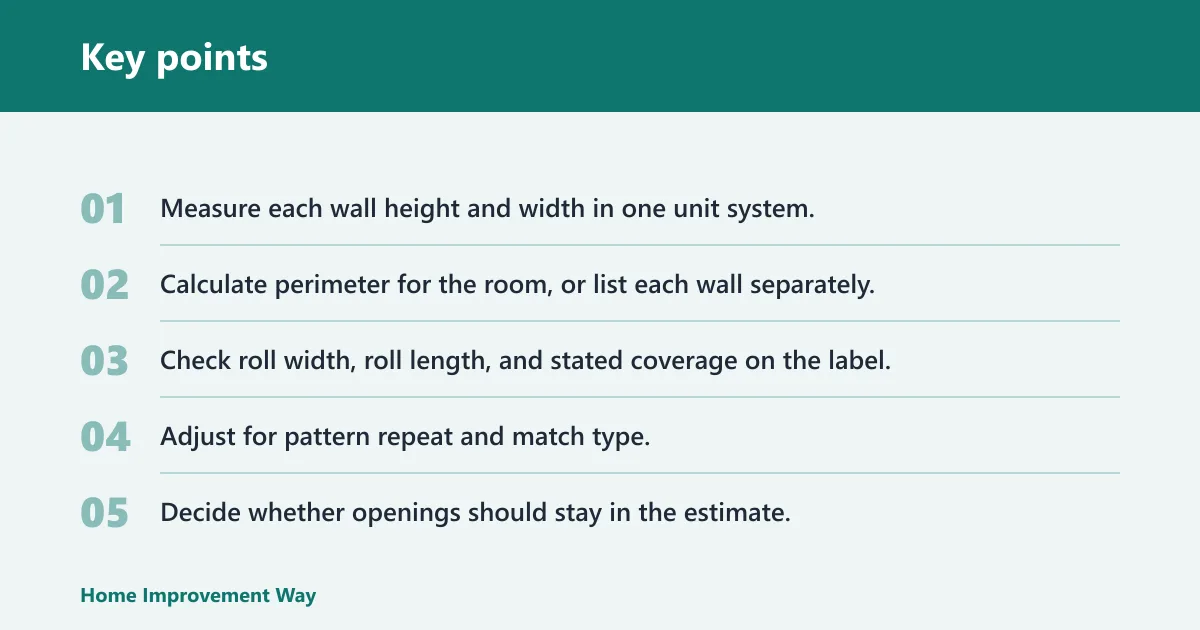
- Measure each wall height and width in one unit system.
- Calculate perimeter for the room, or list each wall separately.
- Check roll width, roll length, and stated coverage on the label.
- Adjust for pattern repeat and match type.
- Decide whether openings should stay in the estimate.
- Add 10% to 20% buffer, then round up to whole rolls.
- Buy one spare repair roll if matching shade matters.
What changes for special rooms?
Special spaces usually need more caution, not less. Accent walls are simpler, but ceilings, stairs, and bathrooms can create waste that a plain rectangle does not. The safest approach is to count each wall or section as its own job, then apply the same roll and repeat rules to every part.
Accent walls and feature walls
Accent walls are often the easiest estimate because you only need one surface. Even so, do not ignore pattern repeat, because a single feature wall can still demand extra drops for alignment at the edges. If the wall is wide but not tall, strip count can still beat area count.
Ceilings and stairs
Ceilings need full coverage and often more hands-on trimming, so they deserve a larger buffer. Stairs are more difficult because they mix vertical rise, angled sections, and awkward offcuts. For both, plan for extra waste and avoid assuming that room area alone will tell you the full roll count.
Small bathrooms and rooms with large openings
Small bathrooms often have more openings per square foot than larger rooms, so the layout can be less efficient than it looks. Rooms with large openings can be similar, because the saved area does not always reduce the strip count. In those cases, a conservative estimate is usually the better buy.
Frequently asked questions
How much wallpaper do I need calculator?
A wallpaper calculator should use wall dimensions, roll dimensions, and pattern repeat to estimate usable drops, then round up to the next roll. A 10% buffer is a practical starting point, and a spare repair roll helps keep the same dye lot available if a strip is damaged later.
How many rolls of wallpaper calculator?
The number of rolls depends on wall height, perimeter, roll width, roll length, and pattern match. A plain wall can often be estimated by area, but patterned wallpaper needs strip counting. Always round up after adding buffer, because fractional rolls are not useful at checkout.
How do you determine how much wallpaper you need?
Measure each wall or the room perimeter and height, then check the roll label for width, length, and coverage. Next, account for repeat length, decide whether to subtract openings, and add extra for waste. That method is closer to how an installer plans a job than a simple area formula.
Should I include doors and windows in a wallpaper estimate?
Usually yes for planning, unless the room is simple and the openings are small enough that the deduction will not change the roll count. Large openings are often better left in the estimate, since trims, returns, and pattern matching can eat up the apparent savings. Thibaut advises not to deduct them.
Does a wallpaper calculator work in feet and metres?
Yes. A good wallpaper calculator should accept either imperial or metric values, as long as you keep the units consistent. Measure in feet and inches or in metres and centimetres, then convert before calculating perimeter, area, and strip count. The formulas do not change when the units are consistent.
Worked example: plain paper versus patterned paper
Here is the installer-style math that separates a quick estimate from a reliable one. Use the same room, then change only the paper type and repeat handling. The opening deduction does not always change the roll count, which is why the wall layout still needs to be checked after the area step.
| Example input | Value | Why it matters |
|---|---|---|
| Room size | 12 ft × 10 ft | Sets perimeter |
| Wall height | 8 ft | Sets cut length baseline |
| Roll width | 21 in | Sets strip count from perimeter |
| Roll length | 33 ft | Sets usable drops per roll |
| Openings | One door and one window | Tests whether deductions change quantity |
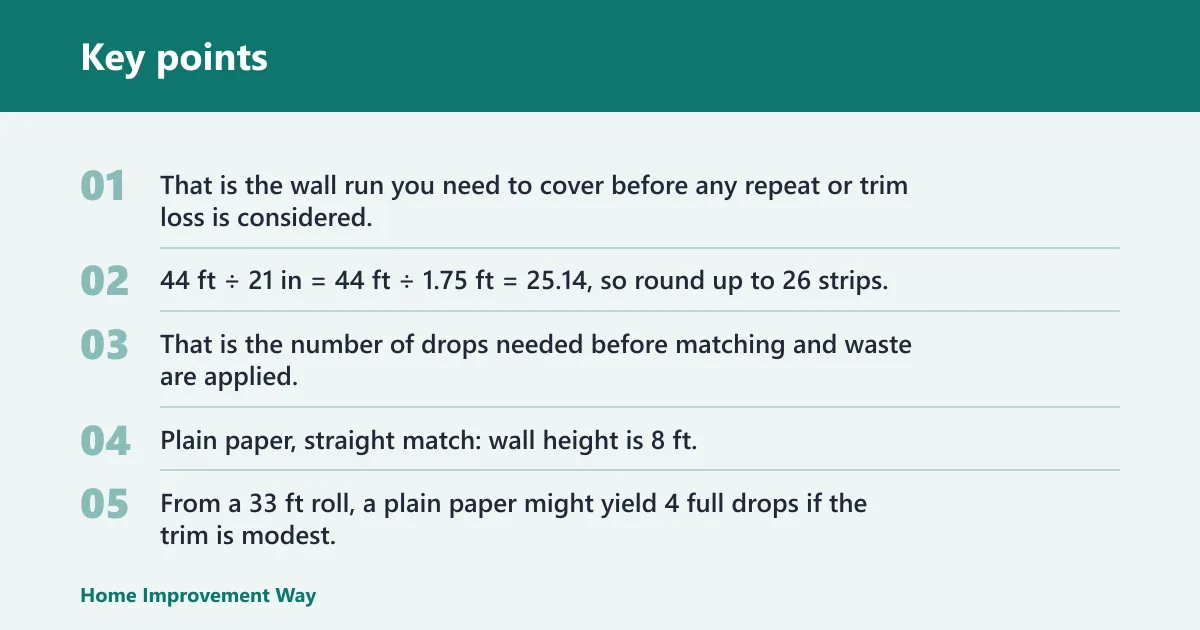
Step 1: calculate perimeter. 2 × (12 + 10) = 44 ft. That is the wall run you need to cover before any repeat or trim loss is considered.
Step 2: calculate strip count. 44 ft ÷ 21 in = 44 ft ÷ 1.75 ft = 25.14, so round up to 26 strips. That is the number of drops needed before matching and waste are applied.
Plain paper, straight match: wall height is 8 ft, so each drop needs about 8 ft plus a small trim allowance. From a 33 ft roll, a plain paper might yield 4 full drops if the trim is modest. 26 strips ÷ 4 drops per roll = 6.5, so round up to 7 rolls. If a small door and window are deducted, the strip count may still stay at 26 because the room perimeter has not changed; in that case, the roll count stays at 7.
Patterned paper, straight match: if the repeat is 20 in, the cut length may need to be aligned to the next repeat increment above the wall height. That can reduce the usable drops per roll from 4 to 3. Then 26 strips ÷ 3 = 8.67, so the estimate becomes 9 rolls before buffer. This is why a patterned paper often needs more rolls than a plain paper in the same room.
Patterned paper, half-drop: half-drop usually wastes more at the top of alternating strips. If the same 20 in repeat forces the same roll to still yield only 3 usable drops, the roll count remains 9; if the alignment wastes enough to reduce usable drops further, the count rises again. The key point is that the repeat type affects usable drops first, and the roll total follows from that.
Opening effect: on a plain room, removing a small door and window may not reduce the roll total because the strip count is still governed by perimeter and drop size. On patterned paper, openings are even less likely to reduce the count enough to matter, because match waste and extra trim typically absorb the theoretical savings. That is why many installers leave openings in the estimate unless the room is simple and the opening area is unusually large.
Buffer: after the roll total is found, add 10% to 20% and round up to the next full roll. That extra amount covers trimming, miscuts, and the chance that a later repair will need the same dye lot. In this example, the buffer can push a plain-paper order from 7 rolls to 8, and a patterned order from 9 rolls to 10.
When area fails checklist: use strip count instead of area when the paper has a repeat, the room has several openings, wall widths are uneven, the ceiling is sloped, or the wall height is close to the roll’s usable cut length. Area is still a useful check, but it is not the decision rule that determines how many rolls to buy.
Plain paper: usable drops step by step
With plain paper, the strip count is driven mostly by room perimeter and roll width. A cleaner cut length means more usable drops per roll, and openings are less likely to change the answer. The estimate is still rounded up, because the final strip on each roll is usually too short to treat as a full usable drop.
Patterned paper: straight match versus half-drop
Straight match keeps the same height alignment from strip to strip, so the waste is predictable. Half-drop shifts every other strip, which usually increases the amount cut off at the top. That can lower usable drops per roll, so the final roll count may be higher even when the wall dimensions do not change.
How openings do or do not change the roll count
Openings only change the roll count when they reduce the number of full strips or remove enough total wall run to change the strip math. In many rooms, the cut-off pieces created by a door or window cannot be reused efficiently, so the roll count stays the same even after deduction. That is why conservative estimates are common.
Sponsored / affiliate links. As an Amazon Associate I earn from qualifying purchases. I may earn additional commission from eligible campaigns.