Dehumidifier Size Calculator: Find the Right Size
Use a dehumidifier size calculator by starting with square footage, then choose roughly 30-pint for smaller spaces, about 50-pint for medium spaces, and around 60–70-pint for basements, crawl spaces, or other especially damp, cooler areas. Too small leaves damp air in the room, raises mold risk, and makes the unit run nonstop. This guide shows the sizing workflow, how temperature changes capacity, and when calculator results need a bigger machine.
How is this calculated?
Press Calculate to see the math with your numbers.
What dehumidifier size means
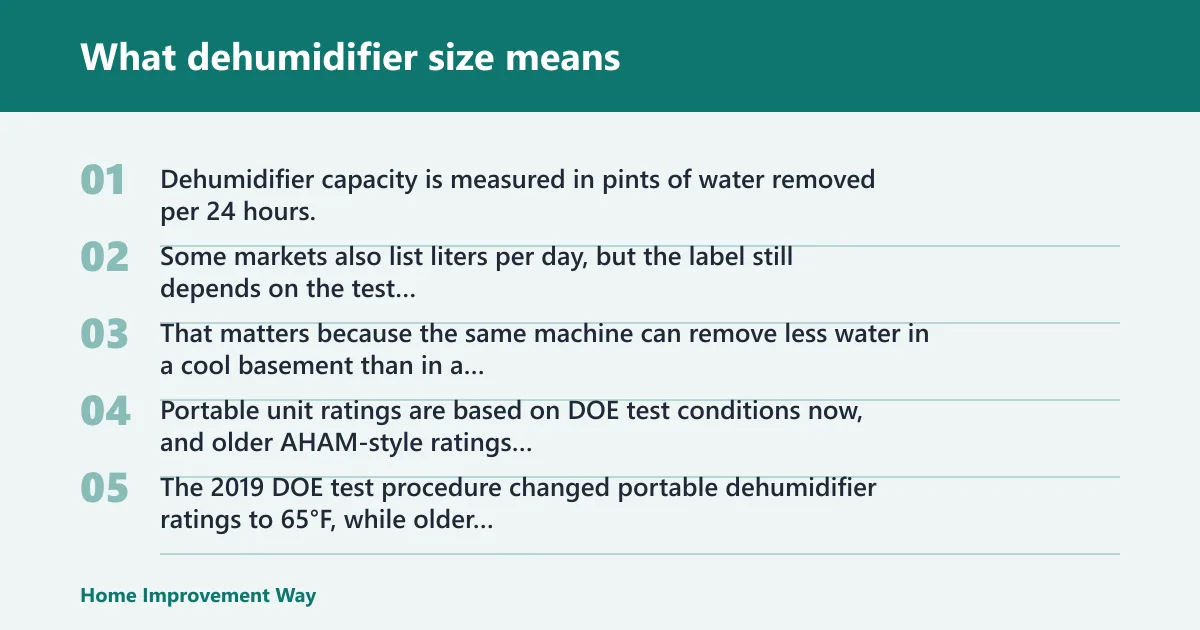

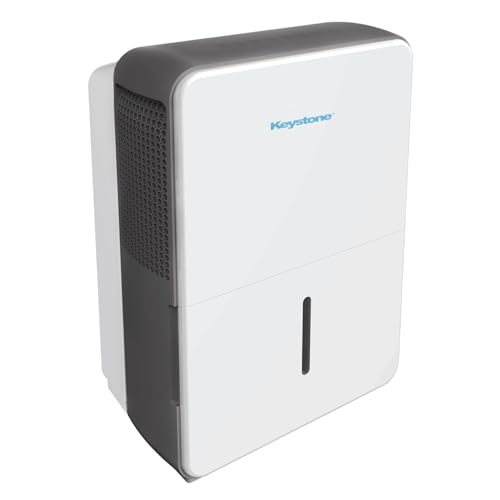

Dehumidifier capacity is measured in pints of water removed per 24 hours. Some markets also list liters per day, but the label still depends on the test condition, not just the number printed on the box. That matters because the same machine can remove less water in a cool basement than in a warm room.
Portable unit ratings are based on DOE test conditions now, and older AHAM-style ratings are not directly comparable. The 2019 DOE test procedure changed portable dehumidifier ratings to 65°F, while older testing used 80°F and 60% relative humidity. That is why a newer 50-pint unit can look smaller than an old 70-pint unit.
Why newer DOE ratings can look smaller than older ratings
A “pint” number only helps when you know which test produced it. Older labels were often measured in warmer, wetter air, so the same hardware could earn a larger number on the old scale. Under DOE’s 65°F test, the label usually falls. That does not mean the unit got weaker.
According to howmanybtus.com — Dehumidifier capacity is measured in pints of water removed per 24 hours.
How to calculate dehumidifier size
Start with room area, then adjust for dampness, ceiling height, open doorways, and the moisture source. ENERGY STAR sizes portable dehumidifiers by space size plus dampness, not square footage alone. A calculator result is enough for a simple bedroom or office, but not for a cool basement, laundry room, or connected floor plan.
Measure the room and convert it to square footage
Multiply length by width. A 20 × 32 ft basement equals 640 sq ft. If a room is irregular, break it into rectangles and add the areas. This is the first input because space size shapes the starting capacity before moisture load changes the final choice.
Match square footage to dampness level
Use the room’s humidity and visible moisture to pick a severity level: slightly to moderately damp, very damp, wet, or extremely wet. For spaces under 2,000 sq ft, slightly/moderately damp spaces start at 20–30 pints/day, very damp spaces at 25–40 pints/day, and wet spaces at 30–50 pints/day.
If the room sits in the 75–90% RH range, it usually needs more than a dry living area. If it is at 90–100% RH, standing water, recurring condensation, or musty finishes are likely driving the load. A calculator that skips this step usually sizes basements too low.
Adjust for ceiling height, open doorways, and moisture sources
Higher ceilings increase the air volume the unit must dry. Open doorways let humid air move in from other rooms. Active sources matter too: showers, dryers, wet concrete, and soil moisture can keep the unit running even when the room area looks modest. That is where calculator results need a bump upward.
What size dehumidifier do I need for my room?
For a small room, a 20–30 pint unit is often enough if the space is only slightly or moderately damp. For a laundry room or medium living area, step up when steam, wet clothes, or open floor plans add moisture. For basements and connected spaces, use the area plus dampness method, then adjust for temperature.
Small rooms and bathrooms
Bathrooms usually create short, intense moisture spikes. A 30-pint unit can handle many small spaces, but only if the room closes off well and does not stay wet for long periods. If the bathroom shares air with a hallway or bedroom, size for the combined area instead of the bathroom alone.
Laundry rooms and medium living spaces
Laundry rooms often need more capacity than their square footage suggests. Dryer vent leaks, damp clothing, and repeated steam loads push the unit harder. In a medium living space, a calculator result is enough if humidity is mild. If the room holds 60% RH or higher after normal use, size up.
Basements and larger connected areas
Basements usually need the largest portable unit in the same square footage class because they collect moisture from concrete, soil, and cooler air. A 640 sq ft basement still falls under the under-2,000-sq-ft guidance. If it connects to a stairwell, utility area, or storage room, include that air volume in the decision.
How much size do basements and crawl spaces need?
Basements and crawl spaces often need more capacity than a similar-size bedroom because they stay cooler and collect moisture from concrete, soil, or plumbing. Below about 65°F, a low-temperature model is recommended. That matters because frost can form on coils, which cuts performance and can make a correctly sized unit act undersized.
Cool basements and frost risk
A finished basement that sits near 60°F is not the same as a warm rec room. Cooler air holds less moisture, so the dehumidifier may not pull water as fast, and the coil can frost sooner. If the space often stays below about 65°F, choose a unit rated for low-temperature operation.
When a crawl space needs more than a standard portable unit
Crawl spaces with soil moisture, vent openings, or chronic condensation can overwhelm a small portable unit. If the space is low, hard to access, or rarely closed off, a standard room unit may not keep up. In those cases, a crawl-space dehumidifier or a whole-home approach is often the better fit.
Worked sizing table: 10 common room scenarios

This table turns room size, dampness, and temperature into a practical recommendation. The pint ranges reflect the common portable classes homeowners compare, while the “when to size up” column shows where a calculator result is not the final answer.
| Scenario | Input assumptions | Recommended pint range | When to size up | Low-temperature operation needed? |
|---|---|---|---|---|
| 1. Small bedroom | 120 sq ft, slightly damp, 70°F, closed door | 20–30 pints/day | If humidity stays above 55% RH after 24 hours | No |
| 2. Guest bath | 80 sq ft, steam after showers, 72°F | 20–30 pints/day | If the room feeds into a hall or stays wet between uses | No |
| 3. Laundry room | 140 sq ft, very damp during loads, 68°F | 25–40 pints/day | If clothes dry indoors or venting leaks moisture | Maybe |
| 4. Living room | 300 sq ft, moderately damp, 72°F | 20–30 pints/day | If it opens to a kitchen or lower level | No |
| 5. Finished basement corner | 400 sq ft, very damp, 62°F | 25–40 pints/day | If condensation returns on walls or windows | Yes |
| 6. 640 sq ft basement | 20 × 32 ft, very damp, 64°F | 25–40 pints/day | If the unit runs nonstop or the basement is 75–90% RH | Yes |
| 7. Wet storage room | 500 sq ft, wet, 70°F, concrete walls | 30–50 pints/day | If puddling or wall seepage is present | No |
| 8. Crawl space | 900 sq ft, very damp, 58°F, low clearance | 40–50+ pints/day | If frost forms or air movement is poor | Yes |
| 9. Open-plan lower floor | 1,200 sq ft, moderately damp, doors open, 70°F | 30–50 pints/day | If humidity spreads from adjoining rooms | No |
| 10. Large basement suite | 1,800 sq ft, very damp, 65°F, several rooms | 40–50+ pints/day | If RH stays above 60% or moisture source is active | Yes |
Should you oversize or undersize a dehumidifier?
Oversizing is usually safer than undersizing, but only to a point. A unit that is too small never reaches target humidity and runs constantly. A unit that is much too large may cycle quickly and leave the room less comfortable. The best choice is usually the smallest unit that can handle the wettest normal condition.
What happens when the unit is too small
Undersized units fail first because they cannot keep up with moisture input. The room stays above the target range, musty odors linger, and the compressor may run nonstop. If the unit is always full or never shuts off in normal weather, the calculator result was too low for the actual load.
When oversizing is the safer choice
Choose the larger class when the room has open access, high ceilings, cool concrete surfaces, or recurring moisture from showers, laundry, or soil. That extra margin helps the unit recover after wet weather. It also matters when the room is near 50–60°F and the listed capacity is likely to drop in real use.
When a whole-home system makes more sense
If several rooms stay damp together, or if the basement and main floor both drift above target humidity, one portable unit may not be the right fix. A whole-home dehumidifier is often better when the moisture problem is spread out, the house is tight, or the room-by-room approach keeps failing.
What humidity should I set my dehumidifier to?
For most homes, a target around 30–50% RH is the practical range. Many homeowners aim near 45% for comfort and mold control. If the room sits at 60% RH or higher after days of running, the unit may be undersized, the room may be too open, or the moisture source may be active.
When 50% RH is enough
Set the unit near 50% RH in most living areas, bedrooms, and finished basements. That level usually keeps surfaces dry without overworking the machine. If the room is cool, a slightly higher setting may reduce short cycling, but the room should still stay below the damp range.
When 60% RH still signals a sizing problem
If the dehumidifier cannot get below 60% RH, the issue is often capacity, not settings. Check whether the room is larger than estimated, the door stays open, the ceiling is high, or the unit lacks low-temperature capability. A correct setpoint cannot fix a unit that is too small for the load.
Frequently asked questions
How do you know what size dehumidifier to buy?
Start with square footage, then add dampness, ceiling height, and room type. ENERGY STAR sizes portable dehumidifiers by space size plus dampness, so a calculator result is only the first pass. If the room is a basement, crawl space, or laundry area, choose the next larger class when moisture is persistent.
What size dehumidifier for 1000 sq ft?
For 1000 sq ft, many spaces fall in the 30–50 pint range, depending on dampness and layout. Slightly damp rooms can land lower, while very damp basements or open connected areas usually need more. If the space sits near 60°F, choose a low-temperature model and lean larger.
What size dehumidifier for 2000 sq ft?
At 2000 sq ft, portable sizing often reaches the upper end of the homeowner range, and room connection matters a lot. If the space is one open level, a larger portable may work. If it is a basement suite or whole-floor problem, a whole-home unit may be the better fit.
What size dehumidifier do I need for a basement?
A basement usually needs more capacity than a similar-size living room because concrete, soil, and cooler air add load. Under 2,000 sq ft, the ENERGY STAR guidance still applies, but a cool basement often needs a low-temperature model. If it stays below about 65°F, do not buy a standard warm-room unit.
Why does a 50 pint dehumidifier today seem smaller than an old 70 pint?
Because the rating changed. The DOE test procedure for portable dehumidifiers changed in 2019 to 65°F, while older testing used 80°F and 60% relative humidity. That means older 70-pint units are roughly comparable to a modern 50-pint rating, so the labels are not directly interchangeable.
Do I need a low-temperature dehumidifier for a cool basement?
If the basement often stays below about 65°F, yes. Cooler air can cause frost risk on coils and cut water removal, which makes the unit act smaller than its label suggests. A low-temperature model is the safer pick for cool finished basements, crawl spaces, and similar spaces.
Sponsored / affiliate links. As an Amazon Associate I earn from qualifying purchases. I may earn additional commission from eligible campaigns.