Thinset Calculator: How Much Thinset You Need for Tile Jobs
A thinset calculator should start with tile area, trowel size, substrate flatness, and back-buttering. As a rough rule, a 50-lb bag may cover about 60-90 sq ft with a 1/4 x 1/4 trowel on flat floors, and less with larger tile or rougher surfaces. Buy short and you stop mid-job. Buy too much and you pay for mortar that sits on the shelf. This guide shows how to estimate coverage, pick a trowel, adjust for substrate and tile type, and turn that into a realistic bag count.
How is this calculated?
Press Calculate to see the math with your numbers.
What does a thinset calculator actually need to know?


A useful thinset calculator needs four inputs first: area, tile format, trowel notch, and substrate condition. Those are the variables that move bag count the most. If it also asks about back-buttering and waste, the estimate gets much closer to what happens on a real job.
Thinset mortar is the cement-and-sand adhesive used to set tile on floors, walls, showers, backsplashes, and patios. Modified and unmodified mortars are not interchangeable. Product choice depends on the tile, the substrate, and the install method called for by the manufacturer and the setting materials standard.
Why back-buttering and waste matter
Back-buttering changes coverage fast, especially with 12×24, 24×48, and other large-format tile. Uneven slabs, lippage correction, and cleanup losses also eat into a bag. A calculator that ignores those factors will usually come in light.
Waste allowance is often in the rough range of 5% to 20%. Smaller rooms with simple cuts sit near the low end. A shower, backsplash, or patio with more cuts and more fitting work pushes higher. One competitor uses 10% as a standard setting, and that is a reasonable middle ground for many jobs.
How the result should round
Round up to whole bags. Always. Thinset is mixed by bag, not by theory, and a half bag on paper is a full bag in the truck. If the area is split across rooms, add the segments before dividing by coverage.
How much thinset do you need for your tile job?
The fastest estimate is area divided by expected coverage per bag, then add waste. On a flat floor with small tile and a modest notch, a 50-lb bag may cover near the high end of the range. With larger tile, rougher substrate, or back-buttering, coverage drops and bag count rises.
Quick estimate by square footage
- 25 sq ft: often 1 bag, sometimes 2 if the substrate is rough or the tile is large.
- 50 sq ft: often 1 to 2 bags.
- 100 sq ft: often 2 to 4 bags.
- 200 sq ft: often 4 to 7 bags, depending on notch and tile size.
Those ranges are not universal. A 1/4 x 1/4 notch on a flat surface will land very differently than a 1/2 x 1/2 notch under 12×24 porcelain with back-buttering.
When to add extra bags
Add extra for showers, backsplashes, and patios where cuts and fit-up waste are common. Add extra again when the floor is not flat, when you are setting over existing tile, or when the tile is large enough that full coverage requires extra mortar on the back.
How thick should thinset be?
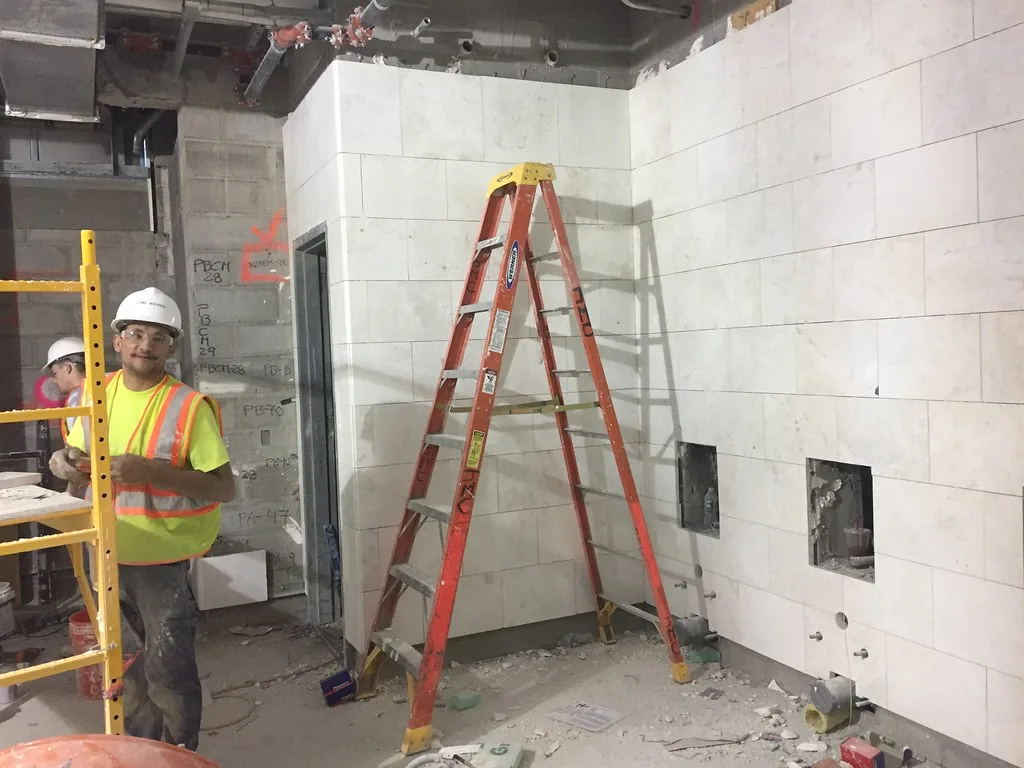
Thinset should be thick enough to support the tile and achieve proper coverage, but not so thick that it becomes a leveling bed. Under most tile, it is a setting layer, not a filler for floor defects. If the substrate is out of flat, fix the substrate instead of trying to bury the problem in mortar.
Normal bed thickness and maximum build-up
With a standard notch, the mortar ridges collapse under the tile and leave a bed that is often around 3/32 to 1/4 inch after the tile is beaten in, depending on the notch and pressure. Maximum build-up varies by product, so the bag and data sheet matter. A bigger notch is not the fix for a wavy floor.
If the floor needs more than what the mortar is rated to handle, the better move is patching or flattening first. That protects bond strength and avoids hollow spots under large tile.
Choose the right trowel notch for the tile
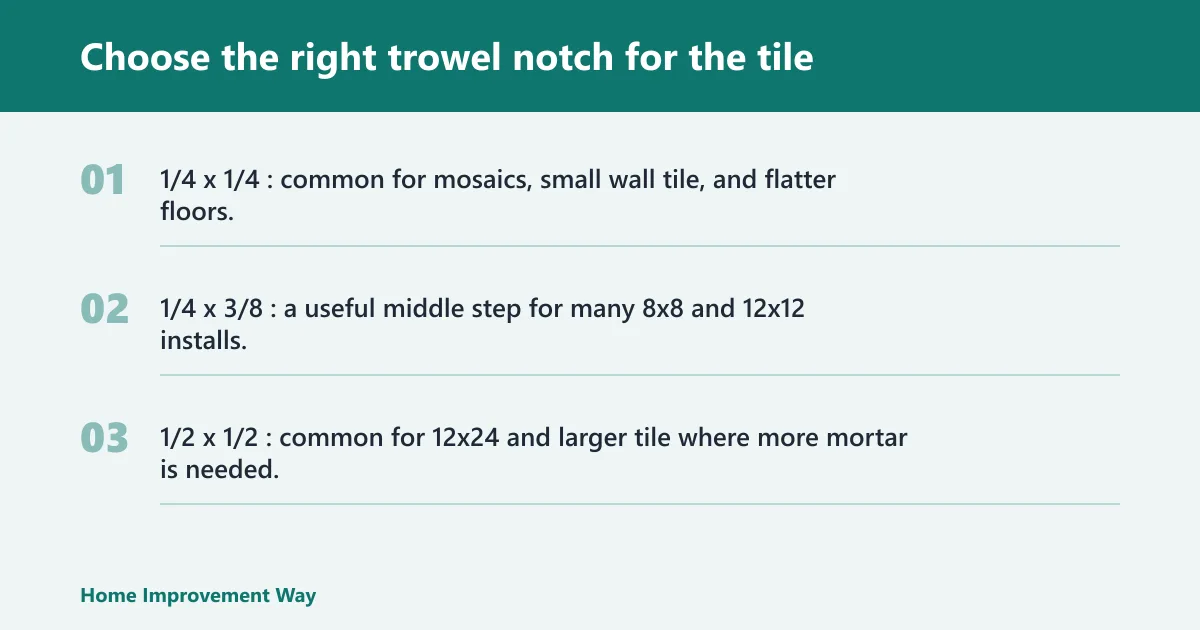
Trowel notch size controls mortar volume and coverage. Common choices are often 1/4 x 1/4, 1/4 x 3/8, and 1/2 x 1/2. Square, U-notch, and V-notch shapes all move mortar differently, so the shape matters as much as the dimension.
What each common notch does
- 1/4 x 1/4: common for mosaics, small wall tile, and flatter floors.
- 1/4 x 3/8: a useful middle step for many 8×8 and 12×12 installs.
- 1/2 x 1/2: common for 12×24 and larger tile where more mortar is needed.
A competitor calculator says a 1/4″ × 1/4″ square-notch can cover about 90–100 sq ft per 50 lb bag, while a 1/2″ × 1/2″ square-notch is around 55–65 sq ft per 50 lb bag. Another page says a 1/4″ × 1/4″ square or V-notch can yield 75–95 sq ft using a 50 lb bag. Those ranges show why notch choice changes the bag count so much.
What to use for common tile sizes
For mosaic and small wall tile, smaller notches often work. For 4×4 and 8×8, the choice depends on flatness and back of tile texture. For 12×12, a 1/4 x 3/8 or 1/2 x 1/2 often makes sense. For 12×24 and 24×48, a 1/2 x 1/2 notch is common, and back-buttering is often part of the setup.
One calculator uses tile sizes from 2″ x 2″ and smaller up to 12″ x 12″ and larger. Another says 1/2″ × 1/2″ square-notch is for 12″×24″, 18″×18″, 24″×24″ and larger. That tracks with field reality: bigger tile usually needs more mortar to reach full support.
How substrate type changes thinset demand
Substrate type affects both demand and cure behavior. Concrete, cement board, plywood, uncoupling membrane, and existing tile each change how much mortar is needed and how the install should be treated. Flat concrete will usually use less mortar than a bumpy substrate or an old tile floor.
Concrete versus cement board
Concrete often gives the most predictable coverage if it is flat and properly prepared. Cement board usually behaves well too, but seams and fasteners still need attention. Both can use less mortar than a rough substrate that has been patched unevenly.
Why plywood, uncoupling membrane, and existing tile can change coverage
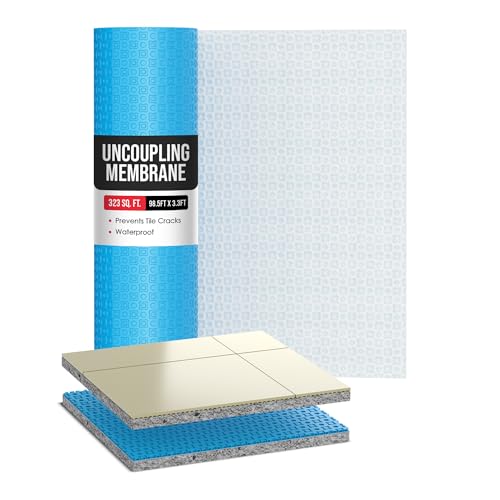
Plywood needs the right mortar and correct prep because the assembly flexes differently than concrete. Uncoupling membrane can add texture and change the feel of the notch. Existing tile often has ridges, glaze, and height changes that force more mortar and more attention to flatness.
For membranes, confirm the mortar and method against the membrane manufacturer. For porcelain, also confirm that the mortar is approved for dense tile and the substrate. ANSI A118 and TCNA guidance frame the choice, but the bag label still decides the actual install method.
Thinset coverage matrix by trowel, substrate, and back-buttering
The table below shows estimated 50-lb bag counts for three trowel sizes across two substrate conditions. It uses a simple assumption: flat substrate means better coverage; rough or less-flat substrate means more mortar use. The back-buttering column is an add-on because large tile often needs it and it changes the bag count.
| Area | 1/4 x 1/4, flat concrete | 1/4 x 1/4, rougher substrate | 1/4 x 3/8, flat concrete | 1/4 x 3/8, rougher substrate | 1/2 x 1/2, flat concrete | 1/2 x 1/2, rougher substrate | Back-buttering add-on |
|---|---|---|---|---|---|---|---|
| 25 sq ft | 1 bag | 1 bag | 1 bag | 1 bag | 1 bag | 1 bag | +0 to 1 bag |
| 50 sq ft | 1 bag | 1 to 2 bags | 1 to 2 bags | 2 bags | 1 to 2 bags | 2 bags | +0 to 1 bag |
| 100 sq ft | 2 bags | 2 to 3 bags | 2 to 3 bags | 3 bags | 2 to 3 bags | 3 to 4 bags | +1 bag |
| 200 sq ft | 3 to 4 bags | 4 to 5 bags | 4 to 5 bags | 5 to 6 bags | 4 to 5 bags | 6 to 7 bags | +1 to 2 bags |
This matrix is transparent on purpose. It does not pretend every 50-lb bag covers the same area. It shows how the count moves when the notch gets larger and when the substrate needs more mortar to achieve coverage.
Worked example
For a job around 100 sq ft of 12×24 porcelain on a concrete floor, a 1/2 x 1/2 notch with back-buttering may push the job into roughly the 3 to 4 bag range before waste. Add 10% waste, and the safer order is usually the higher whole-bag number.
That is exactly how under-ordering happens. The estimate was based on square footage only, but the actual job needed more mortar for the tile back, a flatter bond coat, and a little cleanup loss.
How to read manufacturer coverage charts and standards
Manufacturer coverage charts beat generic estimates because mortar chemistry and trowel behavior vary by product. MAPEI’s calculator hub includes tile mortars and adhesives as a product category, and MAPEI also lists 4 to 1 as a sand-and-cement mortar mix for thick-bed mortar installations. That is not the same thing as standard thinset coverage.
Standards and product examples
ANSI A118.4 and A118.15 are common mortar standards referenced by calculators, and TCNA guidance helps frame the install method. That matters when choosing between modified and unmodified mortar, or when selecting a product for porcelain, membrane work, or wet-area tile.
Product examples such as MAPEI Ultraflex, LATICRETE 254, Schluter ALL-SET, ARDEX X 5, and TEC Full Flex are not interchangeable. Coverage and application vary by product. One calculator even notes a Schluter ALL-SET mix sequence of 5 minutes mix, 10 minutes slake, then 3 minutes remix, which is a reminder that the instructions are product-specific.
How to use the chart without fooling yourself
- Measure the tile area by room or section.
- Pick the tile format and expected notch size.
- Check the substrate for flatness and condition.
- Add back-buttering if the tile size or manufacturer calls for it.
- Add 5% to 20% waste.
- Round up to whole bags and confirm the bag chart on the product you are buying.
Frequently asked questions
how much thinset do i need calculator
A thinset calculator should ask for area, tile size, trowel notch, substrate, waste, and back-buttering. That gives a more honest bag count than square footage alone. The final number should be rounded up to whole bags after checking the manufacturer coverage chart for the exact mortar.
how thick should thinset be
Thinset should end up as a setting layer, not a leveling bed. The finished thickness depends on the notch and tile, but the goal is full coverage without excess buildup. If the floor is out of flat, fix that first instead of relying on extra mortar.
what is the maximum thickness for thinset
Maximum thickness depends on the mortar product, not on a universal rule. Some mortars are made for thicker builds, while standard thinset is not meant to correct large surface defects. Check the bag or technical sheet before using a larger notch to solve a flatness problem.
how many bags of thinset do i need for 100 square feet
For 100 sq ft, the answer can range from about 2 bags to 4 bags depending on notch size, tile format, substrate, and back-buttering. A small mosaic job on a flat floor may sit near the low end, while 12×24 or larger tile moves the count up fast.
what trowel size should i use for 12×12 tile
A 12×12 tile often works with a 1/4 x 3/8 or 1/2 x 1/2 notch, depending on tile backs and substrate flatness. If the slab is very flat, a smaller notch may be enough. If coverage is weak, increase the notch after checking bond and coverage.
do I need different thinset for porcelain or membrane installs
Yes, often. Porcelain is dense and may need a mortar approved for that tile type, while membrane installs must follow the membrane manufacturer’s mortar requirements. ANSI A118 and TCNA guidance help frame the selection, but the product label and install instructions control the final choice.
should I add waste when calculating thinset
Yes. Add 5% to 20% for cuts, uneven floors, back-buttering, and cleanup losses. A simple backsplash may only need a small allowance, while a large shower or badly out-of-flat floor needs more. Waste is cheaper than stopping the job to buy another bag.
Sponsored / affiliate links. As an Amazon Associate I earn from qualifying purchases. I may earn additional commission from eligible campaigns.