Concrete Calculator: How Much to Order
A concrete calculator estimates slab, footing, post, or sonotube volume in cubic feet, then converts to cubic yards or bags; I order 10% extra, and if the pour is over about 0.5 yard, a ready-mix truck is usually cheaper. Under-ordering leaves cold joints, weak edges, or a second trip for bags. This guide covers quick formulas, slope and shape adjustments, and when to buy bags versus yards.
How is this calculated?
Press Calculate to see the math with your numbers.
How does a concrete calculator work?

A concrete calculator turns length, width, and thickness into volume. It gives a first-pass answer in cubic feet, then converts that number to cubic yards or bag counts. I use that first answer to get close, then I check form size, slope, waste, and delivery limits before I order.
What measurements the calculator needs
For a slab, the usual inputs are length, width, and thickness. For a footing, the calculator needs length, width, and depth. For a pier or tube, it needs diameter and height, or the form’s inside dimensions if the shape is square. The calculator estimates the volume and weight of concrete needed for a given area.
Concrete is cement, water, and aggregate mixed together. Ready-mix is commonly sold by the cubic yard, and one cubic yard equals 27 cubic feet. That is why the calculator almost always ends with a yard figure for truck orders and a bag count for smaller pours.
How volume is calculated from length, width, and thickness
The standard path is simple: measure the pour, multiply length by width by thickness, and divide by 27 to convert cubic feet to cubic yards. If thickness is in inches, convert it to feet first by dividing by 12. A 4-inch slab is standard for residential slabs.
- Measure the inside face of the forms, not the rough ground around them.
- Convert inches to feet before multiplying.
- Multiply length × width × thickness.
- Divide cubic feet by 27 to get cubic yards.
- Add extra for waste and jobsite variation.
Why the first answer is only a starting point
The first answer assumes flat, square, fully filled forms. Real pours rarely behave that neatly. Soil settles, subgrades dip, edges flare, and small overcuts add volume. A calculator is the starting line. The final order should reflect the actual shape on site, not the perfect drawing on paper.
How much concrete do you need for a slab?
For a slab, concrete is figured from length, width, and thickness. A square or rectangle is the cleanest case. A 10×10 slab at 4 inches needs 1.24 cubic yards, and a 10×10 slab at 6 inches needs 1.85 yards. That difference is why thickness matters before ordering.
Rectangle and square slab math
For a rectangle or square, use the inside dimensions of the form. A patio, sidewalk section, or garage pad all follow the same volume rule. If the pad slopes, use the average thickness rather than the thickest edge. Otherwise the order comes up short on the low side.
Thickness guide: sidewalks and walkways are commonly 4 inches, driveways are often 4 to 5 inches and may run 5 to 6 inches for heavier use, and garage slabs are commonly 4 to 5 inches. When in doubt, use the actual form height, not the intended finished height.
Worked example for a 10 x 10 slab
A 10×10 slab at 4 inches is 100 square feet times 0.333 feet thick, or about 33.3 cubic feet. Divide by 27 and the result is 1.24 cubic yards. If the same slab is 6 inches thick, the result rises to 1.85 yards. That is before any overage.
If the slab edges are uneven or the base is soft, add more than the calculator shows. A 4-inch patio over well-packed base may need only modest extra. A garage slab on imperfect fill needs a bigger cushion because the subgrade can steal volume as it gets compacted.

How much concrete do you need for a footing or post hole?
Footings and post holes are usually small, but they punish bad estimates. A continuous footing uses length, width, and depth. A square footing uses length, width, and depth. Sonotube and round pier pours use diameter and height. Bell bottoms, wider tops, and tapered holes change the amount sharply.
Continuous footings versus square footings
A continuous or strip footing runs along a wall line, so the length is the big number. Multiply length × width × depth, then divide by 27. A square footing uses the same method, only with a shorter length and width. Structural loads make precision more important here than on a simple patio.
Sonotube and round pier calculations
For a round pier, use the inside diameter, then calculate the cylinder volume from the circle area and height. Tube forms used for deck posts and small piers are often easiest to estimate from the form size printed on the tube. A square pier uses the same volume method as any box-shaped form.
Why hole shape and bell bottoms change the math
Post holes are rarely straight-sided all the way down. The bottom may bell out, the top may flare, or the hole may be cleaned wider than planned. That extra space adds volume. If the hole was augered and then trimmed by hand, the actual opening is usually larger than the nominal hole size.
For deck footings and fence posts, a small miss matters. An extra partial bag is easier to return than a second trip with wet concrete waiting in a wheelbarrow.
How do you calculate concrete for irregular shapes?
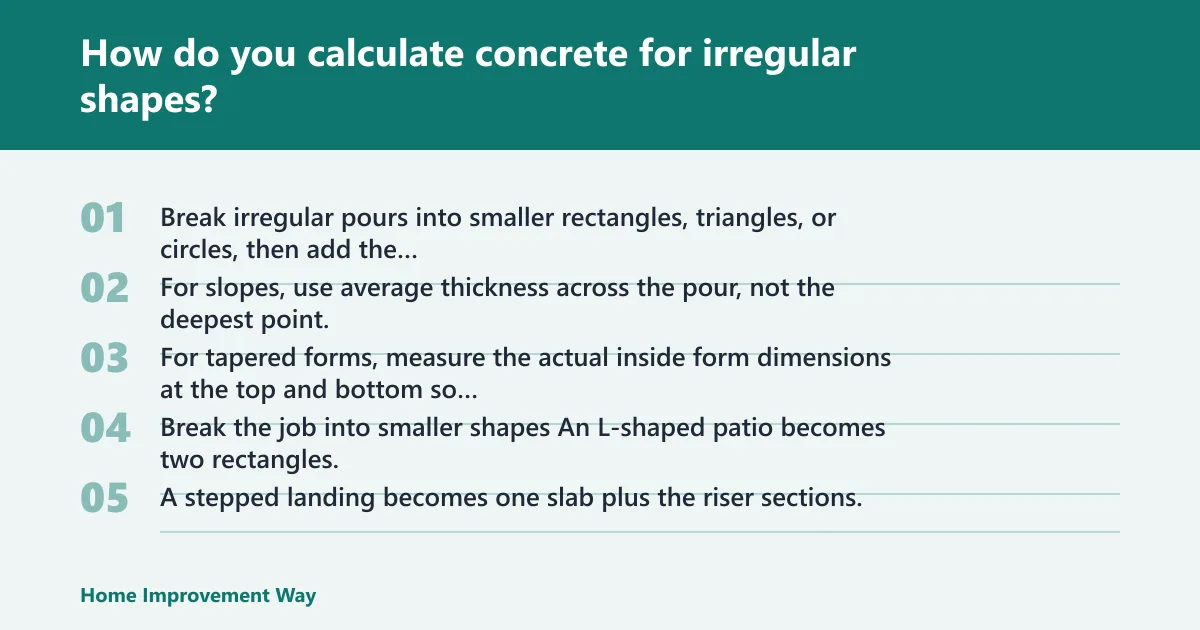
Break irregular pours into smaller rectangles, triangles, or circles, then add the pieces together. For slopes, use average thickness across the pour, not the deepest point. For tapered forms, measure the actual inside form dimensions at the top and bottom so the calculator reflects the real volume.
Break the job into smaller shapes
An L-shaped patio becomes two rectangles. A stepped landing becomes one slab plus the riser sections. A curved edge can often be approximated as a narrow rectangle for estimating, then checked against the actual form line. This method is more dependable than trying to force one odd shape into a single formula.
Use average thickness for slopes and tapered areas
Sloped pads need special handling. A pad that starts around 4 inches and rises to around 6 inches can often be treated as having an average thickness near 5 inches unless the slope is steep. Tapered footings and stair pours should be figured from the true average section depth, not the shallow end alone.
Check actual form dimensions before you order
Nominal dimensions and actual form dimensions are not the same. A 10-foot plan may measure slightly less once the forms are set, or slightly more after cleanup and staking. Measure inside the forms, then check whether the base was overexcavated. That is where many under-orders start.
| Project type | Typical extra | Why the extra is there | Worked adjustment example |
|---|---|---|---|
| Slab | 5% to 8% | Spillage, edge loss, uneven base | 1.24 yards becomes about 1.30 to 1.34 yards |
| Footing | 8% to 10% | Trench irregularity, soil sloughing | 0.80 yards becomes about 0.86 to 0.88 yards |
| Post hole | 10% | Auger oversize, bell bottom, cleanup | 0.12 yards becomes about 0.13 yards |
| Sonotube / pier | 5% to 10% | Tube flare, base waste, settling | 0.20 yards becomes about 0.21 to 0.22 yards |
| Steps | 10% | Small forms, odd corners, finish loss | 0.50 yards becomes about 0.55 yards |
How many bags of concrete do you need?
Bag count depends on the bag size and the yield per bag. Concrete is sold in 60- or 80-pound bags or delivered by mixer trucks. Bag work makes sense for small pours, repairs, posts, and one-step projects. Once the count gets high, the labor often outweighs the savings.
40 lb, 50 lb, 60 lb, and 80 lb bag yield basics
A 50-pound bag of concrete yields about 0.375 cubic feet. An 80-pound bag yields approximately 0.022 cubic yards, and average bag counts per cubic yard are 75 bags at 50 lb, 60 bags at 60 lb, or 45 bags at 80 lb. That is a lot of handling for one yard.
Smaller bags are easier to carry, but they mean more trips, more mixing, and more chances to run short. If the pour is close to a yard, the labor cost usually becomes the real cost.
When bags beat a ready-mix truck
Bags usually make sense for small slabs, a few post holes, stair repairs, or a tiny landing where delivery would be overkill. They also help when access is poor and a truck chute cannot reach the pour. For anything that needs steady placement over time, truck concrete is usually the better choice.
When bag count starts getting impractical
At some point, the number of bags becomes the problem. Mixing dozens of bags by hand is slow, and the first batch may start to set before the last one is poured. If the project is larger than a small patch or two, yard ordering becomes easier to manage.
How much extra concrete should you order?
Adding 5% to 10% extra material is recommended for settling, spillage, and waste. It also lowers short-load risk, which matters when a truck arrives with less than planned or the forms take more than the drawing suggested. Different projects need different buffers, though.
Project-specific overage matrix
The right extra amount depends on the job. Flat slabs waste less than footings. Post holes and stairs are fussier because the shapes are irregular and the edges are hard to judge. Use the matrix below as a working rule, then adjust for rough soil, slope, and form quality.
Why 5% to 10% is the usual range
That range covers normal field loss. A little spills. A little settles. A little sticks in the chute, the wheelbarrow, or the bucket. More important, the extra helps prevent a dry finish at the end of the pour, which is when crews are least able to stop and reorder.
Worked example: if a calculator says 1.24 yards for a 10×10 slab, adding 5% gives about 1.30 yards. Adding 10% gives about 1.36 yards. For a footing that calculates to 0.90 yard, 10% extra brings the order to just under 1.0 yard, which may be the difference between one delivery and a short-load charge.
Should you buy concrete by the yard or in bags?
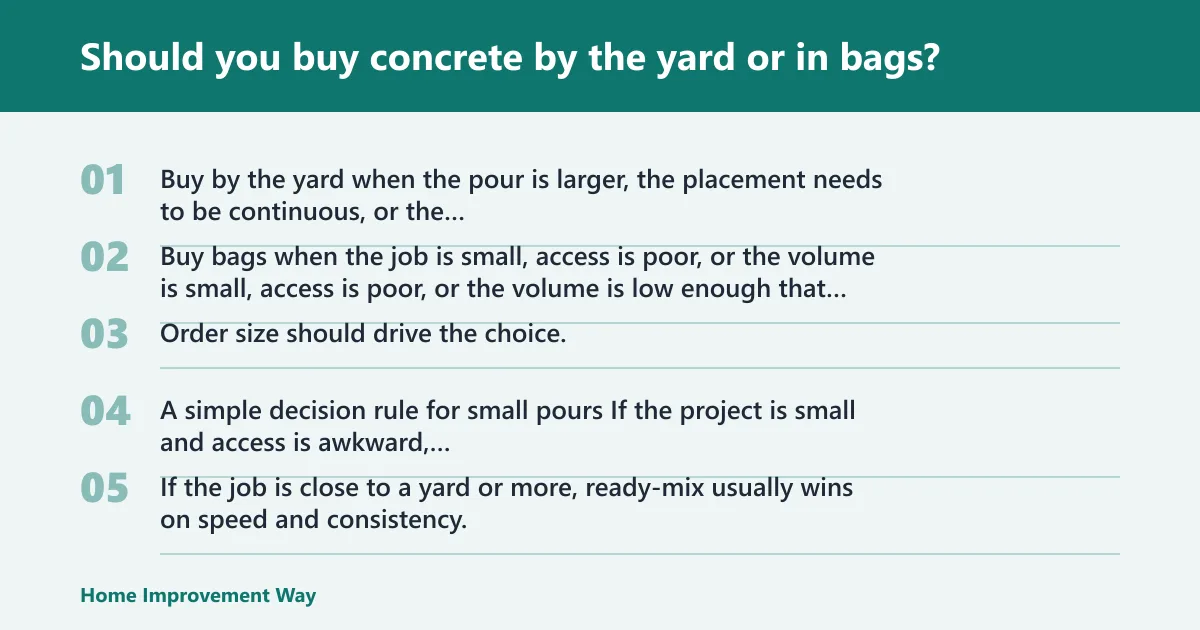
Buy by the yard when the pour is larger, the placement needs to be continuous, or the truck price beats the labor of bag mixing. Buy bags when the job is small, access is poor, or the volume is low enough that delivery minimums and short-load fees would waste money. Order size should drive the choice.
A simple decision rule for small pours
If the project is small and access is awkward, bags can be the cleaner option. If the job is close to a yard or more, ready-mix usually wins on speed and consistency. A calculator helps here because it turns guesswork into a volume number you can compare.
When delivery minimums change the answer
Some suppliers set minimums, and a small load can bring extra fees. That matters on tiny pours. A bag order avoids the truck minimum but adds labor. The real question is not only price per cubic yard; it is total cost, including time, cleanup, and how many people are available to place it.
How cost changes with bag size, truck pricing, and short-load fees
Cost follows volume. A larger bag size often reduces the number of bags needed, but not always the total headache. Ready-mix pricing varies by supplier, and short-load fees can make an undersized truck order expensive fast. If the estimate is close, add waste now rather than pay later for a second delivery.
For a rough check, multiply the cubic yards by the supplier’s yard price, then compare that total with the bag count multiplied by the bag price. Add delivery, possible short-load fees, and the cost of time spent mixing.
Frequently asked questions
How do I calculate how much concrete I need?
Measure the inside length, width, and thickness of the pour, convert thickness to feet, multiply to get cubic feet, then divide by 27 for cubic yards. Add 5% to 10% for waste, spillage, and settling. That gives a safer order than the raw calculator result alone.
How many yards of concrete do I need?
Use cubic yards for ready-mix orders. One cubic yard equals 27 cubic feet. A slab, footing, or pier calculator usually gives volume first, then converts to yards. Round up to the next practical yard amount if the pour is large enough that a short load would cause trouble.
How many bags of concrete do I need?
Convert the project volume into cubic feet or yards, then divide by the bag yield for the size you plan to buy. Bag sizes vary, and 50 lb, 60 lb, and 80 lb bags do not cover the same area. Small pours are workable; large ones get tedious fast.
How much concrete do I need for a 10×10 slab?
A 10×10 slab at 4 inches needs 1.24 cubic yards. A 10×10 slab at 6 inches needs 1.85 yards. Those numbers are for a flat, square slab with no extra waste. Add more if the base is uneven, the slab slopes, or the forms are oversized.
How much concrete do I need for a post hole or sonotube?
Post holes and sonotubes are figured from diameter and height, or from the actual hole shape if it is not round. Bell bottoms and wide tops increase the volume. For deck posts and fence posts, check the hole size after digging, because augers often cut larger than the nominal diameter.
How many cubic feet are in a yard of concrete?
One cubic yard equals 27 cubic feet. That conversion is the bridge between site measurements and truck orders. If you know cubic feet already, divide by 27 to get cubic yards. If you know yards, multiply by 27 to understand the volume in more familiar footing or slab terms.
Sponsored / affiliate links. As an Amazon Associate I earn from qualifying purchases. I may earn additional commission from eligible campaigns.