Wattage calculator: choose the right formula for each load
Use P = V × A for DC and simple loads; use P = V × A × PF for AC loads with power factor, and use P = V² ÷ R or I² × R for resistive circuits. Pick the wrong formula and you can buy an undersized generator, blow a fuse, or drain a battery too fast. Start with the load type, not the calculator. This guide shows which watt formula fits appliances, batteries, PCs, and generators, plus the input checks that stop bad math.
How is this calculated?
Press Calculate to see the math with your numbers.
Start here: which watt formula do you need?
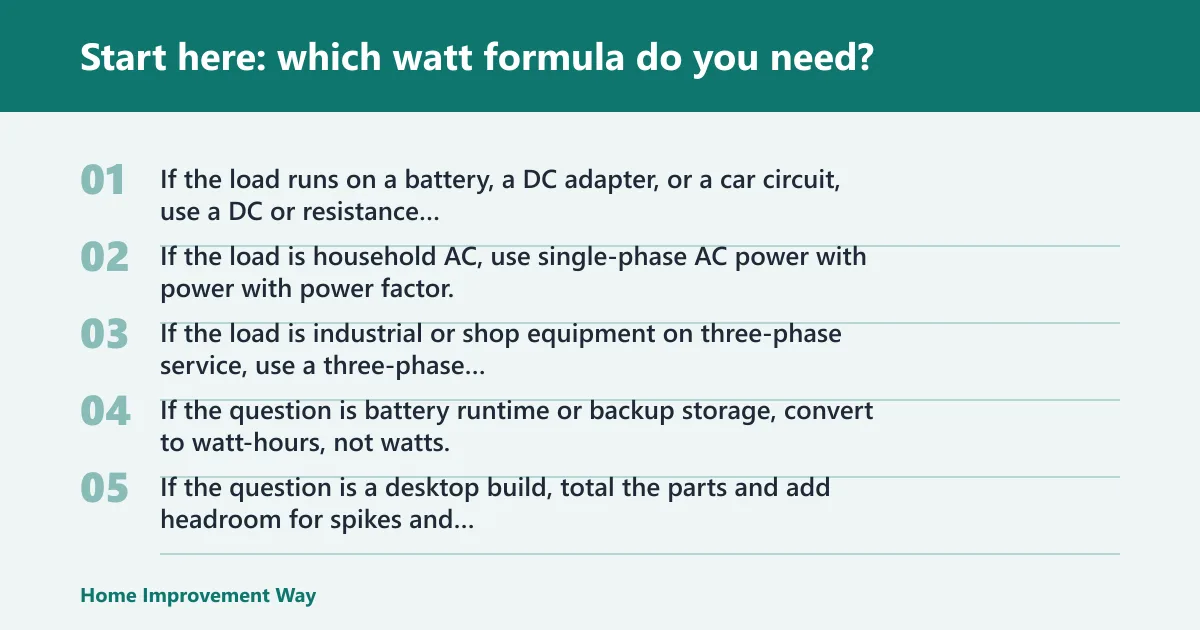
Start with the load type, not the calculator. DC devices, household AC, three-phase equipment, batteries, PC power supplies, and generators each need different inputs. Use the wrong voltage reference or skip power factor, and the answer looks tidy but fails in the field.
Decision tree by load type
- If the load runs on a battery, a DC adapter, or a car circuit, use a DC or resistance formula.
- If the load is household AC, use single-phase AC power with power factor.
- If the load is industrial or shop equipment on three-phase service, use a three-phase formula and confirm whether the voltage on the nameplate is line-to-line or line-to-neutral.
- If the question is battery runtime or backup storage, convert to watt-hours, not watts.
- If the question is a desktop build, total the parts and add headroom for spikes and future upgrades.
- If the question is a generator, separate running watts from starting watts before you size the unit.
Formula selection table
| Use case | Formula | Input units | Common mistake |
|---|---|---|---|
| DC device | P = V × I | Volts, amperes | Using AC power factor when none applies |
| Single-phase AC | P = V × I × PF | Volts, amperes, power factor | Leaving PF out and overestimating wattage |
| Three-phase AC | P = I × V L-L × PF × √3 | Amperes, line-to-line RMS volts, PF | Using line-to-neutral voltage in the line-to-line formula |
| Battery watt-hours | Wh = volts × amp-hours | Volts, amp-hours | Calling Wh “watts” and confusing power with energy |
| PC PSU sizing | Sum component watts, then add margin | CPU, GPU, motherboard, RAM, storage | Ignoring transient spikes and later upgrades |
| Generator load | Running watts + starting watts check | Appliance labels, motor startup load | Sizing only to running watts |
When to stop and check the label instead of calculating
Stop and read the nameplate when the device already lists watts, volts, amps, PF, or starting load. RapidTables says watts, volts, amps, and ohms calculators “Calculates dc power / voltage / current / resistance” and tells users to “Enter 2 values to get the other values.” That helps, but only after the circuit type is clear.
According to Wattage Calculator – Find Power in Watts – Inch Calculator — Inch Calculator states three-phase line-to-line power is "P (W) = I (A) × V L-L(V) × PF × √3".
How are watts calculated from volts, amps, and resistance?
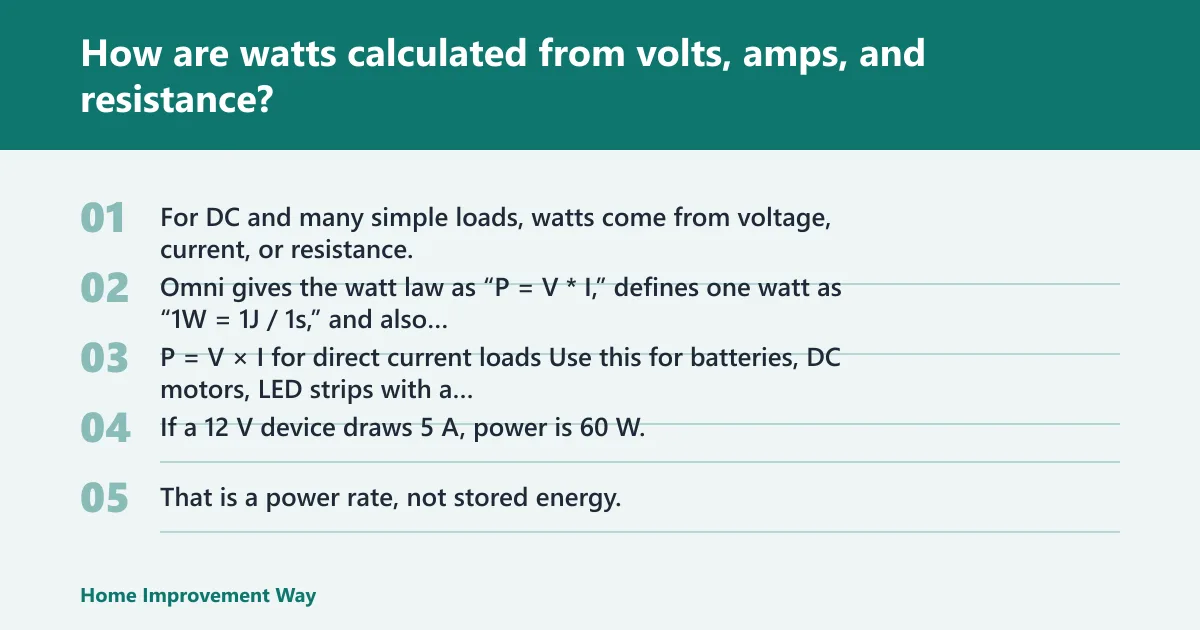
For DC and many simple loads, watts come from voltage, current, or resistance. Omni gives the watt law as “P = V * I,” defines one watt as “1W = 1J / 1s,” and also states “1W = 1V * 1A.” For resistive circuits, use voltage and ohms or current and ohms.
P = V × I for direct current loads
Use this for batteries, DC motors, LED strips with a DC driver, and adapters that list output volts and amps. If a 12 V device draws 5 A, power is 60 W. That is a power rate, not stored energy.
P = I² × R and P = V² / R for resistive loads
When resistance is the known value, Omni gives “V = I * R,” “P = V² / R,” and “P = I² * R.” These forms are common for heaters and bare resistive elements. If a 240 Ω load sits on 12 V, P = 0.6 W; if 2 A flows through 8 Ω, P = 32 W.
What watt, volt, ampere, and ohm mean here
Watt (W) is the SI unit of electric power, or the rate of energy transfer. Volt (V) is electric potential difference. Ampere (A) is current. Ohm (Ω) is resistance. The formulas work because they connect voltage, current, and circuit resistance.
How do you calculate watts for single-phase AC?
Single-phase AC power needs power factor because voltage and current do not always line up. Inch Calculator states the formula as “P (W) = I (A) × V (V) × PF.” For household AC circuits, that PF term separates apparent load from real watt draw.
Why power factor matters
Power factor is the correction that accounts for how much of the AC current does real work. Motors, compressors, and some electronic supplies pull current with a lag, so volts times amps alone can overstate watts. If PF is missing, the result is often too high for real power and too low for circuit stress.
Common household examples and input mistakes
A space heater may be close to PF 1, while a motor or compressor is usually lower. The common mistake is using the breaker rating or plug rating as if it were the load draw. Another mistake is treating nameplate volt-amps as watts when PF is listed separately.
How do you calculate watts for three-phase power?
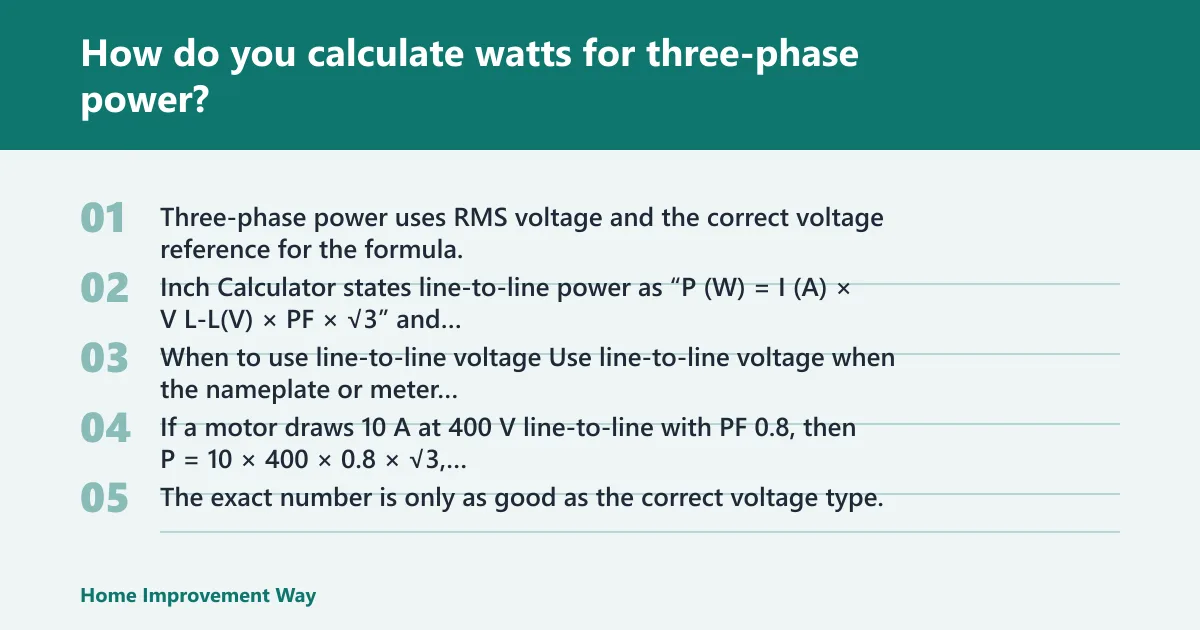
Three-phase power uses RMS voltage and the correct voltage reference for the formula. Inch Calculator states line-to-line power as “P (W) = I (A) × V L-L(V) × PF × √3” and line-to-neutral power as “P (W) = I (A) × V L-N(V) × PF × 3.” Mixing those two voltage types is a common failure.
When to use line-to-line voltage
Use line-to-line voltage when the nameplate or meter gives L-L values, which is common on three-phase equipment. If a motor draws 10 A at 400 V line-to-line with PF 0.8, then P = 10 × 400 × 0.8 × √3, about 5,543 W. The exact number is only as good as the correct voltage type.
When to use line-to-neutral voltage
Use line-to-neutral voltage only when the formula or equipment data explicitly gives it. The line-to-neutral form is not a shortcut for a line-to-line system. Swapping them can push the result far off and make a load look larger or smaller than it really is.
The most common unit mix-up
The usual error is using the supply’s labeled voltage without checking whether it is L-L or L-N. Another problem is rounding PF to 1.0 when the motor or converter never runs that cleanly. For three-phase equipment, the nameplate is the first place to verify before any math.
How do you calculate watt-hours for batteries?
Watts and watt-hours are different things. Watts measure power at a moment in time. Watt-hours measure energy over time. Omni gives a battery example where “capacity (in Wh) = voltage × amp-hours,” which is the right starting point when a battery label shows volts and Ah.
From voltage and amp-hours to Wh
A 12 V, 100 Ah battery has 1,200 Wh on paper because 12 × 100 = 1,200. That does not mean it delivers 1,200 W continuously. It means it stores energy equal to 1,200 watt-hours before losses and usable depth of discharge are considered.
Why battery labels often confuse buyers
Battery buyers often search “watts” when they really need runtime. That mistake leads to bad backup plans and undersized inverters. A 600 W load can drain a battery quickly even if it has a fairly large Wh rating, since runtime depends on the load and on conversion losses.
How much wattage do I need for a PC PSU?
For a PC, total the expected component draw and add headroom for peaks, startup bursts, and future parts. A PSU wattage calculator should include CPU, GPU, motherboard, RAM, storage, fans, and a margin so the supply is not running near its limit during heavy loads.
Component-by-component load estimate
- List the CPU, GPU, motherboard, RAM, storage, and any add-in cards.
- Use each part’s typical watt draw, then add them.
- Add fans, USB-powered accessories, and cooling pumps if present.
- Reserve extra capacity for the GPU and CPU boost spikes.
- Add more headroom if the build will be upgraded soon.
Peak spikes and safety margin
Modern GPUs can jump above their average draw for short bursts. That is why a PSU should not be sized to the average number alone. The margin is there to keep the system stable when loads change quickly, especially during gaming, rendering, or startup.
What to do when the build will be upgraded later
If a stronger GPU or more drives are likely, size for the next build, not the current one. That keeps the PSU useful after the upgrade and lowers the chance of a replacement that could have been avoided. A small cushion is smarter than a near-limit supply.
How much wattage do I need for a generator?
Generator sizing starts with running watts, then checks starting watts for motor loads. Appliances with compressors, pumps, or motors need extra surge capacity at startup. If you size only to the running number, the generator can trip or struggle when the motor kicks in.
Running watts versus starting watts
Running watts are what the appliance uses after it starts. Starting watts are the brief higher draw during startup. Refrigerators, sump pumps, air conditioners, and shop tools often need much more at start than while running, so the generator must handle both.
Appliance load planning
- List every appliance you want to power.
- Write down running watts for each item.
- Mark motor loads with their starting watts.
- Decide which loads must run at the same time.
- Add the simultaneous running loads and confirm the starting surge.
Why motor loads need extra headroom
Motor loads are the common failure point in generator planning. A unit that covers lights and a TV may still fail when a fridge compressor starts. That is why a generator wattage calculator should check the biggest surge load first, then verify the rest of the house or jobsite load.
How power calculator
A good power calculator is not one formula for every job. It asks whether the load is DC, AC single-phase, AC three-phase, battery energy, PC supply sizing, or generator planning, then asks for the right input units. That keeps the answer tied to the actual circuit.
What inputs matter most
For DC, the key inputs are volts and amps. For resistive loads, ohms can replace current. For AC, PF must be included. For batteries, use volts and amp-hours. For generators, use running and starting watts, not just one total.
how is wattage calculator cycling
For cycling gear, wattage usually means rider power, trainer load, or e-bike motor demand. The correct formula depends on what is being measured, because a battery-powered bike uses Wh for range, while a motor controller may need watts for output. Use the device label first, then the matching formula.
Frequently asked questions
How do I calculate watts from volts and amps?
Use P = V × I for DC and other simple loads. If a device draws 10 A at 12 V, the power is 120 W. For AC, add power factor first: P = V × I × PF. Without PF, the result can overstate the real watt draw.
How do I calculate watts with voltage and resistance?
Use P = V² / R when voltage and resistance are known. For a 120 V heater with 30 Ω resistance, power is 480 W. If current is known instead, P = I² × R works too. Both are valid for resistive circuits, not every AC load.
How do I calculate watts to amps?
Rearrange the formula to I = P / V for DC, or I = P / (V × PF) for AC. For example, a 600 W AC load at 120 V and PF 0.8 draws 6.25 A. The wrong formula can make a breaker load look smaller than it is.
How calculate watt hours?
Use Wh = volts × amp-hours for a battery. A 24 V, 50 Ah pack has 1,200 Wh before losses. Watt-hours describe stored energy, not instant power. That is why battery runtime searches need Wh, while appliance draw searches need watts.
How do I calculate watts for a single-phase AC circuit?
Use P = V × I × PF. The power factor matters because single-phase AC loads often do not convert all current into real power. A motor or compressor with lower PF will need the same voltage and current inputs, but fewer real watts than V × I alone suggests.
How do I calculate watts for a three-phase circuit?
Use the formula that matches the voltage type. For line-to-line voltage, P = I × V L-L × PF × √3. For line-to-neutral voltage, P = I × V L-N × PF × 3. Check the nameplate first, because mixing the voltage reference is the most common mistake.
Sponsored / affiliate links. As an Amazon Associate I earn from qualifying purchases. I may earn additional commission from eligible campaigns.