Water Heater Cost Calculator: Monthly and Installed Cost
A water heater cost calculator should compare installed price plus about 12 months of operating cost; if the higher-efficiency unit pays back in roughly a few years, it will often be the better choice on total cost. I have seen homeowners save $500 upfront and then spend hundreds more every year for a decade. This guide compares electric, gas, propane, tankless, and heat pump units on monthly bills and replacement cost.
How is this calculated?
Press Calculate to see the math with your numbers.
How much does a water heater cost?
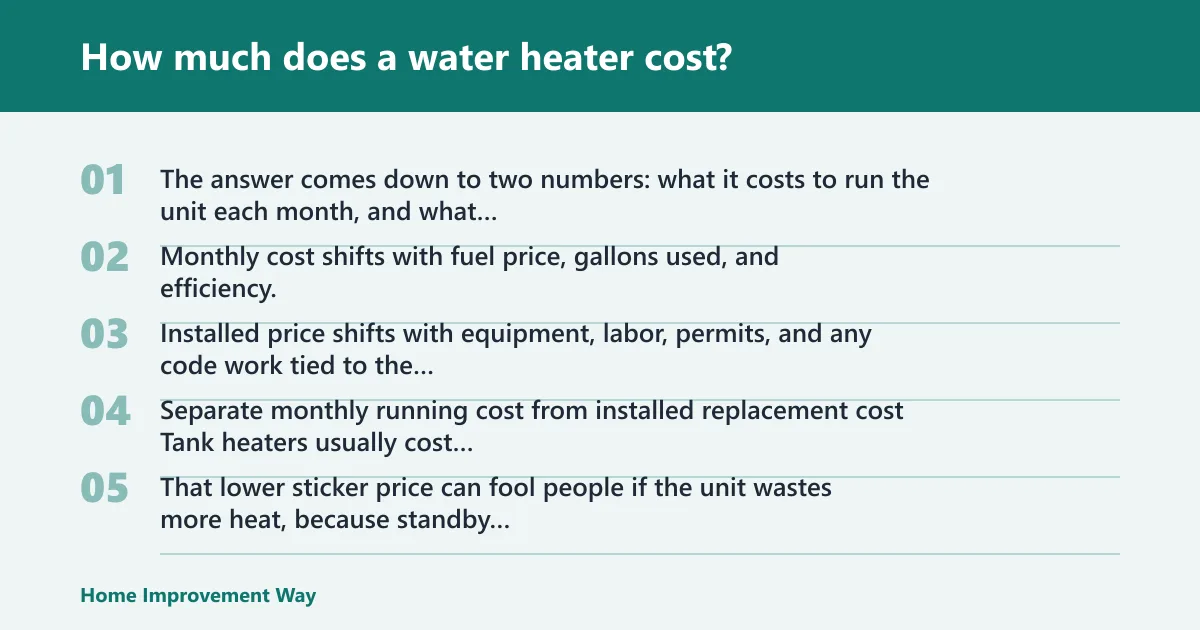


The answer comes down to two numbers: what it costs to run the unit each month, and what it costs to buy and install it. Monthly cost shifts with fuel price, gallons used, and efficiency. Installed price shifts with equipment, labor, permits, and any code work tied to the replacement scope.
Separate monthly running cost from installed replacement cost
Tank heaters usually cost less to buy than tankless or heat pump models. That lower sticker price can fool people if the unit wastes more heat, because standby loss keeps a storage tank warm all day. Tankless units avoid most standby losses, but they often cost more to install and may need gas, venting, or electrical upgrades.
What fuel price, usage, and efficiency change first
Usage and fuel price move the result fastest. A family using more hot water sees the biggest monthly gap between an electric tank, gas tank, propane system, and heat pump unit. Efficiency then decides how much of each dollar becomes hot water instead of heat lost from the tank or flue.
What this calculator estimates and what it does not
This water heater cost calculator compares electric, gas, or heat pump water heaters. It uses DOE draw patterns of 38, 55, and 84 gallons per day, an electricity rate shown as 18.44¢/kWh, a natural gas rate shown as $1.44 per therm, and water heated from 58°F to 125°F. It does not replace a site visit for venting, gas line size, panel capacity, or permit review.
According to heatingcostcalculator.com — The comparison uses water heated from 58°F to 125°F.
What inputs change the result most?

Gallons per day, household size, and utility rates usually move the answer more than the brand name on the tank. Temperature rise matters too. A home with colder incoming water or more showers every morning will spend more on the same heater than a smaller household in a warmer climate.
Gallons per day and household size
Efficiency Maine says a typical family uses 50 gallons per day. That is a useful anchor, but real homes vary a lot. Two people who shower lightly may use far less than a four-person home with laundry, tubs, and back-to-back morning demand. Bigger draw means more recovered heat, more cycling, and a larger annual bill.
Electricity rate, natural gas rate, and propane price
Electricity rate input should be entered in cents per kWh, not as a vague “cheap” or “expensive” label. Natural gas is usually entered in therms, and local winter pricing can differ from the annual average. Propane needs its own line because LP fuel can swing the math fast, especially in non-gas homes.
Temperature rise, tank size, and recovery needs
Temperature rise is the gap between incoming water and set outlet temperature. The calculator compares water heated from 58°F to 125°F, which is a solid baseline for many homes. Bigger tanks do not create hot water more efficiently; they mainly change how often the unit cycles and how much standby loss shows up in the bill.
Current vs average utility rate assumptions
Using a current bill is better than guessing from an annual average. A gas utility in winter can look very different from the same utility’s summer rate, and electric service can vary by region and plan. For a replacement decision, the last 12 months of utility bills usually beat a headline average.

How much should a hot water heater replacement cost?
A replacement cost should include equipment, labor, permits, and any code upgrades required by the new unit or the old installation path. A same-location swap is usually cheaper than moving the heater, changing fuel type, or adding venting, condensate, drain, or electrical work.
Equipment, labor, permits, and code upgrades
The replacement calculator estimates equipment, labor, and permits. That matters because a basic unit swap and a full project are not the same job. Code upgrades can include seismic strapping, pan and drain work, condensate routing, expansion control, vent changes, gas shutoff work, or a dedicated electrical circuit.
Same-location swap vs moved location
A same-location swap keeps piping short and labor lower. Moving a heater across a basement or into a garage adds pipe, fittings, time, and sometimes drainage or venting changes. That is where a “cheap” heater can stop being cheap by the time the final invoice is written.
Fuel switch costs, venting changes, and electrical work
Fuel switching is the biggest cost jump. Gas to electric may need panel space, larger conductors, and possibly service upgrades. Electric to gas can mean new venting, combustion air, gas line sizing, and permit review. Efficiency Maine notes that LP means liquefied petroleum gas, also called propane or butane gas, which behaves differently from natural gas in both price and supply.
Side-by-side homeowner decision table
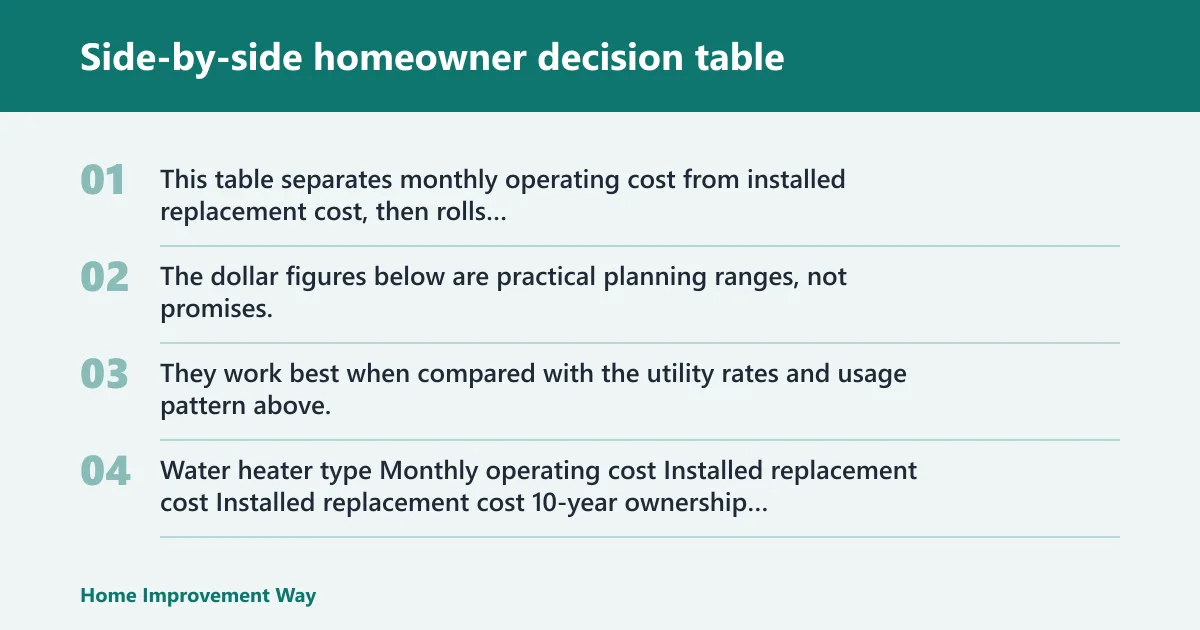
This table separates monthly operating cost from installed replacement cost, then rolls both into a longer-term ownership view. The dollar figures below are practical planning ranges, not promises. They work best when compared with the utility rates and usage pattern above.
| Water heater type | Monthly operating cost | Installed replacement cost | 10-year ownership cost | Break-even notes |
|---|---|---|---|---|
| Electric tank water heater | Higher than gas in many homes; standby losses continue all day | Usually the lowest upfront cost for a straight swap | Often rises fastest if electricity is expensive or usage is high | Best when install cost matters more than long-run utility cost |
| Gas tank water heater | Often lower than electric tank if natural gas is available | PlumbCalc lists tank gas replacement at $800-$1,500; ProjectCostPro notes a typical gas tank swap runs $3,430 to $5,946 nationally | Usually lower than electric tank where gas is cheap and the vent is already in place | Break-even improves when the old venting can stay |
| Propane water heater | Often higher and more volatile than natural gas | Can track gas tank or tankless pricing, plus LP-specific setup | Can become the costliest fuel option over 10 years if LP pricing stays high | Fuel price sensitivity is the key risk |
| Tankless gas water heater | Lower standby loss; savings depend on draw pattern and gas rate | PlumbCalc lists tankless gas replacement at $1,500-$3,500 | Can beat a tank over time, but only if the upfront premium is controlled | Payback depends on hot-water use and venting changes |
| Tankless electric water heater | Low standby loss, but electric demand can be steep | Usually higher electrical work risk than a tank swap | Can be expensive to operate in high-use homes | Often only works well where demand is modest and panel capacity is ready |
| Heat pump water heater | Usually the lowest operating cost of the electric options | ProjectCostPro includes heat-pump options; install can rise if the space needs changes | Often strong on total cost when the unit runs in a suitable warm space | Best payback when replacing an electric tank and the space stays warm enough |
Gas vs electric water heater cost calculator: what the monthly bill really shows
A gas vs electric water heater cost calculator should show monthly operating cost before it talks about replacement cost. Electric tank units usually carry more standby loss cost, while gas tank units can be cheaper to run if natural gas is available and venting is already in place. Tankless units change the math by reducing standby loss, but they do not erase equipment and installation costs.
Electric tank running cost and standby loss
Electric tank water heaters use resistance elements, so their operating cost tracks electricity rate and hot water demand closely. Standby losses matter because the tank keeps reheating stored water between draws. That can be a small annoyance on a low-use home and a major cost on a larger one.
Gas tank running cost and storage efficiency
Gas tank water heaters still lose heat from storage, but their fuel cost can be attractive where natural gas is available. The storage tank’s efficiency or UEF matters because every percent of loss shows up on the bill. The result is often a lower monthly cost than an electric tank, especially for average-family draw patterns.
Tankless gas vs tankless electric operating cost
Tankless gas units heat on demand and avoid most standby losses. Tankless electric units do the same, but the electrical load can be high and may require panel or wiring work. A tankless label does not automatically mean low cost; the fuel type and house demand still decide the bill.
When does a higher upfront price pay back?
A higher upfront price pays back when the annual operating savings are large enough to cover the installation premium in a reasonable time. For many homes, that means a 5- to 10-year view. The right answer is not “cheapest unit on the quote sheet”; it is the lowest total cost across fuel, labor, and likely service life.
Heat pump water heater savings versus electric tank
Heat pump water heaters are electric-only, but their higher efficiency can cut operating cost sharply versus a standard electric tank. Efficiency Maine lets users compare heat pump, oil, gas, propane, and electric tank systems, which is useful because heat pumps often win when the space is warm and the home uses enough hot water to matter.
Tankless payback versus storage tank models
Tankless gas units may pay back by avoiding standby loss, especially where hot-water demand is spread through the day. They are less convincing when the installation needs venting changes or gas line work. Tankless electric units face the same issue plus electrical capacity concerns, so the payback needs to be checked carefully.
When repair makes more sense than replacement
Over a 3- to 10-year horizon, repair can make sense when the tank is young, the leak is external, or the control issue is minor. Replacement is the better financial move when the tank is near end of life, the burner or element is failing repeatedly, or the upgrade can cut enough utility cost to offset the project. Maintenance helps, but it rarely turns a bad fuel choice into a good one.
How much does it cost for water heater maintenance?
Maintenance usually costs far less than replacement, but the goal is not to keep a unit alive forever with service calls. It is to avoid early failure and catch leaks, sediment, vent problems, and electrical faults early. The cost rises when the heater is hard to access, the anode is worn, or the burner and venting need cleaning.
What maintenance usually covers
Typical service includes flushing sediment, checking the T&P valve, inspecting connections, and verifying combustion or electrical operation. Tankless models may need descaling. Heat pump units add filter and airflow checks. These tasks can extend service life, but they do not erase the cost gap between a low-efficiency tank and a better-fit replacement.
When maintenance stops making financial sense
If repair cost plus expected future maintenance approaches a large share of replacement cost, replacement deserves a hard look. That is especially true when energy bills are high and the existing unit is inefficient. Spending a little on service is smart; spending repeatedly on an aging, expensive-to-run unit is not.
Frequently asked questions
How much should a water heater cost?
A water heater should be priced by total project cost, not by the tank alone. The cheapest unit on the shelf may still become expensive once labor, permits, venting, gas line work, or electrical work are added. A good quote separates equipment from installation and shows the running cost as well.
How much should a hot water heater replacement cost?
Replacement cost depends on whether it is a same-location swap or a bigger project. A simple tank replacement can stay relatively modest, while tankless, propane, or fuel-switch jobs can climb quickly because of venting, wiring, or code upgrades. The cleanest quote itemizes each add-on.
Gas vs electric water heater cost calculator
A gas vs electric water heater cost calculator should compare both the monthly bill and the installed price. Gas often has lower operating cost where natural gas is available, while electric can cost less to buy and install. The right answer depends on usage, local rates, and whether venting already exists.
Propane vs electric water heater cost calculator
Propane can change the math fast because LP pricing is often less stable than electric rates. An electric tank may be cheaper to run than a propane tank in some homes, while a propane tankless unit can still lose on total cost if fuel is high. The fuel bill deserves close attention.
Natural gas vs electric water heater monthly cost calculator
Natural gas vs electric water heater monthly cost calculator results should start with the utility rate, then adjust for usage and efficiency. Natural gas often wins on monthly cost where service is available and the vent path is simple. Electric may still win if installation is easier or gas piping is absent.
Cost comparison tank vs tankless water heater
Tank vs tankless comparisons work best when the household’s draw pattern is included. Tankless reduces standby losses, which helps the monthly bill, but the installed cost is usually higher. If the system needs venting or electrical upgrades, the payback period can stretch well past the first few years.
Sponsored / affiliate links. As an Amazon Associate I earn from qualifying purchases. I may earn additional commission from eligible campaigns.