Ontario Deck Building Code Requirements Explained
Building a deck in Ontario can seem a bit tricky at first. Many homeowners wonder about the rules and what they need to do to make sure their new deck is safe and meets all the standards. It’s a common question, and it’s easy to feel overwhelmed by all the details.
But don’t worry! This guide breaks down the Deck Building Code Requirements in Ontario into simple steps. We’ll make it easy to follow so you can build your dream deck with confidence.
Let’s get started on what you need to know to build it right.
Understanding Ontario Deck Building Code Requirements
This section lays the groundwork for what you need to know before you even pick up a hammer. We will explore the fundamental principles behind the building codes related to decks in Ontario. Understanding these core ideas helps make the rest of the information much clearer.
It’s all about safety, how your deck is used, and making sure it lasts. We’ll cover why these rules are in place and what they aim to achieve for homeowners and the community.
Why Deck Codes Exist
Deck codes are created to ensure safety for everyone who uses the deck. They aim to prevent accidents like falls or structural collapses. These rules protect not just your family and friends but also anyone who might use your property.
By following these guidelines, you help ensure your deck is a safe and enjoyable addition to your home for years to come.
Safety First Always
The primary goal of any building code, including those for decks in Ontario, is public safety. This means preventing injuries and property damage. Codes address things like how strong the deck needs to be, how high it can be, and how it connects to your house.
They are based on engineering principles and past experiences to create the safest possible structures.
Durability and Longevity
Beyond immediate safety, codes also consider the long-term durability of your deck. They specify the types of materials you should use and how they should be installed. This ensures your deck can withstand Ontario’s weather, including heavy snow, rain, and temperature changes.
A well-built deck following code will last much longer and require fewer repairs.
Property Value and Insurance
Building to code can also positively impact your property’s value. It shows that the structure is sound and compliant with regulations. Furthermore, if you ever need to make an insurance claim related to your deck, having followed the code can simplify the process.
Insurers often require structures to be built to code to be covered.
Key Ontario Building Code Principles for Decks
The Ontario Building Code provides a framework for safe construction. For decks, it focuses on several key areas. These include structural integrity, safe access and egress, and proper connections.
Understanding these core principles helps you see the reasoning behind specific requirements. It’s about building a structure that is not just beautiful but also fundamentally sound and safe.
Structural Integrity
Structural integrity refers to how well a deck can support weight and resist forces like wind and snow. The code sets minimum standards for the size and spacing of deck joists, beams, and posts. It also dictates how these components are connected to prevent failure.
This ensures your deck won’t sag, break, or collapse under normal use.
Safe Access and Egress
This covers how people get onto and off the deck safely. It includes requirements for stair widths, riser heights, and the presence of handrails. If your deck is higher than a certain level, these requirements become even more critical to prevent falls.
Safe access ensures that people of all ages and abilities can use the deck without difficulty.
Proper Connections
How the deck attaches to your house and how its own parts are fastened together is vital. The code specifies the types of fasteners to use, like galvanized or stainless steel screws and bolts, and how many are needed. Strong connections prevent movement and ensure the entire structure acts as one solid unit.
A weak connection point can be the first place a deck fails.

Deck Structure and Material Requirements in Ontario
Now, let’s get into the specifics of how your deck should be built and what materials are best. This section details the structural components and the approved materials that ensure your deck’s strength and safety. We will cover everything from the foundation to the railings, ensuring you have a clear picture of what is required by Ontario building codes.
This knowledge is essential for a safe and compliant deck build.
Footings and Foundations
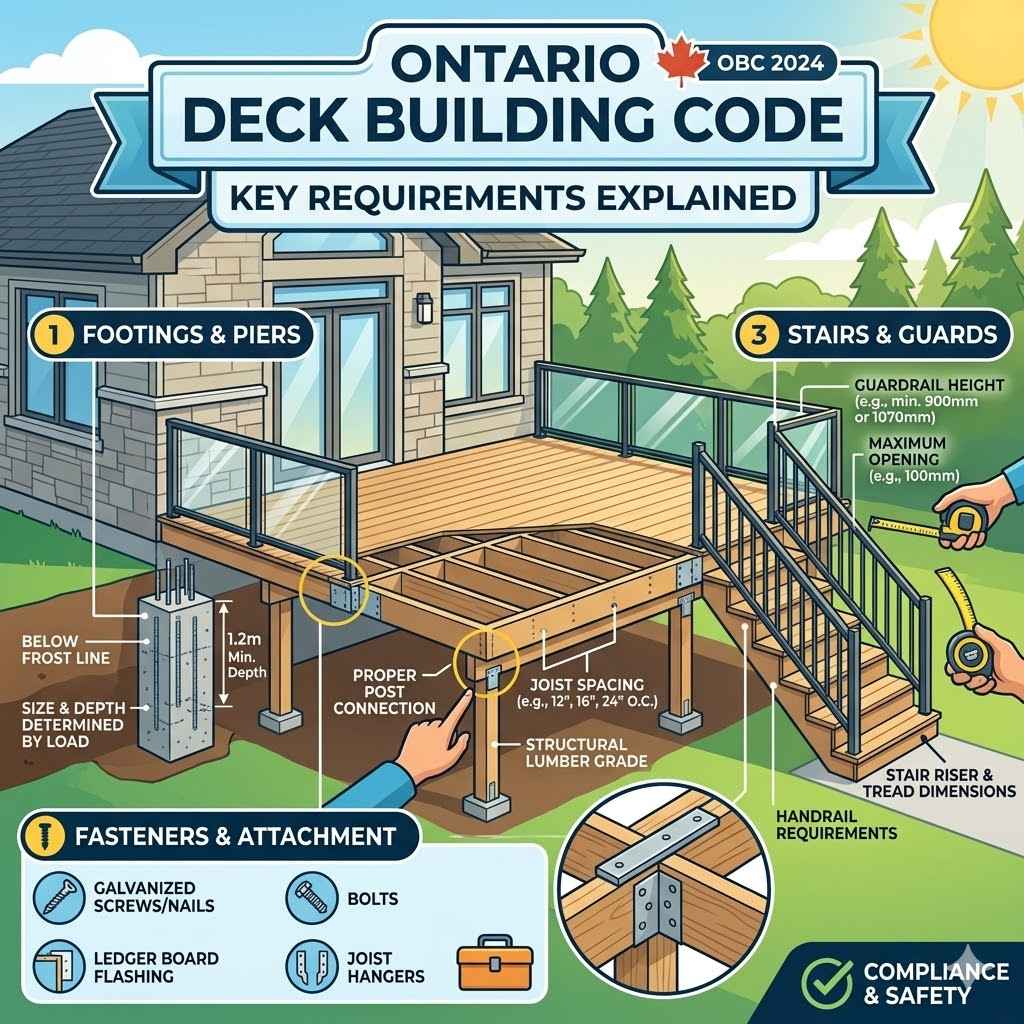
The footings are the base of your deck, anchoring it to the ground. They need to be deep enough to prevent frost heave, which is when the ground freezes and expands, pushing the deck upwards. In Ontario, this depth varies by region but is generally below the frost line.
Proper footings distribute the deck’s weight evenly onto the soil.
Frost Depth Requirements
Ontario has specific frost depth requirements that dictate how deep your footings must be. These depths are set by the Ontario Building Code and are based on climate data for different parts of the province. Digging your footings to the required depth is crucial to prevent structural damage from ground movement.
For example, in some southern Ontario regions, this might be around 1.2 meters, while in colder northern areas, it could be deeper.
Concrete Strength
The concrete used for footings must meet specific strength requirements. This is usually measured in megapascals (MPa). The code often specifies a minimum concrete strength, such as 25 MPa, to ensure the footings are durable and can bear the load of the deck.
Using the correct concrete mix and allowing it to cure properly is vital.
Posts and Beams
Posts support the beams, which in turn support the joists. The size of these components depends on the span they need to cover and the load they will carry. The code provides span tables that help determine the correct size for posts and beams based on their length and the tributary area they support.
Post Size and Spacing
The dimensions of your deck posts are critical for structural support. For a typical residential deck, 4×4 inch posts might be acceptable for short spans and lower heights. However, for larger decks or higher elevations, 6×6 inch posts are often required.
The spacing of these posts is also specified to ensure they effectively transfer the load to the footings.
Beam Size and Attachment
Beams carry the load from the joists and distribute it to the posts. Their size is determined by the span between posts and the weight they must support. For instance, a beam made of two 2x8s nailed together might support a certain load, while a single 2×10 might support a different load.
The code also specifies how beams should be attached to posts, often requiring post caps and bolts for a secure connection.
Joists and Decking
Joists are the horizontal members that run perpendicular to the beams and support the deck boards. Decking boards are laid on top of the joists to form the walking surface. The size and spacing of joists are crucial for preventing floor bounce and ensuring the deck feels solid underfoot.
Joist Size and Spacing
For common residential decks, 2×6 or 2×8 joists are frequently used. The spacing between these joists is typically 16 inches on center, though 12 inches on center may be required for certain types of decking or for increased stiffness. The code provides span tables that indicate the maximum allowable span for joists of a given size and species of wood at different spacing.
Decking Material
The material you choose for your deck boards also matters. Common options include pressure-treated lumber, cedar, redwood, or composite materials. The code generally allows these materials, but it may specify requirements for their grade and installation.
For example, the thickness and width of the boards, and the fasteners used to attach them, are important for durability and safety.
Fasteners and Hardware
The fasteners and hardware used are the backbone of your deck’s structural integrity. Using the wrong type of screw or bolt can lead to premature failure, especially in outdoor conditions where rust and corrosion are a concern. Ontario codes emphasize using appropriate, corrosion-resistant hardware.
Corrosion Resistance
All fasteners, including screws, nails, and bolts, must be corrosion-resistant. This is especially important when using pressure-treated lumber, which can be corrosive to certain metals. Stainless steel or hot-dipped galvanized fasteners are typically required to prevent rust and maintain the connection’s strength over time.
Using standard steel fasteners can lead to them corroding and weakening the structure.
Approved Hardware
The building code often references specific types of hardware that are approved for deck construction. This includes things like joist hangers, post caps, and structural screws. Using these approved products ensures they have been tested and meet the necessary performance standards for load-bearing and durability.
For instance, a specific type of structural screw might be rated to replace a certain number of nails in a connection.
Deck Railing and Stair Safety in Ontario
Safety is paramount, and this is especially true for elements of your deck that prevent falls. Railings and stairs must meet specific requirements to ensure they are safe for everyone, including children and the elderly. This section details these critical safety features and the code requirements for their design and installation in Ontario.
Railing Requirements
Deck railings serve as a barrier to prevent falls from elevated decks. The Ontario Building Code specifies their height, strength, and the spacing of balusters (the vertical elements within the railing). These requirements are designed to be effective for people of various heights and to prevent small children from slipping through.
Railing Height
For most decks in Ontario, the top of the guard (railing) must be at least 900 mm (approximately 36 inches) above the finished deck surface. This height is measured from the walking surface to the top of the uppermost rail. This ensures a sufficient barrier to prevent falls.
Baluster Spacing
The spacing between balusters is critical to prevent small children from falling through. The Ontario Building Code requires that the clear space between balusters be no more than 100 mm (approximately 4 inches). This means a 4-inch sphere should not be able to pass through the openings in the guard.
This is a common safety feature found in many building codes worldwide.
Railing Strength
Railings must be strong enough to withstand lateral forces. The code specifies that guards must be able to resist a horizontal load of 0.74 kN/m applied at the top. This ensures that leaning on the railing or moderate impacts will not cause it to fail.
This load capacity is designed to be greater than what a person would typically exert.
Stair and Step Requirements
Stairs provide safe access to and from the deck. The code defines specific dimensions for treads (the part you step on) and risers (the vertical part between treads), as well as requirements for handrails. These dimensions are designed to make walking up and down stairs comfortable and safe.
Tread Depth and Riser Height
The Ontario Building Code specifies that stair treads should have a minimum depth of 255 mm (approximately 10 inches) and a maximum riser height of 180 mm (approximately 7 inches). Consistency is key; all treads on a flight of stairs should be the same depth, and all risers should be the same height. This uniformity helps prevent tripping.
Handrails
Handrails are mandatory for stairs with more than two risers. They must be located at a height between 800 mm and 900 mm (approximately 32 to 36 inches) above the nosing of the treads. The handrail must be continuous along the length of the stairs and should extend at least one tread depth beyond the top and bottom risers.
This provides support for users.
Stair Width
The minimum width for stair treads is generally 900 mm (approximately 36 inches). This ensures there is enough space for people to walk up and down comfortably. However, for secondary access or decks with lower usage, slightly narrower stairs might be permitted, but it is always best to aim for the standard width for maximum safety and accessibility.
Permits and Inspections for Your Ontario Deck
Before you start building your deck, it’s crucial to understand the permit and inspection process. Most deck projects in Ontario require a building permit from your local municipality. Obtaining a permit ensures your plans meet the Ontario Building Code.
Inspections are then conducted at various stages of construction to verify compliance. This part explains what you need to do to get started legally and what to expect during the inspection process.
Obtaining a Building Permit
A building permit is a formal approval from your local building department to proceed with construction. For decks, a permit is typically required if the deck is more than a certain height above grade or larger than a specified area. For example, in many Ontario municipalities, decks over 100 square feet or higher than 600 mm (about 2 feet) above ground require a permit.
Always check with your local municipality for their specific requirements.
When is a Permit Needed
The need for a permit often depends on the size and height of the deck. Generally, any deck that is elevated above ground level, especially if it’s higher than a couple of steps, will require a permit. Decks that are directly on grade or very low to the ground might not need one, but it’s always best to confirm.
Failure to obtain a permit can lead to fines and the requirement to alter or remove your deck.
Application Process
To apply for a permit, you will usually need to submit detailed drawings of your proposed deck. These drawings should include dimensions, materials, footing details, and railing designs. You will also need to fill out an application form and pay the associated permit fees.
The municipality will review these plans to ensure they comply with the Ontario Building Code.
The Inspection Process
Once your permit is issued and construction begins, inspections are scheduled at critical stages. These inspections are vital to ensure that the work being done matches the approved plans and adheres to the building code. Skipping inspections or proceeding without them can lead to major issues and the inability to get final approval.
Key Inspection Stages
Common inspection stages for deck construction include:
- Footing Inspection: This is typically done after you have excavated for your footings but before you pour the concrete. The inspector will check the depth, diameter, and location of the footings.
- Framing Inspection: This occurs after the main structure of the deck is built but before the decking and railings are installed. The inspector checks the size and spacing of joists, beams, and posts, as well as how they are connected.
- Final Inspection: Once the deck is completely finished, including railings and stairs, a final inspection is performed. This confirms that all aspects of the deck meet code requirements and that the work is complete.
What Inspectors Look For
Inspectors are looking for compliance with the Ontario Building Code. They will verify that correct materials have been used, that dimensions meet the requirements (e.g., joist spans, railing heights, baluster spacing), and that all connections are properly made with approved hardware. They ensure structural integrity and safety for all users.
A common mistake inspectors might catch is using undersized lumber or improper fasteners.
Maintenance and Longevity of Your Ontario Deck
Building a deck to code is the first step. Ensuring it remains safe and in good condition for years to come is just as important. Regular maintenance helps protect your investment and keeps your deck safe for use.
This section provides guidance on how to maintain your deck and prolong its lifespan, addressing common issues specific to Ontario’s climate.
Regular Cleaning and Inspection
A simple routine of cleaning and inspecting your deck can prevent many problems. Over time, dirt, moisture, and UV rays can degrade the wood and fasteners. Keeping your deck clean also makes it easier to spot potential issues early on.
Cleaning Procedures
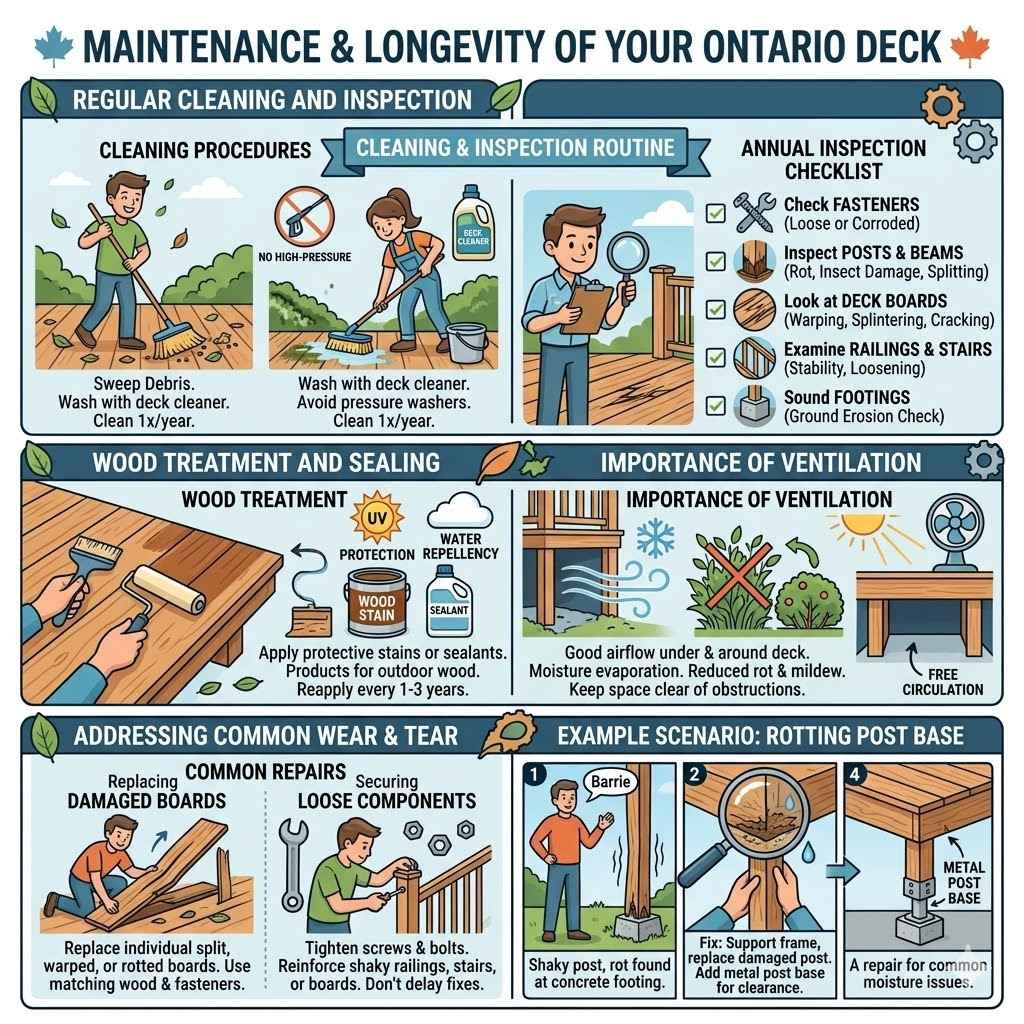
Regular cleaning involves sweeping away debris and washing the deck. For wood decks, using a deck cleaner and a stiff brush can remove dirt and mildew. Avoid using high-pressure washers, as they can damage the wood fibers.
For composite decks, follow the manufacturer’s cleaning recommendations. Aim to clean your deck at least once a year.
Annual Inspection Checklist
When you inspect your deck each year, look for specific signs of wear and tear:
- Check for loose or corroded fasteners (screws, nails, bolts).
- Inspect posts and beams for signs of rot, insect damage, or splitting.
- Look at deck boards for warping, splintering, or cracking.
- Examine railings and stairs for stability and any signs of loosening.
- Check that footings are still sound and no significant ground erosion has occurred around them.
Wood Treatment and Sealing
If you have a wooden deck, proper treatment and sealing are essential for its longevity, especially in Ontario’s varied climate. These steps protect the wood from moisture, UV rays, and decay.
Protective Stains and Sealants
Applying a good quality deck stain or sealant can protect the wood from the elements. Stains add color and UV protection, while sealants provide water repellency. Choose products specifically designed for outdoor wood.
Reapplying these treatments every one to three years, depending on the product and wear, is recommended.
Importance of Ventilation
Good ventilation under and around your deck is crucial. It helps moisture evaporate, reducing the risk of rot and mildew. Ensure there are no obstructions like overgrown plants that block airflow.
The space beneath a deck should ideally be open to allow air to circulate freely. This is a detail often overlooked but vital for wood deck health.
Addressing Common Wear and Tear
Over time, even well-built decks will show signs of wear. Knowing how to address these issues promptly can prevent them from becoming major structural problems.
Replacing Damaged Boards
If individual deck boards become split, warped, or rotted, they should be replaced. This is a relatively simple repair that can significantly improve the deck’s appearance and safety. Make sure to use the same type of wood and fasteners for a seamless repair.
Securing Loose Components
Loose railings, stairs, or deck boards should be addressed immediately. Tighten screws, replace worn bolts, or reinforce connections as needed. A wobbly railing is a safety hazard that needs prompt attention.
Don’t delay in fixing any components that feel unstable.
Example Scenario: Rotting Post Base
Imagine a homeowner in Barrie notices their deck post seems a bit shaky. Upon closer inspection, they find the bottom of the post, where it meets the concrete footing, is soft and crumbly due to prolonged moisture exposure. This indicates rot.
To fix it, they would need to support the deck framing above that post, remove the damaged post, and install a new one, ensuring proper flashing and ground clearance to prevent future rot. They might also consider adding a metal post base that lifts the wood off the concrete. This is a repair that addresses a common issue in damp climates.
Frequently Asked Questions
Question: Do I need a permit for a small deck in Ontario
Answer: In Ontario, a building permit is usually required for decks that are more than 600 mm (about 2 feet) above grade or have an area greater than 100 square feet. It is always best to check with your local municipality as requirements can vary slightly.
Question: What is the maximum height for deck stairs in Ontario
Answer: The riser height for deck stairs in Ontario should not exceed 180 mm (approximately 7 inches). Treads should be at least 255 mm (approximately 10 inches) deep. Handrails are required for stairs with more than two risers.
Question: Can I use standard screws for my deck
Answer: No, standard steel screws are generally not recommended for deck construction in Ontario. You should use corrosion-resistant fasteners, such as hot-dipped galvanized or stainless steel screws, especially when working with pressure-treated lumber.
Question: How far apart should deck joists be
Answer: For most residential decks, deck joists are spaced 16 inches on center. For added stiffness or if using certain types of decking material, they may be spaced 12 inches on center. The Ontario Building Code provides span tables to determine the correct size and spacing.
Question: What is the required height for deck railings
Answer: In Ontario, deck railings (guards) must be at least 900 mm (approximately 36 inches) high from the finished deck surface. The openings between balusters must not be larger than 100 mm (approximately 4 inches) to prevent falls.
Summary
Following the Deck Building Code Requirements in Ontario ensures your deck is safe, durable, and compliant. This involves understanding requirements for footings, posts, beams, joists, railings, and stairs. Obtaining the necessary permits and passing inspections is a crucial part of the process.
Regular maintenance will keep your deck in top condition for many years. You have the knowledge to build a great deck.