Proven Cost to Replace Carpet
The proven cost to replace carpet typically ranges from $2,500 to $8,000 for an average 500-square-foot room, depending heavily on the flooring material you choose (like carpet, laminate, or hardwood), removal fees, and installation complexity. Getting multiple quotes is key to controlling your budget.
Replacing old, worn-out carpet is a big home project. It can feel overwhelming when you start looking at prices. Will it drain your savings? Will you need professional help, or can you handle some of the work yourself? I get it. Understanding the true cost upfront is the first big step toward a beautiful, fresh floor. Don’t worry; we will break down every cost involved—from pulling up the old stuff to laying down that gorgeous new material. By the end of this guide, you’ll have the confidence and the numbers you need to plan your project without surprises. Let’s explore exactly what makes up the final bill for a fresh carpet replacement.
Understanding the Real Cost of Carpet Replacement: More Than Just Material
When people ask “how much does it cost to replace carpet,” they often only think about the price tag on the new roll of flooring. But that’s just one piece of the puzzle! A complete carpet replacement involves several distinct phases, each adding to the final invoice. Think of it like building a birdhouse: you need wood, nails, and maybe some paint. Carpet replacement is similar.
We need to account for:
- The new flooring material itself (the carpet, wood, tile, etc.).
- The old material removal and disposal costs.
- The labor to install the new floor.
- Extra materials needed, like padding, transitions, or subfloor prep.
As a home improvement guide, my goal is to show you where you can save money without sacrificing quality. We’ll look at average costs for a standard 500-square-foot area, which is often the size of a typical living room or master bedroom.
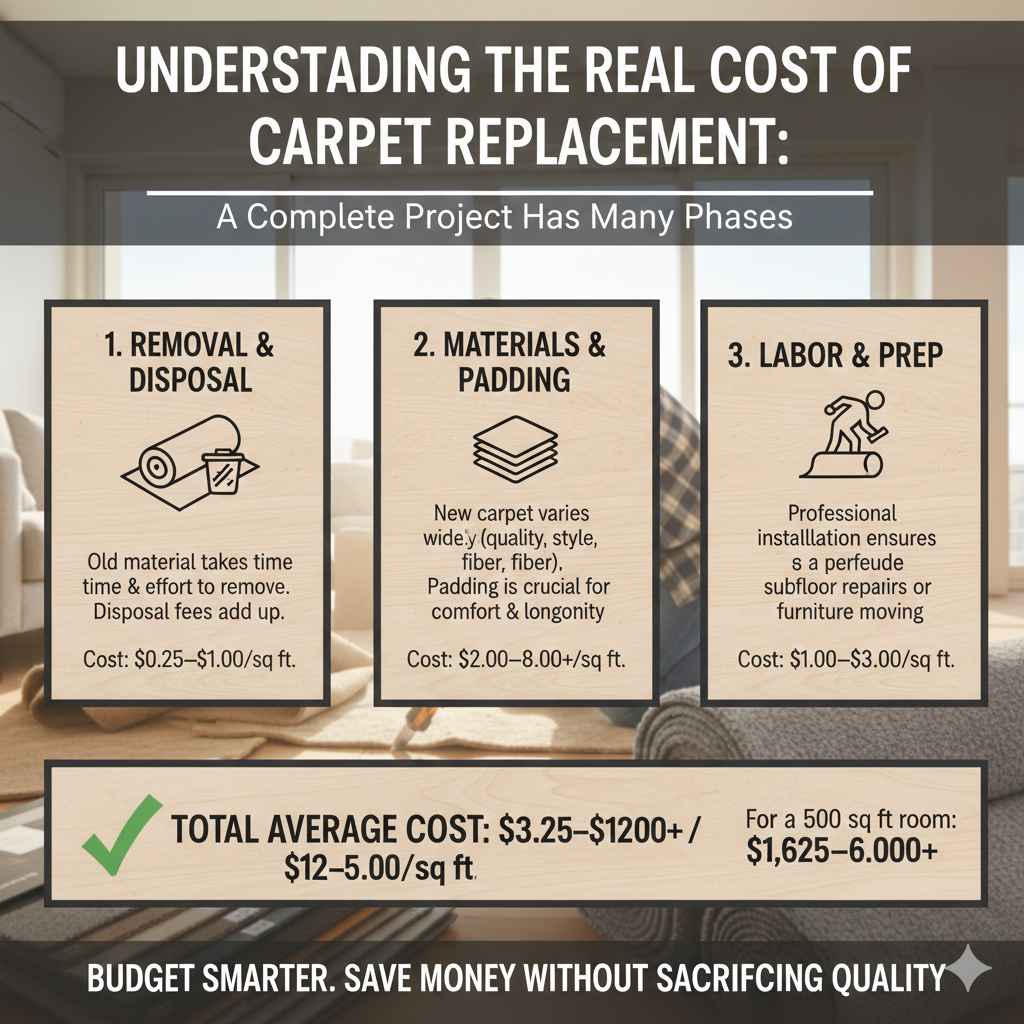
Cost Breakdown: The Three Pillars of Carpet Replacement
To keep things simple, let’s divide the total expense into three main areas. This structure helps you compare quotes accurately.
Pillar 1: Material Costs (The New Floor)
This is often the biggest variable. The type of flooring you select dictates 60% or more of your total budget. Remember, while carpet is usually the most affordable option upfront, switching to something like hardwood might offer better long-term value.
Carpet Material Costs
Carpet is priced by the square foot or square yard. Be sure to clarify which unit the supplier is using! (1 square yard = 9 square feet).
| Carpet Type | Average Cost Per Square Foot (Material Only) | Best For |
|---|---|---|
| Value/Olefin | $1.00 – $2.50 | Low-traffic areas, rentals |
| Nylon (Mid-Grade) | $2.50 – $4.50 | Average family homes, durability |
| Premium Wool | $5.00 – $12.00+ | High-end comfort, natural fibers |
The Big Shift: How Much Does It Cost to Replace Carpet with Hardwood?
Switching from soft carpet to hard surfaces drastically changes the price. Hardwood and engineered wood offer longevity and increased home value. According to the National Association of Realtors, durable flooring can significantly impact buyer appeal.
Here is a quick comparison for material costs, assuming an average 500 sq. ft. room:
- Carpet (Mid-Grade Nylon): $1,500 – $2,250
- Laminate (Good Quality): $1,500 – $3,000
- Engineered Wood: $3,000 – $6,000+
- Solid Hardwood: $4,500 – $8,000+
Pro Tip from Meraj: Always calculate the material needed based on the room dimensions, not just the square footage you measured. Flooring often requires cuts and waste (called “overage”). Ask your supplier for a waste factor, usually 5% to 10% extra.
Pillar 2: Removal and Disposal Fees
You can’t just roll up the old carpet and toss it in your regular bin. Old carpet often needs special disposal, which costs money. This is often overlooked but is crucial for budget planning.
- DIY Removal: If you pull it up yourself, you save labor costs, but you still have to haul it away. Check with your local waste management authority. Many landfills charge a fee by weight or volume to accept construction debris. Expect to pay $50 to $150 for disposal fees, depending on your local service.
- Professional Removal: If the installers do it, they charge an hourly rate or a flat fee per square foot for removal and hauling. This usually runs between $0.75 to $1.50 per square foot.
Pillar 3: Installation Labor Costs
Labor rates vary widely based on where you live (major cities cost more) and the complexity of the job.
Installation Rate Comparison (Per Square Foot)
| Flooring Type | Average Installation Cost (Labor Only) | Notes |
|---|---|---|
| Carpet | $1.50 – $3.00 | Includes stretching and tack strip installation. |
| Laminate/Vinyl Plank | $2.00 – $4.50 | Floating floor installation is faster. |
| Hardwood (Nail Down) | $5.00 – $10.00+ | Requires specialized tools and subfloor inspection. |
When installers put down carpet, they must use tack strips around the perimeter and usually install new padding underneath. Padding costs around $0.50 to $1.50 per square foot.
The Hidden Costs: What Can Surprise Your Budget?
As a DIY enthusiast, I’ve learned the hard way that preparation costs money too! Don’t let these sneaky expenses derail your project.
Subfloor Issues
This is the number one budget killer when replacing carpet with hardwood or tile. Carpet is forgiving; hard surfaces are not. If your subfloor (the wood or concrete beneath the carpet) is warped, damp, or uneven, it must be fixed first. Repairing damaged subflooring can add hundreds of dollars to the project.
Transition Pieces and Trim
If your new floor meets a different type of floor (like tile in the kitchen meeting wood in the living room), you need transition strips (T-molding or reducers). These metal or wood pieces cost $15 to $50 each and must be installed correctly for safety.
Moving Furniture
If you hire the installers to move heavy items like pool tables, grand pianos, or large sectionals, they will charge an extra fee, often $100 to $300, depending on the weight and time involved.
Ripping Up Old Carpet Pad and Padding Removal
Sometimes, the old glue or padding sticks stubbornly to the concrete slab, especially in basements. Removing this debris takes specialized grinding equipment or harsh chemicals, significantly increasing labor time.
Step-by-Step: How to Calculate Your Project Cost Confidently
Follow these simple steps to get a realistic budget for replacing the carpet in your space. Let’s use a 400 sq. ft. room as our working example.
Step 1: Measure Your Space Accurately
Measure the length and width of the room in feet. Multiply them to get the square footage. Always measure the longest points.
Example: 20 ft. wide x 20 ft. long = 400 sq. ft.
Step 2: Add Waste/Overage Factor
Add 10% to your total square footage for cuts and mistakes. This prevents running short on material.
Example: 400 sq. ft. + (400 x 0.10) = 440 sq. ft. needed.
Step 3: Estimate Material Cost
Decide on your material. Let’s assume you want mid-grade nylon carpet at $3.00 per sq. ft. (including the padding).
Example: 440 sq. ft. x $3.00/sq. ft. = $1,320 (Material Cost)
Step 4: Estimate Removal and Labor
Assume you hire pros to remove the old carpet and install the new one. Let’s use average labor rates: $1.00/sq. ft. for removal and $2.50/sq. ft. for installation.
Example Removal Labor: 400 sq. ft. x $1.00 = $400
Example Installation Labor: 400 sq. ft. x $2.50 = $1,000
Step 5: Total It Up (The Rough Estimate)
Add all the primary costs together. Always set aside 10% more for unexpected repairs.
- Material & Padding: $1,320
- Removal Labor: $400
- Installation Labor: $1,000
- Subtotal: $2,720
- Contingency (10%): $272
- Estimated Total Project Cost: $2,992
This example shows that a 400 sq. ft. carpet replacement can run close to $3,000 when hiring professionals for everything.
DIY vs. Hiring Professionals: Saving Money on Installation
One of the best ways to control the proven cost to replace carpet is by deciding what you can handle yourself. Carpet installation requires specialized tools like a power stretcher, which can be rented, but the learning curve is steep.
When to DIY (Do It Yourself)
- Carpet Removal: This is straightforward. Rent a carpet puller or use a utility knife to cut the carpet into strips, roll it up, and haul it away. This saves $400+ in labor for our example room.
- Laminate or Vinyl Plank: These floating floors are designed for DIYers. If you are comfortable with measuring and using a miter saw (or circular saw with a guide), you can save thousands compared to hardwood installation.
When to Hire a Pro
If you are switching to hardwood, especially solid hardwood that needs to be nailed down to joists, hiring an expert is often wise. Incorrect nailing can cause squeaks or warping, which is costly to fix later. Hardwood installation requires precision that an experienced professional guarantees. For more on general renovation safety and best practices, resources from organizations like the U.S. Consumer Product Safety Commission (CPSC) offer great starting points.
Long-Term Value: When Does Hardwood Make Sense?
While the initial cost to replace carpet with hardwood is significantly higher, thinking long-term changes the equation.
Consider the lifespan:
- Carpet: Typically lasts 7–15 years before needing replacement due to wear, stains, and allergens.
- Laminate: Usually 10–25 years. Scratches are hard to repair.
- Engineered Wood: Can last 25–40 years, often refinishable once or twice.
- Solid Hardwood: Can last 50–100 years with proper care and multiple refinishings.
If you plan to stay in your home for more than ten years, the higher upfront cost of hardwood is often absorbed by avoiding two future carpet replacement costs and increasing your home’s resale value.
Finding the Best Deals: Getting Competitive Quotes
Never settle for the first price you are quoted. Getting three or more detailed estimates is non-negotiable when managing a renovation budget.
What to Look for in a Quote:
- Itemized Costs: Does the quote clearly separate material, padding, labor, removal, and disposal? Vague quotes hide extra charges.
- Material Source: Are they pricing materials based on showroom samples or general estimates? Ensure they include the exact product SKU/model number.
- Warranty: What warranty do they offer on the installation workmanship? Most reputable installers offer a one-year labor warranty.
- Subfloor Prep Included: Specifically ask if leveling, sealing, or minor repairs to the subfloor are included, or if they are billed separately as “change orders.”
When you get quotes for how much it costs to replace carpet with hardwood, make sure they account for the expansion gap required around the perimeter of the room, which affects transition piece needs.

Frequently Asked Questions (FAQ) About Carpet Replacement Costs
Q1: How much does it cost to replace carpet in a 1,000 sq. ft. house?
For a whole house (1,000 sq. ft.), assuming mid-grade carpet, removal, padding, and professional installation, you can expect a total cost between $5,000 and $10,000. This range depends heavily on local labor rates.
Q2: Can I reuse my old carpet padding?
Generally, no. Reusing old padding leads to an inferior final look and feel. Old padding is often crushed, compressed, or may harbor dirt and mold. For the best results and warranty coverage on new carpet, new padding is required.
Q3: What is the cheapest way to replace old carpet?
The cheapest option is DIY removal and disposal, followed by installing budget-grade carpet or the most affordable click-and-lock laminate flooring. Choosing a carpet remnant (leftover pieces from larger jobs) can also save substantially on material costs.
Q4: Does replacing carpet with hardwood require more preparation work?
Yes. Carpet hides imperfections. Hardwood and laminate require a very flat, dry, and clean subfloor. If your concrete slab has moisture issues or your wood subfloor has dips greater than 1/8 inch over 6 feet, remediation will increase the cost.
Q5: Are carpet removal fees negotiable?
Labor fees are often negotiable, especially if you choose to remove the old carpet and padding yourself. If you are purchasing the material from the same company doing the install, they may be more willing to lower the labor charge slightly to secure the larger material sale.
Q6: How long does the entire process take?
For a single room (around 400 sq. ft.), professional installation usually takes one full day. If you are switching to hardwood, prep work (acclimation, subfloor leveling) might add an extra day before the final floor goes down.