Turpentine vs Mineral Spirits vs Paint Thinner Explained
Choosing the right cleaner or thinner for your paint projects can be confusing. Many different products have similar names and uses, and it’s hard to know which one is best. You might wonder about the differences between turpentine, mineral spirits, and paint thinner.
These are common questions for anyone starting out. This guide will make it simple and clear, step by step, so you can pick the perfect product for your needs. We will break down each one so you can feel confident in your choice.
Understanding Turpentine vs Mineral Spirits vs Paint Thinner
When you’re working with paints, especially oil-based ones, you often need something to thin them or clean up your tools. This is where solvents come in. Turpentine, mineral spirits, and paint thinner are all common solvents used in painting.
However, they are not the same thing. Each has its own properties, strengths, and weaknesses. Understanding these differences is key to getting the best results and making sure your projects turn out just right.
Knowing these distinctions will help you avoid common mistakes and make informed decisions about which solvent to use for various tasks.
What is Turpentine
Turpentine is a solvent that comes from pine trees. It is made by distilling pine sap. This gives it a strong, distinct smell that many people recognize.
It’s been used for a very long time in art and for cleaning. Because it’s natural, it can be more expensive than some other solvents. It’s also known for its strong odor and can be harsh on the skin if not handled carefully.
When you use turpentine, you should always do so in a well-ventilated area. It’s effective for thinning oil paints and varnishes, and for cleaning brushes used with these mediums.
Turpentine’s natural origin makes it a favorite among traditional artists who prefer natural materials. It has a unique evaporation rate that can affect how paint dries and flows. This controlled evaporation is important for achieving smooth finishes, especially in fine art.
The solvent power of turpentine is quite strong, making it efficient for dissolving resins and oils found in oil paints. It also has a characteristic tackiness that can be beneficial in certain applications, allowing paint to adhere well.
How Turpentine is Made
The process of making turpentine begins with the sap collected from pine trees. This sticky liquid, known as oleoresin, is gathered from living trees, typically pines like the longleaf pine or slash pine. The sap is then heated in a still.
As it heats, the volatile oils in the sap turn into vapor. This vapor is captured and cooled, which turns it back into a liquid. This liquid is the turpentine.
The remaining solid material left in the still is called rosin. It’s a complex process that requires careful temperature control to get pure turpentine.
Properties of Turpentine
Turpentine is a volatile liquid, meaning it evaporates easily and quickly. This fast evaporation can be good for thinning paint to a desired consistency. It allows the paint to dry faster as well.
It has a strong, pungent odor that is quite noticeable. This smell is a characteristic feature. Turpentine is also a powerful solvent.
It can dissolve many organic materials, including natural oils and resins, which is why it works so well with oil-based paints and varnishes. It has a specific gravity that is slightly less than water.
When it comes to its solvency, turpentine excels at breaking down sticky or gummy substances. This makes it ideal for removing dried paint or cleaning stubborn residues. It has a refractive index that is typical for organic solvents.
Its flash point is relatively low, meaning it can ignite easily if exposed to heat or a spark, so caution is needed. The consistency of pure turpentine is thin and clear, with a slightly yellowish tint sometimes.
Uses of Turpentine
Turpentine is primarily used as a solvent for oil-based paints, varnishes, and enamels. Artists use it to thin these paints, alter their consistency, and create different artistic effects like glazes. It’s also effective for cleaning brushes, palettes, and other painting tools that have been used with oil paints.
Beyond art, turpentine has been used in traditional remedies and as a cleaning agent for certain materials. Its ability to dissolve resins makes it useful in some wood finishing applications as well.
In the world of fine art, turpentine is almost a staple for oil painters. It helps achieve a smoother application of paint, reducing brush strokes and creating a more uniform finish. When mixed with linseed oil, it can create mediums that change the paint’s drying time and flow.
For example, an artist might use a higher ratio of turpentine to create a thin glaze that dries quickly, or a lower ratio to create a thicker, more workable paint consistency.
What are Mineral Spirits
Mineral spirits are another popular solvent, often used as a substitute for turpentine. They are derived from petroleum, not trees. This makes them generally less expensive and more readily available.
Mineral spirits are also called white spirits or Stoddard solvent. They have a milder odor compared to turpentine and are less harsh on the skin, though still require caution. They are widely used for thinning oil-based paints, cleaning brushes, and degreasing surfaces.
The chemical composition of mineral spirits is a mixture of aliphatic and alicyclic hydrocarbons. This composition gives them their solvent properties. They evaporate at a moderate pace, which can be advantageous for painters who prefer a longer working time.
They are a good choice for general cleanup and thinning tasks in many painting projects. Their widespread use in the industry highlights their versatility and effectiveness for common painting needs.
How Mineral Spirits are Made
Mineral spirits are a product of the petroleum refining process. Crude oil is separated into various components through distillation. One of these fractions is what becomes mineral spirits.
The specific distillation and refining steps can vary, leading to different grades of mineral spirits with slightly different properties. These hydrocarbons are then treated to remove impurities and achieve the desired solvency and evaporation rate. The result is a clear, colorless liquid.
The process often involves hydrotreating, which removes sulfur and other compounds that can cause odors and affect performance. This careful refining ensures that mineral spirits are consistent and reliable for their intended uses. Different manufacturers might have slightly different processes, leading to variations in their specific products.
However, the core method involves separating and purifying hydrocarbon fractions from petroleum.
Properties of Mineral Spirits
Mineral spirits are also volatile, but generally evaporate slower than turpentine. This slower evaporation gives you more time to work with the paint and can help prevent it from drying too quickly on your brush or palette. Their odor is less sharp and pungent than turpentine, making them more pleasant to use, especially in enclosed spaces.
They are effective solvents for oil-based paints, alkyds, and some varnishes. Their solvency power is strong enough for most general painting and cleaning tasks.
The flash point of mineral spirits is typically higher than turpentine, meaning they are slightly less flammable. This offers a bit more safety during use. They are also less likely to cause skin irritation than turpentine, although wearing gloves is still recommended.
Mineral spirits are generally less expensive than turpentine, making them a cost-effective choice for many projects. They are miscible with most organic solvents and oils.
Uses of Mineral Spirits
The most common use for mineral spirits is thinning oil-based paints and alkyd paints. They help achieve the desired consistency for application, whether brushing, rolling, or spraying. They are also excellent for cleaning brushes, rollers, spray guns, and other tools after use with oil-based products.
Mineral spirits can be used to degrease surfaces before painting, ensuring good adhesion. They are also effective at removing grease, tar, and wax from various surfaces.
For DIY enthusiasts and professionals alike, mineral spirits offer a reliable and affordable solution for many cleanup and thinning needs. They are a staple in workshops and art studios for their versatility. For example, a painter might use mineral spirits to thin an oil-based primer to ensure it spreads easily over a rough surface.
After painting, they would use mineral spirits to thoroughly clean their brushes, ensuring they remain soft and usable for future projects.
What is Paint Thinner
Paint thinner is a broad term that can refer to a variety of solvent blends. Sometimes, it refers specifically to mineral spirits. Other times, it can be a mixture of different solvents, possibly including mineral spirits, naphtha, xylene, or toluene, designed for specific thinning or cleaning tasks.
Because it can be a blend, its properties and smell can vary significantly. It’s always important to check the label to know exactly what you are buying and its intended use.
This variety is what makes “paint thinner” sometimes confusing. A product labeled “paint thinner” might be very similar to mineral spirits, or it could be a much stronger, faster-evaporating solvent. The label will often specify what kind of paints it is best suited for and what its components are.
This specificity helps users choose the right product for their particular paint system and application.
How Paint Thinner is Made
Paint thinner is not made from a single source like turpentine or mineral spirits. Instead, it is typically a formulated mixture of different petroleum distillates and other chemical solvents. Common ingredients include mineral spirits, naphtha (which itself can be a blend of hydrocarbons), toluene, xylene, and acetone.
The exact composition depends on the manufacturer and the intended purpose of the paint thinner. Some are designed for fast drying, while others are formulated for specific types of paint.
The manufacturing process involves blending these individual solvent components in precise ratios. This blending is done to achieve specific evaporation rates, solvency strengths, and compatibility with different types of paints and coatings. For instance, a paint thinner formulated for acrylics might contain different solvents than one designed for heavy-duty industrial coatings.
This custom blending allows for a wide range of applications and performance characteristics.
Properties of Paint Thinner
The properties of paint thinner vary widely depending on its formulation. Some paint thinners are similar to mineral spirits in their evaporation rate and odor. Others are much stronger and evaporate very quickly.
Stronger paint thinners often have a more potent, sometimes chemical-like smell. They can be very effective at dissolving stubborn paints and resins but can also be more aggressive on surfaces and skin. Always read the product label to understand its specific properties.
A key characteristic of many paint thinners is their ability to break down and dissolve dried paint effectively. This makes them useful for tackling tough cleanup jobs. Their volatility can also be adjusted; some are designed to evaporate quickly for fast drying, while others have a slower evaporation rate for more controlled application.
The solvency power can range from moderate to very strong, depending on the chemical makeup.
Uses of Paint Thinner
Paint thinner is used to thin oil-based paints, enamels, and varnishes. It is also a common choice for cleaning brushes, spray guns, and other equipment used with these types of coatings. Stronger formulations can be used to remove old paint, graffiti, or stubborn adhesive residues.
It’s essential to match the paint thinner to the type of paint you are using, as using the wrong thinner can damage the paint or the surface.
For example, if you have a tough oil-based stain that won’t budge with water, a general-purpose paint thinner might be the solution. It can penetrate and dissolve the stain effectively. In the automotive industry, specific paint thinners are used to achieve the perfect consistency for spray applications, ensuring a smooth, flawless finish on car bodies.
However, it’s crucial to test on an inconspicuous area first, as some thinners can affect plastics or finishes.

Turpentine vs Mineral Spirits vs Paint Thinner Comparison
Understanding the differences between these three common solvents is crucial for achieving good results in your painting projects. While they all serve similar purposes, their origins, properties, and best uses vary significantly. This section will break down the key distinctions to help you make the right choice every time.
We will look at how they are made, what they do, and when to use each one, providing a clear guide to the Turpentine vs Mineral Spirits vs Paint Thinner dilemma.
Key Differences Summarized
The main difference lies in their origin and chemical composition. Turpentine is natural, derived from pine trees. Mineral spirits are petroleum-based, a refined hydrocarbon mixture.
Paint thinner is a broad category, often a blend of petroleum distillates and other solvents, with specific formulations for different tasks. This affects their smell, drying time, solvency power, and cost.
Evaporation Rate
Turpentine generally evaporates the fastest among the three. Mineral spirits evaporate slower, offering more working time. Paint thinner evaporation rates can vary greatly depending on its specific formulation, from fast to slow.
Fast evaporation can be useful for quick drying, while slower evaporation allows for smoother application and blending.
Here is a look at how evaporation rates generally compare:
| Solvent | Evaporation Rate (General) |
|---|---|
| Turpentine | Fast |
| Mineral Spirits | Moderate |
| Paint Thinner (varies) | Fast to Slow |
Odor and Safety
Turpentine has a strong, distinct pine scent. Mineral spirits have a milder, less pungent odor. Paint thinner odors can range from mild to very strong and chemical.
All solvents require good ventilation and protection for skin and eyes. Turpentine can be more irritating to the skin and respiratory system than mineral spirits. Always wear gloves and eye protection, and work in a well-ventilated area.
Safety considerations are paramount when working with any solvent:
- Ventilation: Always use these solvents in a well-ventilated area. Open windows and doors, or use fans to circulate air. This helps to disperse fumes and reduce inhalation risks. Poor ventilation can lead to headaches, dizziness, and other health issues.
- Skin and Eye Protection: Solvents can dry out and irritate the skin. They can also cause serious damage if they get into the eyes. Wear chemical-resistant gloves, such as nitrile or neoprene, and safety glasses or goggles to protect yourself from splashes.
- Flammability: Most solvents are flammable. Keep them away from open flames, sparks, heat sources, and smoking. Store them in tightly closed containers in a cool, dry place.
Solvency Power
Turpentine is a strong solvent, excellent for dissolving resins and oils. Mineral spirits are also good solvents, effective for most oil-based paints. Paint thinners can have varying solvency powers; some are very strong and can dissolve tougher materials, while others are milder.
The specific formulation dictates its effectiveness on different types of paint and coatings.
Cost and Availability
Turpentine, being a natural product, is often more expensive than petroleum-based solvents. Mineral spirits are generally more affordable and widely available in hardware stores and art supply shops. Paint thinners vary in price depending on their formulation and brand, but are typically competitive with mineral spirits.
When to Use Turpentine
Turpentine is a classic choice for artists and professionals who appreciate its natural origin and specific working properties. It offers a unique feel and performance that many prefer for certain applications. Its strong solvency and distinct drying characteristics make it ideal for specific techniques and materials.
When working with traditional oil paints or when a natural solvent is preferred, turpentine stands out as a primary option.
Artists often choose turpentine for its ability to create luminous glazes and its specific interaction with oil paint. The distinct smell, while strong, is familiar and comforting to many who have used it for years. Its effectiveness in dissolving resins makes it excellent for reviving old oil paints or varnishes.
When the goal is to achieve a particular artistic effect or to maintain a traditional approach to oil painting, turpentine is often the solvent of choice.
For Oil Painting
In oil painting, turpentine is used to thin oil paints, making them flow more easily from the brush. It helps create thinner layers, which can be built up over time to achieve rich textures and depth. It is also used to clean oil painting brushes.
A small amount of turpentine can quickly remove excess paint from brushes, preparing them for the next color or for cleaning with soap and water.
A common artistic technique involves using a mixture of turpentine and linseed oil as a painting medium. The turpentine thins the paint and speeds drying, while the linseed oil adds fluidity and gloss. For example, an artist might use a 1:1 ratio of turpentine to linseed oil for applying smooth, thin layers of color.
This helps achieve a painterly effect with visible brushwork and a luminous quality.
For Varnishing
Turpentine can be used to thin oil-based varnishes. This allows for a smoother, more even application of the varnish. Thinned varnish penetrates the surface better and reduces the risk of brush marks.
It’s important to use the correct ratio to ensure the varnish dries properly and provides adequate protection. Too much turpentine might compromise the film’s durability.
When varnishing a finished oil painting, thinning the varnish with turpentine can make a significant difference. A thick varnish applied directly might leave visible brush strokes. By thinning it, the varnish flows more freely, self-levels, and creates a glass-like finish.
This is crucial for protecting the artwork while enhancing its visual appeal. Always test the thinned varnish on a scrap piece if possible.
For Natural Finishes
Because it is a natural product, turpentine is often preferred when using natural oil finishes or waxes. It can help achieve a desired consistency for these natural products, making them easier to apply and work into wood surfaces. It integrates well with traditional wood finishing techniques.
Its use aligns with a preference for less synthetic products in certain crafts and restorations.
Consider restoring an antique piece of furniture. You might be using traditional oil and wax finishes. Turpentine would be the logical choice to thin these natural products for application.
It will not introduce harsh chemicals that could react with the old materials. This ensures the restoration respects the original materials and methods, preserving the piece’s integrity and historical value.
When to Use Mineral Spirits
Mineral spirits are a workhorse solvent, popular for their balance of effectiveness, cost, and milder odor. They are a go-to choice for many general painting tasks, from thinning paints to cleaning up tools. Their moderate evaporation rate and solvency make them versatile for a wide range of applications, particularly with oil-based and alkyd paints.
They are often the most practical choice for everyday painting needs.
For DIYers, hobbyists, and professionals alike, mineral spirits offer a reliable and accessible solution. They are safe to use with proper precautions and are readily available at most hardware stores. Their ability to clean up paint effectively without being overly aggressive makes them a preferred option for routine maintenance and project completion.
They strike a good balance between performance and ease of use.
For General Paint Thinning
Mineral spirits are excellent for thinning most oil-based paints and alkyd paints. They help create a smoother consistency for brushing or rolling, making application easier and resulting in a more uniform finish. They can also be used to adjust the viscosity for spray applications, though specific spray thinners might be recommended for certain coatings.
Imagine you are painting a wooden fence with an oil-based exterior paint. The paint might be a bit thick for easy brushing. Adding a small amount of mineral spirits will thin it down perfectly, allowing it to spread smoothly over the wood grain and cover the surface evenly.
This makes the job faster and results in a better-looking, more durable finish.
For Cleaning Tools and Brushes
After using oil-based paints, mineral spirits are highly effective for cleaning brushes, rollers, palettes, and other painting tools. They break down and dissolve the oil-based paint, making it easy to rinse away. Regular cleaning with mineral spirits helps maintain the condition of your brushes, keeping them soft and usable for years to come.
It is a critical step for tool longevity.
After a day of painting, your oil-based brushes will be covered in paint. Rinsing them under running water won’t do much. Instead, soak them in a container of mineral spirits.
Swish them around, and you’ll see the paint start to dissolve. Once most of the paint is out, you can wash them with soap and water to remove any remaining solvent and paint residue. This thorough cleaning ensures your brushes remain in good condition.
For Degreasing Surfaces
Mineral spirits can be used to clean and degrease surfaces before painting. Oil, grease, and grime can prevent paint from adhering properly. Wiping down the surface with mineral spirits removes these contaminants, ensuring a clean base for your paint.
This step is crucial for achieving a durable and long-lasting paint job, especially on surfaces like metal or previously painted wood.
Before painting a metal garage door, you might notice a film of grease and dirt. Wiping the entire surface with mineral spirits will cut through that grease, leaving a clean, tack-free surface. This preparation is vital because oil-based paints adhere best to clean surfaces.
Without this degreasing step, the paint might peel or flake off prematurely.
When to Use Paint Thinner
Paint thinner is a versatile category, and its use depends entirely on its specific formulation. Some paint thinners are essentially equivalent to mineral spirits, while others are much stronger and designed for tougher jobs. It’s crucial to read the product label carefully to determine its composition and intended use.
This ensures you select the right thinner for your specific task, whether it’s thinning paint, cleaning stubborn residues, or preparing surfaces.
The broad range of paint thinners means they can be used in a wider array of situations than specialized solvents like turpentine. If a standard mineral spirit isn’t strong enough, or if you need a very specific drying time, a formulated paint thinner might be the answer. They are often the go-to for industrial applications or when dealing with particularly difficult coatings.
For Stronger Cleaning Tasks
When you encounter very stubborn paint, dried-on gunk, or thick adhesives, a stronger paint thinner formulation might be necessary. These thinners often contain more aggressive solvents like xylene or toluene, which can break down tougher materials more effectively. They are useful for removing old layers of paint or cleaning up spills that have hardened.
Imagine you’re renovating an old piece of furniture and find layers of thick, hardened paint that are difficult to scrape. A strong paint thinner, applied carefully, can soften these layers, making them much easier to remove with a scraper or putty knife. This saves a lot of manual labor and can restore the piece to its original condition.
For Specific Paint Types
Some paint thinners are specifically formulated to work with particular types of paints or coatings, such as epoxy paints, lacquers, or certain industrial enamels. These thinners contain solvents that are compatible with the resin system of the paint, ensuring proper thinning and curing without damaging the coating. Using the wrong thinner can cause the paint to not dry, become gummy, or fail in other ways.
For instance, if you are working with a two-part epoxy coating for a garage floor, the manufacturer will likely recommend a specific epoxy thinner. This thinner is designed to properly reduce the viscosity of the epoxy resin and hardener, allowing for application and ensuring the coating cures correctly into a durable, protective layer.
For Removing Adhesives and Residues
Many paint thinners are effective at dissolving various adhesives and removing sticky residues left behind by labels, tapes, or caulking. Their solvent power helps to break down the adhesive bonds, making it easier to wipe or scrape away the unwanted material. This is a common use when preparing surfaces for repainting or refinishing.
You might remove old wallpaper and find stubborn adhesive residue left on the walls. A good paint thinner can help dissolve this sticky film, allowing you to wipe it clean before applying a new coat of primer and paint. This ensures a smooth, uniform finish without bumps or imperfections caused by leftover adhesive.
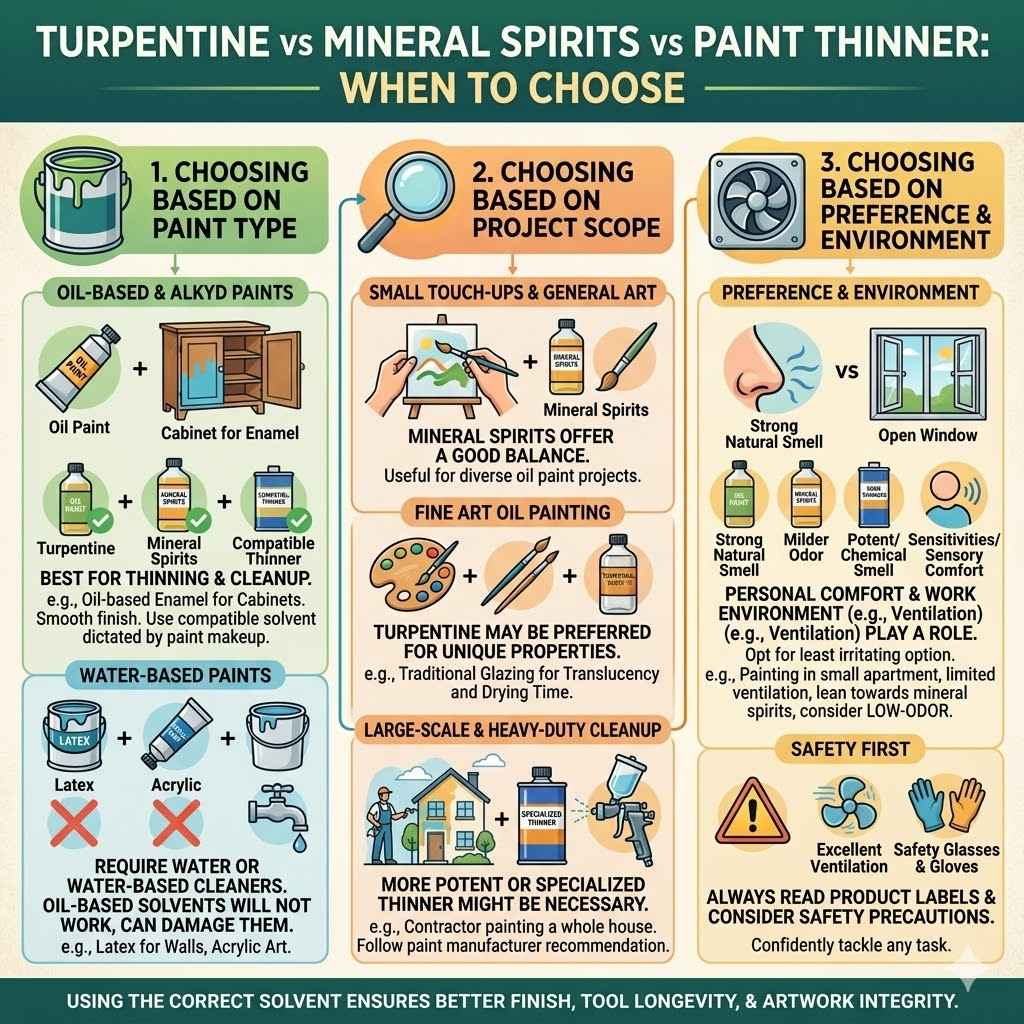
Turpentine vs Mineral Spirits vs Paint Thinner When to Choose
The choice between turpentine, mineral spirits, and paint thinner often comes down to the specific project, the type of paint being used, and personal preference. For traditional oil painting and natural finishes, turpentine is a classic choice. For general cleanup and thinning of most oil-based paints, mineral spirits are usually the most practical and cost-effective option.
For specialized tasks or tougher cleaning jobs, a carefully selected paint thinner might be required.
Understanding the fundamental differences in origin, properties, and intended use allows for informed decisions. Always read product labels and consider safety precautions. Using the correct solvent ensures not only a better finish but also the longevity of your tools and the integrity of your artwork or project.
By knowing these distinctions, you can confidently tackle any painting or cleaning task.
Choosing Based on Paint Type
The type of paint is the most significant factor. Oil-based paints and alkyd paints are best thinned and cleaned with solvents like turpentine, mineral spirits, or compatible paint thinners. Water-based paints (like latex or acrylics) typically require water or specialized water-based cleaners, as oil-based solvents will not work effectively and can damage them.
If you’re using an oil-based enamel for cabinets, mineral spirits are a great choice. They thin the paint for a smooth finish and clean up the brushes effectively. If you are painting with acrylics, you would use water for thinning and cleaning, not any of these solvents.
The paint’s chemical makeup dictates the compatible solvent.
Choosing Based on Project Scope
For small touch-ups or general art projects, mineral spirits offer a good balance. For fine art oil painting where specific artistic effects are desired, turpentine might be preferred for its unique properties. For large-scale industrial applications or heavy-duty cleanup, a more potent or specialized paint thinner might be necessary.
Consider the scale and demands of your project.
A hobbyist painting a small canvas might reach for mineral spirits for their oil paints. An artist specializing in traditional glazing techniques might opt for turpentine to achieve the desired translucency and drying time. A contractor painting a whole house with oil-based exterior paint might use mineral spirits for cleanup and possibly a specific thinning solvent recommended by the paint manufacturer.
Choosing Based on Personal Preference and Environment
Some users prefer the natural smell of turpentine, while others find its odor too strong. Mineral spirits offer a less intense scent, which can be more pleasant to work with, especially indoors. Paint thinners vary widely.
Personal comfort and the work environment (e.g., ventilation) play a role. If you have sensitivities, always opt for the least irritating option and ensure excellent ventilation.
If you are painting in a small apartment with limited ventilation, you might lean towards mineral spirits due to their milder smell compared to turpentine or some stronger paint thinners. You might also consider using low-odor mineral spirits, which are available and further reduce the olfactory impact. Safety and comfort are key considerations.
Frequently Asked Questions
Question: Can I use turpentine to clean brushes used with latex paint?
Answer: No, turpentine is an oil-based solvent and will not effectively clean latex or water-based paints. For latex paints, you should use water for cleanup.
Question: Are mineral spirits safe to use indoors?
Answer: Mineral spirits can be used indoors if the area is very well-ventilated. Always open windows and doors, or use fans, and wear appropriate protective gear. Low-odor mineral spirits are also available for reduced scent.
Question: Is paint thinner the same as mineral spirits?
Answer: Not always. Paint thinner is a broad term. Some paint thinners are very similar to mineral spirits, while others are blends of different, stronger solvents and have different properties.
Question: Will using too much solvent damage my oil paint?
Answer: Yes, using too much solvent, especially turpentine or strong paint thinners, can make oil paint brittle and affect its durability. It’s best to use solvents sparingly and follow recommended ratios for thinning.
Question: Can I use turpentine or mineral spirits on plastic?
Answer: It’s generally not recommended. Solvents like turpentine and mineral spirits can dissolve or damage many types of plastic. Always test on an inconspicuous area first or use a solvent specifically recommended for plastics.
Summary
Turpentine is natural and strong, mineral spirits are petroleum-based and versatile, and paint thinner is a broad category with varied uses. Each has a role in thinning paints, cleaning tools, or preparing surfaces. Choose based on your paint type, project needs, and safety.
Always prioritize ventilation and protective gear for a safe and effective experience.