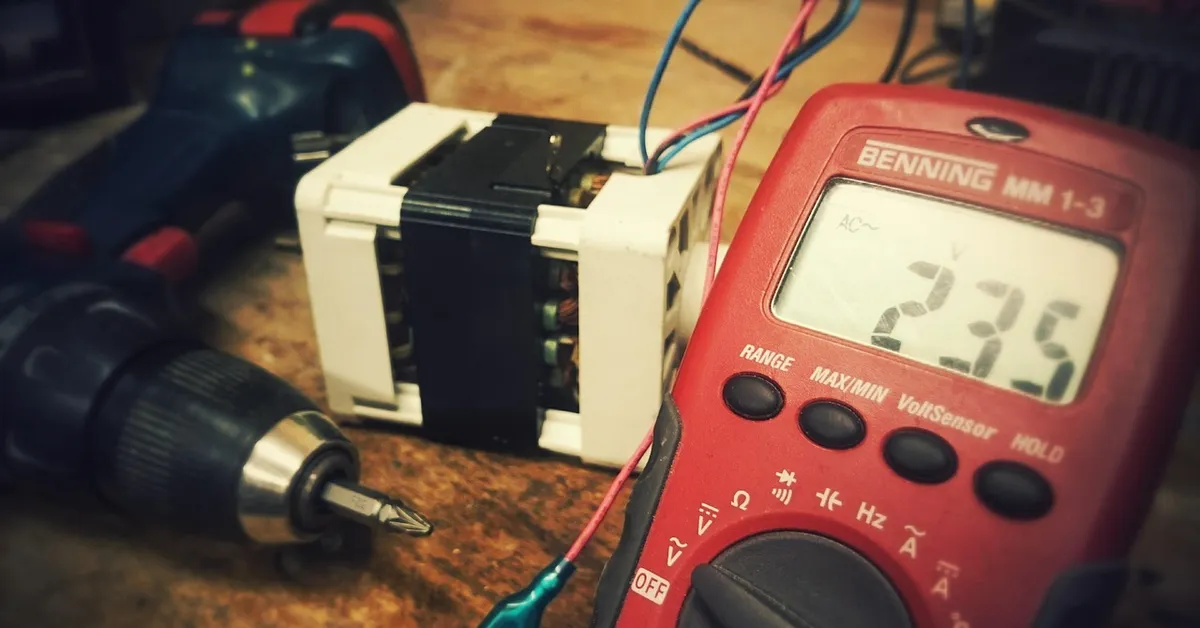
Types of Multimeters: How to Choose the Right One
The right multimeter depends less on price and more on three specs: auto-ranging versus manual, whether it’s true-RMS, and its CAT safety rating, since those determine what you can safely and accurately measure. This guide breaks down the real differences between multimeter types so you’re not paying for features you won’t use, or worse, using one that isn’t rated for the job.
Analog vs. digital
Analog multimeters use a moving needle over a dial and are largely obsolete for everyday work, but some technicians still prefer them for watching a slowly changing value, like a capacitor discharging, where a needle’s motion is easier to read at a glance than a scrolling digital number. Digital multimeters (DMMs) are the standard today, giving a precise numeric readout and typically far better accuracy and durability.
Auto-ranging vs. manual-ranging
A manual-ranging meter requires turning a dial to select the expected measurement range before testing, which is cheaper but leaves room for error if you guess wrong and either get no reading or risk an overload. Auto-ranging meters detect the range automatically and display the correct value, trading a small amount of speed (they take a moment to settle) for a much lower chance of a mistaken setting.
Clamp meters for high-current work
A clamp meter has a hinged jaw that closes around a single wire and measures current through induction, without breaking the circuit to insert the meter in series. This makes it the practical choice for HVAC and appliance circuits where opening the circuit to test current isn’t realistic, while a standard multimeter remains better for voltage, resistance, and continuity testing.
True-RMS matters more than most buyers realize
Average-responding meters are only accurate on a clean sine wave. Anything with a distorted waveform, like a variable-frequency drive, a dimmer switch, or most modern electronics, will read incorrectly on a non-true-RMS meter. A true-RMS meter calculates the actual root-mean-square value regardless of waveform shape, which matters for anyone working near motors or modern appliance electronics rather than a simple incandescent circuit.
CAT ratings are a safety spec, not a marketing number
CAT II, III, and IV ratings describe how much transient overvoltage a meter can safely withstand at different points in an electrical system. CAT III covers building wiring and distribution panels; CAT IV covers the utility service entrance and outdoor equipment where transients are largest. Using a meter rated below the environment you’re testing in is a genuine arc-flash and injury risk, not just a technicality.
Frequently Asked Questions
What’s the real difference between CAT III and CAT IV?
CAT III is rated for fixed building wiring like panels and hardwired equipment; CAT IV is rated for the higher-energy transients found at the utility connection or main service entrance, ahead of the building’s own panel.
Do I need true-RMS for basic household use?
For simple outlet and battery checks, not strictly, but the price difference is usually small enough that it’s worth having if you ever test anything with a dimmer, a motor, or variable-speed electronics.
Is auto-ranging worth the extra cost?
For anyone who isn’t testing electronics daily, yes. It removes the guesswork of selecting a range and reduces the chance of a misread or a skipped measurement from picking the wrong setting.
Sponsored / affiliate links. As an Amazon Associate I earn from qualifying purchases. I may earn additional commission from eligible campaigns.

![AGVEE 2 Pack 5ft Coiled USB-A to USB-C Cable [USB-IF Certified] Carplay](https://m.media-amazon.com/images/I/41OJA2LpRSL._SL500_.jpg)