What Ratchet Wrench Size Is Best for Household Repairs?
For many household repairs, a 3/8-inch drive ratchet wrench is often a practical first choice; 1/4-inch is commonly used for small fasteners and tight spaces, and 1/2-inch is typically used for larger, higher-torque jobs. Picking the wrong drive can strip small hardware or leave you without enough torque on stubborn bolts. This guide explains which ratchet size fits common home repairs and when a smaller or larger drive makes sense.
Choosing between 3/8, 1/4, and 1/2 inch drives
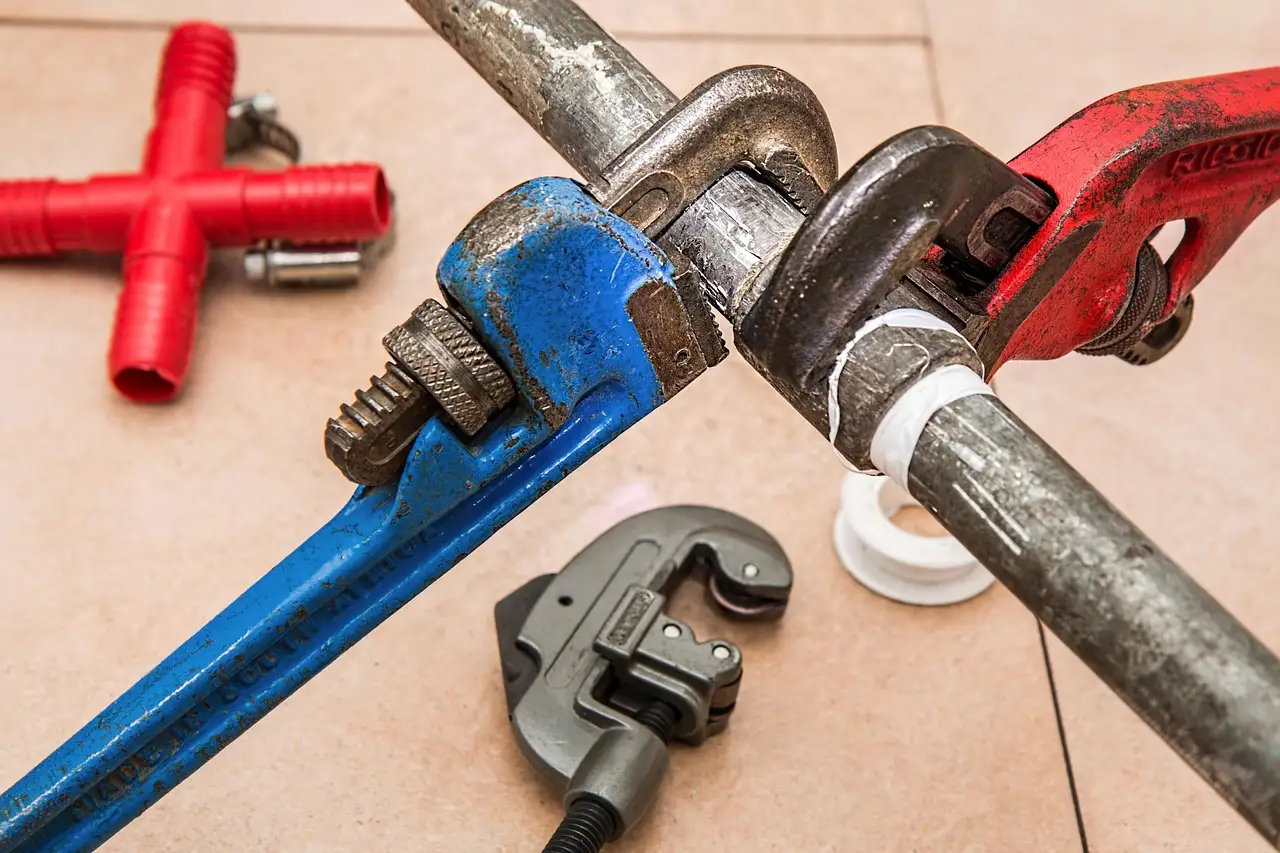

Three-eighths inch is often considered the safest single buy for a homeowner. It fits most medium fasteners around the house, works with common socket sets, and still has enough strength for many stubborn bolts without feeling oversized for cabinet, furniture, and light equipment work.
Why 3/8-inch is the default choice
A 3/8-inch drive sits in the middle for a practical reason. It handles furniture bolts, appliance mounting hardware, and small engine maintenance without pushing you into a tiny socket system or a heavy-duty setup you may rarely need.
It also pairs well with the socket sizes you are most likely to buy first. If you want one ratchet that stays useful across the home instead of only in one corner of it, 3/8-inch is the best starting point.
When 1/4-inch makes more sense
Choose 1/4-inch drive when the fasteners are small, the space is cramped, or the work is delicate. It fits light-duty repairs and precision tasks where you do not want a bulky tool crowding the access point or putting too much force on small hardware.
Common household examples include cabinet hinges, light furniture connectors, small brackets, and appliance panels with small hex-head screws. A 1/4-inch ratchet is also the compact second choice when you already own a 3/8-inch set and want something easier to move in tight spots.
When 1/2-inch is worth buying
Use 1/2-inch drive when the fastener is larger, the torque demand is higher, or the job moves beyond ordinary home repair. It is less useful for most household work because the sockets and tool are bulkier than you need for everyday repairs.
For a homeowner, 1/2-inch makes more sense as a later purchase than a first purchase. It helps with heavier equipment and stubborn hardware, but it is usually overkill for cabinet work, small furniture, and the light maintenance tasks that dominate indoor DIY.
Ratchet size decision table
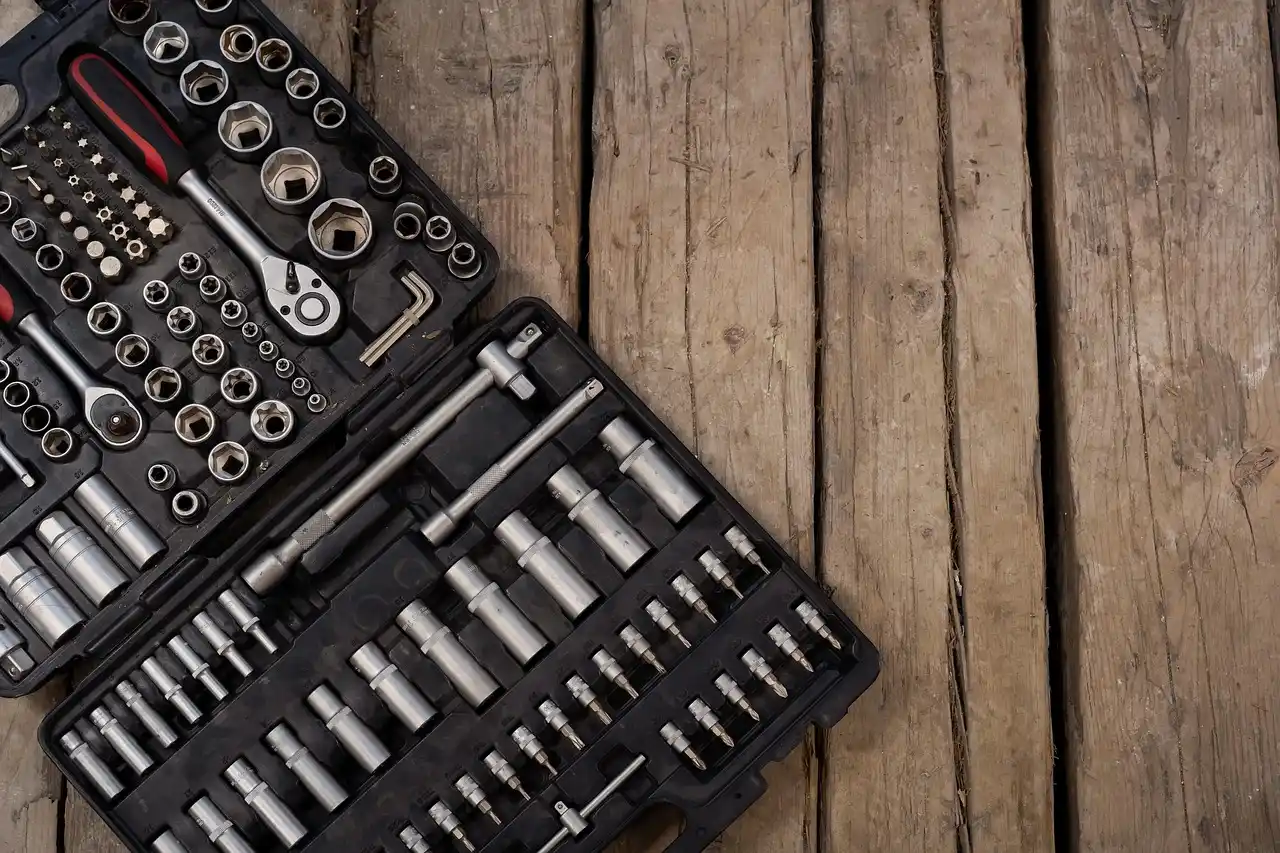
This table maps common homeowner tasks to the drive size that usually fits best. The key is not only torque. You also need enough clearance for the ratchet head, enough socket access for the nut or bolt, and a drive size that matches the fastener without forcing an adapter chain.
| Task type | Likely fastener size | Recommended drive size | Why it fits |
|---|---|---|---|
| Cabinet hinges | Small screws, small hex nuts, often 8 mm or 10 mm equivalents | 1/4-inch | Compact size fits tight cabinet spaces and small hardware without feeling oversized. |
| Furniture assembly | Small bolts and connector nuts, often 7 mm to 13 mm range | 1/4-inch or 3/8-inch | Use 1/4-inch for light connectors; 3/8-inch is better when the hardware is larger or tighter. |
| Faucet mounting nuts | Medium nuts, often 13 mm, 14 mm, or 15 mm | 3/8-inch | Gives better reach and torque for sink-area hardware without jumping to a bulky 1/2-inch drive. |
| Appliance panels | Small screws or hex-head fasteners, often 1/4-inch drive sockets or nut-driver sizes | 1/4-inch | Many panels use small fasteners that are easier to control with a compact drive. |
| Lawn equipment | Mix of small and medium fasteners, often 10 mm, 11 mm, 13 mm, and 14 mm | 3/8-inch | Works across more fastener sizes and gives more torque for stubborn outdoor hardware. |
| Buy first / buy later | Most mixed household fasteners | Buy 3/8-inch first, 1/4-inch later, 1/2-inch last | 3/8-inch covers the widest range of common home jobs; 1/4-inch adds precision; 1/2-inch is for heavier work. |
For house work, that often leaves you with a ratchet that feels clumsy on small hardware and still does not solve the need for a separate small-drive set for cabinet or appliance fasteners.
Say your cabinet hinge screw backs out and the replacement fastener is a small hex head. A 1/4-inch ratchet with the correct socket is the cleaner choice. A larger drive can work with adapters, but that adds bulk and makes the tool harder to position in a tight corner.
Is 1/4-inch or 3/8-inch better for home use?
For most home use, 3/8-inch is the better all-around pick because it covers more common fasteners and gives more torque margin than 1/4-inch. Choose 1/4-inch when the work is small, delicate, or crowded. Choose 3/8-inch when you want one ratchet that can handle more of the household fastener range without feeling too small for medium-duty jobs.
Where 1/4-inch shines
One-quarter inch works best on small fasteners and in confined spots. It fits light-duty repairs, small brackets, cabinet hardware, and panel screws where the socket and ratchet need to stay compact. It is also a good second tool after a homeowner already owns a 3/8-inch set.
Where 3/8-inch is the better all-around pick
Three-eighths inch handles the middle ground better than any other common drive size. It is common for DIY maintenance because it fits a useful spread of socket sizes and gives more torque margin than 1/4-inch without moving into the bulk of 1/2-inch.
That matters on mixed household repairs. One job may need a 10 mm socket; the next may need 13 mm or 14 mm. A 3/8-inch drive handles that range without forcing you to rebuild your whole socket collection around tiny fasteners only.
What to buy if you only want one set
If you only want one ratchet and one socket set for DIY jobs, start with 3/8-inch drive. It is the safest compromise for cabinet repairs, furniture, faucet brackets, lawn equipment, and general maintenance. Add 1/4-inch later if you keep running into small hardware or cramped access.
What sockets work with a 3/8 ratchet?
A 3/8 ratchet accepts 3/8-drive sockets only, so the drive size must match. The drive size is what links the socket to the ratchet, and it also shapes the torque range the tool is meant to handle. A 1/4, 3/8, or 1/2 socket will not directly fit the wrong drive.
Matching drive size to socket size
Socket drive size is commonly available in 1/4-inch, 3/8-inch, 1/2-inch, 3/4-inch, and 1-inch variants. For household repairs, the first three matter most. You should match the drive stamped on the socket to the drive stamped on the ratchet, unless you are using a proper adapter and understand the tradeoff in bulk and strength.
Common metric and SAE socket examples
For home repairs, a 3/8 set often includes sizes such as 8 mm, 10 mm, 12 mm, 13 mm, 14 mm, and 15 mm, plus common inch sizes such as 1/4, 5/16, 3/8, 7/16, and 1/2. Those cover many cabinet, furniture, faucet, and equipment fasteners.
If your home uses a mix of metric and SAE hardware, buy a set that includes both. That avoids the common problem of having the right drive size but the wrong socket measurement.
When deep sockets help
Deep sockets help when the nut sits on a long stud or the bolt threads stick out past the top of a standard socket. They are useful on some faucet mounting nuts, small equipment, and a few furniture fasteners. Standard sockets are enough when the fastener sits flush and there is room to seat the socket fully.
Do not buy deep sockets as your only set for household work. Standard sockets are the everyday choice; deep sockets are the add-on that solves specific clearance problems.
How tight spaces change the choice
Tight spaces change more than comfort. They can decide whether a ratchet actually works. Better quality ratchets typically use gears with 72 to 120 teeth, and that finer gear count allows smaller swing arcs, often just 3 to 5 degrees, which helps where a full swing is impossible.
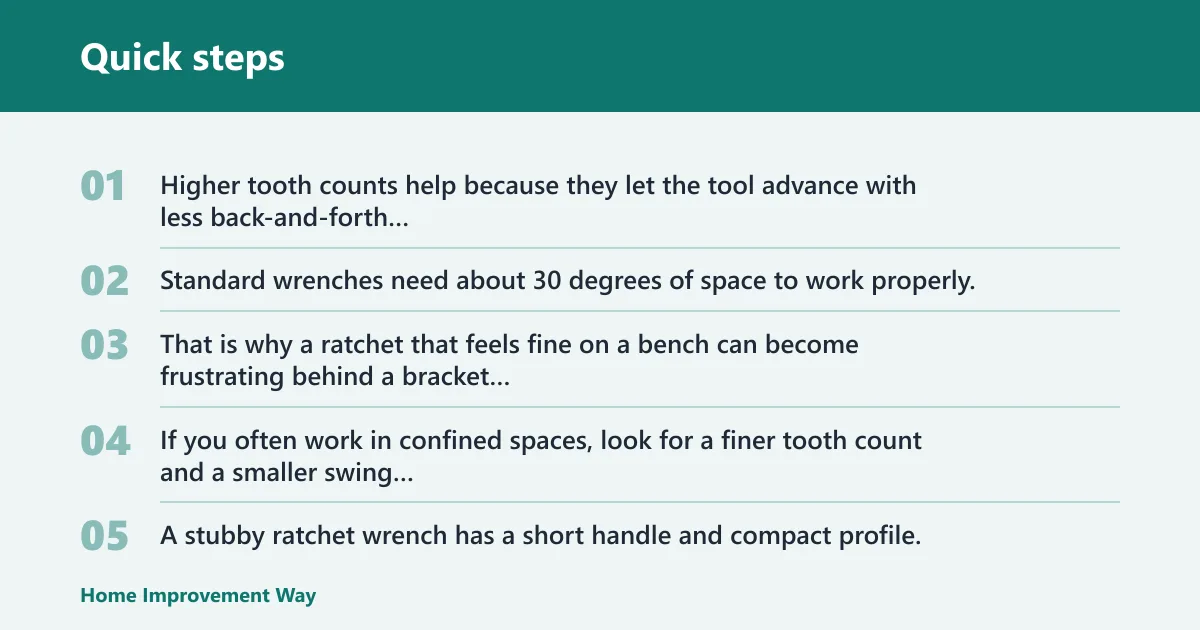
Ratchet head tooth count and swing angle
Higher tooth counts help because they let the tool advance with less back-and-forth movement. Standard wrenches need about 30 degrees of space to work properly, while 5°–10° swing arcs are ideal for cramped access and 15°–25° swing arcs are more general-purpose but less useful in tight spots.
That is why a ratchet that feels fine on a bench can become frustrating behind a bracket or under a panel. If you often work in confined spaces, look for a finer tooth count and a smaller swing angle.
Stubby ratchet wrench use cases
A stubby ratchet wrench has a short handle and compact profile. It is useful when your hand movement is restricted and a full-length handle hits nearby parts. Cabinet work, panel fasteners, and motorcycle-style tight access are the kinds of jobs where stubby tools earn their place.
Flex-head ratchet wrench use cases
A flex-head ratchet has a pivoting head that helps line up with awkward fasteners. It is useful when a straight ratchet cannot align cleanly with a recessed nut or bolt. If the access angle is the problem, not the socket size, a flex-head can save time and frustration.
Suppose a furnace access panel has a recessed fastener tucked behind a lip. A standard straight ratchet may miss the angle. A flex-head or stubby version can change the approach without forcing the wrong socket or the wrong drive size onto the job.
Can a cordless ratchet replace a manual ratchet?
A cordless ratchet can replace a manual ratchet for some home repairs, but not all. It is useful for faster fastening on automotive repairs, furniture assembly, and general maintenance tasks. A manual ratchet still makes more sense when you need fine control, limited bulk, or a tool that always works without a battery.
What a cordless ratchet does well
A cordless ratchet is efficient when you have repeated fasteners, especially on larger projects. It reduces hand fatigue and speeds up repetitive work. Some models are sold in 1/4 and 3/8 versions, and the 3/8 model is often the better fit for smaller, detailed jobs that still need decent reach and speed.
Where a manual ratchet is still better
A manual ratchet is still better for occasional DIY work when you need simple reliability, more tactile control, and lower tool cost. It is also better when you want to feel resistance before a fastener strips or when the space is too awkward for a powered tool body.
A cordless ratchet is far more efficient than a manual ratchet for larger projects, but that does not make it the only tool you need. For many homeowners, it is a useful upgrade after the basic manual set is in place.
How to decide for occasional DIY work
- Buy a 3/8-inch manual ratchet first if you need one general-purpose tool.
- Add 1/4-inch if you work on small hardware, cabinets, or panel screws often.
- Choose a cordless ratchet only if you regularly face repeated fasteners and want faster turnaround.
- Skip 1/2-inch unless you know you need heavier torque more than once in a while.
Frequently asked questions
What ratchet wrench size is best for household repairs?
For most household repairs, 3/8-inch drive is the best first choice. It handles a wide spread of common home fasteners, from furniture and faucet brackets to light equipment, without feeling too small or too bulky. Use 1/4-inch for smaller hardware and 1/2-inch only when you need more torque.
Is a 1/4-inch or 3/8-inch ratchet wrench better for home use?
Three-eighths inch is better for general home use because it covers more jobs and more socket sizes. One-quarter inch is better for small fasteners, light-duty repairs, and cramped access. If you only want one ratchet, choose 3/8-inch first and add 1/4-inch later if needed.
What size sockets work with a 3/8 ratchet wrench?
A 3/8 ratchet works only with 3/8-drive sockets. For household use, that usually means a set that includes common metric sizes like 8 mm through 15 mm and common SAE sizes like 1/4 through 1/2 inch. Deep sockets are helpful only when the fastener sits on a long stud.
Do I need a deep socket set for household repairs?
Not as your only set. Standard sockets handle most household repairs, including furniture, cabinet hardware, and many small equipment fasteners. Add deep sockets if you often reach nuts on long studs or recessed hardware where a standard socket cannot fully seat.
When should I use a stubby ratchet wrench?
Use a stubby ratchet when hand movement is restricted and a full-length ratchet hits nearby parts. It is handy for cabinet interiors, tight panel access, and other spaces where a shorter handle makes positioning easier. It does not replace a full-size ratchet; it fills a clearance problem.
Can a cordless ratchet replace a manual ratchet for home repairs?
Sometimes, but not always. A cordless ratchet is useful for repeated fasteners, furniture assembly, and general maintenance, and it can save time on larger projects. A manual ratchet is still better for precision, lower cost, and jobs where battery power is unnecessary or inconvenient.
What’s the difference between a ratchet wrench and an impact ratchet?
A manual ratchet uses a one-way gear mechanism so you can turn a fastener without removing the socket each time. An impact ratchet adds powered, repeated turning force. The manual tool gives more control; the powered version is faster on repetitive jobs but is not the same thing as a standard hand ratchet.
What drive size should I buy if I only want one ratchet for DIY jobs?
Buy 3/8-inch drive first. It is the best all-around choice for most household repairs because it spans the widest useful range of common fasteners and gives enough torque for many stubborn home jobs. Choose 1/4-inch later if you keep meeting small hardware or tight spaces.
Sponsored / affiliate links. As an Amazon Associate I earn from qualifying purchases. I may earn additional commission from eligible campaigns.