Ratchet Tools: A Complete Guide to Types and Their Use
Ratchet tools are socket wrenches with a pawl-and-gear mechanism; choose 1/4-inch drive for small fasteners, 3/8-inch for general automotive and home repairs, and 1/2-inch for higher-torque work. The wrong drive size, tooth count, or handle length can round fasteners, break tools, and slow the job. This guide covers how ratchets work, which setup fits each task, proper use and care, and the failure signs that call for repair or replacement.
What ratchet tools are and how the mechanism works


Ratchet wrench vs other ratcheting tools
A ratchet wrench is a socket wrench with a one-way drive that turns a fastener while the socket stays on the nut or bolt between strokes. In use, the mechanism drives in one direction and resets in the other, so you do not have to lift and reposition the tool after each swing.
That broader definition matters because the word ratchet also shows up on tie down straps. Tie down straps use a ratcheting mechanism too, but they are not socket tools. Here, the focus is the ratchet wrench used with sockets and accessories.
How the gear, pawl, and clicking action create one-way drive
The ratchet head holds the working parts. Inside is a toothed gear on the drive square and a spring-loaded pawl that drops into those teeth. As you move the handle in the drive direction, the pawl locks into a tooth face and turns the socket.
On the return stroke, the pawl rides over the next tooth and makes the clicking sound. Reverse motion is stopped because the pawl catches the steep face of the gear tooth. That is why the fastener turns one way while the handle resets for the next stroke.
Free movement in the non-drive direction matters in cramped spaces. Under a sink, behind an alternator, or between drawer slides, the whole point is being able to reset the handle without pulling the socket off the fastener.
What the drive square, retention ball, and direction selector do
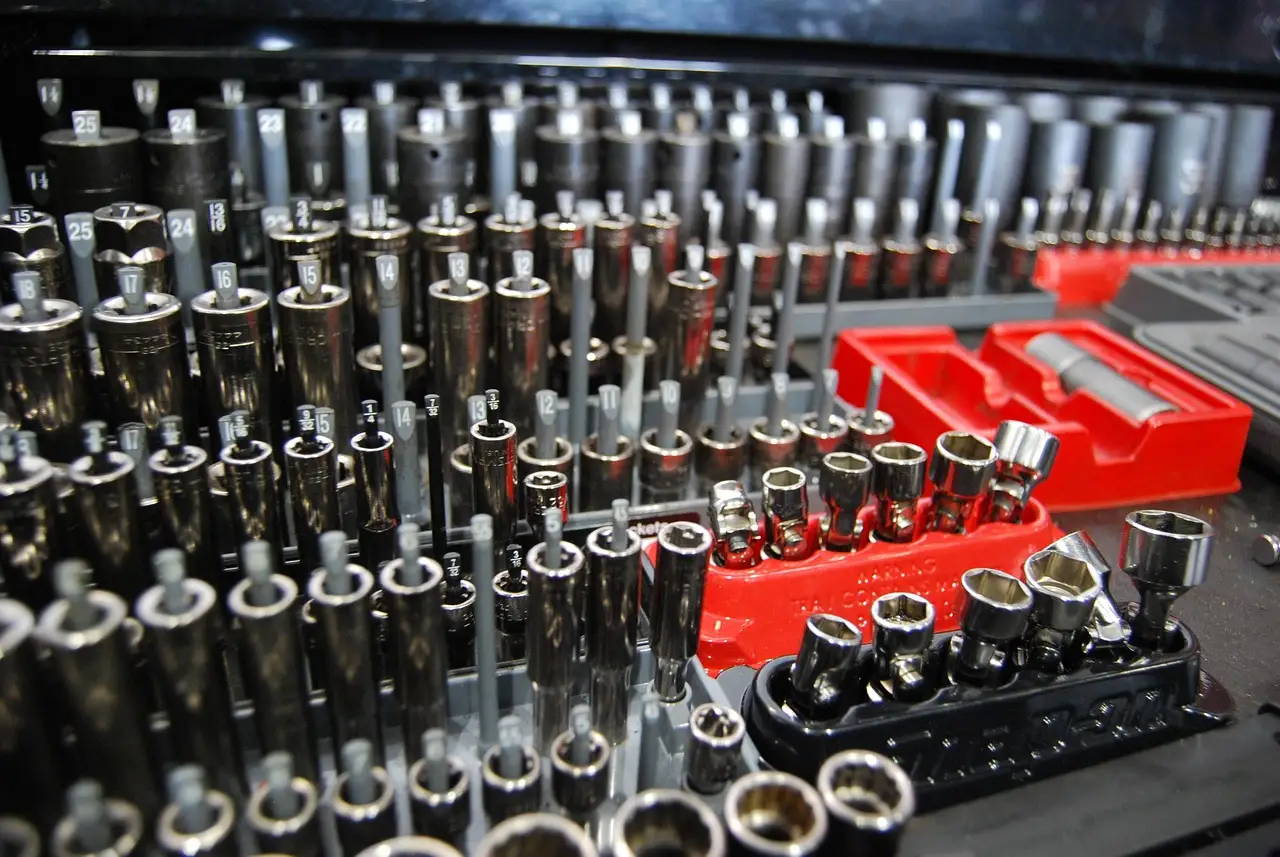
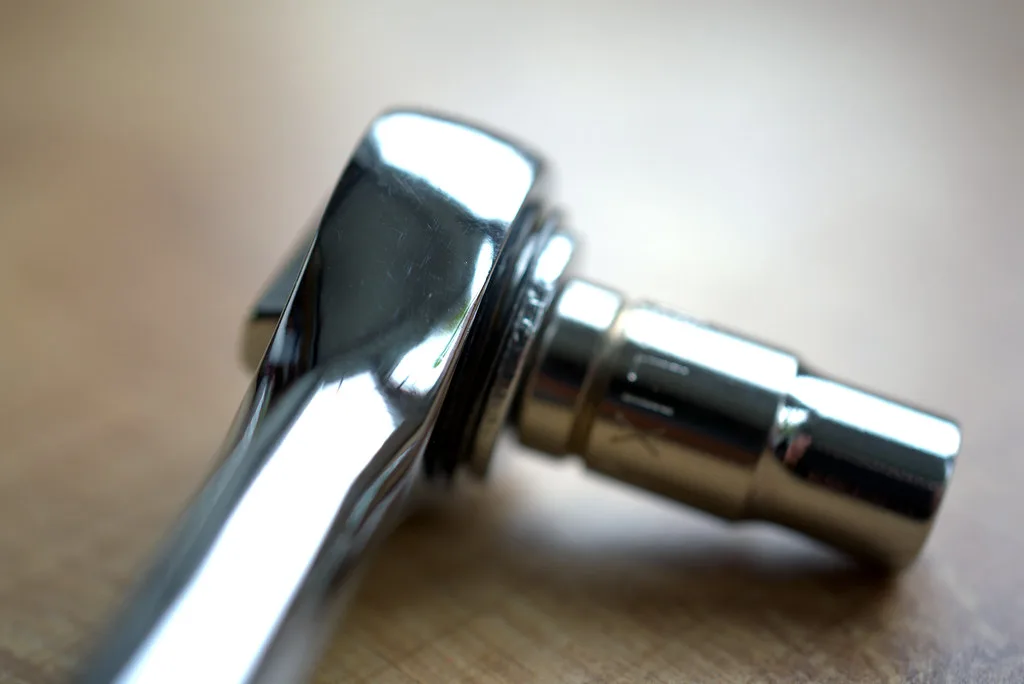
The drive square is the point where sockets and accessories attach. It must match the socket drive size exactly. Common ratchet drive sizes include 1/4-inch, 3/8-inch, 1/2-inch, and 3/4-inch.
Most drive squares use a small retention ball bearing to hold the socket in place. If that ball wears flat, sticks down, or the square corners round off, sockets may wobble or pull off too easily. That is more than annoying, it also raises the chance of partial engagement on the fastener.
The direction selector is usually a thumb lever or small reversing switch built into the ratchet head near the gear. It repositions the pawl so the tool tightens in one setting and loosens in the other. A good selector moves smoothly and stays put. Sloppy movement, vague detents, or self-switching under load suggest wear inside the head.
📊 A fine-tooth ratchet can provide working angles as small as 5 degrees. Source: How to Use a Ratchet Wrench: Complete Step-by-Step Guide.
Which ratchet drive size fits your job?
Choose 1/4-inch drive for small trim screws, appliance panels, furniture assembly, and confined access; 3/8-inch drive for most vehicle service and home repair; 1/2-inch drive for tighter suspension, lug, and machinery fasteners; and 3/4-inch drive when fasteners and torque needs move beyond ordinary household or light automotive work.
1/4-inch drive for trim fasteners, light assemblies, and confined spaces
1/4-inch drive is the smallest common choice. It suits light-duty work where fastener heads are small, clearances are tight, and over-torque is a real risk. Think hose clamps with sockets, interior panels, battery brackets, furniture hardware, and small engine covers.
Its advantage is access, not force. A smaller head and lighter handle fit where a larger ratchet will not. The downside is lower tolerance for abuse. If a corroded fastener needs a hard break-loose effort, this is usually the wrong drive size.
3/8-inch drive as the general-purpose choice
For many readers, 3/8-inch drive is the default. It balances access, socket range, and torque capacity well enough for brake hardware, engine bay service, mower repair, shelving anchors, and most household bolts that are too large for 1/4-inch tools.
Suppose a brake caliper bracket bolt is tucked near a splash shield. A 3/8-inch flex-head ratchet with a properly fitted socket gives better access than a 1/2-inch tool, yet it has far more margin than a 1/4-inch ratchet if the fastener resists.
1/2-inch and 3/4-inch drive for higher torque and larger fasteners
1/2-inch drive is usually better suited to higher-torque work, such as lug nuts, suspension bolts, hitch hardware, larger machinery fasteners, and stubborn outdoor equipment. The larger drive square and heavier internals better suit higher loads.
3/4-inch drive is a step beyond ordinary DIY use. It comes into play when sockets are large, fasteners are heavily loaded, and handle length alone will not make a smaller ratchet appropriate. For many home users, 3/4-inch drive is more of an occasional rental than an obvious starter purchase.
How drive size affects socket choice, force at the handle, and failure risk
Drive size is more than a socket connection standard. It changes head size, handle length, mechanical advantage, and how much force the mechanism sees. A too-small drive on a seized fastener can damage the pawl, chip teeth, or round the drive square long before the fastener moves.
The socket still has to fit the fastener precisely. Use standard-depth sockets where space is limited and deep sockets when thread length or stud protrusion requires it. Before applying torque, seat the socket fully on the fastener and fully onto the drive square.
How tooth count and working angle change real-world use
58-tooth, 72-tooth, and 80-tooth mechanisms in practical terms
Tooth count affects how far the handle must swing before the ratchet grabs the next tooth. The guide says 72 teeth or more can indicate a fine-tooth mechanism, while lower-priced ratchet wrenches may use 58 teeth. A ratchet wrench article also cites an 80-tooth ratchet torque wrench example.
Higher tooth count helps in cramped spaces because engagement happens with less handle movement. It does not automatically make a ratchet stronger or longer-lasting. Strength depends on gear design, pawl design, steel quality, head size, and how much force the tool is built to carry.
Working angle from about 15 degrees down to about 5 degrees
Working angle is the arc the handle must move before the mechanism re-engages. A fine-tooth ratchet can provide working angles as small as 5 degrees. Lower tooth counts often correspond to a smaller working angle, depending on the mechanism.
Picture a bolt hidden behind a drawer runner with only a few inches of handle travel. A coarse ratchet may never catch on the return stroke, while a finer mechanism can keep the work moving with short swings. In open space, that advantage matters less.
Back-drag, speed, and strength tradeoffs
Fine-tooth ratchets usually win on access. Coarser mechanisms can feel more direct and may be cheaper to build well. Back-drag also matters: some ratchets resist movement on the free stroke more than others, which can spin the fastener backward with light-threaded hardware.
For repetitive assembly, lower back-drag and a quick-release socket button can save time. For stubborn fasteners, the better choice is often a stronger, larger-drive ratchet or a breaker bar for initial loosening, then the ratchet for removal once the fastener turns freely.
What ratchet style should you buy?
Buy the ratchet style that matches access and load, not the style with the most features. Standard and pear-head ratchets suit most work, round heads fit some tight spots, flex-heads help around obstructions, stubby ratchets fit confined areas, and long handles make sense only when the fastener load matches the tool’s drive size.
Standard-head, pear-head, and round-head ratchets
Pear-head ratchets are common because they fit a strong mechanism into a compact head. Standard-head designs are often the general-purpose middle ground. Round-head ratchets can rotate more comfortably in certain hand positions and may fit some narrow clearances better.
Head size matters at least as much as drive size when access is tight. A compact 3/8-inch head can do work that a bulky 1/4-inch ratchet still cannot reach.
Stubby, long-handle, and flex-head designs
Stubby ratchets are access tools. Use them under dashboards, behind plumbing traps, or inside furniture carcasses where handle swing is minimal. They trade force for fit.
Long-handle ratchets increase reach and torque. That can be useful on larger 3/8-inch or 1/2-inch tools, but it also makes overloading easier. Flex-head ratchets angle around obstructions, useful for engine bays and equipment frames, though the moving joint adds one more wear point.
Quick-release and sealed-head features worth paying for
Quick-release is useful if sockets stick hard on the retention ball, especially with oily gloves or awkward access. A sealed head can keep grit out better than an open design, which matters in dirty automotive and outdoor-equipment work.
What usually fails first in low-cost ratchets is rarely the polished handle. More often it is the pawl spring, the selector feel, the tooth engagement under load, or the retention ball and spring. Value comes from a decent mechanism and available service parts, not surface finish.
How do you set up and use a ratchet correctly?
Set up a ratchet by matching drive size to the load, fitting the exact socket size and depth, pushing the socket fully onto the drive square, setting the direction selector, and seating the socket squarely on the fastener. Use smooth strokes, stop if the ratchet strains, and switch tools before forcing a stuck fastener.
Step-by-step setup
- Choose the drive size that fits the job: 1/4-inch for small fasteners, 3/8-inch for most repair work, 1/2-inch or 3/4-inch for heavier loads.
- Choose the exact socket size for the fastener. If a stud protrudes, use a deep socket; if clearance is tight, use a standard-depth socket.
- Push the socket fully onto the drive square until the retention ball engages.
- Move the direction selector to tighten or loosen. It should click or settle positively, not float between positions.
- Seat the socket fully on the fastener before applying torque.
- Use a controlled stroke, then re-index the handle on the return swing.
Proper hand position, stroke length, and re-indexing
Keep the socket square to the fastener. Side-loading the head while pushing hard can make the pawl skip and can round the fastener corners. Use the handle, not the head, to apply force.
A common first-timer mistake is using tiny, choppy strokes with a coarse ratchet that needs more handle movement to re-engage. If the mechanism clicks but does not advance, the problem may be working angle, not broken teeth.
When to stop using the ratchet and switch tools
Do not use a ratchet as a breaker bar on seized fasteners. If the fastener does not move with reasonable force, step back. Re-check socket fit, use penetrating oil on corrosion, and break the fastener loose with a breaker bar or other tool meant for higher shock-free force.
How should you handle stuck or corroded fasteners?
Handle stuck fasteners by confirming exact socket fit, applying penetrating oil when corrosion is present, giving it dwell time, then using a breaker bar or other loosening tool before switching back to the ratchet. Forcing the ratchet first is how pawls skip, teeth chip, and fastener corners round off.
When to use penetrating oil and how long to let it dwell
The guide says rusted ratchet parts should get penetrating oil first, and the same approach applies to corroded fasteners. Wet the threads or exposed joint area and allow time for the oil to work before applying force.
Exact dwell time depends on corrosion level and product instructions, so follow the label. For light surface rust, a short wait may be enough. On exposed underbody hardware, more time and a second application are often sensible.
The correct sequence: socket fit, breaker bar, then ratchet
Start with the best-fitting socket, fully seated. If the fastener is stubborn, use the stronger loosening tool first. Once the fastener cracks free and turns smoothly, switch to the ratchet for speed.
Say your 1/4-inch ratchet is on a corroded lawn-equipment bolt and the head starts to feel jumpy. That is the point to stop, not to add a pipe over the handle. Move up to the correct drive size and use the proper loosening tool.
Warning signs that force is exceeding what the ratchet should take
Watch for skipping under load, a selector that shifts, visible socket twist on the square drive, or the need to brace the head by hand to keep it aligned. Those signs mean the mechanism or setup is near its limit, or already damaged.
Ratchet buying and use table by tier and job
How to read the side-by-side table
The table ties specs to actual work. Tooth count affects working angle and access. Drive size affects load range and socket selection. The failure column shows what usually goes wrong first. The last column helps decide whether to clean, rebuild, or replace.
| Tier | Drive size | Tooth count | Working angle | Best-use case | Common failure mode | Replace vs repair guidance |
|---|---|---|---|---|---|---|
| Compact light-duty | 1/4-inch | 58-tooth | About 15 degrees | Furniture assembly, appliance covers, trim fasteners, tight access with low torque | Pawl skipping under load; weak retention ball; selector slop on budget heads | Repair only if parts are sold and drive square is sound; replace if the square rounds or the head skips on normal hand force |
| General-purpose DIY | 3/8-inch | 72 teeth or more | As small as 5 degrees | Most home repair, mower work, brake service, engine-bay tasks, household bolts | Rough back-drag from dirty grease; selector wear; occasional pawl wear after overload | Clean and lubricate first; rebuild if a service kit exists and teeth are intact; replace if selector play is severe or the drive square is damaged |
| Automotive higher-load | 1/2-inch | 72 teeth or more | Typically finer than coarse heads; often near 5 degrees on fine-tooth designs | Lug hardware, suspension bolts after break-loose, hitch fasteners, larger equipment service | Head looseness from overload; chipped gear teeth if used as a breaker bar | Repair if internals are serviceable and the anvil is undamaged; replace when tooth damage or cracked head parts appear |
| Torque-wrench companion | 3/8-inch or 1/2-inch | 80-tooth example | Very small swing requirement, often close to 5 degrees | Confined-access fasteners where smooth engagement matters before final torque with the torque wrench | Fine mechanism wear if contaminated; back-drag complaints rather than outright breakage | Worth rebuilding if supported by parts; replace if engagement becomes inconsistent and service parts are unavailable |
| Heavy-duty service | 3/4-inch | Usually lower than fine-tooth compact heads | Often closer to 15 degrees than 5 degrees, depending on design | Large machinery fasteners, truck-scale hardware, very high load work | Drive wear from oversized sockets or abuse; head damage after extreme overload | Repair only on serviceable professional-grade tools; replace if the drive square or head casting is compromised |
How do you diagnose, fix, or rebuild a ratchet?
Diagnose a ratchet by matching the symptom to the part: skipping under load points to pawl or gear wear, selector slop points to selector or detent wear, weak socket hold points to the retention ball or drive square, and rough back-drag points to dirt, old grease, or damaged internals. Clean first, rebuild only when parts and condition justify it.
Skipping under load, selector slop, and rough engagement
Skipping under load is the classic failure sign. If the ratchet clicks forward instead of driving, the pawl may be worn, the spring may be weak, or the gear teeth may be damaged. Continued use can make the damage worse quickly.
Selector slop feels different. The lever may not settle firmly into tighten or loosen, or the drive direction may feel uncertain. Rough engagement and gritty back-drag often point to contaminated grease, rust, or internal debris rather than a fully broken mechanism.
Worn pawl, damaged teeth, and rounded drive retention symptoms
The pawl is spring-loaded and must engage cleanly with the ratchet teeth. Wear or skipping indicates damage. If sockets fall off too easily, look at the retention ball first. If sockets wobble even when fully seated, inspect the drive square corners for rounding.
Head looseness in a flex-head model may be a simple pivot issue, but looseness inside the ratchet head itself is different. Internal looseness under load is a warning sign, especially if paired with inconsistent clicking or selector problems.
Cleaning, lubrication, and rebuild limits
For serviceable ratchets, disassemble only as the maker allows. Clean old grease, grit, and corrosion from the head, inspect the gear and pawl faces, lubricate lightly with the correct grease, and replace internal parts with a service kit where available.
Repair has limits. If gear teeth are chipped, the drive square is rounded, the selector bore is worn out, or replacement parts do not exist, replacement is usually the smarter path. Many low-cost ratchets are effectively disposable once the mechanism fails.
How do you choose the best ratchet for value?
The best ratchet is the one that fits the job, carries the load without abuse, has a mechanism suited to the space available, and can be serviced or replaced sensibly. Brand matters less than drive-size fit, tooth-count tradeoffs, selector feel, head strength, and access to repair parts.
What matters more than brand alone
Three checks reveal value quickly: how solid the selector feels, how cleanly the pawl engages under hand pressure, and whether the drive square holds sockets without wobble. Those traits affect daily use more than marketing language.
Most buyers should treat tooth count as one factor, not the scorecard. A 72-tooth 3/8-inch ratchet is often a strong all-around choice because it balances access and broad usefulness. A cheaper 58-tooth ratchet can still make sense for light-duty work where swing room is generous.
Service parts, warranty terms, and repairability
If a ratchet will see frequent automotive use, look for available rebuild kits or clear warranty support. For occasional household use, paying extra for full rebuildability may matter less than getting the right drive size, a compact head, and dependable engagement.
A short buying checklist to avoid weak-value options
- Match the drive size to the heaviest fasteners the tool will regularly see.
- Choose finer tooth count for tight-access work, not for bragging rights.
- Inspect selector feel and socket retention before buying if possible.
- Prefer serviceable models for regular automotive or equipment work.
- Avoid relying on long-handle small-drive ratchets for seized fasteners.
Frequently asked questions
what is a ratchet tool
A ratchet tool is a tool that uses a one-way mechanism to drive in one direction while allowing free movement in the other. In hand-tool use, the term usually means a ratchet wrench: a socket wrench with a gear, a spring-loaded pawl, a direction selector, and a square drive for sockets.
how does a ratchet work
A ratchet works by using a gear and a spring-loaded pawl inside the ratchet head. In the drive direction, the pawl engages the gear teeth and turns the socket. On the return stroke, it clicks over the teeth, allowing the handle to reset without removing the socket.
how to use a ratchet set
Use a ratchet set by choosing the correct drive size, then the exact socket size and depth for the fastener. Push the socket fully onto the drive square, set the selector for tighten or loosen, seat the socket fully on the fastener, and use smooth strokes without forcing the mechanism.
how to set up a ratchet
Set up a ratchet by matching the ratchet drive size to the job, selecting a socket that fits the fastener precisely, attaching it until the retention ball engages, setting the direction selector, and checking that the socket sits square and fully seated before any torque is applied.
how to release a ratchet
Release a ratchet by pulling the socket straight off the drive square, or pressing the quick-release button if the tool has one. Avoid prying sideways against the socket, because that can damage the retention ball or round the drive square corners over time.
who makes the best ratchets
The best ratchets are made by companies that combine solid engagement, good selector feel, suitable tooth count, and available service parts. For buyers, the better question is which ratchet is best for the job: a compact 1/4-inch, an all-purpose 3/8-inch, or a stronger 1/2-inch for heavier work.
Sponsored / affiliate links. As an Amazon Associate I earn from qualifying purchases. I may earn additional commission from eligible campaigns.