Where to Put Handles on Cabinet Doors: Essential Guide
Quick Summary
Finding the perfect spot for cabinet handles is easier than you think! For most standard doors, aim for the center of the door’s height and about 2-3 inches from the edge. For drawers, center them horizontally and vertically on the drawer front. This guide will walk you through simple measurements and tips for a professional look.
Ever stood in front of your kitchen cabinets, a new handle in hand, wondering, “Where does this actually go?” It’s a common feeling! Getting the placement just right can make a big difference in how your cabinets look and how easy they are to use. A few inches off can make them feel awkward or look a bit… well, wonky. But don’t worry! With a few simple steps and a bit of measuring, you can place your cabinet handles like a pro. We’ll guide you through finding that sweet spot so your cabinets are both beautiful and functional. Let’s get your cabinets looking their best!
Why Handle Placement Matters
The placement of your cabinet handles isn’t just about aesthetics; it’s about functionality and feel. When handles are placed correctly, they are easy to grip and pull, making your daily kitchen tasks smoother. Imagine reaching for a drawer and having to stretch awkwardly or strain to open a cabinet door – it’s not ideal! Proper placement ensures comfortable use for everyone in the household, regardless of height. Beyond comfort, well-placed handles contribute to the overall visual balance of your cabinetry and kitchen. They act as visual anchors, guiding the eye and reinforcing the design of your space. Think of them as the jewelry for your cabinets – the right placement makes them shine!

Understanding Cabinet Door Types
Before we grab our tools, let’s quickly look at the main types of cabinet doors you might encounter. Knowing this helps us choose the best placement strategy.
- Standard Overlay Doors: These doors slightly overlap the cabinet frame. Most handles are placed on the door itself.
- Inset Doors: These doors sit flush within the cabinet frame. Handles are also placed on the door front, but the overall look is more integrated.
- Drawer Fronts: Drawers are essentially shorter, wider doors. Their placement often differs slightly from vertical doors.
Essential Tools You’ll Need
Don’t worry, you don’t need a workshop full of fancy tools for this! Here’s what will make the job much easier and more accurate:
- Measuring Tape: For precise measurements.
- Pencil: A light touch is key to mark your spots without damaging the cabinet.
- Level: To ensure your marks are straight, especially for multiple handles.
- Drill with Drill Bits: The correct size bit is crucial for a clean hole.
- Screwdriver: To attach the handles.
- Handle Template (Optional but Recommended): Many hardware stores offer free templates, or you can make your own. These are lifesavers for consistent placement.
- Painter’s Tape: To protect the cabinet surface and help with marking.
The Golden Rules for Handle Placement
There are a few standard guidelines that most people follow for a balanced and functional look. These are great starting points, and we’ll cover variations next.
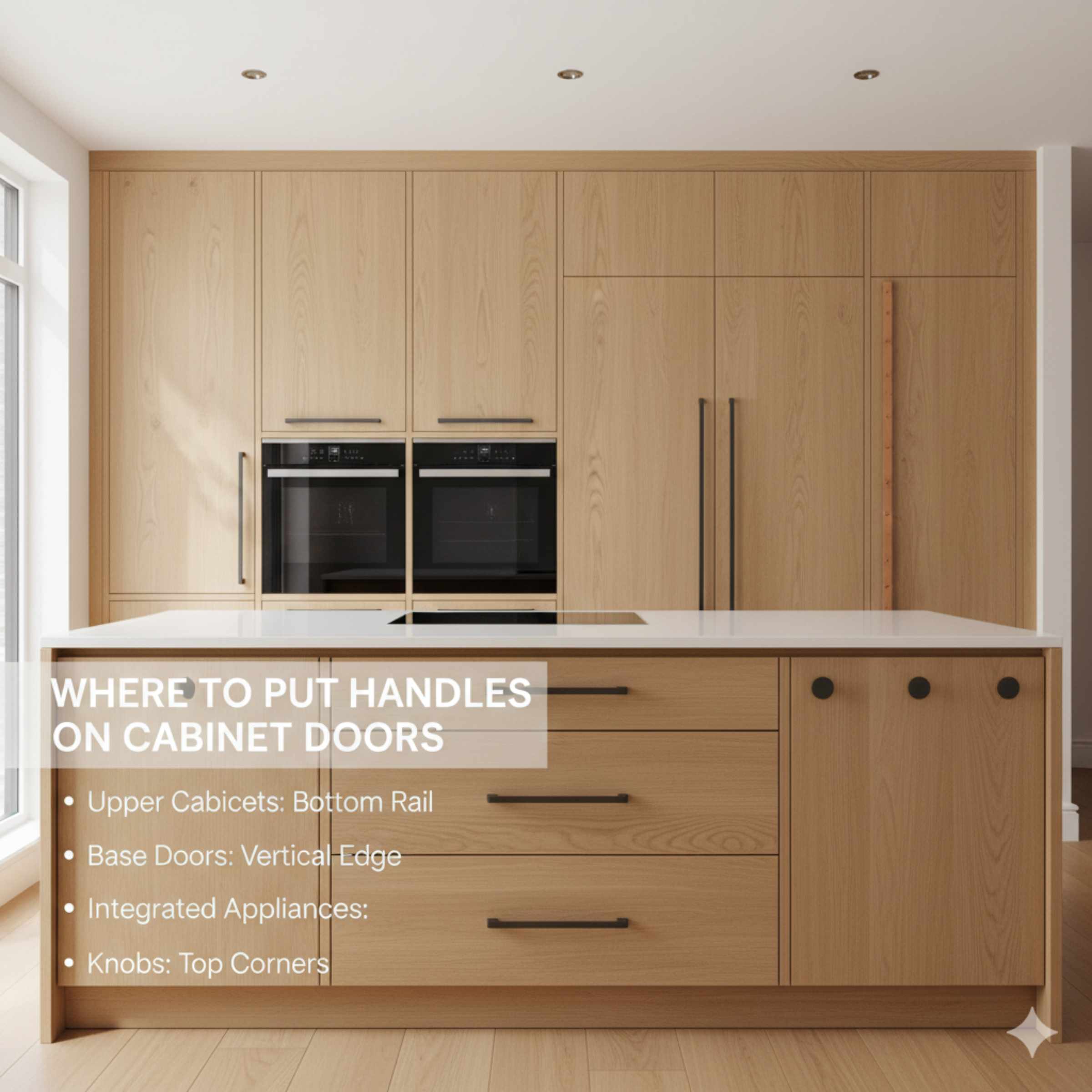
- For Cabinet Doors: The most common and comfortable placement is centered horizontally and vertically on the door. However, for a more modern or streamlined look, handles are often placed closer to the edge of the door, about 2 to 3 inches from the side.
- For Drawer Fronts: Handles are typically centered both horizontally and vertically on the drawer face.
Step-by-Step Guide: Placing Handles on Cabinet Doors
Let’s get down to business! Follow these steps for accurate and professional-looking handle placement on your cabinet doors.
Step 1: Choose Your Handle Placement Style
Decide if you want your handles centered or offset. For a classic look, center them. For a sleeker, modern feel, place them closer to the edge.
Step 2: Measure and Mark the Center Line (Horizontal)
Close the cabinet door. Measure the width of the door from one side edge to the other. Divide this number by two to find the exact horizontal center. Make a small, light pencil mark at this center point on the door.
Example: If your door is 18 inches wide, the center is 9 inches from each side.
Step 3: Measure and Mark the Center Line (Vertical)
Now, measure the height of the door from the top edge to the bottom edge. Divide this number by two to find the vertical center. Make another light pencil mark at this point. Your two marks should intersect, showing you the exact center of the door.
Example: If your door is 30 inches tall, the center is 15 inches from the top and bottom.
Step 4: Adjust for Edge Placement (If Desired)
If you’re going for the modern, edge-placed look, you’ll adjust this step. Instead of marking the exact center of the door’s width, measure 2 to 3 inches in from the side edge (whichever side you prefer – usually the side opposite the hinges). Then, find the vertical center as you did in Step 3. Your mark will be at the intersection of the vertical center line and your chosen distance from the side edge.
Pro Tip: Use painter’s tape along the edges where you’ll be measuring and marking. This protects your cabinet finish and gives you a clean surface to work on.
Step 5: Mark the Screw Hole(s)
Hold your handle against the door at your marked spot to get a feel for it. If your handle has one screw hole, you’re all set with your single mark. If it has two, you’ll need to measure the distance between the screw holes on the handle. Then, using your measuring tape and pencil, mark the second hole’s position relative to your first mark. Ensure these marks are perfectly level with each other!
Using a Template: If you have a handle template, now’s the time to use it! Align the template with your initial center marks, secure it with tape, and mark your screw hole(s) through the template. This ensures perfect alignment every time.
Step 6: Drill the Holes
Select a drill bit that is the same size or slightly smaller than the screw that comes with your handle. You don’t want the hole to be too large, or the screw won’t have enough to grip. Carefully drill straight through the marked spot(s). For cabinet doors, it’s often best to drill from the outside in. If you’re concerned about the drill bit splintering the back of the door, you can drill halfway through from the front, then flip the door over and finish drilling from the back to meet the first hole.
Safety First: Wear safety glasses to protect your eyes from any wood dust or debris.
Step 7: Attach the Handle
Align your handle with the drilled holes. Insert the screws from the inside of the door and tighten them into the handle from the outside. Don’t overtighten, as this can strip the screw or damage the cabinet.
Step 8: Repeat for All Doors and Drawers
Consistency is key! Use the same method for all your cabinet doors and drawers. For drawers, you’ll typically center the handle both horizontally and vertically on the drawer face. Measure the drawer width and height, find the center, and mark your screw holes. If you have a long drawer, you might opt for two handles placed symmetrically.
Placement Guide: Cabinet Doors vs. Drawers
While the process is similar, there are slight nuances for doors and drawers. Here’s a quick comparison:
| Cabinet Part | Horizontal Placement | Vertical Placement | Common Styles |
|---|---|---|---|
| Standard Cabinet Door | Center of width OR 2-3 inches from side edge | Center of height | Single handle centered, or single handle offset from edge. |
| Drawer Front | Center of width | Center of height | Single handle centered. For wide drawers, two handles placed symmetrically. |
| Tall Pantry Door | Center of width OR 2-3 inches from side edge | Can be centered, or placed higher (e.g., 1/3 from top) for easier reach. | Single handle. |
Tips for Different Cabinet Styles
Not all cabinets are created equal, and sometimes you need to think a little outside the box.
Tall Pantry Doors
For very tall pantry doors, placing the handle exactly in the vertical center might put it too high for shorter individuals. Consider placing the handle about one-third of the way down from the top of the door. This still looks balanced and improves accessibility.
Wide Drawers
If you have a very wide drawer (like a pot and pan drawer), a single handle in the center might feel a bit lost or require a longer reach. In this case, it’s often best to install two handles, spaced evenly on the drawer front. Measure the total width, decide on your desired spacing between handles and from the edges, and mark accordingly.
Drawers with Vertical Pulls
Sometimes, drawer pulls are designed to be mounted vertically along the top edge of the drawer front. In this case, you’ll measure the width of the drawer, mark the center, and then position your vertical pull centered on that line. You’ll drill one or more holes as per the pull’s design.
Shaker Style vs. Flat Panel
The style of your cabinet door (like Shaker with its raised or recessed panels, or a simple flat panel) doesn’t usually dictate handle placement, but it can influence the overall look. For Shaker doors, placing handles on the flat center panel is common. For flat panel doors, you have more freedom with centering or offsetting.
Common Mistakes to Avoid
Even with the best intentions, a few slip-ups can happen. Knowing them beforehand helps you avoid them:
- Not measuring twice (or thrice!): This is the golden rule of DIY. Measure, mark, measure again, then drill.
- Drilling the wrong size hole: Too big and the screw won’t hold; too small and you might not get the screw in.
- Not using a level: Especially for multiple handles, a level ensures everything looks straight and professional.
- Drilling through the finish: Using painter’s tape can prevent accidental scratches or chips on your cabinet surface.
- Overtightening screws: This can damage the cabinet material or the handle itself.
When to Use Templates
Handle templates are fantastic for beginners and seasoned DIYers alike. They are especially useful when:
- You have multiple doors or drawers that need identical handle placement.
- Your handles have two screw holes, and you want to ensure perfect alignment.
- You’re unsure about measuring accurately.
You can often find free templates at hardware stores, or you can easily make one yourself using sturdy cardboard or thin plywood. Simply mark the screw hole locations on your template based on your handle’s measurements, and then use the template to transfer those marks precisely to your cabinets.
Securing Your Hardware: A Note on Screws
Most cabinet handles come with screws. It’s crucial to use the correct length. If the screws are too long, they might poke through the other side of the cabinet door or drawer. If they are too short, the handle won’t be securely attached. If the provided screws aren’t the right size for your cabinets, you can usually find suitable replacements at your local hardware store. Always test the screw length before drilling!
The Impact of Handle Style on Placement
The type of handle you choose can subtly influence placement decisions.
- Knobs: These are the simplest. They typically go in the single, centered spot (either vertically and horizontally, or just vertically if used on a very wide drawer).
- Bar Pulls: These are versatile. They can be centered, or offset towards the edge for a modern look, as we’ve discussed. Their length also means precise alignment is important.
- Cup Pulls: Often used on drawers, these are usually centered horizontally and vertically.
- Edge Pulls: These are designed to be mounted on the top or side edge of a cabinet or drawer, requiring a different measurement approach focused on the edge.
For a cohesive look throughout your kitchen, try to use handles that have a similar visual weight and style, and maintain consistent placement rules.
Maintaining Consistency Across Your Kitchen
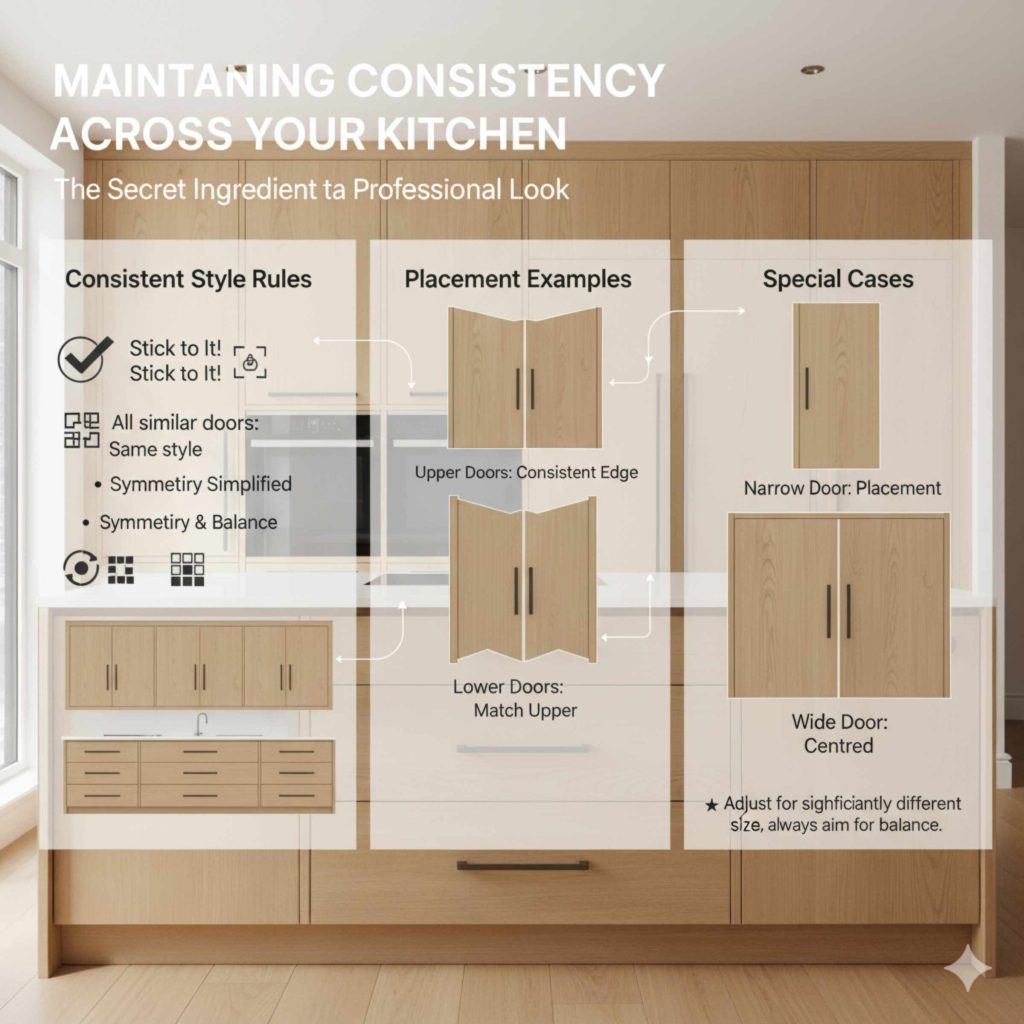
Consistency is the secret ingredient to a professional-looking kitchen. Once you decide on a placement style for one cabinet door, stick to it for all similar doors. For example:
- All upper cabinet doors: Center placement OR edge placement.
- All lower cabinet doors: Same style as upper doors, or a different but consistent style.
- All drawers: Centered placement.
If you have doors of significantly different sizes, you might adjust placement slightly for the best visual balance, but always aim for symmetry and balance. For instance, a very narrow door might look better with a handle placed closer to the edge than a wide door.
FAQ: Your Cabinet Handle Questions Answered
Q1: What is the standard height for cabinet handles?
A1: For most standard cabinet doors, the handle is placed vertically centered on the door. For drawers, it’s centered both horizontally and vertically.
Q2: Should I put handles on all my cabinets?
A2: That’s a design choice! Many people put handles on all doors and drawers for a unified look and easy access. Others opt for knobs on some and handles on others, or even go handle-less for a minimalist style. Consistency is key if you choose a mix.
Q3: How far from the edge should cabinet handles be placed?
A3: For a modern look, 2 to 3 inches from the side edge of the door is a common and attractive placement. Always ensure it’s consistent across similar doors.
Q4: Can I put handles on glass-front cabinets?
A4: Yes, you can! Just be extra careful when drilling. It’s often recommended to use a special drill bit for glass and to drill slowly, perhaps with a template, to avoid cracking. Some people prefer to use adhesive hardware for glass fronts.
Q5: What if my cabinet doors are very small?
A5: For very small doors, like those on a spice rack or a small utility cabinet, you might need to adjust placement. Simply centering the handle on the available space is usually the best approach. Ensure it doesn’t interfere with hinges or other hardware.
Q6: How do I ensure my handles are straight on drawers?
A6: Use a level! After marking your first hole, use a level to draw a perfectly straight line for your second hole (if applicable) or to confirm your handle is aligned before you drill. A template is also excellent for this.
Conclusion
You’ve got this! Placing handles on your cabinet doors might seem like a small detail, but getting it right makes a world of difference. By following these simple measurement techniques, using the right tools, and paying attention to consistency, you can achieve a professional and polished look for your cabinets. Remember to measure twice, mark carefully, and enjoy the satisfaction of a job well done. Your beautiful, functional cabinets are just a few steps away!