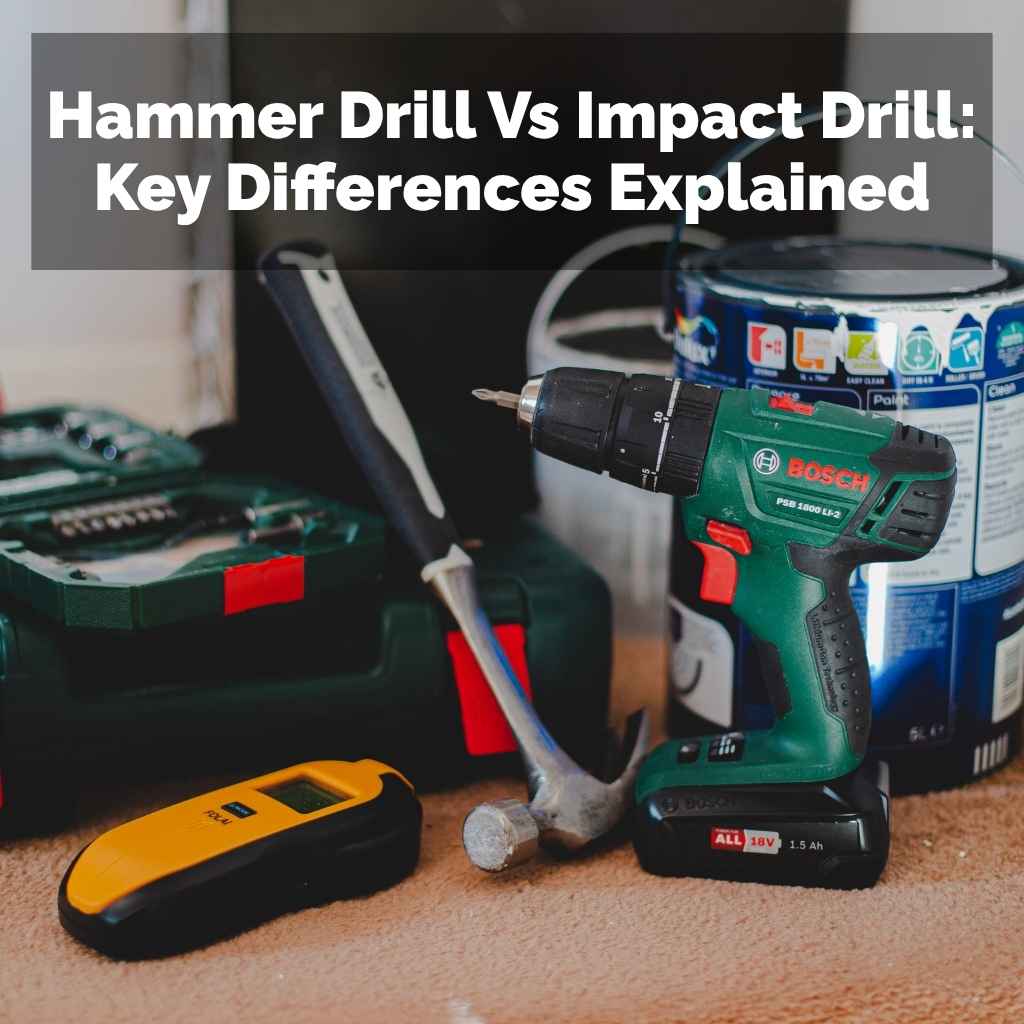
Hammer Drill Vs Impact Drill: Key Differences Explained
Sometimes, choosing the right tool can feel confusing, especially when names sound similar. For beginners, the Hammer Drill vs Impact Drill: Key Differences can be a bit tricky to figure out. Both are powerful, but they do slightly different jobs.
Don’t worry, though! We will break it down very simply, step by step. You’ll learn exactly what makes them unique and which one you might need.
Let’s get started by looking at what each tool is best for.
Deciding between a hammer drill and an impact drill often comes down to the kind of work you plan to do. While they share some similarities, their core functions and mechanics set them apart significantly. Understanding these differences is key to picking the right tool for your project, whether you’re a seasoned DIYer or just starting out.
This guide aims to clarify these distinctions, helping you make an informed choice. We will cover what each tool is designed for and how they achieve their results.
What is a Hammer Drill
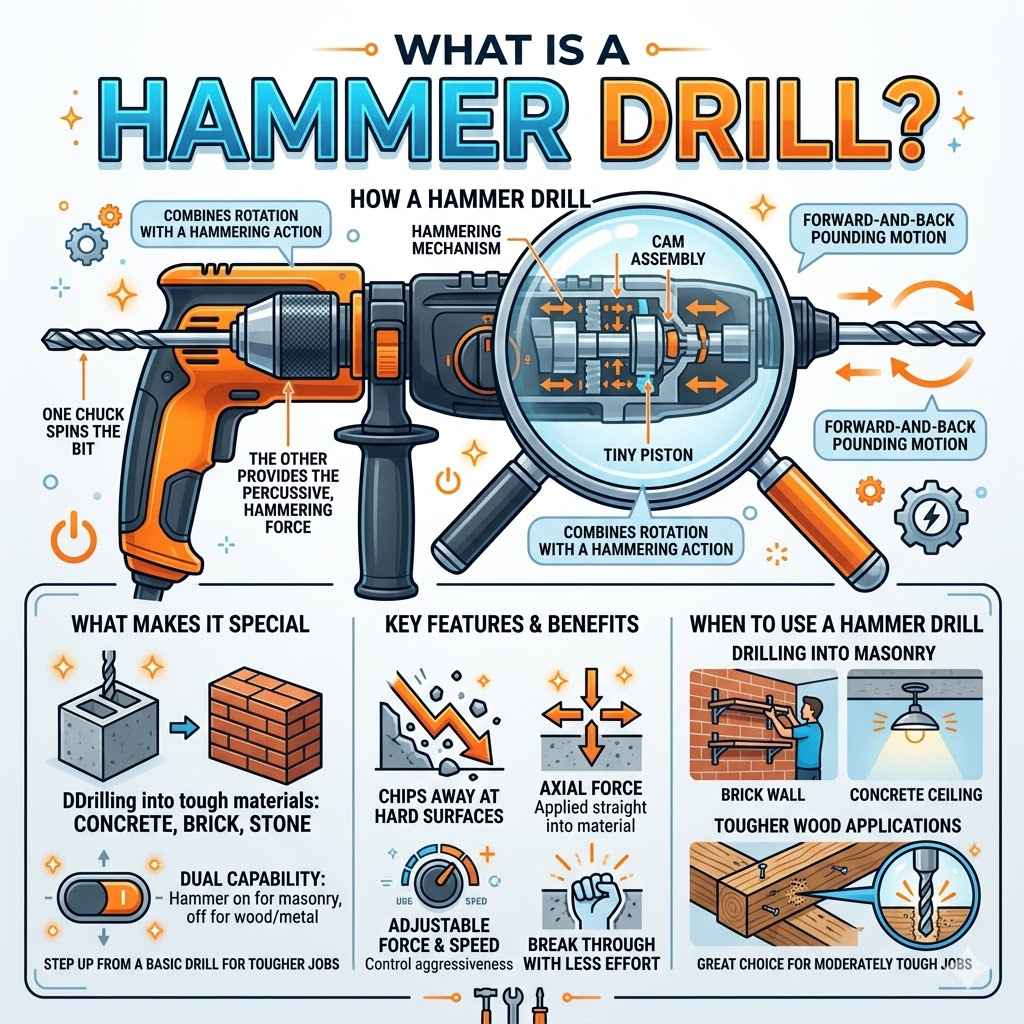
A hammer drill is a versatile power tool designed for drilling holes. It combines the typical rotation of a drill with a hammering action. This hammering is a forward-and-back pounding motion, similar to a tiny jackhammer.
This added feature makes it excellent for drilling into tough materials like concrete, brick, and stone. It works by having two chucks that move against each other. One chuck spins the drill bit, while the other provides the percussive, hammering force.
The hammering action is what distinguishes it from a standard drill. Without the hammer function engaged, it operates just like a regular drill, suitable for wood or metal. This dual capability makes it a handy tool for many home improvement tasks.
It’s a step up from a basic drill for tougher jobs.
How a Hammer Drill Works
Inside a hammer drill, there’s a mechanism called a “hammering mechanism” or “cam assembly.” When you turn on the hammer function, this mechanism engages. It creates a rapid series of forward and backward blows. Think of it like a tiny piston repeatedly hitting the back of the drill bit.
This pounding, combined with the drill bit’s rotation, chips away at hard surfaces. The force is applied axially, meaning straight into the material.
The amount of force and speed can usually be adjusted. This allows you to control how aggressively it drills. For very hard materials, the hammer action is essential.
It helps the bit break through without excessive user effort. For softer materials, you can turn the hammer function off. This prevents damage and ensures a clean hole.
When to Use a Hammer Drill
A hammer drill shines when you need to drill into masonry. This includes materials like concrete walls, brick foundations, or stone patios. If you’re hanging shelves on a brick wall or installing a light fixture in a concrete ceiling, a hammer drill is a great choice.
It makes the job much faster and easier than a regular drill.
It’s also useful for tougher wood applications or situations where you might encounter small nails or screws embedded in the material. For example, if you’re drilling through old wooden beams that might have remnants of metal fasteners. The hammering action can often power through these obstacles.
It’s a good all-around tool for moderately tough jobs.
What is an Impact Drill
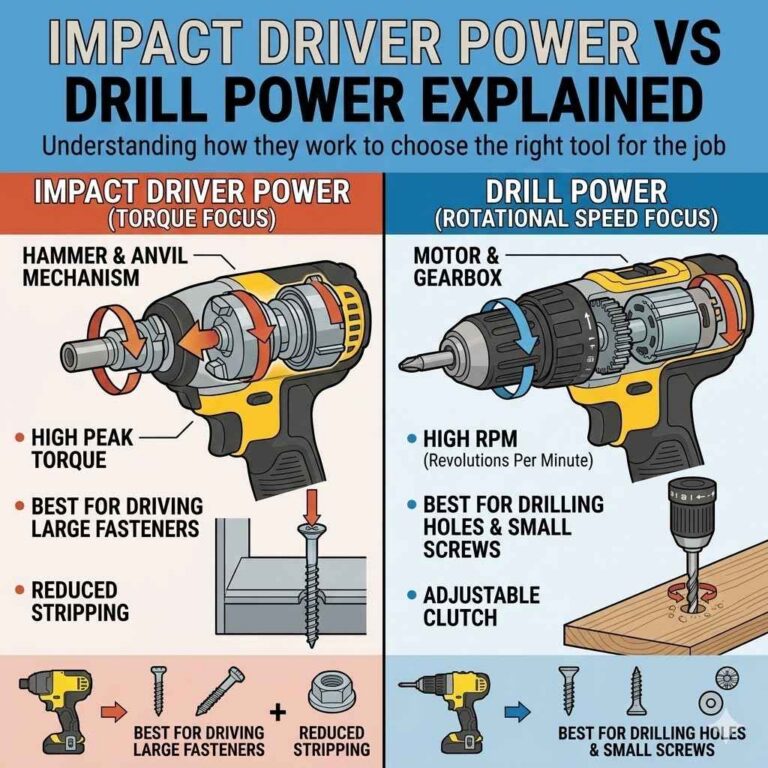
An impact drill, often called an impact driver, is a specialized power tool designed for fastening and loosening screws. It also has a hammering action, but it works differently than a hammer drill. Instead of pounding forward and back, an impact drill delivers rotational impacts.
These are very strong, quick twists or “kicks” to the bit. This rotational force is incredibly powerful. It’s ideal for driving long screws into hard materials or removing stubborn bolts.
The key difference is how the force is applied. Hammer drills push forward and back. Impact drills twist with force.
This makes impact drills much more efficient for driving screws. They can often do the job of a standard drill and a power screwdriver combined.
How an Impact Drill Works
An impact drill uses a rotary-percussion mechanism. When you squeeze the trigger, an anvil mechanism spins. If it meets resistance, a hammer hits the anvil.
This creates powerful, rapid rotational impacts. Imagine a very fast, controlled hammer blow, but delivered in a twisting motion. This action is applied to the fastener, not the material directly in a forward pushing way.
This means an impact drill applies significantly more torque. Torque is the rotational force that turns a screw or bolt. The rapid, powerful twists can drive screws much deeper and faster than a regular drill.
They also help prevent cam-out, where the driver bit slips out of the screw head. The impacts are very strong, so it’s important to use the right bit and not overtighten.
When to Use an Impact Drill
An impact drill is perfect for driving lots of screws or very large screws. If you are building a deck, assembling furniture with many screws, or working on a construction project, an impact drill will save you a lot of time and effort. It’s also excellent for removing stubborn or rusted screws and bolts.
The powerful twisting force can break them free where other tools might fail.
It’s particularly useful when working with hardwoods or engineered lumber, which can be resistant to screws. It can also be used for drilling, though it’s not its primary function. The rotational impacts can help drill through some materials, but it’s best suited for driving fasteners.
Hammer Drill vs Impact Drill Key Differences Comparison
The main distinction between a hammer drill and an impact drill lies in their power delivery and primary use. A hammer drill’s hammering action is linear, pushing forward and backward. This is best for creating holes in hard materials like concrete.
An impact drill, on the other hand, delivers rotational impacts, like powerful twists. This is ideal for driving screws and bolts with high torque.
Think of it this way: a hammer drill is like a chisel that pounds forward, while an impact drill is like a super-fast wrench that twists very hard. The amount of torque an impact drill can deliver is typically much higher than that of a hammer drill. This is why impact drills are favored for fastening tasks requiring significant force.
Hammer drills are more about the repetitive forward pounding to break through material.
| Feature | Hammer Drill | Impact Drill |
|---|---|---|
| Primary Action | Rotational with linear hammering (forward/back) | Rotational with rotary impacts (twisting) |
| Best For | Drilling into concrete, brick, stone | Driving screws and bolts, removing stubborn fasteners |
| Torque | Moderate | Very High |
| Mechanism | Cam assembly (piston-like) | Anvil mechanism (rotary impacts) |
| Common Uses | Masonry drilling, general drilling | Deck building, furniture assembly, automotive work |
Drilling Action Explained
When a hammer drill is set to its hammering mode, it performs a forward and backward pounding motion. This is achieved through a series of cams that slide against each other, creating a piston-like action. This action is directed along the axis of the drill bit.
It’s effective at breaking up hard materials like concrete and stone. The bit rotates while being pounded, creating a hole.
An impact drill, however, uses a different principle. While it rotates, when it encounters resistance, a weighted hammer inside spins and strikes an anvil. This causes the anvil, and thus the attached bit, to twist with immense force.
This twisting impact is incredibly efficient for driving fasteners. It can get screws into dense wood or metal with less strain on the user and the tool.
Fastening Power Compared
The fastening power of an impact drill is significantly greater than that of a hammer drill. Impact drills are designed to deliver high torque, which is the rotational force needed to turn screws and bolts. This is crucial for tasks like driving long screws into dense lumber or securing lag bolts.
The rapid, powerful twists overcome resistance easily.
Hammer drills can drive screws, but they lack the sheer torque of impact drills. Their hammering action isn’t helpful for fastening; it can even be detrimental if it’s engaged incorrectly. While some hammer drills have a clutch to prevent overtightening, their primary strength is hole-making, not high-torque fastening.
Understanding Torque and Impacts
Torque is a fundamental concept when discussing power tools. It measures the twisting force a tool can apply. For impact drills, torque is paramount.
The measure for torque is often in inch-pounds (in-lbs) or Newton-meters (Nm). A higher number means the tool can twist with more force. For example, an impact drill might offer 1,500 in-lbs of torque, whereas a hammer drill might offer 500 in-lbs.
The “impacts per minute” (IPM) is another measure. This refers to how many times the hammering mechanism strikes per minute. For hammer drills, a higher IPM means faster drilling into masonry.
For impact drills, the IPM relates to the frequency of the powerful twists. Both IPM and torque work together in impact drills to provide their driving prowess.
Real-Life Scenarios
Imagine you are building a wooden deck. You have hundreds of long screws to drive into thick wooden joists. Using a standard drill would be slow and tiring.
A hammer drill’s hammering action is not needed here. An impact drill would be perfect. Its high torque and quick twisting impacts would drive screws quickly and deeply, making the job much easier.
Now, consider you need to hang heavy shelving on a concrete wall in your garage. You need to drill holes for mounting brackets. A standard drill would struggle immensely or might not even be able to penetrate the concrete.
A hammer drill, with its forward-and-back pounding action, is specifically designed for this. It will chip away at the concrete efficiently, allowing you to create the necessary holes for your anchors.
Choosing the Right Tool for the Job
The decision between a hammer drill and an impact drill hinges on your primary tasks. If your projects often involve drilling into brick, concrete, or stone, a hammer drill is your go-to tool. Its linear hammering action is essential for these materials.
If your work mostly involves driving a lot of screws, especially long or large ones, or removing stubborn fasteners, then an impact drill is the better choice due to its high torque.
Some DIYers might even opt for both. A good hammer drill handles drilling into masonry and general drilling needs. An impact drill complements this by excelling at all fastening tasks.
This combination covers a wide range of home improvement and building projects effectively. Always check the tool’s specifications for torque and IPM to match it to your needs.
Additional Features and Considerations
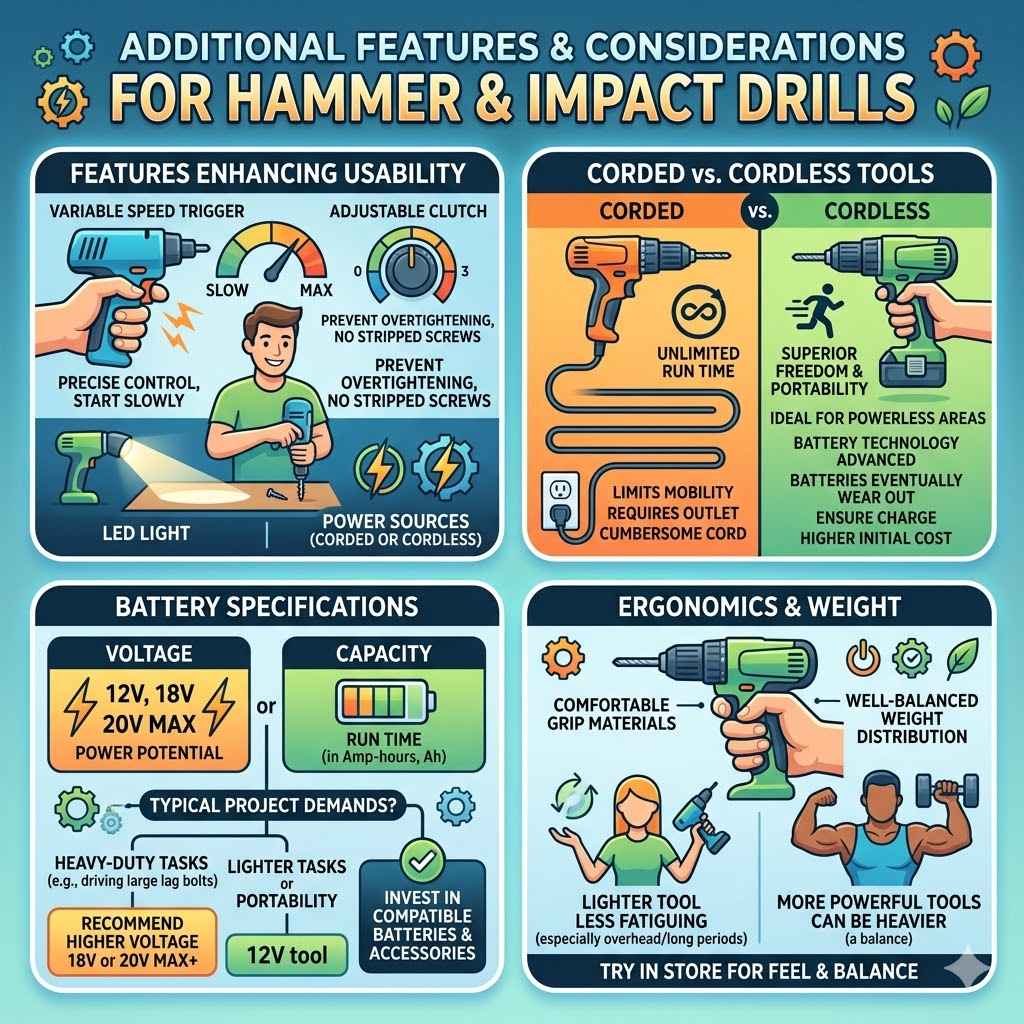
Beyond their core functions, both hammer drills and impact drills come with various features that enhance their usability. These can include variable speed triggers, adjustable clutches, LED lights, and different power sources (corded or cordless). Understanding these additional elements can further help you choose the best tool.
For example, a variable speed trigger allows for more control. You can start slowly and gradually increase speed, which is helpful when beginning a hole or driving a screw precisely. An adjustable clutch on a drill can prevent overtightening screws, saving you from stripping the screw head or damaging the material.
Corded vs. Cordless Tools
The choice between corded and cordless power tools is a significant one. Corded tools offer unlimited run time, as they are powered directly from an electrical outlet. They often provide consistent power output.
However, they limit your mobility and require access to an outlet, along with managing the cord itself, which can be cumbersome.
Cordless tools, powered by rechargeable batteries, offer superior freedom and portability. This makes them ideal for working in areas without easy access to power, or for large projects where you move around a lot. Battery technology has advanced significantly, offering long run times and quick charging.
However, batteries eventually wear out, and you need to ensure you have enough charge for your task. The initial cost of cordless tools can also be higher due to the battery and charger.
Battery Voltage and Capacity
For cordless tools, battery voltage and capacity are key specifications. Voltage (e.g., 12V, 18V, 20V MAX) indicates the tool’s power potential. Higher voltage generally means more power and torque.
Capacity, measured in Amp-hours (Ah), indicates how long the battery can supply power. A higher Ah rating means longer run time on a single charge.
When choosing a cordless tool, consider the demands of your typical projects. For heavy-duty tasks like driving large lag bolts, a higher voltage tool (18V or 20V MAX and above) is recommended. For lighter tasks or if portability is a priority, a 12V tool might suffice.
It’s also wise to invest in tools from brands that offer a wide range of compatible batteries and accessories.
Ergonomics and Weight
The comfort and ease of use of a power tool are vital, especially for extended work sessions. Ergonomics refers to how well the tool fits your hand and body, allowing for comfortable operation. Look for tools with comfortable grip materials, well-balanced weight distribution, and intuitive controls.
Weight is also a critical factor. A lighter tool is less fatiguing, particularly when working overhead or for long periods. However, sometimes more powerful tools can be heavier.
It’s a balance between power and manageable weight. Try to hold the tool in a store if possible to get a feel for its balance and how it fits your hand.
Frequently Asked Questions
Question: Can I use a hammer drill for regular drilling
Answer: Yes, you can use a hammer drill for regular drilling. Most hammer drills have a switch that allows you to turn the hammer function off. When the hammer function is off, it operates just like a standard drill.
This makes it a versatile tool that can handle both drilling into wood and metal, as well as masonry when needed.
Question: Can an impact drill drill holes
Answer: While an impact drill’s primary function is driving screws, it can also drill holes, especially in wood and metal. The rotational impacts help turn the drill bit. However, it is not as effective as a hammer drill for drilling into hard materials like concrete or brick.
For masonry, a hammer drill is far superior.
Question: Which is more powerful a hammer drill or an impact drill
Answer: An impact drill generally delivers significantly more torque (twisting power) than a hammer drill. This makes it more powerful for driving screws and bolts. A hammer drill’s power comes from its linear hammering action, which is effective for breaking through hard materials, but it doesn’t offer the same rotational fastening force as an impact drill.
Question: What is the difference in their hammering action
Answer: A hammer drill’s hammering action is linear—it pounds forward and backward, like a tiny jackhammer. This action chips away at hard surfaces. An impact drill’s “hammering” is rotational.
It delivers powerful, quick twists or impacts to the fastener, which is excellent for driving screws and bolts with high torque.
Question: Do I need both a hammer drill and an impact drill
Answer: Whether you need both depends on your projects. If you frequently drill into concrete or brick, a hammer drill is essential. If you do a lot of screw driving, especially with large screws or in tough materials, an impact drill is highly recommended.
For many DIYers, having both provides the best coverage for a wide range of tasks.
Wrap Up
Choosing between a hammer drill and an impact drill hinges on your tasks. Hammer drills excel at making holes in masonry with their forward-and-back pounding. Impact drills deliver powerful twists for driving screws and bolts efficiently.
Understand these core differences. Then, you can pick the tool that best fits your project needs and get the job done right.